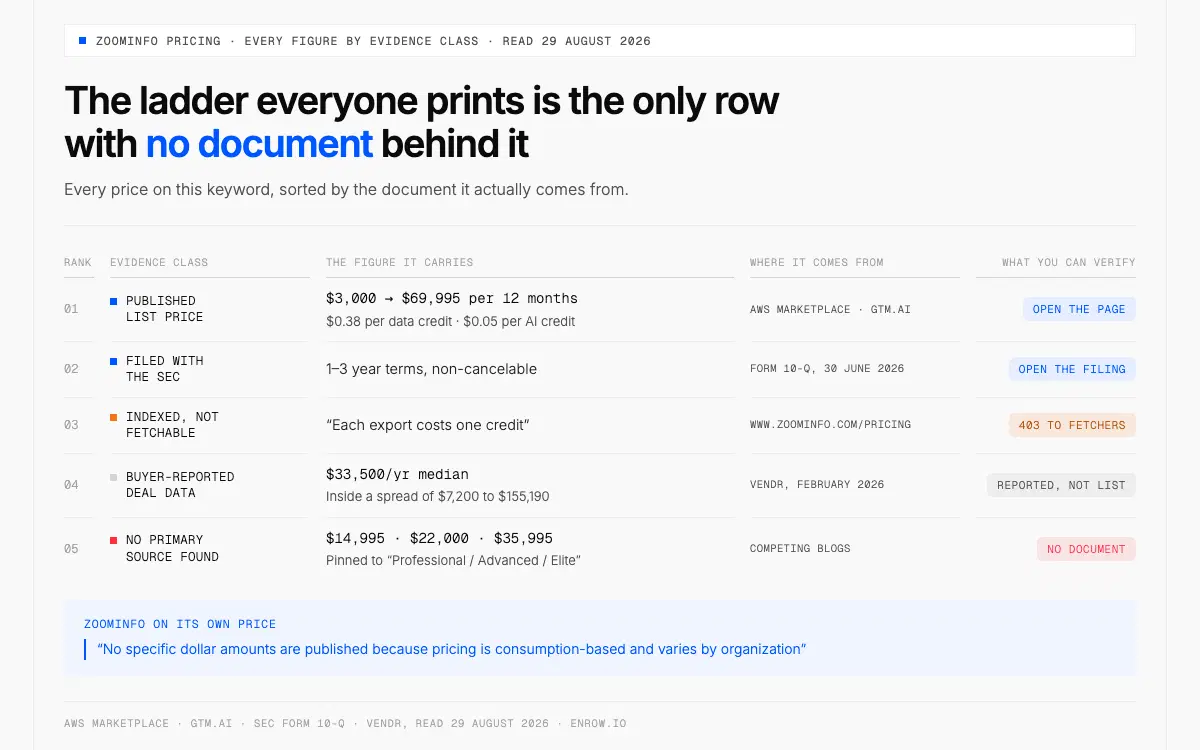
Blogs quote blogs: the Professional, Advanced and Elite ladder is the only row no document supports.
Key takeaway ZoomInfo publishes no price for its platform, and says so itself: "No specific dollar amounts are published because pricing is consumption-based and varies by organization." But it does publish prices, in two places page one of this result never opens. AWS Marketplace, ZoomInfo as named seller: $3,000 per 12 months for one user and 2,000 bulk credits, $34,995 for ZoomInfo Sales. And gtm.ai, its API surface: $0.38 per data credit, no contract, no seat fee. The $33,500 everyone repeats is Vendr's median of buyer-reported purchases, February 2026, sitting inside a spread of $7,200 to $155,190. Two things the blogs on this keyword have backwards: a lookup that finds nothing is not charged, and the Q2 2026 Form 10-Q moves part of per-seat revenue onto a platform fee plus prepaid credits, starting this quarter.
Search zoominfo pricing and page one hands you a tidy three-rung ladder: Professional near $14,995 a year, Advanced in the twenties, Elite past $35,000. Chase any of those three amounts back toward a ZoomInfo document and the trail stops early. They are blogs quoting blogs.
So I went looking for documents: two AWS Marketplace listings with ZoomInfo as vendor of record, a self-serve price list on gtm.ai, four developer docs, a Form 10-Q filed this month, and a long article ZoomInfo wrote about its own cost. All read 29 August 2026. My bias, up front: I run Enrow, and it gets one section near the end.
Every ZoomInfo price I could source, graded
Sorted by origin, ZoomInfo's published prices are smaller and much less round than the ladder circulating on this keyword.
| Figure | What it covers | Where it comes from | Evidence class |
|---|---|---|---|
| $3,000 per 12 months | 1 user + 2,000 bulk credits (Sales Basic) | AWS Marketplace, seller: ZoomInfo | Published list price |
| $34,995 · $69,995 · $39,000 · $15,000 / 12 months | Sales · Marketing · Operations · Talent | AWS Marketplace, seller: ZoomInfo | Published list price |
| $0.38 per data credit · $0.05 per AI credit | one record enriched or exported | gtm.ai/pricing | Published list price |
| 1–3 year terms, non-cancelable | every subscription contract | Form 10-Q, quarter ended 30 June 2026 | Filed with the SEC |
| "Each export costs one credit" | the definition of a credit | www.zoominfo.com/pricing | Indexed by Google; page 403s to fetchers |
| $33,500/yr median · $7,200–$155,190 range | reported purchases (the page prints both 1,570 and 1,012) | Vendr, February 2026 | Buyer-reported deal data |
| $14,995 · $22,000 · $35,995 per year | dollar figures pinned to "Professional / Advanced / Elite" | competing blogs | No primary source found |
Six of those rows can be re-checked by anyone with a browser. The bottom one can't be checked anywhere, and it's what this whole search result rests on.
ZoomInfo does have list prices. They're on AWS Marketplace.
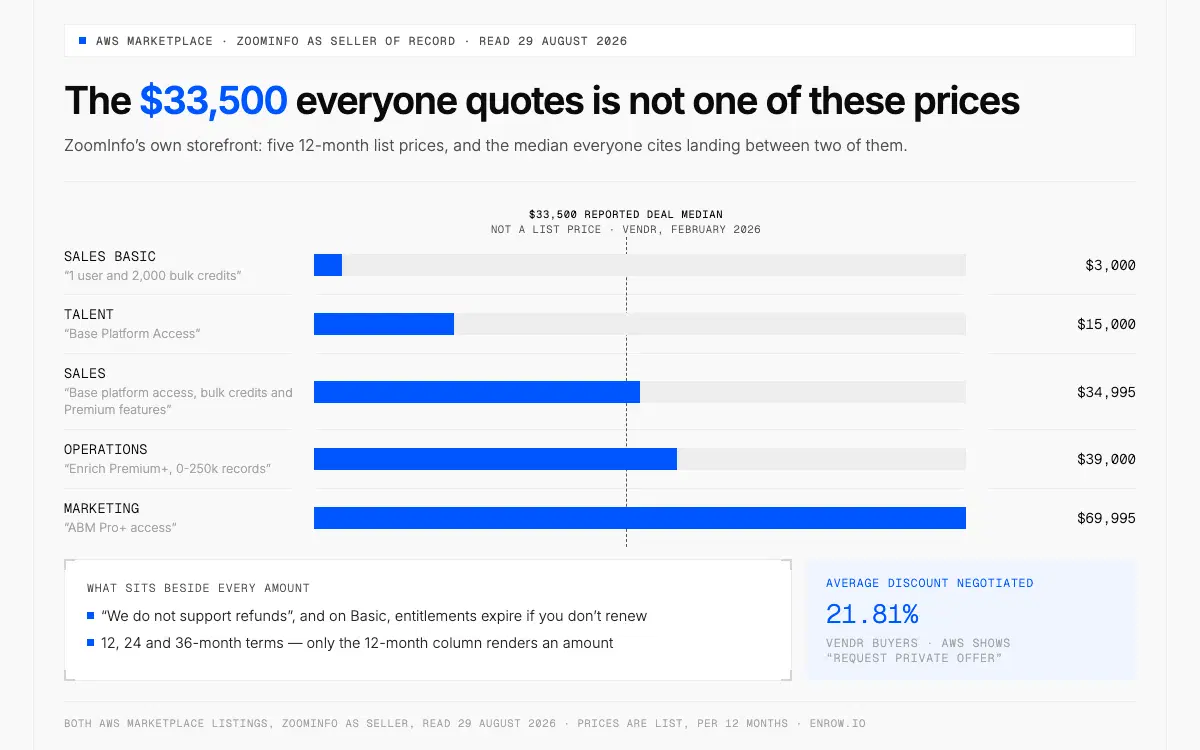
Buyers told Vendr they paid a median of $33,500, a figure none of the five list prices matches.
ZoomInfo sells through AWS Marketplace under its own name, which puts five 12-month prices on a public page — the cheapest an order of magnitude below what this keyword implies.
| Listing dimension | Price per 12 months | ZoomInfo's own wording |
|---|---|---|
| ZoomInfo Sales Basic | $3,000 / 12 months | "ZoomInfo Basic gives access to 1 user and 2,000 bulk credits" |
| ZoomInfo Talent | $15,000 / 12 months | "Base Platform Access (includes Americas, APAC, non-GDPR EU Data)" |
| ZoomInfo Sales | $34,995 / 12 months | "Base platform access, bulk credits and Premium features available" |
| ZoomInfo Operations | $39,000 / 12 months | "Enrich Premium+, 0-250k records" |
| ZoomInfo Marketing | $69,995 / 12 months | "ABM Pro+ access, additional premium add-ons available" |
Divide it out. Sales Basic lands at $250 a month, and charging the whole $3,000 to the credits while valuing the seat at zero puts a ceiling of $1.50 on a bulk credit — a ceiling, not a rate, because the seat is inside that number too. ZoomInfo Sales is $2,916 a month. Both listings offer 12, 24 and 36-month terms and render no amount for the longer two. Two clauses come first: "We do not support refunds", and on Basic, "access to these entitlements will expire" if you don't renew. Treat all five as list. AWS shows "Request private offer" beside each, and Vendr puts the average discount its buyers negotiate at 21.81%.
The $33,500 everyone quotes sits between ZoomInfo Talent and ZoomInfo Sales on ZoomInfo's own storefront.
And a per-credit price list, on gtm.ai
Bought through ZoomInfo's headless surface, a record costs thirty-eight cents and nobody books you a call.
| Item on gtm.ai/pricing | Published price | What it buys |
|---|---|---|
| Data credit, $1,000 spend tier | $0.38/credit | "one company, contact, or intent record enriched or exported" |
| 5,000-credit pack | $1,900 one-off | 5,000 records |
| ZoomInfo's worked example | $215 for 500 credits ($0.43/credit) | "Enrich 500 leads from your CRM" |
| AI action credit | $0.05/credit — "Flat rate. No volume tiers." | $100 buys 2,000 AI credits |
| Entry top-up | "Pay-as-you-go after that, from $20." | self-serve, no sales call |
That surface covers API, MCP and CLI, calls itself "One tier, no contract, no seat fees", and discounts by volume automatically. Browsing costs nothing — "Search and lookup never cost credits" — and the meter only starts when you enrich a record or run AI research. Mobile phone data, SSO/SAML and a 25-plus vendor waterfall sit behind Enterprise. Credits "expire 12 months after they are granted, whether free or purchased." Signup hands over 1,000 data and 1,000 AI credits with no card, which at list rates is $380 and $50 of usage you can spend before deciding anything.
And the page argues with itself where a buyer cares: the headline promises "Charged once per record per year", while the FAQ says Records Under Management "is an Enterprise benefit and does not apply to the free tier".
How ZoomInfo credits work
ZoomInfo credits are spent when a record comes back, never when you go looking, and that record is then free to pull again for a year.
The credit-usage doc, updated 24 August 2026, sets the rule: one credit is consumed and "the record is placed Under Management for one year from the initial enrichment date", after which it "can be enriched again without consuming an additional credit". Searching sits outside that ledger entirely.
Almost everything a rep does to find a person is free. The meter starts at the moment data is written back.
| Operation | Credits consumed |
|---|---|
| Lookup · Search Companies · Search Contacts · Find Similar · Find Recommended Contacts | 0 credits |
| Enrich Companies | 1 bulk data credit per new company record |
| Enrich Contacts | 1 bulk data credit per new contact record |
| Enrich Company Signals | 1 bulk data credit per signal returned |
| Account Research · Contact Research | 5–15 AI action credits per call, typical |
| Conversation Intelligence | 9 AI action credits per call, minimum |
First three rows: docs.zoominfo.com/docs/credit-usage-and-limits, updated 24 August 2026. Last three: gtm.ai/docs/mcp/credits, read 29 August 2026.
Search, lookup and find-similar draw nothing. The charge lands on the write-back.
MCP is "included with all ZoomInfo subscriptions at no additional cost", runs on bulk credits only, handles 25 records per enrichment call, and carries a line worth quoting to anyone about to hand an agent a budget: "There is no cost preview shown before a tool call." Free credits exist to test it: 10 a month on ZoomInfo Lite, or 1,000 data plus 1,000 AI credits at gtm.ai signup. What the ZoomInfo Chrome extension surfaces is a separate page.
Two current ZoomInfo properties describe the unit differently. Its cost article has a basic contact record consuming fewer credits than one carrying technographic or org-chart data; the developer docs say a flat one credit per new record whatever is on it. The rate-limit ladders don't line up either — Builder, Standard and Scaling at 5, 25 and 35 requests a second in the rate-limits doc of 24 July 2026, against Default, Premium and Premium+ add-ons at 25, 30 and 35 in the credit doc a month newer.
Does ZoomInfo charge a credit if it finds nothing?
No — a ZoomInfo enrichment that comes back empty costs nothing. The Enrich Contacts reference states it outright: "If we fail to find the record and return 'No match' or if we return an error code a credit will not be charged." Searching consumes nothing either, and Search Contacts deliberately returns no emails or phone numbers.
That cuts against a lot of published criticism, an earlier note of my own included, which had ZoomInfo filed with the tools that bill for the attempt. It doesn't bill that way. A credit lands on a record delivered, which is a different question from whether the mailbox still opens.
Is ZoomInfo priced per seat, and what sets the quote?
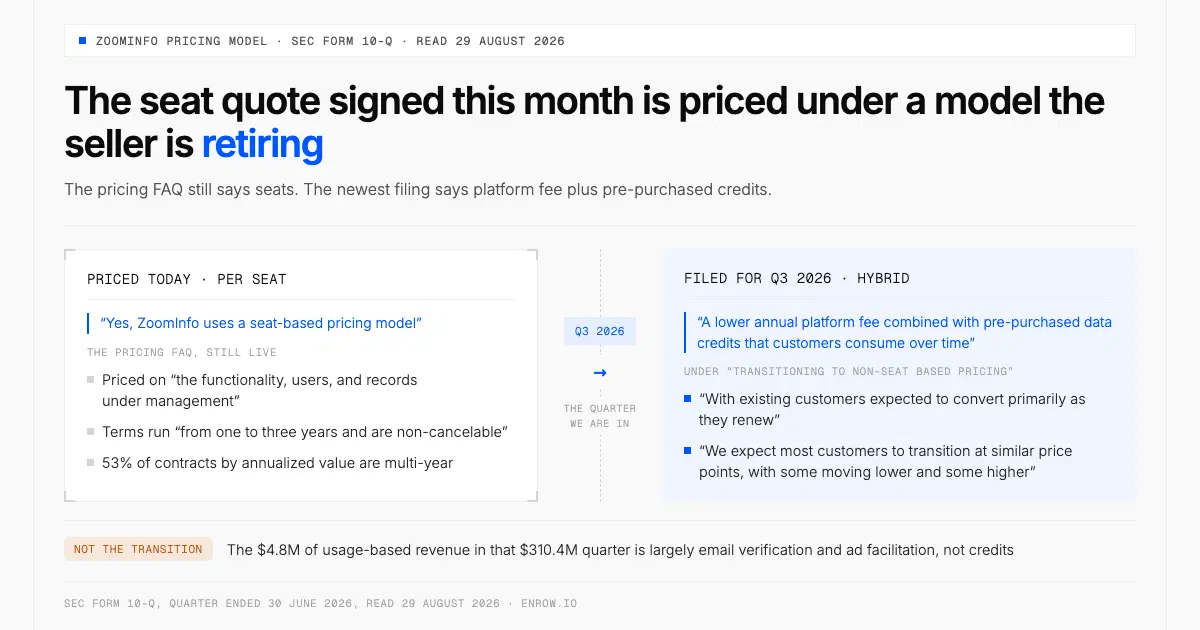
A seat quote signed this quarter is priced under the model ZoomInfo's own 10-Q starts retiring as customers renew.
ZoomInfo is priced per seat today and is in the middle of moving off it. Three of its own properties give three answers, and the newest one is a filing rather than a web page. The pricing FAQ still says: "Yes, ZoomInfo uses a seat-based pricing model." Its July 2026 article says you pay for usage rather than a fixed seat tier. Then the Form 10-Q for the quarter ended 30 June 2026, under a heading called "Transitioning to Non-Seat Based Pricing":
"Beginning in the third quarter of 2026, we intend to transition a portion of our per-seat subscription revenue to a hybrid model consisting of a lower annual platform fee combined with pre-purchased data credits that customers consume over time, with existing customers expected to convert primarily as they renew."
Q3 2026 is the quarter we're in, so none of the filing's own numbers show the new model yet. The $4.8M of usage-based revenue inside that $310.4M quarter is not credits: the filing defines it as "largely email verification and facilitation of online advertisements". Don't let any page tell you it measures the transition.
What the filing does settle is the shape of a quote. Subscriptions are priced "based on the functionality, users, and records under management that are included in each product edition", terms run "from one to three years and are non-cancelable", 53% of contracts by annualized value are multi-year, and billing lands "at the beginning of each annual, semi-annual, or quarterly period". ZoomInfo's own article adds that "Monthly billing is not standard."
On what the switch will cost an existing customer, ZoomInfo's risk language is the closest thing to a commitment anyone has in writing: "we expect most customers to transition at similar price points, with some moving lower and some higher."
ZoomInfo names five levers behind a custom quote: team size, credit volume, the features required, integrations and API access, and contract length. Under "features required" it lists intent data, technographics and WebSights, and puts a dollar amount against none of them. Multi-year commitments, it adds, price better than a single year.
The negotiating advice is ZoomInfo's own, an odd thing for a vendor to publish: time the call to its fiscal quarter-end, cap renewal increases in writing, and ask, in its own words, "whether unused credits roll over… or expire". The instruction is itself the answer. Get the credit allocation onto the paper alongside the headcount, because a seat quote signed this month is priced under a model the seller is retiring.
The number everyone quotes, and the ladder nobody can source
One is real buyer data with a twenty-one-fold spread inside it, from Vendr: a $33,500 annual median, deals from $7,200 to $155,190, an average negotiated discount of 21.81%, updated February 2026. Read it closely and it counts its own dataset twice, at 1,570 purchases in one block and 1,012 in another, so lean on the median and not the sample size. Vendr states plainly that "ZoomInfo does not publish transparent list pricing".
The other has no dollar behind it. The plan names are half real: the 10-Q enumerates "ZoomInfo Copilot, ZoomInfo Sales, ZoomInfo Marketing, ZoomInfo Operations, and ZoomInfo Talent…, GTM Studio, and… ZoomInfo Lite", and zoominfo.com/pricing carries a Professional tier and a Copilot Advanced tier. What has no source anywhere is the money nailed to them. I looked for $14,995, $22,000–$29,995 and $35,995–$45,000-plus in the developer docs, both AWS listings, gtm.ai, ZoomInfo's cost article and a filing that lists every edition the company sells. None of the three appears, and neither does the circulating $1,500–$2,500 per extra seat or $5,000–$15,000 per add-on. They sit here as claims other articles make.
Turning a credit price into a cost per usable contact
The sticker is not the cost. The formula the rest of this site uses:
real $/valid = sticker ÷ find rate ÷ (1 − bounce rate)
The first divisor exists for vendors that bill on the attempt. ZoomInfo's API doesn't, so drop it. The default I use elsewhere for per-search tools that publish nothing is roughly a 30% find rate — an assumption about a category, never a measurement of a named vendor, and pushing it onto ZoomInfo would invent a fact the company never agreed to.
The second divisor is where nobody can help you, me included, and it's why an honest ZoomInfo cost per usable contact can't be published by anyone. ZoomInfo gives no bounce or deliverability figure on what it returns, and appears in no independent benchmark I'd put my name to. Any page quoting you a ZoomInfo bounce rate made it up. Measure it yourself on a 500-record sample: thresholds sit in email bounce rate, and the sampling method in how to vet a B2B data provider. Apollo takes the opposite approach and publishes its ladder outright, from a free plan at 900 credits a year to Basic at $49/user/mo on annual billing.
Where Enrow sits underneath all of this
ZoomInfo indexes more of the B2B world than anyone else selling data, and I won't pretend otherwise. Off its own data page, read the same day: 500M+ professional profiles, 122M+ company records, 158M+ locations, 300M+ verified business emails, 135M+ direct dial numbers, 4,500+ intent topics. Vendor figures, unaudited, and still the reason enterprises sign.
Enrow does one step of that. Someone you've already identified becomes a deliverable address, or an EU-cleared direct dial, then a finished contact card written into HubSpot, Salesforce or Pipedrive from the profile you're reading. That write is a create-or-update: an existing record gets completed, a missing one gets created, so you finish a contact instead of forking it. What that looks like on HubSpot specifically is walked through here.
The ladder runs the opposite way to a quote. Every rung on the page, billed monthly, no call.
| Plan | Monthly | Credits per month | Per valid email | Seats |
|---|---|---|---|---|
| Free | $0/mo | 50 credits/mo, recurring, no card | — | — |
| Start | $17/mo | 1,000 credits/mo | $0.017/valid email | 1 user |
| Pro | $87/mo | 10,000 credits/mo | $0.0087/valid email | unlimited |
| Scale | $397/mo | 50,000 credits/mo | $0.0079/valid email | unlimited |
| Scale, top rung | $1,397/mo | 200,000 credits/mo | ~$0.007/email | unlimited |
One balance covers all of it, so nothing here is additive. Forty credits return a direct dial, near $0.35 on Pro; re-checking an address draws a quarter credit. Nothing is billed unless the result comes back valid, every address clears more than ten separate tests first, and catch-all domains are pushed to a verdict rather than parked under "risky". Two names in five come back empty on my own files — the measurement, not the target — and hard bounces stay under 1%, observed rather than warranted. The per-credit ratio only means something with its scope attached: $0.38 against $0.017 on Enrow Start is roughly 22 to 1, but a gtm.ai credit buys a whole multi-field record where an Enrow credit buys one verified email.
And here's the limit ZoomInfo throws into hard relief. Enrow has no index you can search. Ask it for every VP of Marketing at a US fintech between 200 and 1,000 headcount and it has nothing whatsoever to say. It answers about one person you've already named, live, in two to five seconds. That's why the addresses hold up on send, and why the list has to come from you, out of LinkedIn or Sales Navigator. A team buying an index should buy one, then run a data layer under it. More than 5,000 companies use Enrow on those terms.
ready to stop wasting time?
Connected in minutes.
Verified data in seconds.
FAQ
How much does ZoomInfo cost?
No platform price is published, and ZoomInfo says pricing is consumption-based and varies by organization. The prices it does publish sit on AWS Marketplace, from $3,000 per 12 months for Sales Basic to $69,995 for ZoomInfo Marketing. Buyer-reported deals cluster around a $33,500 annual median (Vendr, February 2026).
How much does a monthly ZoomInfo subscription cost, and how long is the contract?
There is no monthly subscription in the normal sense. ZoomInfo states that "Most paid plans are billed annually upfront. Monthly billing is not standard." The Form 10-Q says contracts run "from one to three years and are non-cancelable", billed in advance annually, semi-annually or quarterly. AWS offers 12, 24 and 36-month terms and supports no refunds.
How much do ZoomInfo credits cost?
Three published rates exist. On gtm.ai a data credit lists at $0.38 at the $1,000 spend tier, and an AI action credit at a flat $0.05. ZoomInfo's own worked example prices 500 credits at $215, or $0.43 each. The AWS Sales Basic listing implies $1.50 per bulk credit.
How do ZoomInfo credits work?
One bulk data credit is consumed per new record enriched, and that record is then placed Under Management for one year from the initial enrichment date, re-enrichable without a further charge. Searching, lookup and find-similar cost nothing. AI research draws a separate pool, typically 5 to 15 credits per call.
Does ZoomInfo charge a credit if it finds nothing?
No. ZoomInfo's Enrich Contacts API reference states that "If we fail to find the record and return 'No match' or if we return an error code a credit will not be charged." Search consumes no credits either. A credit attaches to a record returned, which is separate from whether that address is still deliverable.
Is there a free version of ZoomInfo?
Two of them exist. ZoomInfo Lite is permanent, needs no credit card and carries no expiration: 10 monthly credits, 25 with Community Edition, plus search, exports, the ReachOut extension and WebSights Lite at 10 visitor reveals a day. Separately, gtm.ai grants 1,000 data and 1,000 AI credits at signup, also without a card.
How I checked these numbers
Every figure above came off a first-party document on 29 August 2026: two AWS Marketplace listings with ZoomInfo as seller, gtm.ai's pricing page and MCP credits reference, three docs.zoominfo.com developer pages, zoominfo.com/data, ZoomInfo's own cost article, its llms.txt, and the Form 10-Q for the quarter ended 30 June 2026, read from the SEC's own archive. Vendr supplied the reported-deal figures, labelled as such.
Two rules governed what got printed. Where a quotation could not be reconfirmed word for word today, the paraphrase went in and the quotation marks came off. And no find rate, bounce rate or cost-per-valid is attributed to ZoomInfo anywhere on this page, because the company publishes none and no independent test I trust has measured it — the ~30% find-rate figure used elsewhere on this site is a category assumption for tools that bill per search, and ZoomInfo does not bill per search.
One exception matters. www.zoominfo.com/pricing and /faqs/pricing both return HTTP 403 to non-browser clients — ZoomInfo confirms the bot protection in its own llms.txt — so the quotes from them come from Google's live index, not a direct read. Where two ZoomInfo documents contradict each other, both readings are printed with their source.