Key takeaway Seven criteria decide a B2B data provider. Price is not the first one. Billing model is. Real cost per valid = sticker ÷ find rate ÷ (1 − bounce rate), divided again by credit utilisation when credits expire. Under pay-per-valid the find-rate term equals 1 and drops out, because a miss is never billed. That leaves the bounce haircut alone. Our own live sends bounce under 1%, an observed average and not a guarantee, so Enrow's $0.017 per valid email on Start barely moves. Bill the same sticker per attempt and the number multiplies. The other six: match rate and who measured it, bounce on a live send, database versus real-time, catch-alls, EU coverage and legal basis, credit shape.
A B2B data provider is a company that sells business contact and company records to sales and marketing teams: work email addresses, direct phone numbers, job titles, company size, industry. Some run a stored database you search and export from. Others run real-time lookup, resolving one person to one verified address at the moment you ask. That split drives freshness, coverage, price and legal exposure, and almost no comparison page mentions it.
Disclosure, up top rather than in a footnote. Search "b2b data provider" and page one is vendors ranking vendors: ZoomInfo, Cognism, Demandbase, Bright Data and Kaspr each publish a best-providers list, and each appears in its own. I sell data too, so point the criteria at me as readily as at anyone else.
Criterion 1 — the billing model, before the price
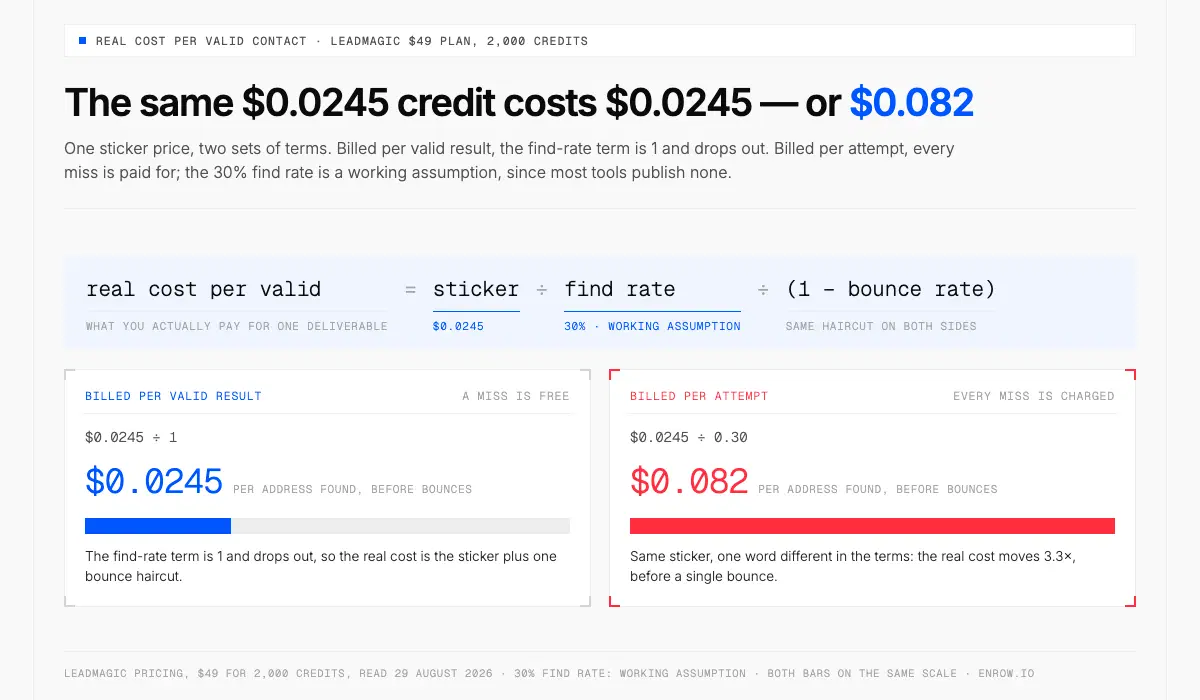
One word in the terms, not the sticker price, moves the real cost 3.3×.
First question. Not close.
Two models exist. Per attempt: the vendor charges when you ask, whether or not anything usable comes back. Reveal-a-row platforms belong here, since a credit goes the moment a record is opened. Per valid result: a miss is free, the meter moves only on a deliverable contact.
Twenty-seven of the tools whose prices we track bill for the attempt or the row returned rather than the verified valid. That list is ours and dated 6 July 2026, so read your shortlist's terms before you trust my count.
real cost per valid contact = sticker ÷ find rate ÷ (1 − bounce rate)Work it with published numbers. LeadMagic's $49 plan carries 2,000 credits, $0.0245 each, and it bills per verified valid, so the find-rate term is 1 and disappears. What is left is that sticker, about 1.4× Enrow's $0.017 on Start, and the bounce term, which only a send of your own can fill in.
The counterfactual: same sticker, billed per attempt instead, and the find rate comes back into the division. A tool that finds a third of your file charges three times the sticker for every address it returns, $0.0735, before a single bounce. One word different in the terms, real cost triples. Enrow barely shifts under it, $0.017 on Start and $0.0087 on Pro, because we were the second tool in the world to charge per email found rather than per search.
Reveal-credit databases widen it further. UpLead sells 170 credits for $99, one per contact taken for export: $0.613 per deliverable after its own 95% accuracy claim. $99 buys 170 contacts there. $17 buys 1,000 valid emails here.
Criterion 2 — match rate, and who ran the test
Every provider publishes an accuracy number. Almost every one was measured by the party selling the data.
That does not make the number false. It makes it a claim until you have seen three things: the input file, the date, and the method that turned raw output into a score. A figure you cannot rerun is marketing with a decimal point.
Then pull apart two numbers that look alike. A found rate counts what a tool handed back. A usable rate is what is left once the addresses that bounce have been taken out, and only a real send measures it. Watch for a vendor quoting the first in a sentence built to sound like the second.
Criterion 3 — bounce measured on a live send
Accuracy and deliverability are different claims. Providers mix them constantly.
"95% accurate" means a record matched a source at some point. It says nothing about whether mail sent today arrives. The figure that maps to your outcome is hard bounce on a real send, which is why a found rate means little until you know how much of it bounced. Set your threshold before the sales call: mailbox providers start treating a sender as careless around 2%, and the damage outlives the campaign (mechanics).
Our own live sends run under 1% bounce — an observed average, not a guarantee, and I will not dress it up as one. It is also a house number, exactly the kind of figure this article tells you to discount. Put a file of your own through us and count.
Criterion 4 — stored database or real-time lookup
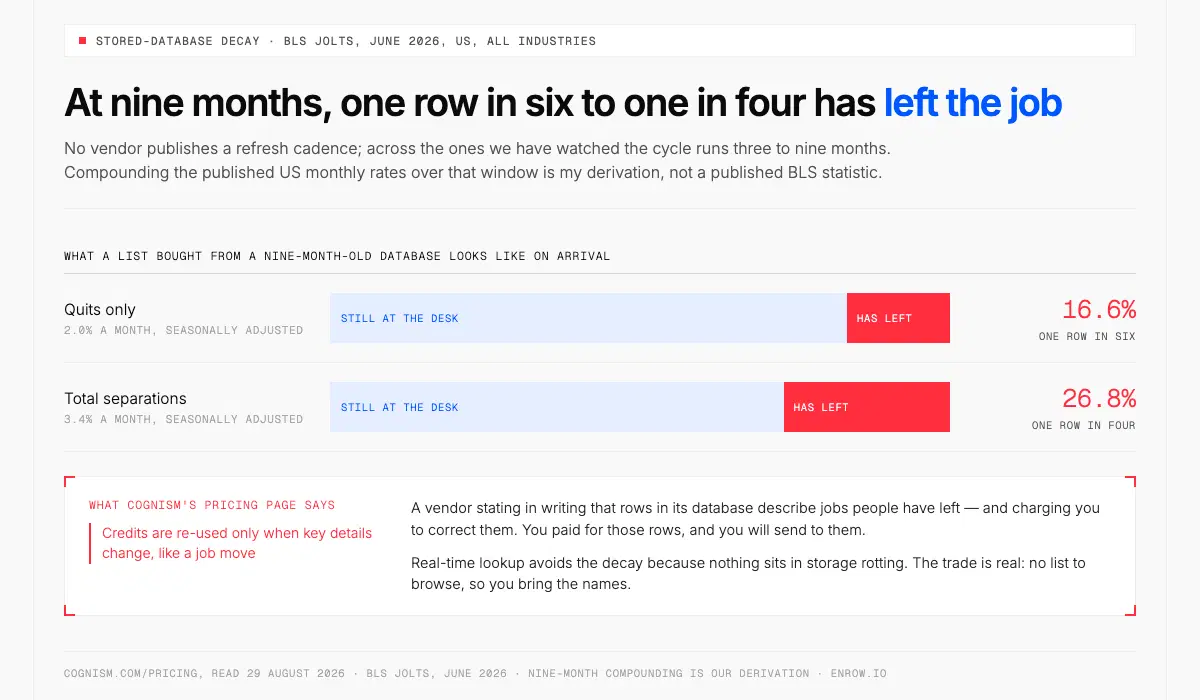
You pay for one row in six to one in four describing a job the person has already left.
Ask which architecture you are buying. That answer predicts most of the rest.
A stored database is built by crawling and buying, then refreshed on a cycle. Across the vendors we have watched that cycle runs three to nine months — an observation, since none publishes one. What they do publish is the consequence. Cognism's pricing page says credits are re-used only when key details change, like a job move. That is a vendor stating in writing that rows in its database describe jobs people have left — and charging you to correct them.
Put a number on it with labour statistics, not vendor copy. BLS JOLTS for June 2026 reports a monthly quits rate of 2.0% and total separations of 3.4%, US, all industries, seasonally adjusted. Compound quits alone and 16.6% of a list has walked after nine months; compound separations and it is 26.8%. Those are my derivations, not published BLS statistics. A nine-month refresh hands you one row in six to one in four describing a job the person has left. You paid for those rows, and you will send to them.
Real-time lookup avoids the decay because nothing sits in storage rotting. The trade is real: no list to browse, so you bring the names. Dropcontact goes further, saying it works exclusively with algorithms and holds no contact databases. If you cannot name your targets you need a search interface, and you pay for staleness.
Criterion 5 — what happens to catch-all domains
This one silently removes a large slice of a European list, and never shows on a feature grid.
An accept-all domain takes delivery of mail addressed to any mailbox on it, real or not. Hunter's help centre says verification tools, its own included, cannot confirm deliverability here, advising a confidence-score filter of 85% or higher. NeverBounce finds no definitive way to call such an address valid or invalid; ZeroBounce assigns an accept_all sub-status for the same reason.
Nobody is being lazy — it is in the protocol. RFC 5321 §3.5.2 lets an operator disable address-verification commands, and §3.5.3 requires a server that cannot verify in real time to answer 252.
The commercial consequence is yours. Whatever share of your list sits on accept-all domains gets stamped risky and, in practice, deleted. Findymail puts that share at about 30% of B2B domains — a vendor figure, read as one, though European lists skew higher.
Enrow resolves these instead of labelling them: repeated SMTP passes from servers in different regions, checked against deliberately fake control addresses on the same domain, inside the 10+ verification checks behind every result. Resolved catch-alls come back valid and bill as found; unresolvable ones come back invalid and cost nothing (how). Make a vendor say which it does. "We flag them" and "we resolve them" produce very different exports.
Criterion 6 — EU coverage, and the legal basis under it
Two separate questions get collapsed into one here, and buyers pay for the confusion.
Coverage first. Plenty of providers hold no European phone data at all. Findymail says so in writing: due to GDPR we don't provide phone data for EU contacts. Rarer honesty than it should be. If your territory is Europe and your motion is calling, this one criterion eliminates most of the market.
Legal basis second, and it is yours as much as your vendor's. GDPR Article 14 puts an information duty on whoever obtained personal data from a third party — you, the buyer of the file — at the latest one month later, subject to the disproportionate-effort exemption at 14(5)(b). Recital 47 accepts direct marketing as a possible legitimate interest, subject to assessing whether the person could reasonably expect it. Then it fragments: ePrivacy Article 13(1) makes prior consent the rule for email marketing, and 13(5) applies that only to natural persons, leaving legal persons to each member state. A vendor claiming one clean EU-wide basis is oversimplifying.
France shows the divergence. The CNIL allows prospecting professionals on legitimate interest rather than consent, provided the approach relates to their job, they were told their details might be used for prospecting, and they can object. On phones, the loi du 30 juin 2025 took effect on 11 August 2026: prior consent before calling consumers, professional prospecting carved out, décret n° 2026-662.
Enrow covers EU direct dials. More in direct dial numbers.
Criterion 7 — the shape of the bill: seats, pools, expiry
Same headline price, wildly different money out the door.
Per-seat pricing scales with headcount, not usage, and the credit allowance attaches to the user. A per-account plan looks kinder until you price the reveal. Lusha publishes $49.90 a month for 400 credits on one account, one per email reveal and five per phone: $0.125 a revealed email, about 7× Enrow's Start rate, and $0.62 a phone against $0.47 per valid phone on Start ($47 a month for 100 phones, the Enrow tier that sits at a comparable volume) and $0.35 once you are on Pro. And that credit is spent on the reveal, whatever the address does afterwards.
"Unlimited" needs reading twice. Apollo caps its unlimited plans by fair-use policy at the lesser of dollars-paid ÷ $0.025 or one million credits per account per year. Kaspr's terms set 10,000 credits per account per month. Both caps are published. Neither is on the pricing headline.
Then expiry, the subtlety nobody computes. Assume 15% of credits go unused in a normal month plus one idle month a year: you pay for twelve, consume 11 × 0.85 = 9.35. Utilisation 77.9%, so cost per used credit is sticker × 1.28. Lusha rolls monthly credits to twice the plan limit, then resets annual credits at cycle end. Hunter's add-on packs expire after three months. Apollo's never roll over. Bill per attempt and expire credits monthly, and the penalties multiply:
real cost per valid = sticker ÷ find rate ÷ (1 − bounce) ÷ 0.78Enrow takes neither haircut: billed only on a valid result, credits roll over on Pro and Scale, no per-seat fees, so adding a rep costs zero.
The checklist
Take it into the call. The middle column is what you want in writing.
| Criterion | Get this in writing | What a bad answer sounds like |
|---|---|---|
| Billing model | "We charge only when a verified, deliverable result is returned" | "Credits are consumed per lookup", or silence on found |
| Match rate | Input file, date, and the scoring formula behind any ranking | "Our data is 95%+ accurate", no method |
| Bounce | Hard bounce measured on a live send to the addresses supplied | An accuracy percentage offered as deliverability |
| Architecture | Stored database with a stated refresh cadence, or real-time lookup | "Continuously updated", no cadence, no definition |
| Catch-alls | Resolved and delivered as valid, or flagged and excluded | "We filter risky addresses for you", no share disclosed |
| EU data | Country-level phone coverage, lawful basis, sourcing trail | "We're fully GDPR compliant", as a single sentence |
| Credit terms | Rollover rules, expiry date, per-seat allocation, overage cost | "Unlimited", with the fair-use cap buried in the terms |
Clear all seven and the provider is worth pricing. Dodge two and you have your answer.
What Enrow does not do
Better here than in week three.
No searchable database. You cannot browse Enrow, filter by industry and export 5,000 rows. Deliberate, for the reason in criterion 4: stored databases decay, and we would be selling you the decay. Source names on LinkedIn or Sales Navigator, then bring the list — exporting them is a solved problem.
There is no outreach sequencing either, and we are not going to build it. Emelia, La Growth Machine and lemlist do that job properly, in that order of my preference. No technographics: company data goes as far as a LinkedIn profile.
And we do not find everyone. No finder does: a name with no professional footprint comes back empty here as it would anywhere else. That miss costs nothing, but it is still a miss, and I would sooner say so than pretend.
What is left is narrow on purpose: real-time email and phone lookup, 10+ verification checks, catch-alls resolved instead of dropped, EU direct dials, billing that moves only on a valid result. Same accounting through the official API and the EnrowAPI/enrow-mcp server. And the Chrome extension writes the whole verified contact from a LinkedIn profile into HubSpot, Salesforce or Pipedrive in one click, create-or-update rather than a blind insert. The record, not a copied address.
Pick two providers. Same thousand rows, same day, then a real campaign to both sets and count the bounces. A week of work, and it settles an argument that otherwise runs a year.
Ours starts free: 50 credits every month, no card, no call.
ready to stop wasting time?
Connected in minutes.
Verified data in seconds.
FAQ
What is a B2B data provider?
A company that sells business contact and company records to sales teams: work emails, direct phone numbers, job titles, firmographics. Stored-database providers crawl and buy records, hold them, and let you search and export. Real-time providers hold no list and resolve a named person to a verified contact when you ask.
How much does B2B data cost?
The sticker is the wrong number. Use real cost per valid contact: sticker ÷ find rate ÷ (1 − bounce rate), divided again by credit utilisation if credits expire. A $0.0245 credit billed per attempt, from a tool that finds a third of your file, costs $0.0735 for each address it returns, before any bounce. Pay-per-valid billing cancels the find-rate term, so Enrow's $0.017 per valid email on Start barely moves: our own live sends bounce under 1%, an observed average, not a guarantee.
Who are the top B2B data providers?
I am not handing you a ranking: every ranking on this search result was written by a vendor appearing in it. Run the test that settles it. Same thousand rows to two providers on the same day, count what comes back, measure hard bounces on a real campaign, then divide what you paid by the contacts that landed.
What are some examples of B2B data providers?
Four types. Stored-database platforms sold per seat or per revealed record: Apollo, Cognism, Lusha, UpLead. Real-time finders billed per valid result: Enrow, Findymail, Dropcontact. Waterfall aggregators routing a lookup through many upstream vendors at a markup: FullEnrich, BetterContact. And list brokers, common in the UK, selling a file outright. Naming them is easy; sorting them is the job of the criteria above.
Are there free B2B data providers?
Free tiers exist and most are one-shot trials built to expire. Enrow gives 50 credits every month, recurring, no card — 50 verified emails, or 200 verification checks at 0.25 credit each. A free B2B contact database with a browsable export is a red flag, not a bargain: somebody paid for that data, and the recovery arrives as staleness.
Is buying B2B contact data GDPR-compliant?
It can be, and the obligation lands on you more than on the seller. GDPR Article 14 requires you to inform people whose data you obtained from a third party, at the latest one month later, unless the disproportionate-effort exemption applies. ePrivacy Article 13 then leaves the B2B regime to each member state, so the answer differs by country. Ask for the lawful basis and sourcing trail in writing.