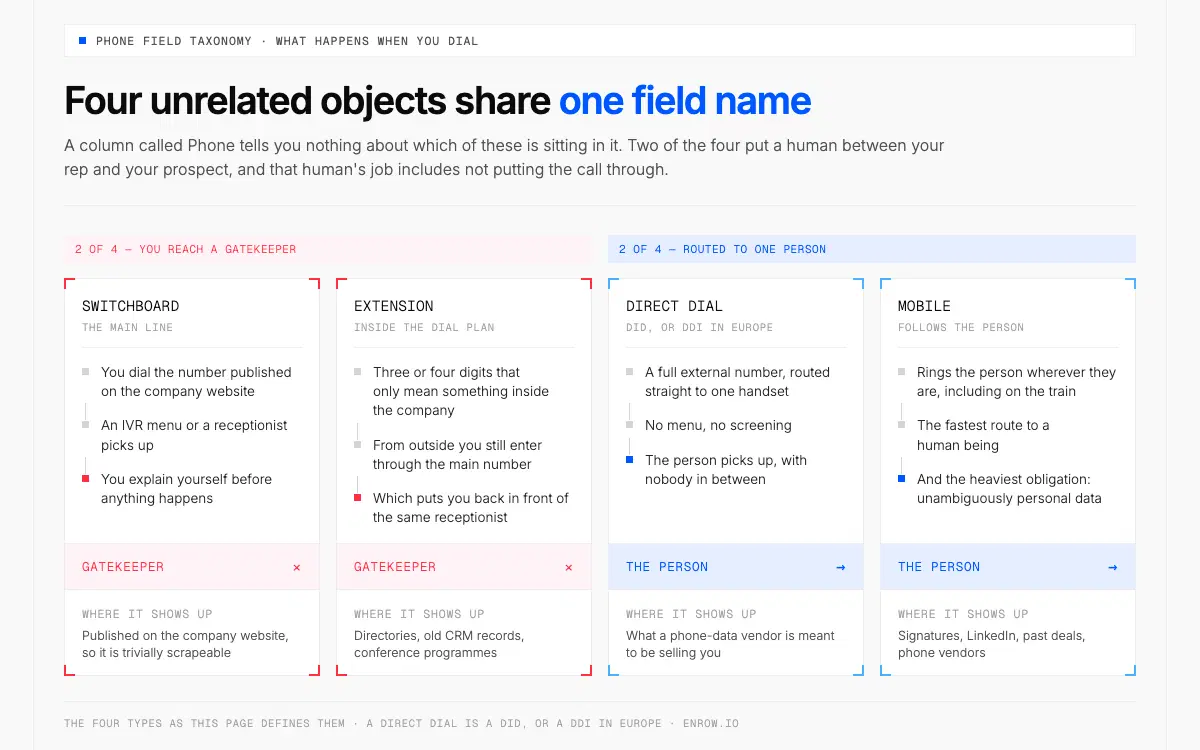
A field labelled "Phone" can hold any of the four, and two of them drop you behind a gatekeeper.
Key takeaway A direct dial is a number the carrier maps to one internal handset. You dial it, that person's phone rings, nobody screens the call. A switchboard number is the company's front door and behaves nothing like it. Switchboard, extension, direct dial, mobile — four unrelated objects share one field name. Vendors rarely label which one they sold you, and the difference decides whether your rep speaks to a human. B2B calling law is not one rule. The UK is opt-out with mandatory CTPS screening. Germany wants presumed consent as a floor, business subscribers included. France switched to consent on 11 August 2026, for consumers only. US business-to-business calls sit outside the Do-Not-Call regime under 16 CFR 310.6(b)(7). Enrow spends 40 credits on a phone and nothing when the lookup fails, which lands a valid number at $0.47 on Start's 4,000-credit tier and roughly $0.35 on Pro. Feed it a hundred LinkedIn contacts and 92 come back with a mobile — our figure, measured in-house, on that input and no other. Lusha bills 5 credits the moment a number is revealed, live or dead, and a hundred numbers a month put you on its mid tier at about $0.58 a reveal. Outbound B2B page. Not a reverse lookup page.
A direct dial is a phone number that rings one person. Not the company. Not a menu. Not a receptionist asking what it's regarding.
That's the whole definition, and it's the thing most B2B phone data gets wrong. A field labelled "Phone" tells you nothing about which of four objects is sitting in it. One reaches your prospect. Two drop you behind a gatekeeper. The fourth was somebody's mobile in 2021 and belongs to a stranger now.
One boundary, stated once. This page is about B2B outbound, not consumer reverse phone lookup — the "who just called me" search Whitepages and Truecaller answer. Enrow has no reverse lookup product and won't build one.
Switchboard, extension, direct dial, mobile
| Type | What happens when you dial it | Where it shows up |
|---|---|---|
| Switchboard (main line) | An IVR menu or a receptionist picks up, and you explain yourself before anything happens. | Published on the company website, so it is trivially scrapeable and fills cheap "phone" fields. |
| Extension | Three or four digits that only mean anything inside the company's dial plan. From outside you still enter through the main number. | Directories, old CRM records, conference programmes. |
| Direct dial (DID, or DDI in Europe) | A full external number routed straight to one handset. No menu, no screening. | What a phone-data vendor is meant to be selling you. |
| Mobile | Rings the person wherever they are, including on the train. | Signatures, LinkedIn, past deals, phone vendors. The most useful and the most legally loaded. |
Almost nobody labels which is which. Search sales phone numbers and you land in two unrelated markets at once: vendors selling a number to call from, and vendors selling numbers to call.
Mobiles sit apart. Fastest route to a person, heaviest obligation, because a personal mobile is unambiguously personal data under GDPR in a way a switchboard often isn't. B2B mobile numbers are worth having, and not worth having casually.
How a direct dial actually works
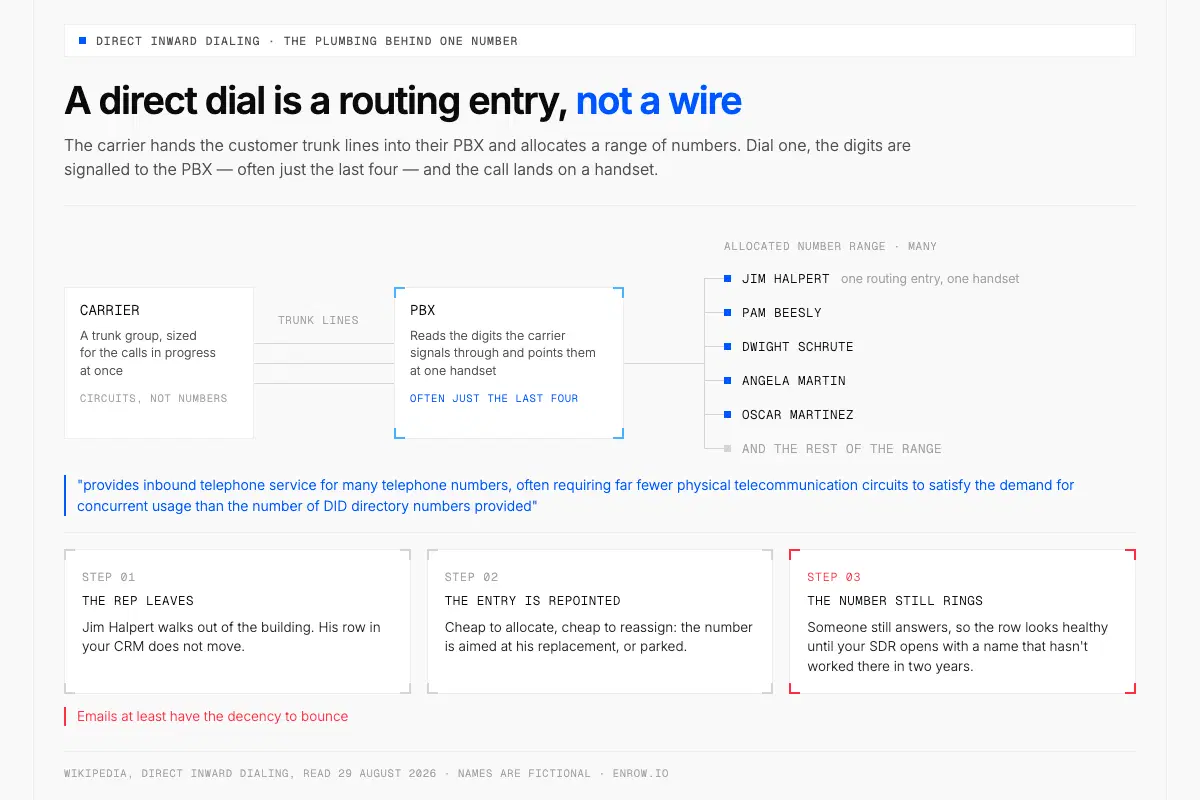
Because a direct dial is only a routing entry, it keeps ringing long after the person has left.
Two minutes on the plumbing, because it explains a failure mode nobody warns you about.
The carrier hands the customer trunk lines into their PBX and allocates a range of numbers. Dial one and the digits are signalled to the PBX, usually as a partial format such as the last four, and the PBX routes the call to a handset. Wikipedia's entry on direct inward dialing carries the load-bearing part: the service "provides inbound telephone service for many telephone numbers, often requiring far fewer physical telecommunication circuits to satisfy the demand for concurrent usage than the number of DID directory numbers provided."
So a direct dial is a routing entry, not a wire. Cheap to allocate, cheap to reassign.
Which is why stored phone data rots quietly. When a rep leaves, their direct dial doesn't die — it gets pointed at their replacement, or parked. The number still rings. Someone still answers. The row looks healthy right up until your SDR opens with a name that hasn't worked there in two years. Emails at least have the decency to bounce.
Connect rate, and why the label decides it
A switchboard puts a human between your rep and your prospect, and that human's job includes not putting your call through. A direct dial removes them. Uncontroversial as a mechanic.
The figures attached to it are another matter. ZoomInfo's eBook claims SDRs are "147% more likely" to connect at VP level with direct dials, and puts standard business lines at 8 to 18 dials per prospect. Cognism repeats the 147% and adds 3× for mobiles, sourced to its own State of Cold Calling 2026. All published by companies that sell phone data, none with a sample size or a method attached. I don't have better numbers, and I'd be wary of anyone quoting those as fact.
There is one thing a vendor can honestly count, and it is its own side of the wire: how many numbers come back off a list it was handed. So here is ours, with the protocol attached instead of missing. Give Enrow a hundred contacts pulled off LinkedIn and a mobile comes back for 92 of them, averaged across files we ran in-house. But that is a coverage figure and nothing more. Nobody audited it, and it is not a connect rate.
The input is doing part of that work, so it belongs in the sentence and not in a footnote. LinkedIn profiles go in. A cold name and a company is a thinner input and gives back a thinner result, which is why a coverage percentage printed without its input is close to meaningless. Ninety-two numbers are also not ninety-two conversations — what happens after the dial belongs to your market and your reps.
Run it against your own list rather than trusting mine. A free account renews 50 credits every month with no card, and at 40 credits a number that covers exactly one phone: proof of the format, not of the coverage. Twenty-five numbers costs $17 on Start. Small enough to expense, big enough to settle it.
Connect rate itself is simple: the percentage of dials that produce a live two-way exchange with the person you meant to reach, a few seconds past hello. Not a voicemail, not the receptionist. Teams inflate it by counting every answered call, and by counting the switchboard pickup as a connect.
Measuring your own takes a fortnight. Tag every number in the CRM with its type before the rep dials it, run 200 dials, split the rate by type. That tells you what your data is worth on your market, which no vendor benchmark can.
How a sales team gets direct dial numbers
Four routes, not equally good. The person hands it over in a signature or on a badge: best quality, lowest volume. Your own CRM already holds it from an old deal, worth enriching properly before buying anything new. A vendor finds and verifies the number at the moment you ask. Or you buy a list.
That last one is where the trouble starts. Search b2b mobile numbers and the results are thick with list sellers. A bought list is a snapshot of a moment, sold to everyone who asks, with no record of where each row came from — which matters more than buyers realise, because the law is about to ask exactly that.
The legal part, with the actual instruments
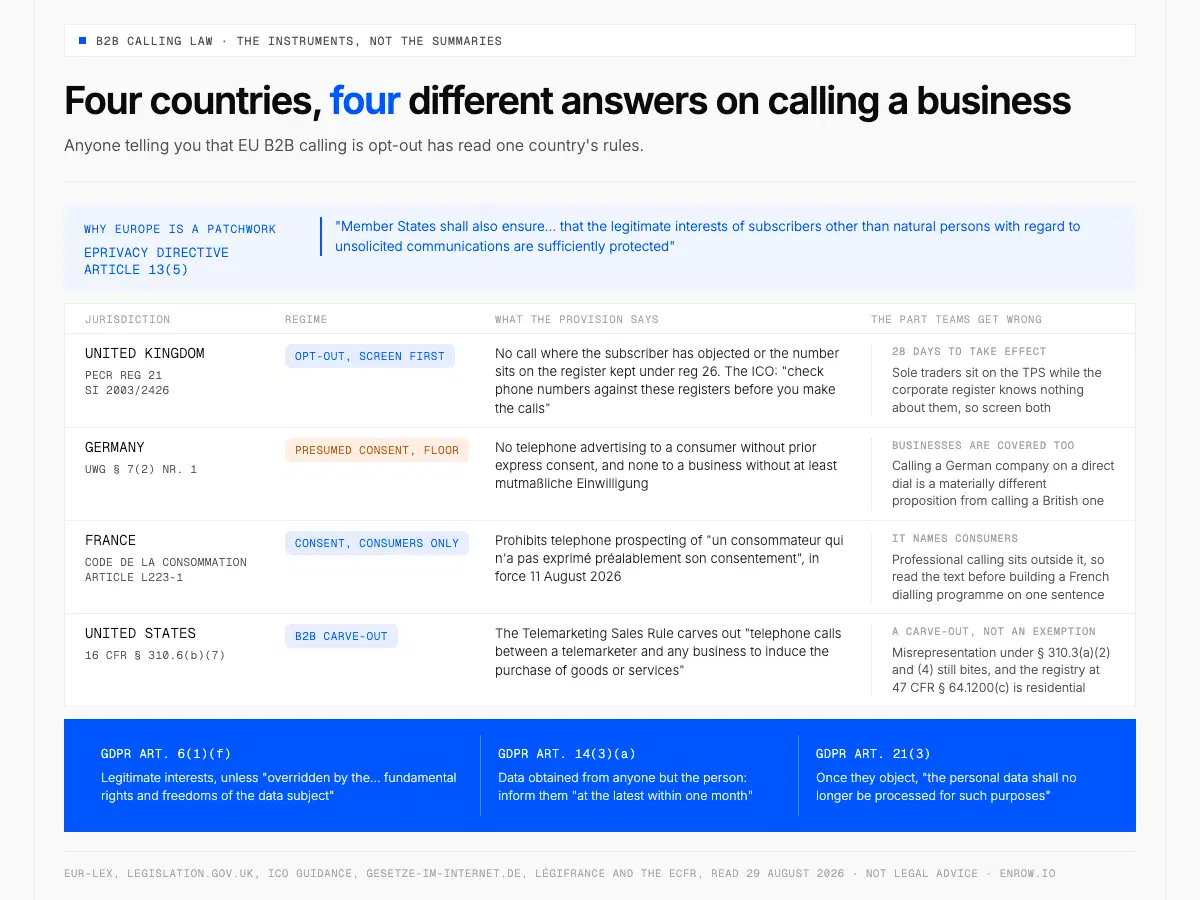
The ePrivacy Directive left business subscribers to national law, so read each country's instrument before you dial.
Every page ranking on this topic has a compliance section. Not one cites a source. Here are the provisions that actually govern B2B phone data.
Start with the lawful basis. GDPR Article 6(1)(f) is what every legitimate phone vendor relies on: processing is lawful where it "is necessary for the purposes of the legitimate interests pursued by the controller or by a third party, except where such interests are overridden by the... fundamental rights and freedoms of the data subject". A balancing test, not a blank cheque.
Then comes the obligation nobody budgets for. Article 14 applies whenever personal data was not obtained from the person themselves, which describes all third-party phone data. The controller "shall provide the data subject with the following information", and 14(3)(a) sets the clock: "at the latest within one month". Article 14(5)(b) does let you off where notification "proves impossible or would involve a disproportionate effort", and that opening is narrower than the industry behaves as though it is.
And one provision overrides the balancing act entirely. Article 21(3): "Where the data subject objects to processing for direct marketing purposes, the personal data shall no longer be processed for such purposes." No balancing, no interests weighed.
Why Europe is a patchwork
Because a 2002 directive said so. ePrivacy Directive, Article 13(5): "Paragraphs 1 and 3 shall apply to subscribers who are natural persons. Member States shall also ensure... that the legitimate interests of subscribers other than natural persons with regard to unsolicited communications are sufficiently protected."
Business subscribers went to national legislators, and twenty-odd parliaments answered differently. Anyone telling you "EU B2B calling is opt-out" has read one country's rules.
Germany is the counterexample. UWG § 7(2) Nr. 1 bans telephone advertising to a consumer without prior express consent, and to any other market participant — a business — without at least mutmaßliche Einwilligung, presumed consent. Calling a German company on a direct dial is a materially different proposition from calling a British one.
France changed 18 days before this page went up. Article L223-1 of the Code de la consommation, as in force 11 August 2026, prohibits telephone prospecting of "un consommateur qui n'a pas exprimé préalablement son consentement". It names consumers, so professional calling sits outside it. Read it yourself before building a French dialling programme on one sentence.
The UK: opt-out, but you must screen
PECR Regulation 21 (SI 2003/2426) prohibits unsolicited marketing calls where the subscriber "has previously notified the caller that such calls should not for the time being be made on that line", or where the number sits on the register kept under regulation 26.
The ICO on those registers: TPS and "the corporate version, the Corporate Telephone Preference Service (CTPS), are statutory registers of those who don't want to receive live marketing calls... The numbers must feature on the register for 28 days for it to take effect." Registration is free and covers mobiles. The instruction is unambiguous: "If you want to make live marketing calls, you must check phone numbers against these registers before you make the calls."
One trap. Sole traders and unincorporated partnerships count as individual subscribers, which puts their numbers on the TPS while the corporate register knows nothing about them. Screen both, or the one-man consultancy you took for a company becomes a complaint.
The US: B2B is carved out, not exempt
At 16 CFR § 310.6(b)(7) the Telemarketing Sales Rule carves out "telephone calls between a telemarketer and any business to induce the purchase of goods or services". The carve-out has carve-outs of its own. Misrepresentation under § 310.3(a)(2) and (4) still bites, and retail sales of nondurable office or cleaning supplies stay inside the rule.
The national Do-Not-Call registry is residential. 47 CFR § 64.1200(c) restricts solicitations to "any residential telephone subscriber" before 8 a.m. or after 9 p.m., and to residential subscribers on the registry. Safe harbour needs a registry copy obtained "no more than 31 days prior to the date any call is made".
None of that is legal advice, and those three European jurisdictions are the three I verified. Spain, Italy and the Nordics do their own thing.
Why some vendors return nothing in Europe
The cleanest illustration is a competitor's own policy page. Findymail puts it in one line on its phone finder page: "Due to GDPR regulations, we do not provide phone numbers for contacts in the European Union." Its pricing page labels the data point "Phone (non-EU)".
Defensible, and honestly stated. I'd rather a vendor say that than quietly hand you a Munich switchboard. It does mean no Findymail price exists for a European direct dial at any volume, so the comparison can't be made at all.
Enrow's position, flatly: GDPR does not block us on EU phones. Europe is where our coverage is strongest.
What that does not do is make your calls compliant. Our documentation covers our processing. CTPS screening, the national DNC registers, the objection somebody sent your team last month — those stay yours, and any vendor implying otherwise is selling a comfort you didn't buy. For a sense of the operational work, Cognism publishes that it screens against 15 DNC lists across the UK, Germany, France, Spain, Ireland, Belgium, Croatia, Portugal and Sweden. Its own unaudited claim.
What a direct dial should cost
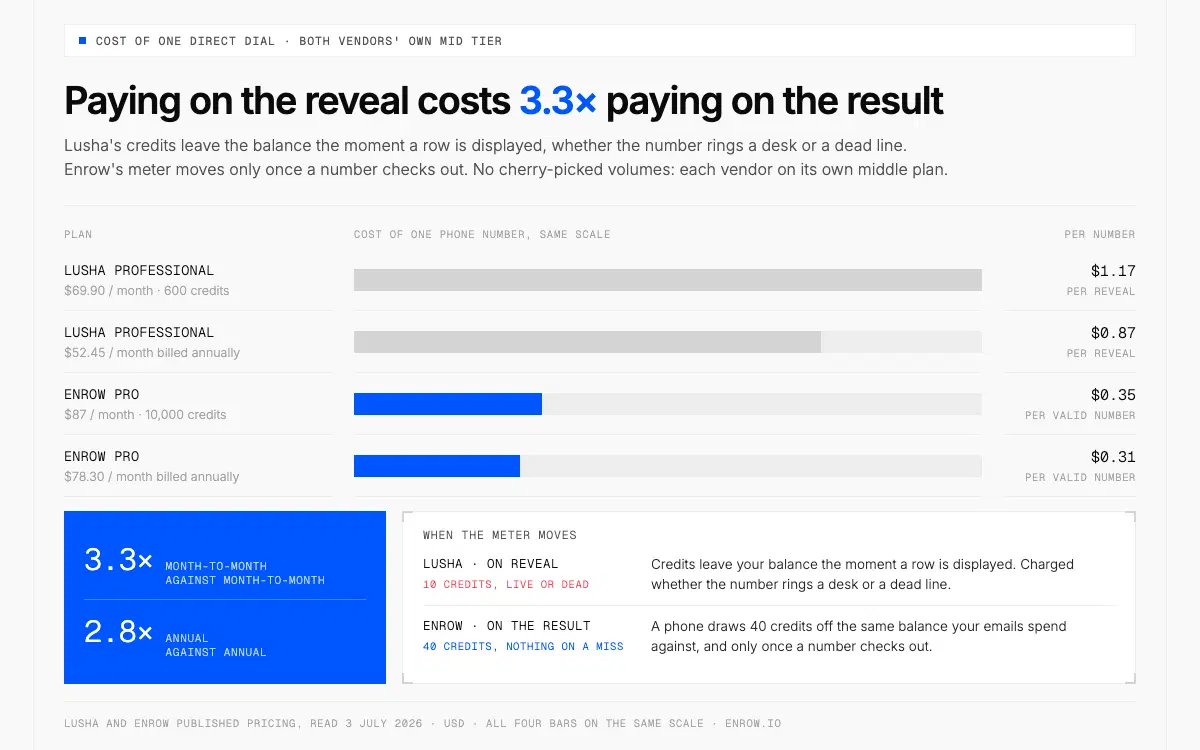
On monthly plans, a number billed on the reveal costs 3.3 times one billed only when it checks out.
Two billing models, and the gap between them is bigger than any sticker price suggests.
Lusha bills the reveal. Credits leave your balance the moment a row is displayed. Off its pricing page: reveal an email, 1 credit; reveal a phone number, 5 credits. Professional is $69.90 a month for 600 credits, so 120 phone reveals, so $0.58 per revealed number. Billed annually the same plan is $52.45 a month, $629.40 for the year, still 600 credits a month, $0.44 per reveal. Charged whether the number rings a desk or a dead line. The self-serve ladder also stops at five users; a sixth means a quote.
Enrow bills the result. A phone draws 40 credits off the same balance your emails spend against, with nothing set aside separately for phones, and the meter moves only once a number checks out. Pro is $87 for 10,000 credits, which is 250 phones, which is $0.35 per valid number. Start: $17 for 1,000 credits, 25 phones, $0.68, or $47 for 4,000 credits, 100 phones, $0.47. Scale: $397 for 50,000 credits, 1,250 phones, $0.32. The 200,000-credit tier at $1,397 works out to 5,000 phones at $0.28. Annual knocks Pro to $78.30 a month ($0.31) and Scale to $357.30 ($0.29).
Like-for-like means the same volume on the same billing. Take a hundred numbers a month, month-to-month: Enrow's 4,000-credit Start covers them for $47, $0.47 a valid number, while Lusha's Starter ($49.90, 400 credits) stops at 80 reveals, so the hundred takes Professional at $69.90, $0.58 a reveal. Annual against annual, Enrow begins at Pro, 250 numbers a month for $78.30, $0.31 each. Lusha's annual Professional stops at 120 reveals ($0.44 apiece); 250 a month means Premium, $299.95 a month for 3,400 credits. Our full working on Lusha's ladder sits on the Lusha alternatives page.
All of those price a single number. None says how many numbers a hundred-name list gives up, which is the coverage question from earlier and the one no pricing page has ever answered. Lusha publishes no find rate, so there is nothing here to set the 92 against; that comparison is yours to run rather than mine to assert.
The seat model behaves differently again. Kaspr sells users, not credits: 100 phone credits per user per month on Starter, 200 on Business, 5 on the free plan, with annual plans front-loading twelve months into the account. Its "unlimited" B2B emails are fair-use capped at 10,000 per account per month, so never read that word bare. I quote Kaspr's euro list, so this comparison runs in euros on both sides: Starter is €59 a user a month, Business €99. Five reps on Business is €495 a month for 1,000 phone credits, or about €0.50 a reveal — a reveal, not a live number, since the credit goes either way. Enrow Scale is €360 for 1,250 numbers that came back valid, about €0.29 each, no per-seat fee, up to 10 team members on Pro and unlimited on Scale. Add a sixth rep and Kaspr's invoice moves; ours doesn't. Full seat maths on the Kaspr comparison.
Apollo sells seats as well: $65 a seat month-to-month for 2,500 unified credits, with a mobile at 8 credits. Its credits expire monthly with no rollover, and its mobiles are stored rather than found live, US-leaning, with no EU direct-dial product. A price per reveal on a stored row says nothing about how many of those numbers still ring.
Where Enrow stops
No searchable database. There is no index of "every VP of Sales in Munich" to page through, because nothing sits on a shelf waiting for you — the lookup runs when you ask for it. Freshness is what that buys; the missing browse screen is what it costs. Source the names in LinkedIn or Sales Navigator and hand them over, which our guides to exporting LinkedIn contacts and finding an email address walk through.
No sequencing either, and it isn't coming: send the campaigns through Emelia, La Growth Machine or lemlist, tools built for exactly that. No technographics. And no reverse lookup, which I flagged at the top.
One warning about the credit model. At 40 credits a phone, heavy phone enrichment empties a plan roughly forty times faster than email work, so size the plan on phone volume rather than contact count. Start has no annual billing and no rollover.
What we do have: a Chrome extension that pushes the full verified contact from a LinkedIn or Sales Navigator profile into HubSpot, Salesforce or Pipedrive in one click, an official API, an MCP server at github.com/EnrowAPI/enrow-mcp, and the direct phone finder itself.
Free tier: 50 credits every month, recurring, no card. Ten emails and one direct dial — enough to check whether the numbers we return are the ones your last vendor already sold you.
ready to stop wasting time?
Connected in minutes.
Verified data in seconds.
FAQ
What is the difference between a main phone number and a direct dial?
A main or switchboard number is the company's published front door: dialling it reaches an IVR menu or a receptionist, and getting further depends on convincing them. A direct dial is an external number the carrier points at a single handset, so the person picks up with nobody in between. Both sit in fields called "Phone", which is why the label matters more than the number.
Is a direct dial the same as a mobile number?
No. A direct dial is normally a landline assigned to a desk phone through the company's PBX, so it stops working when the person leaves, or gets reassigned to their replacement. A mobile belongs to the person and follows them between employers, and it is more clearly personal data, so the obligations around it are heavier. Good phone data distinguishes the two.
Is B2B cold calling legal?
It depends on the country. In the UK, live marketing calls to businesses are allowed unless the subscriber has objected or the number sits on the TPS or CTPS, which PECR Regulation 21 requires you to check first. Germany sets a higher floor under UWG § 7(2) Nr. 1, where presumed consent is the minimum and business subscribers are covered too. France's consent regime, in force since 11 August 2026, names consumers, leaving professional calling outside it. In the US, 16 CFR § 310.6(b)(7) exempts business-to-business calls from the Telemarketing Sales Rule, though the misrepresentation provisions still apply.
Does GDPR apply to B2B phone numbers?
Yes, wherever the number identifies a person. A named individual's direct dial or mobile is personal data; a generic switchboard usually isn't. Vendors rely on the legitimate interests basis at Article 6(1)(f), a balancing test rather than automatic permission. Article 14 then requires the person to be informed within one month of their data being obtained from a third party, and Article 21(2) lets them object to direct marketing at any time — an objection that ends the processing outright.
Does the TCPA apply to B2B calls?
The national Do-Not-Call rules at 47 CFR § 64.1200(c) are written around residential telephone subscribers, both for the 8 a.m. to 9 p.m. window and for the registry itself, so a business line is not covered. The FTC's Telemarketing Sales Rule separately exempts business-to-business calls at 16 CFR § 310.6(b)(7), except for the misrepresentation rules and nondurable office or cleaning supplies. Autodialer and prerecorded-message rules are a separate question, worth checking with counsel.
Is it legal to buy a list of B2B mobile numbers?
Buying isn't the risky part. Being unable to document the origin of each row is. Under Article 14 you owe every person on that list information about where their data came from, within a month. If the seller can't tell you the source, you can't tell the data subject and you can't answer a regulator. Numbers found and verified on demand, with the sourcing documented by the provider, put you somewhere much better than a spreadsheet already sold to two hundred other buyers.