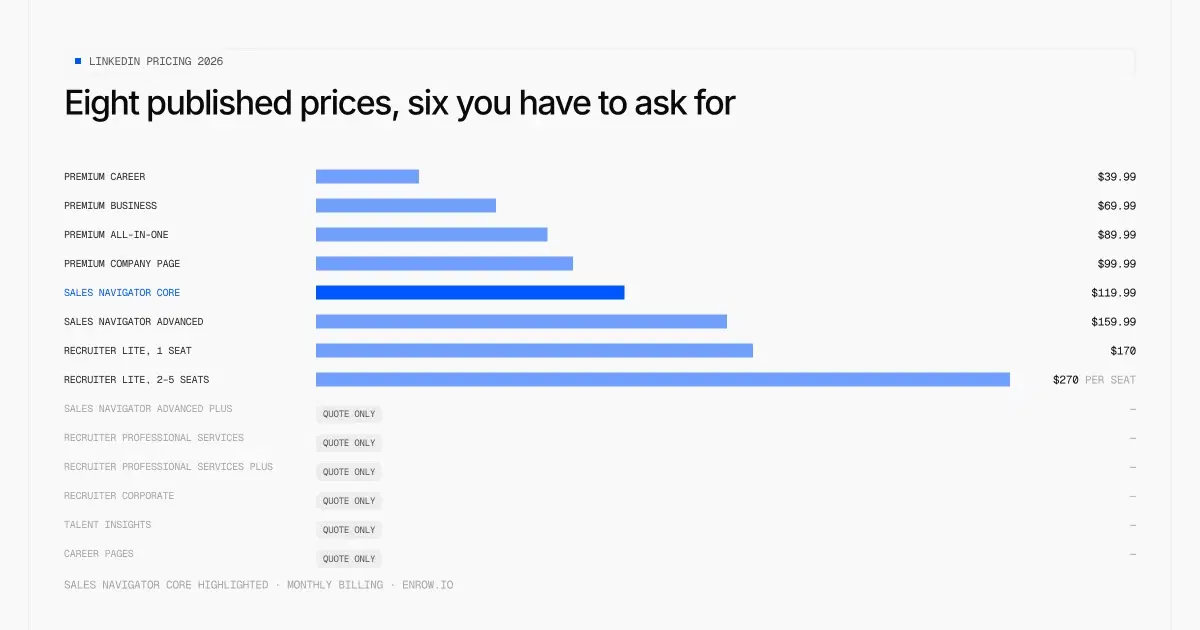
Eight tiers carry a published price. Six you have to ask for.
Prices verified August 28, 2026, re-checked on the 29th, against LinkedIn's own pricing FAQs on business.linkedin.com, premium.linkedin.com and the Recruiter help centre. Not one figure below is quoted from another article.
Key takeaway LinkedIn sells fourteen different paid tiers. Eight have a published price, between $39.99 and $170 a month. The other six are quote-only, and one of those reportedly runs past $10,000 per seat per year. If you only read one line: almost everyone buying LinkedIn to generate business should buy Sales Navigator Core at $119.99 and nothing else. It's the cheapest plan per InMail, it's the only search tool worth the name, and the tiers below it are mostly presentation. No LinkedIn subscription, at any price, gives you someone's email address or phone number. Every price here was read off LinkedIn's own pages on August 29, 2026.
LinkedIn's pricing is confusing by construction. Four Premium plans, three Sales Navigator tiers, four Recruiter products, plus Talent Insights and Career Pages, spread across three different websites with three different naming conventions.
I've now gone through all of them properly, reading LinkedIn's own pricing FAQs rather than the blog posts quoting each other. This page is the summary: what everything costs, and which one fits which job.
Fair warning about my bias. I run Enrow, which finds verified emails and phone numbers. That makes me a LinkedIn customer, not a competitor, and it means I care a lot about the last section of this page, where LinkedIn's products stop.
Every LinkedIn price in one table
Eight of the fourteen paid tiers carry a published price. They start at $39.99/mo for Premium Career and top out at $270/mo per seat for Recruiter Lite once you hold a second licence, and the annual discount across them swings by anywhere between 6% and 50% depending on which plan you pick.
| Product | Monthly | Annual | Annual/mo | InMails/mo |
|---|---|---|---|---|
| LinkedIn Basic | Free | Free | — | 0 |
| Premium Career | $39.99/mo | $239.88/yr | $19.99/mo | 5/mo |
| Premium Business | $69.99/mo | $539.88/yr | $44.99/mo | 15/mo |
| Premium All-in-One | $89.99/mo | $899.88/yr | $74.99/mo | 30/mo |
| Premium Company Page | $99.99/mo | $839.88/yr | $69.99/mo | — |
| Sales Navigator Core | $119.99/mo | $1,079.88/yr | $89.99/mo | 50/mo |
| Sales Navigator Advanced | $159.99/mo | $1,799.88/yr | $149.99/mo | 50/mo |
| Sales Navigator Advanced Plus | Quote | Quote | — | 50/mo |
| Recruiter Lite, 1 seat | $170/mo | $1,680/yr | $140/mo | 30/mo |
| Recruiter Lite, 2–5 seats | $270/mo per seat | $2,670/yr per seat | $222.50/mo | 30/mo per seat |
| Recruiter Professional Services | Quote | Quote | — | 100/mo |
| Recruiter Professional Services Plus | Quote | Quote | — | 140/mo |
| Recruiter Corporate | Quote | Quote | — | 150/mo |
| Talent Insights | Quote | Quote | — | — |
| Career Pages | Quote | Quote | — | — |
All prices in USD, excluding VAT and GST. The four Premium pages carry LinkedIn's own "Last updated: April 20, 2026" stamp; the Recruiter help page says "Last updated: 9 months ago".
Reported figures put Recruiter Corporate and RPS somewhere between $7,000 and $15,000 per seat per year, and Sales Navigator Advanced Plus around $1,600 per seat annually. LinkedIn publishes neither, so treat both as hearsay until a rep quotes you.
The number that decides most purchases
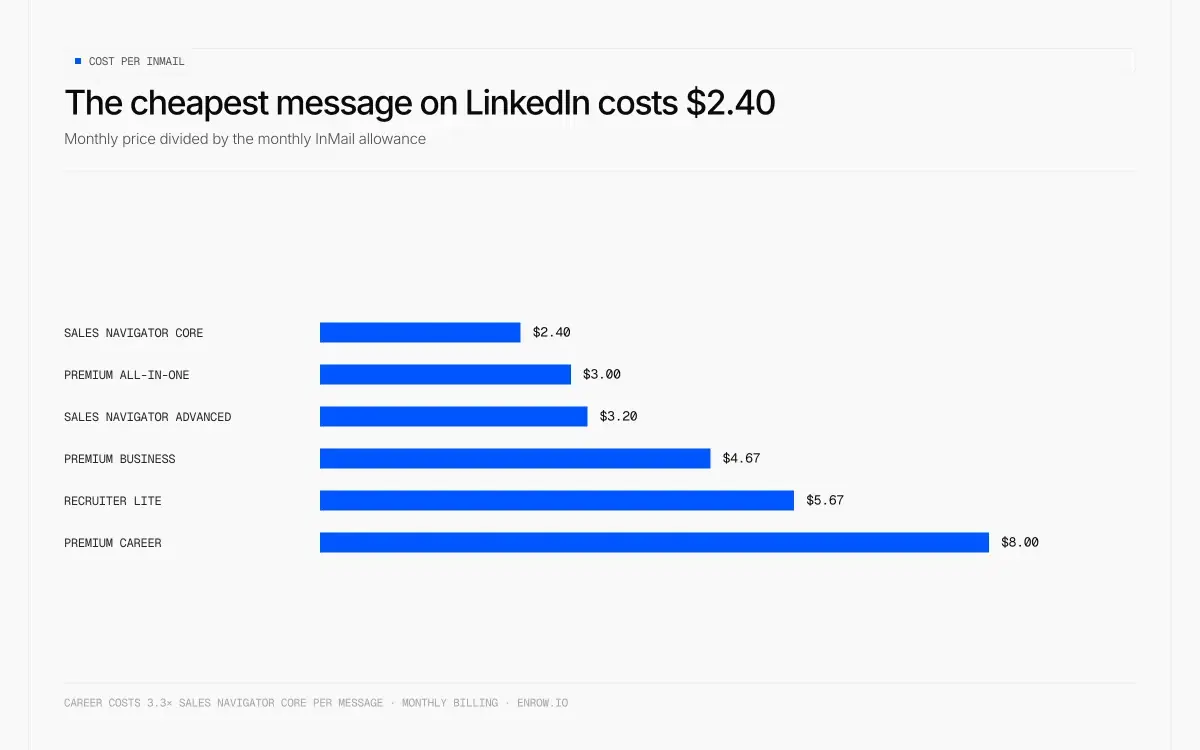
The same message costs $2.40 or $8.00, depending on what you pay for.
Strip out the marketing and LinkedIn's paid tiers differ on one axis that matters: how many people you can contact who aren't already connected to you. Everything else is presentation.
Divide each monthly price by its InMail allowance and the ranking inverts. Across the six single-seat plans that publish both numbers the spread is 3.3×, $2.40 to $8.00 a message, and the cheapest subscription in the range turns out to be the dearest way to send one.
| Plan | Monthly | InMails | Cost per InMail |
|---|---|---|---|
| Sales Navigator Core | $119.99/mo | 50/mo | $2.40/InMail |
| Premium All-in-One | $89.99/mo | 30/mo | $3.00/InMail |
| Sales Navigator Advanced | $159.99/mo | 50/mo | $3.20/InMail |
| Premium Business | $69.99/mo | 15/mo | $4.67/InMail |
| Recruiter Lite | $170/mo | 30/mo | $5.67/InMail |
| Premium Career | $39.99/mo | 5/mo | $8.00/InMail |
The most expensive plan on the list is not the cheapest per unit of actual reach. Sales Navigator Core is. It costs more per month than three plans above it and still sends each message for less than any of them: $2.40, against $3.00 to $8.00.
Two other things fall out of that table. Sales Navigator Advanced costs $40 a month more than Core and includes exactly the same 50 InMails, which makes it worse per message than the plan beneath it. And Recruiter Lite, at $170, buys fewer messages than Sales Navigator Core at $119.99.
Which one to buy
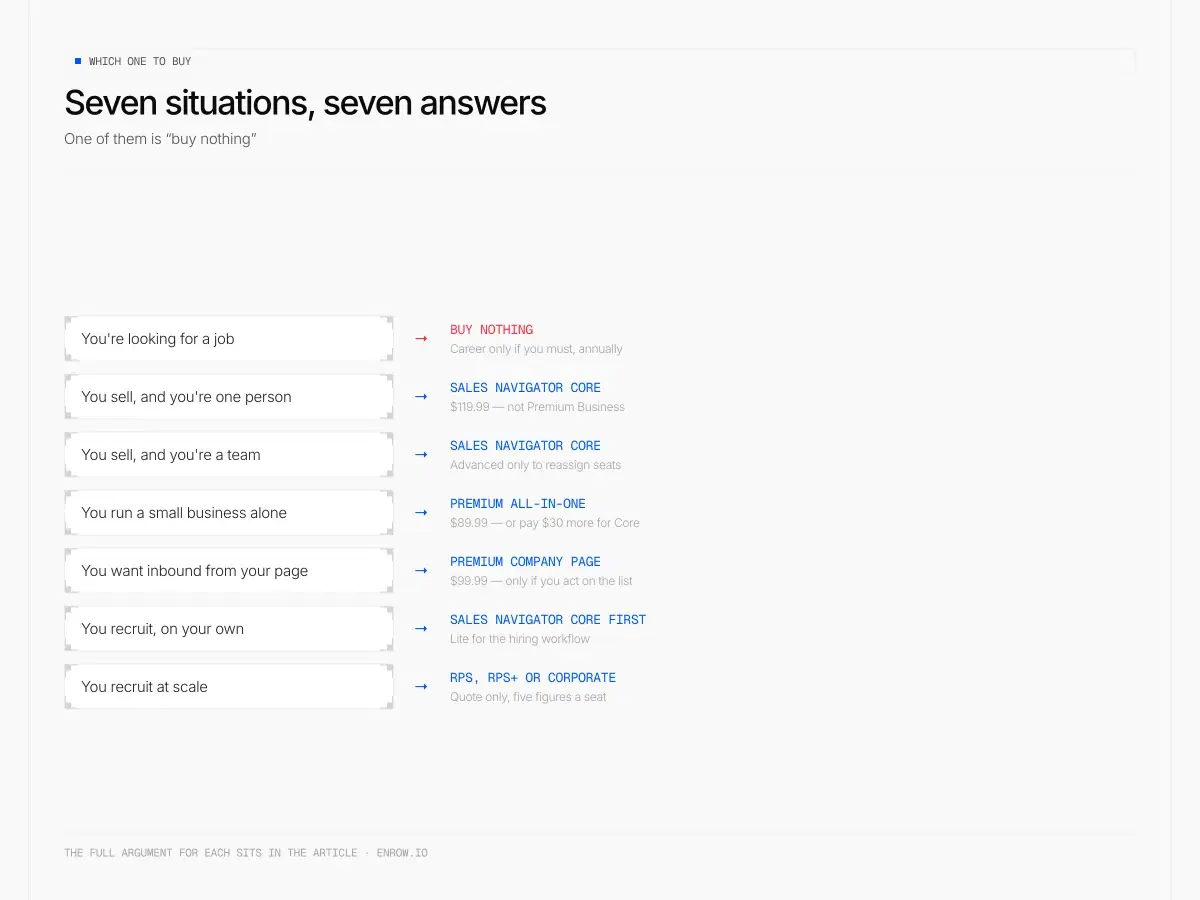
Seven situations. One of the answers is to buy nothing.
You're looking for a job
Buy nothing. LinkedIn Premium Career gives you no additional database and no hidden listings; it's a nicer interface to the same jobs everyone else sees. The signals it sells, Top Applicant and Top Choice, have been diluted by sheer volume.
If you want it anyway, take it annually at $19.99 a month rather than $39.99, and use the free month first. The full argument, including LinkedIn's own hiring statistics and why they don't prove what the page implies, is in the Premium Career breakdown.
You sell, and you're one person
Sales Navigator Core, $119.99. Not Premium Business.
Business is $50 cheaper and gives you a third of the messages, no lead lists, no saved searches and a weaker filter set. The $50 gap is the best-value money in LinkedIn's whole catalogue. Details here.
You sell, and you're a team
Still Core, for almost everyone. Advanced adds two things worth having: CSV account import, and the ability to reassign licences between people.
That second one has a use nobody advertises. If you have ten reps who don't all need the tool daily, five Advanced licences rotated among them costs $8,999.40 a year, against $10,798.80 for ten Core licences. Cheaper, and you get CSV import as well. That's the only scenario where the upgrade saves money.
You run a small business and do everything yourself
Premium All-in-One at $89.99 is the plan aimed at you, and the $50 monthly post-boost credit in it is genuinely good value if you'd advertise anyway.
But it sits $30 below Sales Navigator Core, and for that $30 you swap samples of four products for one real one. Buy All-in-One only if you'll use the boost credit every month. Otherwise go up. The Premium comparison works through it.
You want inbound leads from your company presence
Premium Company Page, $99.99. This is the one LinkedIn upgrade I pay for personally, and the reason is a single feature: you can see who visited your Page. People who look you up on purpose are the warmest signal you'll get for free.
It only pays if you act on the list. If nobody follows up on those names, you're buying a gold badge for $1,200 a year. Full breakdown.
You recruit, on your own
Look hard at Sales Navigator Core before Recruiter Lite. Lite costs $50 a month more and gives you 20 fewer InMails, and for finding and contacting people the Sales Navigator search is better.
Lite earns its place if you want the recruiting workflow around the search: projects, candidate pipelines, hiring-specific filters. One seat, one person. Do not buy a second seat casually, for reasons in the next section.
You recruit at scale
RPS, RPS+ or Corporate, all quote-only, all realistically five figures per seat. The jump from Lite isn't an upgrade, it's a different product: full network access, ATS integration for 28+ partners, 20 free collaborator licences per seat, and company-owned data. What each tier includes.
The comparisons people actually search for
LinkedIn Premium vs Sales Navigator
Premium Business improves your own profile. Sales Navigator finds other people. That's the whole distinction.
Business gets you a custom call-to-action button, profile presentation tools, services matching and 15 InMails. Sales Navigator gets you lead and account lists, saved searches, 40+ filters and 50 InMails. If your goal is being found, Premium. If your goal is finding, Sales Navigator, and it isn't close.
Premium Career vs Premium Business
Career at $39.99 is built for job hunting: top-applicant signals, job filters, 5 InMails. Business at $69.99 is built for selling and networking: the custom button, business insights, unlimited search, 15 InMails.
Career has by far the better annual discount, 50% against 35.7%. Business has the better product. Neither gives you contact details for anyone.
Recruiter vs Recruiter Lite
Lite caps you at third-degree connections, 20+ filters, 30 InMails, five seats, no ATS connector and no AI features whatsoever. Corporate opens the full network, 40+ filters, 150 InMails per seat, 28+ ATS integrations.
One line in LinkedIn's own table deserves attention before a company buys Lite for an employee: on Lite, data is owned by the Purchaser Admin, not the company. On RPS and above it stays with the business.
Sales Navigator vs Recruiter Lite
Sales Navigator Core is $119.99 with 50 InMails. Recruiter Lite is $170 with 30. For pure search-and-contact, Sales Navigator wins on both price and volume, and it's the comparison most independent recruiters never run.
Three pricing traps
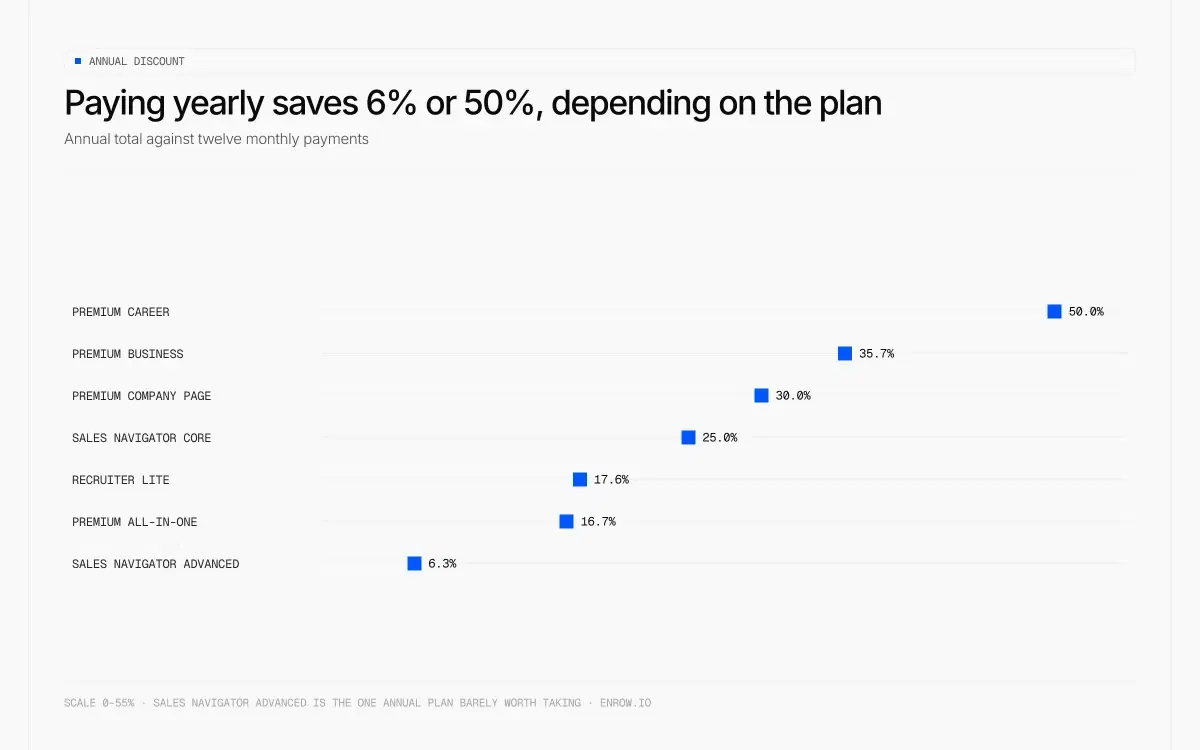
Paying yearly is a bargain on one plan and almost pointless on another.
The annual discount is wildly inconsistent. Premium Career gives you 50% off for paying yearly. Sales Navigator Advanced gives you 6%. Both figures are LinkedIn's own. "Always take the annual plan" is excellent advice on some plans and nearly pointless on others, so check before you commit twelve months.
Recruiter Lite gets more expensive per seat as you grow. One licence is $170 a month. Licences 2 to 5 are listed at $270 a month each. Adding a colleague raises your per-seat cost by 59%, which is the opposite of how almost every other tool prices. Read LinkedIn's table as written, with $270 applying to every licence, and two seats come to $540 a month, more than three times one seat. Even if your first licence stays at $170, the pair costs $440, 2.6 times the price of one.
The annual price is not the monthly price times twelve. Sounds obvious. Yet the most widely repeated figure for Recruiter Lite's annual plan is $2,040, which is simply $170 × 12. LinkedIn's actual annual price is $1,680. A lot of published budgets are 21% too high.
The lever nobody writes about
The biggest saving available on LinkedIn isn't the annual toggle. It's the currency you're billed in.
LinkedIn sells self-serve subscriptions in 57 currencies, and your price locks to whichever one you signed up with. When that currency weakens, your real cost falls at every renewal. LinkedIn does re-price markets that drift too far from reality, but that applies to new buyers; existing subscriptions carry on at the old number.
Over two years, a price frozen in Argentine pesos got 37.3% cheaper in dollar terms. In Turkish lira, 28.9%.
It isn't free money and it isn't risk-free. Some soft currencies strengthened instead — the Nigerian naira gained 14.4% in a year. Changing currency later means cancelling and waiting out your billing cycle. It only works on self-serve purchases, so Advanced Plus and every Recruiter tier above Lite are excluded, since LinkedIn accepts just 12 currencies on rep-sold contracts. And LinkedIn's User Agreement requires accurate profile information, with account restriction as the stated consequence.
The method and the full set of caveats are in the Sales Navigator article.
What none of these plans do
Here's the thing that unites every product on this page, from the $39.99 tier to the $15,000-a-seat contract.
None of them give you an email address or a phone number.
LinkedIn shows you exactly the right person. Current title, current company, recent hires on their team, a post they wrote last week. Then it stops, because the entire business model depends on the conversation staying inside LinkedIn. InMail is that model made into a product: you rent the right to send 5, 15, 30 or 50 messages a month on their platform, at between $2.40 and $8.00 each.
That gap is what my company works on, so read the rest of this knowing it.
Enrow finds and verifies work emails and direct phone numbers in real time, rather than serving them from a stored database. That choice is the point: stored databases refresh every few months, so you end up contacting people who changed jobs last spring. Each address goes through 10+ verification checks, with observed bounce under 1%, and catch-all addresses get verified and delivered instead of being flagged and dropped. On European direct dials we're not blocked by GDPR.
The way you use it alongside LinkedIn matters more than the feature list. Our Chrome extension runs inside LinkedIn and Sales Navigator, so you open a profile you were going to open anyway and the person's verified email and direct phone are found on that page. No second tab, no pasting a name into another tool, no losing your place in a search.
Contacts then sync natively into HubSpot, Salesforce and Pipedrive. Native meaning a direct integration, not a chain of automation tools you have to maintain.
You're charged only when a result comes back valid. Plans start at $17 a month for 1,000 credits, where one email costs one credit and one direct phone costs 40. There's an API for bulk work and an MCP server (github.com/EnrowAPI/enrow-mcp) for AI workflows. The free tier is 50 credits every month, no card.
Where it won't help: Enrow has no searchable database, deliberately, so building the list still happens in LinkedIn or Sales Navigator. It doesn't send sequences either, and won't. For that, Emelia, La Growth Machine or lemlist.
ready to stop wasting time?
Connected in minutes.
Verified data in seconds.
FAQ
How much does LinkedIn cost per month?
LinkedIn Basic is free. Paid plans with published prices run from $39.99 a month for Premium Career to $170 for Recruiter Lite, with Premium Business at $69.99, Premium All-in-One at $89.99, Premium Company Page at $99.99, Sales Navigator Core at $119.99 and Sales Navigator Advanced at $159.99. Six further tiers are quote-only.
Which LinkedIn subscription is best?
For generating business, Sales Navigator Core at $119.99. It's the cheapest plan per InMail at $2.40 and the only genuine search tool in the range. For job hunting, none of them. For company-level inbound, Premium Company Page. For recruiting at scale, one of the quote-only Recruiter tiers.
Is LinkedIn Premium worth the money?
Premium Business and All-in-One are hard to justify when Sales Navigator Core sits $50/mo and $30/mo above them respectively with far more capability. Premium Career is the weakest of the range. Premium Company Page is the one I'd defend, because visitor identification is real, actionable data.
What's the cheapest way to get LinkedIn Premium?
Annual billing, which takes Premium Career from $39.99 to $19.99 a month, a 50% saving. Career and Business also have a two-licence duo price where the second seat runs at half price on Career. Every plan comes with a free month, and trial eligibility returns after 12 months.
Does any LinkedIn plan include email addresses?
No. No LinkedIn subscription at any price provides an email address or a phone number, from the free Basic tier up to a five-figure Recruiter Corporate seat. InMail lets you message someone inside LinkedIn, 5 to 150 messages a month depending on the plan, without ever handing you their contact details.
How much is LinkedIn Recruiter compared to Sales Navigator?
Recruiter Lite is $170 a month with 30 InMails. Sales Navigator Core is $119.99 a month with 50. Sales Navigator is cheaper and gives more reach, so most solo recruiters doing search-and-contact work should compare the two carefully before defaulting to Recruiter.
How we verified these prices
Every figure on this page came from LinkedIn, not from other articles about LinkedIn.
On 28 and 29 August 2026 I pulled the pricing FAQs on business.linkedin.com, premium.linkedin.com and the Recruiter help centre, including the accordion panels most people never open, which is where the currency grids and the duo prices are kept. Four of those pages carry LinkedIn's own "Last updated: April 20, 2026" stamp; the Recruiter comparison page says "Last updated: 9 months ago".
Monthly-equivalent prices, annual discounts and cost-per-InMail figures are calculated from those raw numbers rather than copied, so an arithmetic error would show up as an inconsistency across the cluster rather than a plausible-looking wrong number.
Where LinkedIn publishes nothing — Advanced Plus, the three upper Recruiter tiers, Talent Insights, Career Pages — the article says so and labels reported figures as unverified. No price is presented as fact unless LinkedIn published it.
Prices move. This page carries the date it was checked so you can judge how much to trust it, which is more than most of the results above it will tell you.