Key takeaway Premium Company Page costs $99.99 a month, or $839.88 a year, which works out to $69.99 monthly. Creating the Company Page itself stays free — this is an upgrade admins buy on top. I've been critical of most LinkedIn subscriptions. This is the one I pay for, and the reason is a single feature: you can see who visited your Page. That's a list of companies and people who looked you up on purpose, which is about as warm as an inbound signal gets. The second useful piece is auto-invite, which pulls people who engaged with your content into following the Page without you doing it by hand. There's still plenty of decoration in the bundle. At $99.99 it's expensive. With a free trial attached, it's worth finding out. Prices verified August 28, 2026 on LinkedIn's own Premium Company Page listing, which carries LinkedIn's stamp "Last updated: April 20, 2026". Google was serving six different monthly figures for this one product that day, from $39.99 to $100, some of them monthly rates and some annual-equivalents. There's a table further down putting each one against the official price.
I've spent four articles being fairly hard on LinkedIn's paid tiers. So it's only fair to say when one of them is good, and this is it.
Premium Company Page isn't ancient. LinkedIn piloted it in April 2023 and rolled it out broadly in June 2024, which is why so few people have a settled opinion on it. It's also the only Premium plan that upgrades your company's presence rather than your own profile.
Prices come from LinkedIn's own Premium Company Page listing, read on August 28, 2026 and stamped by LinkedIn "Last updated: April 20, 2026".
Disclosure as always: I run Enrow. It's relevant here in a way it isn't in the other pieces, because the workflow I get most out of this subscription runs through my own product. I'll flag it clearly when we get there.
What it costs
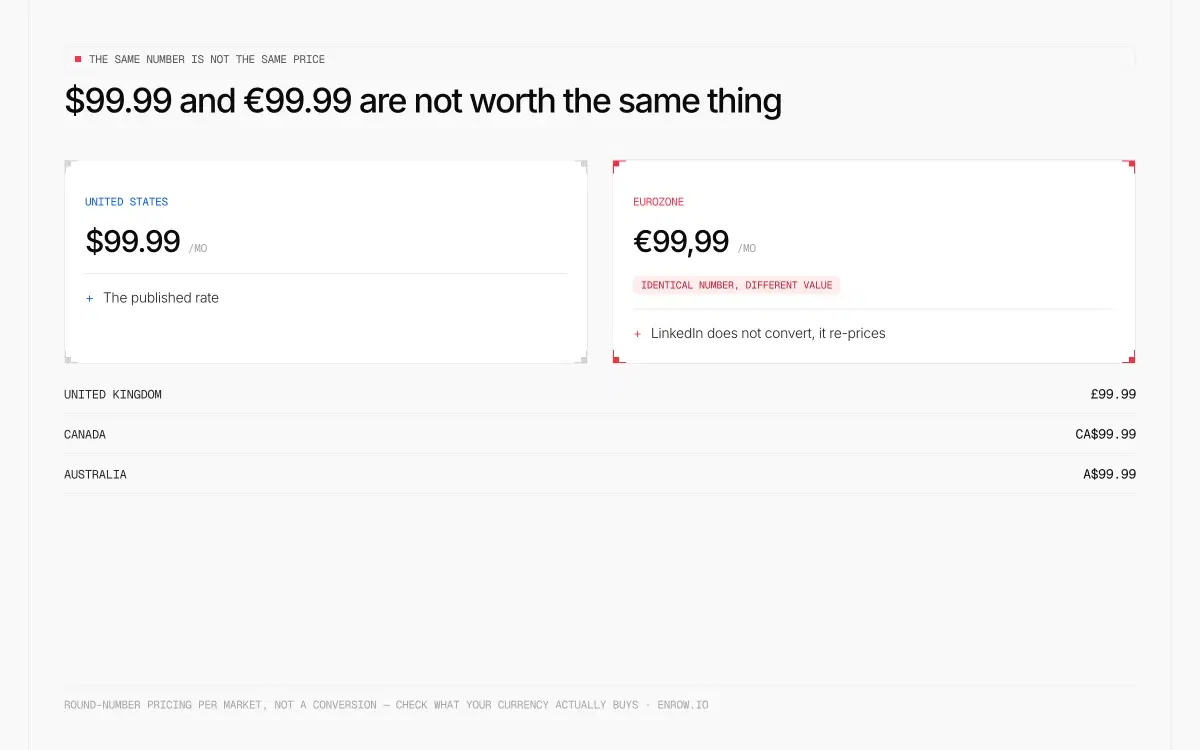
$99.99 and €99.99 are the same number and not the same price.
One Premium Company Page costs $99.99/mo. Pay for the year up front and the bill is $839.88, which works out at $69.99/mo, so committing to twelve months takes 30% off the monthly rate and saves $360.00 a year.
| Plan | Monthly | Annual | Annual per month | Saving vs paying monthly |
|---|---|---|---|---|
| Premium Company Page | $99.99/mo | $839.88/yr | $69.99/mo | 30% off the monthly rate, $360.00/yr |
No duo option here, unlike Career and Business. One Page, one price.
The currency detail worth catching
LinkedIn sells this Page in five currencies and the annual discount barely moves between them: 30.0% off the monthly rate in USD and EUR, 30.1% in GBP, 30.7% in CAD, 29.9% in AUD. What moves is the entry price. And one row moves in a way the others don't.
| Currency | Monthly | Annual | Annual per month |
|---|---|---|---|
| USD | $99.99/mo | $839.88/yr | $69.99/mo |
| EUR | €99,99/mo | €839,89/yr | €69,99/mo |
| GBP | £79.67/mo | £668.04/yr | £55.67/mo |
| CAD | C$139.99/mo | C$1,163.88/yr | C$96.99/mo |
| AUD | A$156.99/mo | A$1,319.88/yr | A$109.99/mo |
Source: the pricing accordion on premium.linkedin.com/small-business/company-page, read August 28, 2026.
Look at the euro row. LinkedIn charges €99,99 against US$99.99, a straight nominal copy. Since the euro is worth more than the dollar, European buyers are paying meaningfully more for the identical product. Sterling gets a genuine discount, Canadian and Australian buyers a substantial premium.
That parity trick is unique to this plan. On Career, Business and All-in-One, LinkedIn actually sets separate market prices in euros.
What the upgrade adds
Straight from LinkedIn:
- See who's visited your Page — "Identify new clients and gain insights by seeing who's visited your Page"
- Auto-invite engaged prospects — automatically invite people who've engaged with your content to follow the Page
- Invite followers of similar Pages — reach people who follow comparable Pages, without a connection
- A custom call-to-action button across your Page header, your posts, and search results
- A customer testimonial displayed on the Page
- The gold Premium badge
- A content writing assistant
- Deeper Page analytics
LinkedIn's headline claim for it: "Premium helps you grow your LinkedIn Company Page followers 6.7x", sourced to LinkedIn data from July 2024. Their own data, from the month of the rollout, so read it as marketing rather than evidence.
My honest read
Page visitors are the whole product
Everything else in this bundle is a nice-to-have. Knowing who visited your Company Page is a genuinely different kind of information, and it's the reason I keep paying.
Think about what that list represents. Someone typed your company name, or clicked through from a post, and spent time looking at what you do. Nobody does that by accident. In a world where intent data is mostly inference and guesswork, this is people raising their hand without meaning to.
It's actionable, too, which is rarer. A visitor list is a set of names and companies you can do something with, not a dashboard that makes you feel informed.
Auto-invite is the quiet time-saver
The second feature I'd defend. Inviting people to follow your Page used to be a manual grind through a list. Auto-invite handles the people who already engaged with your content, which is exactly the group most likely to say yes.
Growing followers isn't glamorous, but a Page with an audience gives every future post somewhere to land. This does it while you're not looking.
The rest is decoration
The gold badge is a badge. The custom testimonial is a nice touch that nobody has ever bought from because of. The content writing assistant does what any general AI does, less well. The custom CTA button is mildly useful and shared with Premium Business anyway.
So you're paying $99.99 for two real features and a stack of trimmings. Which brings me to the honest verdict: it's expensive, and I still think it's worth trying. That's not a contradiction. The visitor data either converts into pipeline for your business or it doesn't, and a month of the free trial tells you which. Most LinkedIn subscriptions can't be evaluated that cleanly.
The mistake I'd avoid
Don't buy this to look more credible. Buy it for the visitor list. If you're not going to do anything with the names, you're spending $1,200 a year on a gold badge.
Pros
- Visitor identification, genuinely actionable intent data
- Auto-invite pulls in people who already engaged with your content
- Invite followers of comparable Pages, without a connection
- Custom call-to-action button across header, posts and search results
- 30% annual discount, plus a free trial
Cons
- $99.99 is the most expensive published Premium tier
- European buyers pay nominal parity with the dollar, so more in real terms
- Badge, testimonial block and writing assistant are decoration
- Worthless if nobody follows up on the visitor list
- No duo option
Best for: B2B companies with someone who will actually work the visitor list. In B2C it's hard to justify.
Company Page is not the same as Career Page
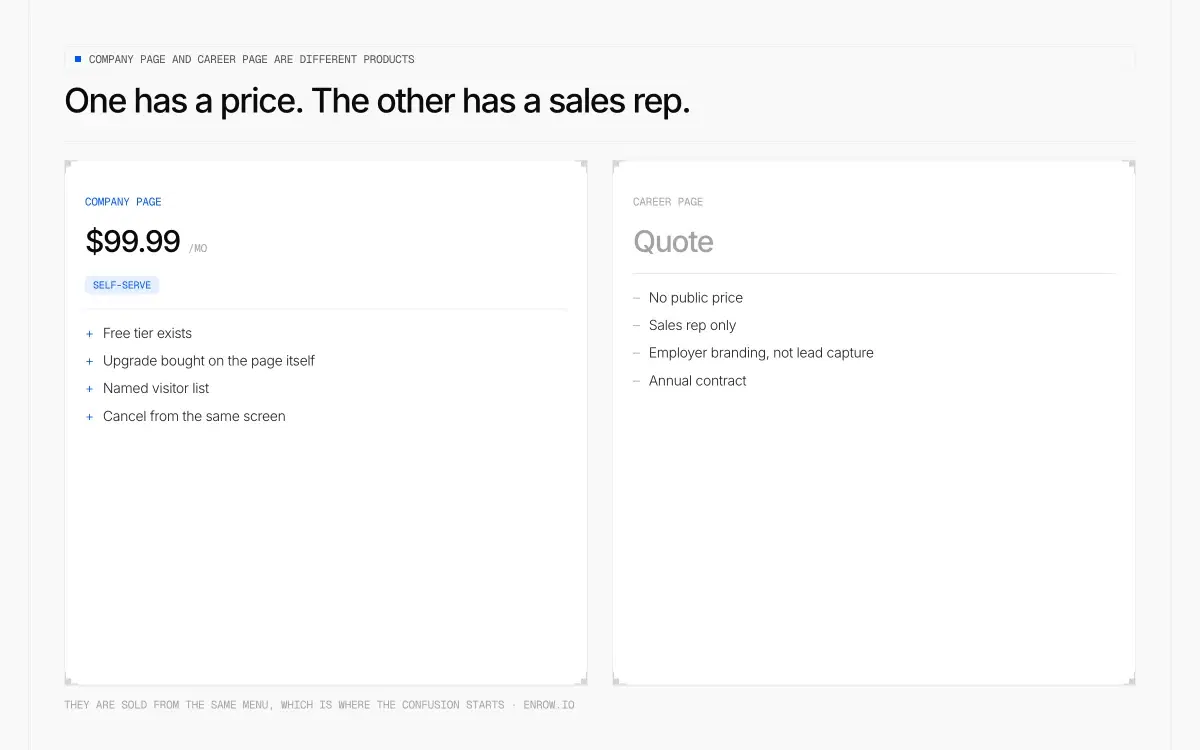
One has a price on the page. The other has a sales rep.
This confuses people constantly, and the names don't help.
A Company Page is the LinkedIn presence for your business. Anyone can create one, free, in a few minutes. Premium Company Page is the paid upgrade on top, at $99.99 a month, and that's what this article is about.
A Career Page is a separate LinkedIn product for employer branding: a recruitment-oriented layer showing life at the company, culture content, and jobs to candidates. It has no public price at all. LinkedIn sells it through a sales rep, aimed at companies with real hiring volume.
So they're not two tiers of the same thing. One is a free page with a paid upgrade; the other is an enterprise product you get quoted for.
My view on Career Pages, briefly: I wouldn't. Building your careers presence inside LinkedIn means renting it. You get their layout, their constraints, their analytics, and none of it belongs to you. Build the careers section on your own site instead. You'll produce something better, you'll own the traffic, and you can point LinkedIn job posts at it. A Career Page is a lot of money to decorate a page on somebody else's platform.
If you're in B2C, the calculation shifts further. Your buyers largely aren't on LinkedIn evaluating you, so paying to polish a LinkedIn presence for them is hard to justify. Premium Company Page earns its money in B2B, where the visitor list is full of people who might actually buy.
Paying less for it
The annual plan takes $99.99 down to $69.99 a month, a 30% saving, and there's a free trial before you commit to anything.
Beyond that, the same lever applies here as on every other LinkedIn subscription: the currency you're billed in. LinkedIn sells self-serve subscriptions in 57 currencies and locks your price to the one you signed up with. When that currency weakens, your real cost falls at every renewal, and LinkedIn's periodic re-pricing of a market only affects new subscribers. Over two years, a price frozen in Argentine pesos fell 37.3% in dollar terms; in Turkish lira, 28.9%.
It isn't automatic money. Some soft currencies strengthened — the Nigerian naira gained 14.4% against the dollar in the past year. Switching currency later means cancelling and waiting out your billing cycle. And LinkedIn's User Agreement requires accurate profile information, with account restriction as the stated penalty, which is a far greater loss than the subscription. The Sales Navigator article sets out the method and the risks properly.
The workflow that makes this subscription pay
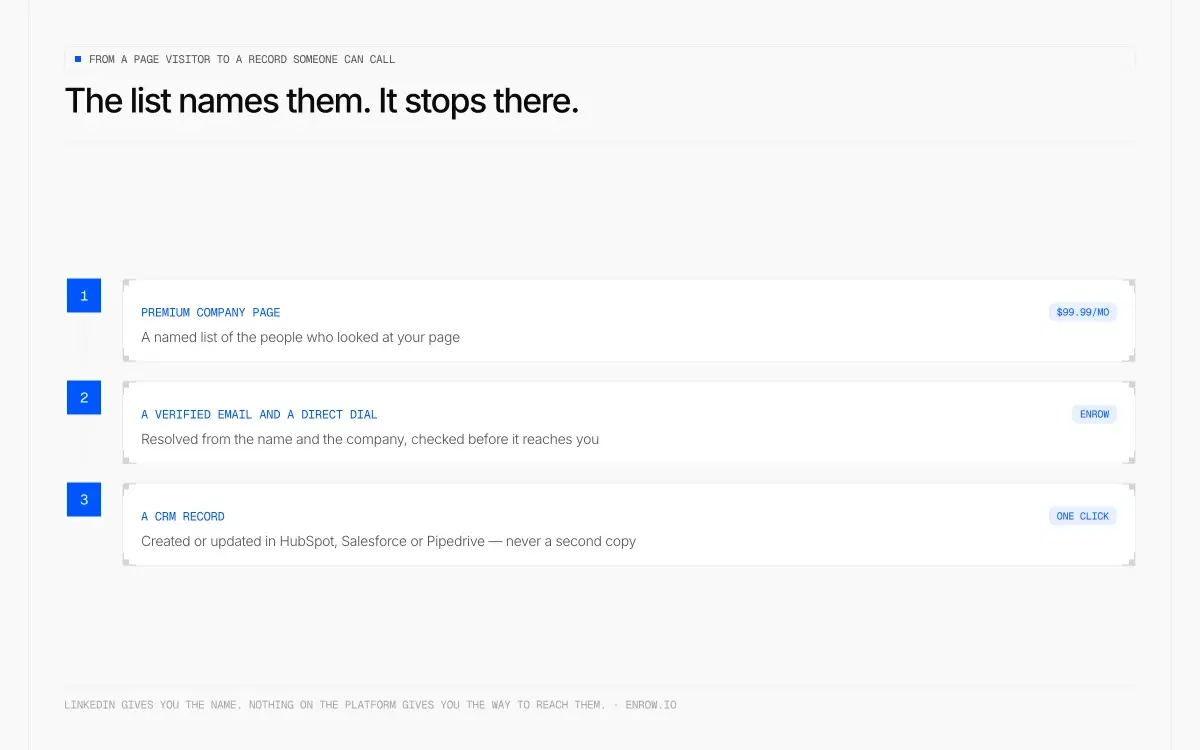
LinkedIn names the visitor. Nothing on the platform tells you how to reach them.
Here's where my own product comes in, so weigh it accordingly.
A visitor list is names. Names don't reply. To do anything with the people who looked at your Page, you need to reach them somewhere they'll actually answer, and LinkedIn will never hand you an email address or a phone number.
That's what Enrow is for. Its Chrome extension sits on a LinkedIn or Sales Navigator profile and finds the person's verified work email and direct phone number right there in the profile, without opening another tab or bouncing between windows. You stay in the flow you're already in, which sounds minor until you've done it two hundred times.
From there the contact goes straight into your CRM. Enrow integrates natively with HubSpot, Salesforce and Pipedrive — not through a middleman automation tool, but as a direct connection, so what you find on LinkedIn lands as a proper record in the system your team already works in.
And it lands as a create-or-update. A visitor list is full of people you already have some history with — an old lead, or the account a colleague called back in March and never closed. Enrow matches the person first and completes the record it finds. The second copy, the one that quietly forks your lists and makes your reporting count one company as two, never gets created.
The data is found and verified in real time rather than pulled from a stored database. That distinction matters more than it sounds: stored databases refresh every few months, so you end up contacting people who moved on last spring. Each address runs through 10+ verification checks, with observed bounce under 1%, and catch-all addresses get verified and delivered instead of being flagged and dropped. On European direct dials we aren't blocked by GDPR.
You're charged only when a result comes back valid. Pricing starts at $17 a month for 1,000 credits, where one email is one credit and one direct phone is 40. The free tier is 50 credits every month, no card, which is enough to test the loop on a real visitor list.
Where it won't help you: Enrow has no searchable database, on purpose, so building lists still happens in LinkedIn or Sales Navigator. And it doesn't send sequences — for that, Emelia, La Growth Machine or lemlist.
ready to stop wasting time?
Connected in minutes.
Verified data in seconds.
FAQ
How much does a LinkedIn Premium Company Page cost?
LinkedIn Premium Company Page costs $99.99/mo, or $839.88/yr, which works out at $69.99/mo. That's 30% off the monthly rate, a saving of $360.00 a year. Creating the Company Page itself is free; Premium is an upgrade bought by Page admins. Verified on LinkedIn's pricing page, August 28, 2026.
Is a LinkedIn Company Page free?
Yes. Any business can create a Company Page at no cost. Premium Company Page is an optional paid upgrade at $99.99 a month that adds visitor identification, auto-invites, a custom call-to-action button, a testimonial block and the gold badge.
Is LinkedIn Premium Company Page worth it?
Premium Company Page, at $99.99/mo or $839.88/yr, is worth it on one condition: that somebody will act on the visitor list. Seeing who visited your Page is genuinely useful intent data and the main reason to buy. Auto-invite is a real time-saver. The badge, testimonial and writing assistant are decoration. In B2B, with a process for following up on visitors, it earns its money. In B2C, or with nobody to act on the list, it doesn't.
What's the difference between a Company Page and a Career Page?
A Company Page is your free business presence on LinkedIn, with an optional Premium upgrade at $99.99/mo. A Career Page is a separate employer-branding product for recruiting, sold only through a LinkedIn sales rep with no public price. They're different products, not two tiers of one.
Do I need Premium Business as well as Premium Company Page?
No. They overlap on the custom call-to-action button and both are aimed at growth, but one upgrades your personal profile and the other your company's Page. LinkedIn markets them as a pair. Most small businesses get more from picking whichever side generates their leads.
Can I see exactly who visited my LinkedIn Company Page?
Visitor identification is the headline feature of the Premium upgrade — LinkedIn describes it as being able to "identify new clients and gain insights by seeing who's visited your Page". Free Company Pages only get aggregate demographics.
How we verified this
Pricing, the currency grid and the feature list came from LinkedIn's Premium Company Page listing on 28 August 2026, stamped "Last updated: April 20, 2026" by LinkedIn. Every figure in the tables above is read from that page or is arithmetic on it, never retyped from a secondary source.
The rollout dates were checked separately, because they're easy to get wrong on a product this recent: piloted April 2023, rolled out broadly from June 2024. LinkedIn's own follower statistic on the page is sourced to July 2024, consistent with that timeline.
For Career Pages, a full read of LinkedIn's employer-branding page returned no price of any kind, which is the basis for describing it as quote-only rather than guessing at a figure.
The comparison table of circulating prices was built by extracting all 484 price strings from the Google results actually served for this cluster on 28 August 2026, filtering to the 46 returned for "linkedin company page cost", and checking each claim about Premium Company Page against LinkedIn's own figure. Ranks are the positions those pages held that day. The AI Overview text is quoted as Google served it.
Visitor identification is described here using LinkedIn's own wording. What that feature surfaces in practice can vary with region and with a visitor's privacy settings, so the article avoids claiming a specific level of detail.