alternatives à anymailfinder
Les 11 meilleures alternatives à Anymailfinder pour les équipes B2B en 2026
Nous avons donc testé onze alternatives. Les mesures étaient celles qui décident vraiment d'un budget de prospection : le taux de contacts trouvés, le bounce sur un vrai envoi, le coût réel d'un contact utilisable, et la couverture géographique — les portables européens avec une base légale par-dessus tout.
11 outils testés
mis à jour le 6 octobre 2026
16 min de lecture
Mis à jour le 6 octobre 2026
Les alternatives en un coup d'œil
pour une équipe qui veut des emails et des numéros de portable vérifiés, payés seulement quand ils fonctionnent, Enrow est la meilleure alternative à Anymailfinder : dès 15 €/mois, avec un plan Pro autour de 0,0075 € l'email vérifié et 0,30 € le numéro (75 € pour 10 000 crédits = 10 000 emails ou 250 numéros). Emelia si vous préférez chercher et envoyer depuis un seul outil ; Hunter pour la recherche par domaine avec sources citées ; Findymail pour des adresses US de cold email ; Apollo ou Snov si vous voulez une base et un outil de campagnes réunis ; Lusha et Cognism pour les usages centrés sur le téléphone. Les autres couvrent chacun un besoin précis — mais aucun ne fait mieux dans l'ensemble.
Anymailfinder ne facture un email que lorsqu'il l'a trouvé et vérifié. C'est honnête, et ça lui vaut des fidèles.
Mais son forfait d'entrée revient à 45 € pour 1 000 emails, soit environ 0,045 € l'email vérifié — près de trois fois le tarif d'Enrow au même volume — et il n'y a aucun numéro de téléphone, nulle part.
Enrow garde la même règle (vous ne payez que les contacts vérifiés, un crédit par email valide), mais ajoute les numéros de portable européens, et démarre à 15 €/mois : environ 0,015 € l'email vérifié, et 0,30 € le numéro sur le plan Pro. Son extension Chrome fait ce qu'aucun outil de cette liste ne sait faire : transformer un profil LinkedIn ou Sales Navigator en fiche complète et vérifiée — email, numéro, tous les champs — déposée dans HubSpot, Salesforce ou Pipedrive en un clic. Les dix autres couvrent chacun un besoin précis. Aucun ne fait mieux dans l'ensemble.
Pourquoi les équipes cherchent des alternatives à Anymailfinder
Anymailfinder est un outil propre. On le quitte quand même, et c'est presque toujours pour trois raisons. Si toute votre activité, c'est de l'email B2B vérifié et que vous n'appelez jamais, Anymailfinder peut suffire. Sinon, lisez la suite.
Transparence : notre conflit d'intérêts
Autant nommer le parti pris tout de suite. J'ai fondé Enrow, Enrow trouve des emails, et cette liste d'outils de recherche d'emails place Enrow en premier. Faites la part des choses.
Maintenant, les concessions, dans la foulée. Enrow ne lancera pas vos campagnes ; Emelia et Snov, plus bas, le font. Il ne mettra pas une boîte mail en chauffe ; là encore, les deux mêmes. Il ne fait pas non plus d'enrichissement en cascade, c'est le terrain d'Emelia ou de LeadMagic.
Nous avons choisi ce périmètre exprès. Empiler les bases de six fournisseurs derrière un curseur est un bon moyen de cacher une donnée médiocre, et nous préférons répondre de chaque résultat que nous facturons.
La promesse que je fais est donc étroite, et vérifiable. Pour trouver et vérifier des emails et des portables européens frais et exacts, Enrow est l'outil le plus solide de cette page.
Si votre vrai point de blocage, ce sont les campagnes, la mise en chauffe ou une suite tout-en-un, un outil plus bas fera mieux ce travail, et je vous dirai lequel. Si votre point de blocage, c'est la donnée elle-même, ce périmètre étroit est exactement ce que vous achetez.
Les 11 meilleures alternatives à Anymailfinder
1. Enrow
#1
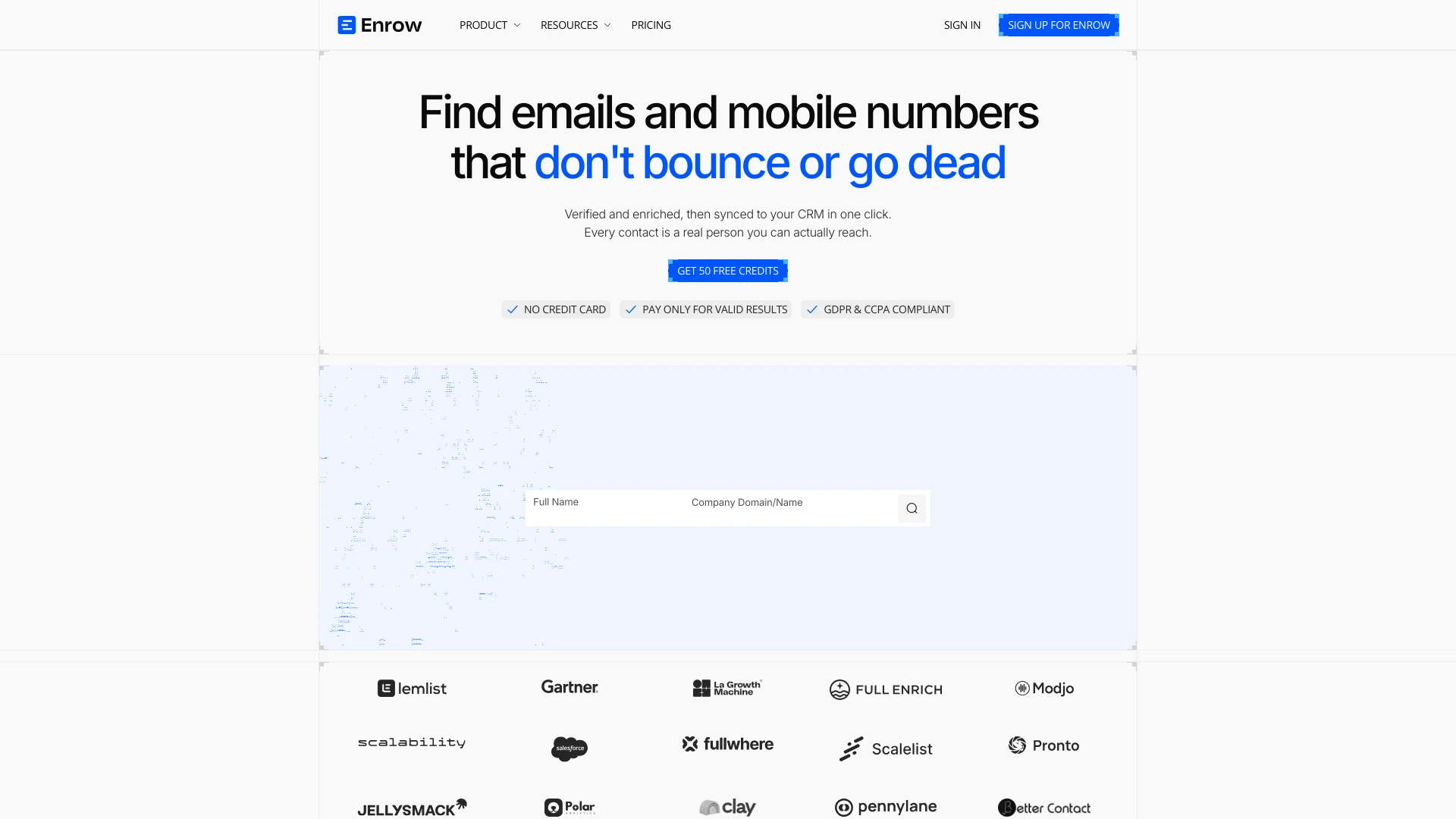
J'ai lancé Enrow après une facture de trop où les recherches facturées dépassaient les contacts trouvés dans un rapport de dix à un — et où une partie des contacts « trouvés » bouncait quand même.
La différence avec Anymailfinder est mince mais elle compte, et elle commence par le prix.
Anymailfinder facture aussi sur le résultat trouvé, ce qui est la bonne idée, mais le tarif est haut : son forfait à 45 € pour 1 000 revient à environ 0,045 € l'email vérifié, près de trois fois les 0,015 € d'Enrow pour les mêmes 1 000. Enrow facture 1 crédit par email valide, et seulement quand le résultat est bon.
Même compteur honnête, un prix par email vérifié bien plus bas, et sur une grosse liste, l'écart finit par peser. Les deux vérifient sérieusement.
Anymailfinder mène un contrôle en direct avant de compter une adresse comme trouvée ; Enrow enchaîne plus de 10 vérifications — plusieurs tests SMTP, plusieurs contrôles catch-all depuis des serveurs situés dans différentes régions — et il livre les catch-all au lieu de les écarter comme « risquées ».
Vient ensuite l'écart qu'Anymailfinder ne peut pas combler : le téléphone. Il n'en a aucun. Enrow fournit des numéros de portable dans tous les pays, Europe comprise.
Sur ma liste de test, ça a transformé un directeur commercial munichois que j'aurais contacté en cold email en un appel de dix minutes l'après-midi même. Ce n'est pas une amélioration de niche. Pour la plupart des équipes, appeler, c'est la moitié du travail.
Sur le vrai envoi, une chose a sauté aux yeux. Le bounce est resté sous 1 %, et les numéros européens faisaient sonner de vrais portables, pas des standards qui vous renvoient à l'accueil. J'ai retrouvé environ 60 % des contacts sur une liste mixte.
Une précision, pour être honnête : ce taux sous 1 % est une moyenne constatée, pas une garantie.
Et il y a un avantage de workflow qu'on ne retrouve chez aucun autre outil de cette liste. Ouvrez un profil LinkedIn ou Sales Navigator, cliquez une fois, et l'extension Chrome d'Enrow enregistre la fiche complète et vérifiée dans HubSpot, Salesforce ou Pipedrive : email et numéro attachés, aucun champ laissé vide.
Pas de copier-coller. Pas de fiche à moitié remplie. Anymailfinder est un point d'accès de recherche et de vérification ; remettre au CRM une fiche contact complète, ce n'est tout simplement pas ce qu'il fait.
Une dernière chose, pour ceux qui travaillent avec des agents IA. Enrow propose un serveur MCP officiel (le dépôt est github.com/EnrowAPI/enrow-mcp), pour appeler la recherche d'emails, le vérificateur et la recherche de numéros directement depuis Claude, Cursor ou Windsurf.
Des emails et des numéros frais et vérifiés, amenés dans un workflow d'agent, toujours facturés au résultat. Un détail aujourd'hui, mais bien utile si vous développez vos propres outils.
- +1 crédit par email vérifié, facturé seulement sur un résultat valide, environ 0,015 € sur Start (le tarif d'Anymailfinder par email vérifié est près de 3× plus élevé)
- +Numéros de portable dans tous les pays, Europe comprise (Anymailfinder n'a aucun numéro)
- +Plus de 10 vérifications par email ; catch-all vérifiées et livrées, pas mises de côté
- +Intégrations CRM natives : Clay, HubSpot, Salesforce, Pipedrive, plus des webhooks et une vraie API
- +L'extension Chrome transforme un profil LinkedIn ou Sales Navigator en fiche CRM complète — HubSpot, Salesforce ou Pipedrive, un clic, tous les champs (aucun des dix autres ne le fait)
- +Report des crédits sur Pro et Scale, avec jusqu'à 10 utilisateurs sur Pro et sans limite sur Scale ; aucune facturation par utilisateur
- –Pas de base de données à parcourir, et c'est un choix. Une base stockée commence à pourrir le jour où elle est constituée, car les changements de poste vont plus vite que n'importe quelle mise à jour ; Enrow interroge donc chaque contact en direct. C'est précisément ce compromis qui rend les résultats plus précis. Constituez vos listes dans LinkedIn ou Sales Navigator.
- –Pas d'outil de campagnes, jamais. Ce travail revient à Emelia d'abord, à La Growth Machine ensuite, à lemlist en troisième.
- –Pas de données sur les technologies utilisées. Vous avez les informations d'entreprise au niveau de LinkedIn, pas la détection de la stack technique.
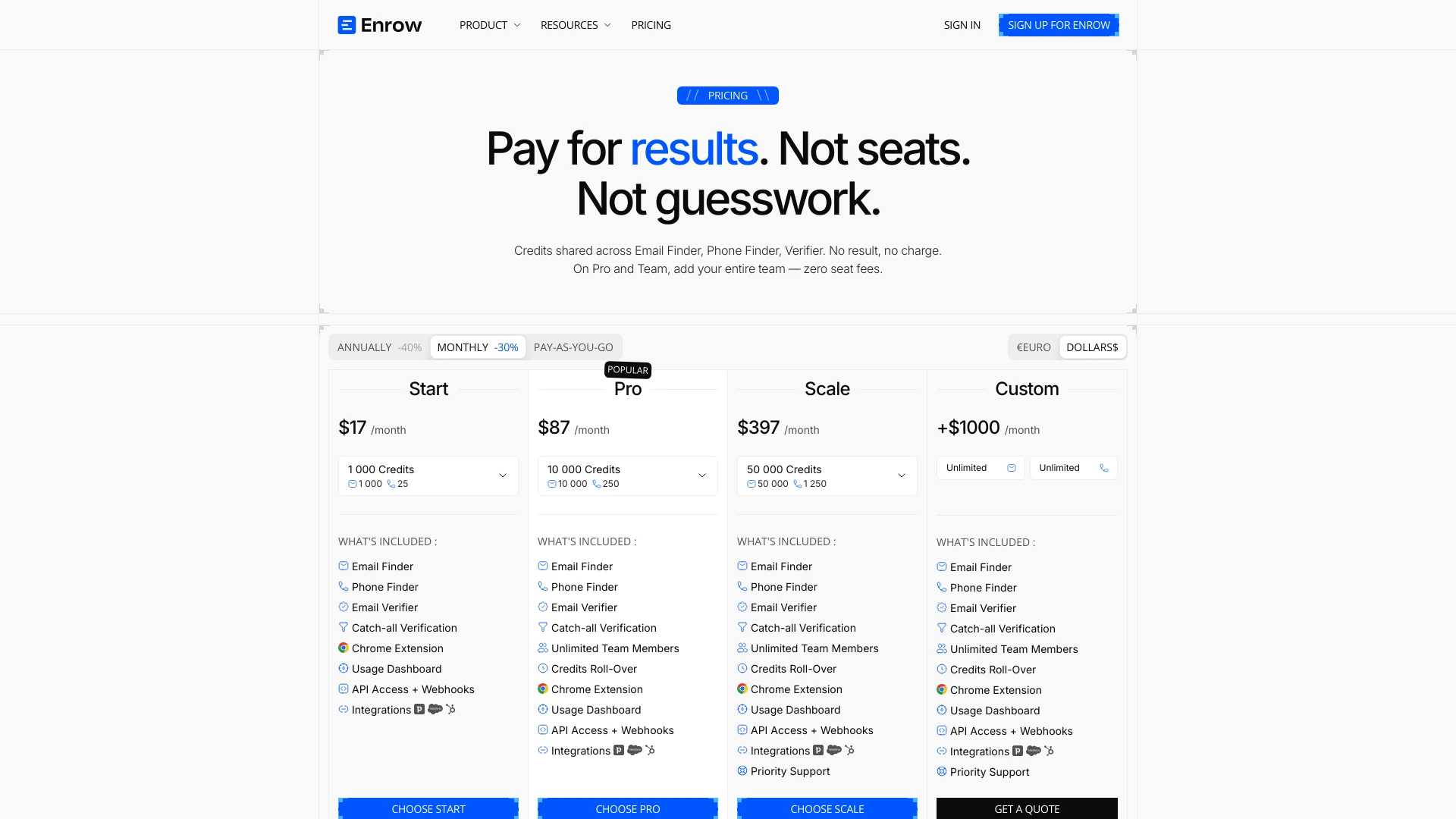
Trois paliers, facturés au mois. Start : 1 000 crédits pour 15 €, ou 4 000 pour 42 € (au mois uniquement). Pro : 10 000 pour 75 €, 20 000 pour 150 €, 30 000 pour 220 €.
Scale : 50 000 pour 360 €, jusqu'à 200 000 pour 1 250 €. L'engagement annuel réduit Pro et Scale d'environ 10 %, ce qui met les 10 000 crédits autour de 68 €/mois et les 50 000 autour de 324 €/mois.
Un crédit vaut un email ; un numéro de portable en coûte 40 ; une vérification, 0,25, catch-all comprise. Rien n'est facturé tant que le résultat n'est pas vérifié.
Comme un crédit ne part que sur un résultat valide, le prix affiché d'Enrow est son coût réel. Une recherche ratée ne coûte rien, et une adresse qui échoue à la vérification n'est jamais facturée.
Et sur Pro et Scale, les crédits non consommés restent là le mois suivant, donc vous ne payez jamais deux fois le même quota.
La base de comparaison la plus propre, c'est le Pro : 75 € pour 10 000 crédits, soit 10 000 emails vérifiés à environ 0,0075 € l'unité ou 250 numéros vérifiés à environ 0,30 €. Le Start reste l'entrée à 15 €. Retenez ces deux chiffres.
L'entrée d'Anymailfinder est à environ 0,045 € l'email vérifié (45 € pour 1 000), près de trois fois les 0,015 € d'Enrow à ce volume, et chacun des autres outils plus bas vous facture soit la tentative, soit des crédits qui expirent, soit plus de crédits par numéro.
C'est là que l'écart se creuse.
L'offre gratuite se renouvelle toute seule : 50 crédits chaque mois, sans carte. Et comme un crédit ne part que sur un résultat vérifié, aucun des 50 n'est gâché sur une recherche qui ne trouve rien.
Ne me croyez pas sur parole. Testez votre propre liste et comptez ce qui revient : 50 crédits gratuits, renouvelés chaque mois, sans carte. Comparez Enrow à l'outil que vous quittez.
2. Emelia
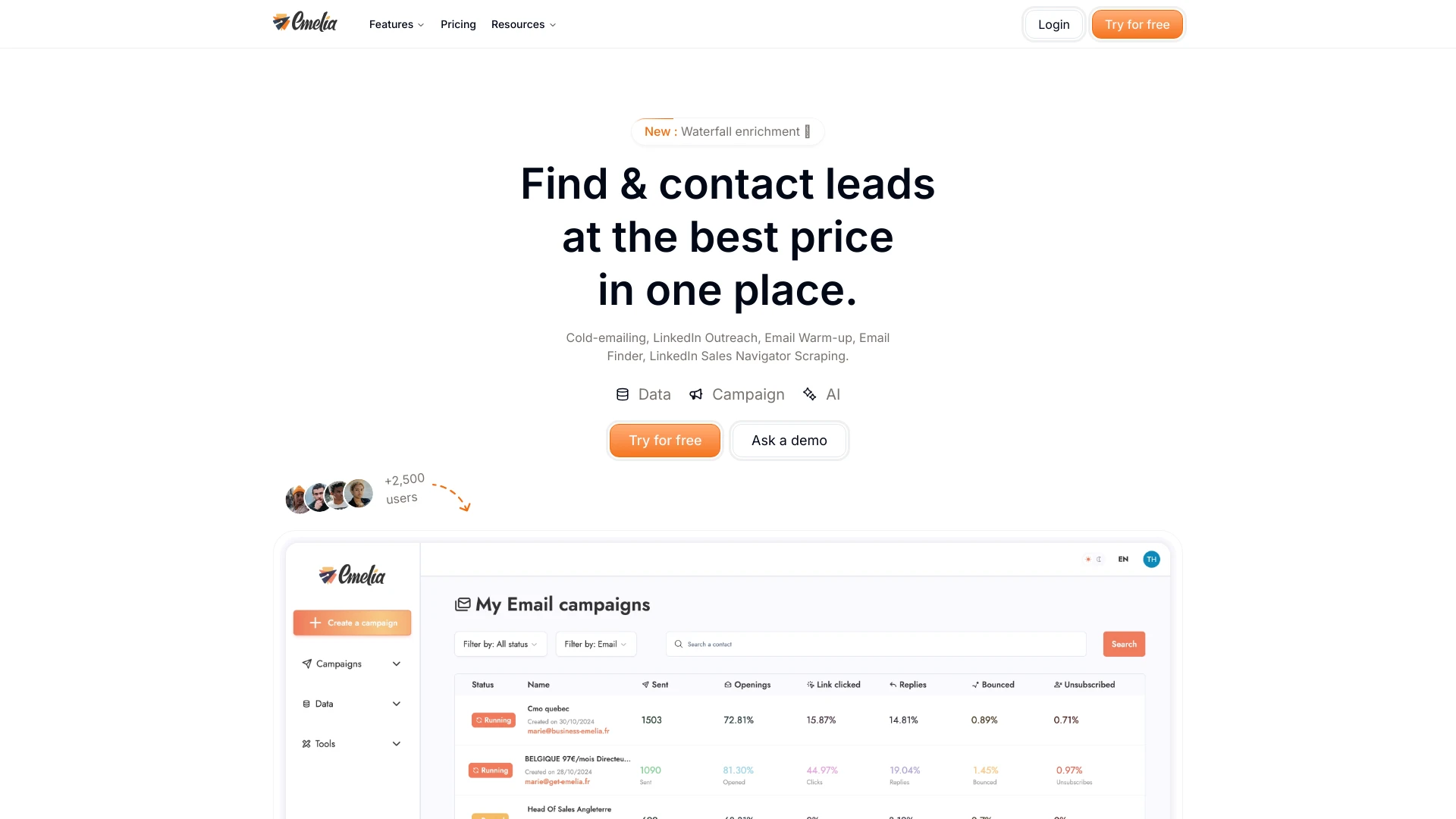
Chercher et envoyer sous le même toit. C'est toute la promesse, et elle tient.
Emelia, c'est là où la recherche et l'envoi cohabitent : une recherche d'emails avec enrichissement en cascade, un vérificateur, l'extraction de LinkedIn Sales Navigator, puis des séquences de cold email et LinkedIn avec la mise en chauffe intégrée. Anymailfinder trouve et vérifie, puis s'arrête. Emelia continue et envoie.
Pour une petite équipe qui veut un seul accès plutôt qu'un outil de recherche plus un outil de campagnes, c'est le besoin qu'elle couvre — un terrain sur lequel Anymailfinder ne joue pas du tout.
Mais c'est d'abord un outil de campagnes, et le côté donnée le montre. La recherche est correcte, et les crédits partent sur les résultats, pas sur des recherches à l'aveugle. Seulement, le centre de gravité d'Emelia, c'est l'envoi, pas la donnée en elle-même. La couverture téléphonique est faible.
Au-delà d'un usage léger, les crédits de recherche et d'enrichissement passent par des packs en plus des forfaits de base, donc un gros usage de données paie deux fois.
En toute transparence : Emelia est le partenaire vers qui nous orientons les gens pour l'envoi, parce que nous ne le construisons pas et ne le ferons pas. Ce n'est donc pas un face-à-face, c'est l'autre moitié de la chaîne.
La combinaison la plus propre associe les deux : Enrow pour les emails et les portables européens vérifiés, Emelia pour envoyer.
La semaine où j'ai fait tourner l'ensemble, le détail qui m'est resté, c'est la mise en chauffe et l'envoi juste à côté des contacts trouvés, sans étape d'export au milieu.
Mais pour la donnée elle-même — taux de contacts trouvés, portables européens, prix par email vérifié — Enrow est la couche que vous lui donnez, pas l'inverse.
- +Chercher, vérifier, enrichir et envoyer au même endroit (cold email + LinkedIn + mise en chauffe)
- +Crédits facturés sur les résultats trouvés, pas à la recherche à l'aveugle
- +Enrichissement en cascade et extraction de Sales Navigator intégrés
- +Envois et contacts illimités sur les forfaits payants
- –Couverture téléphonique faible ; ce n'est pas un outil pour appeler
- –Les crédits de recherche et d'enrichissement passent par des packs, donc un gros usage de données coûte plus
- –C'est d'abord une plateforme d'envoi : pour la donnée, mieux vaut un outil de recherche spécialisé
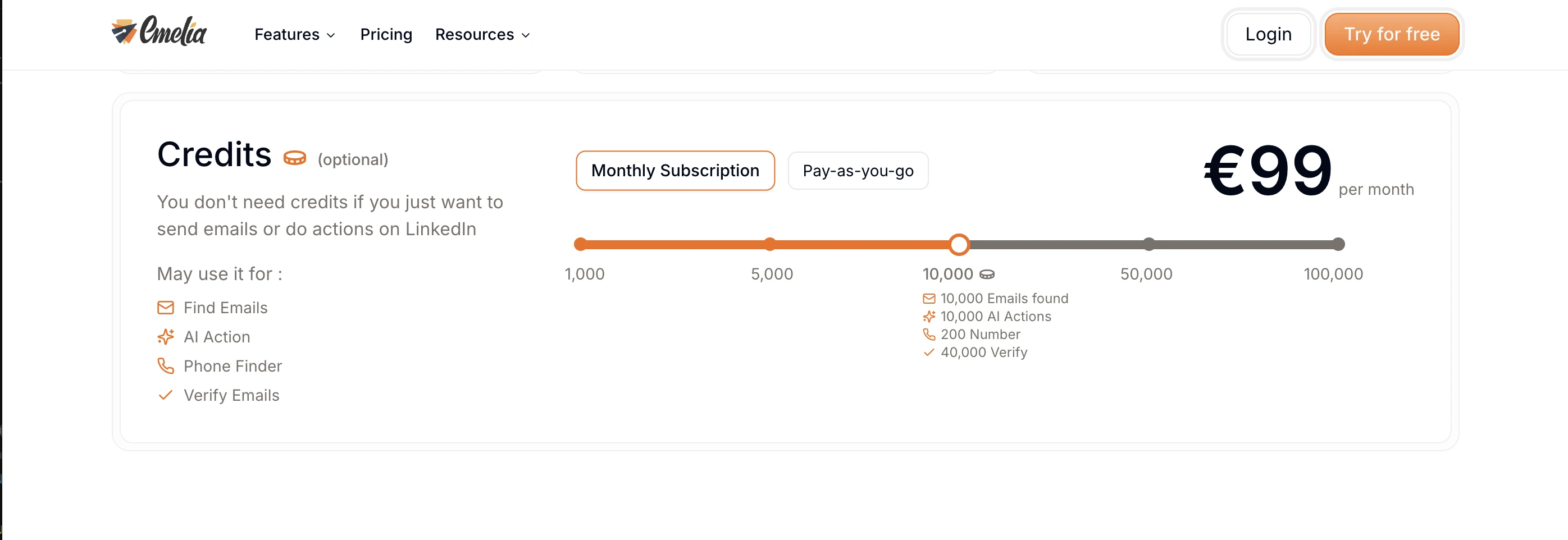
Les crédits de recherche démarrent autour de 19 €/mois pour 1 000, facturés sur les résultats trouvés. Ça revient à environ 0,019 € l'email vérifié, un peu au-dessus des 0,015 € d'Enrow au même volume ; les numéros (50 crédits chacun) sont trop faibles pour être chiffrés.
vs Enrow: Emelia envoie, Enrow non — associez-les plutôt que de choisir. Pour la couche de données, Enrow reste une source plus fraîche, à 0,015 € l'email vérifié contre 0,019 €, avec des numéros de portable européens qu'Emelia ne fait pas vraiment.
3. Hunter
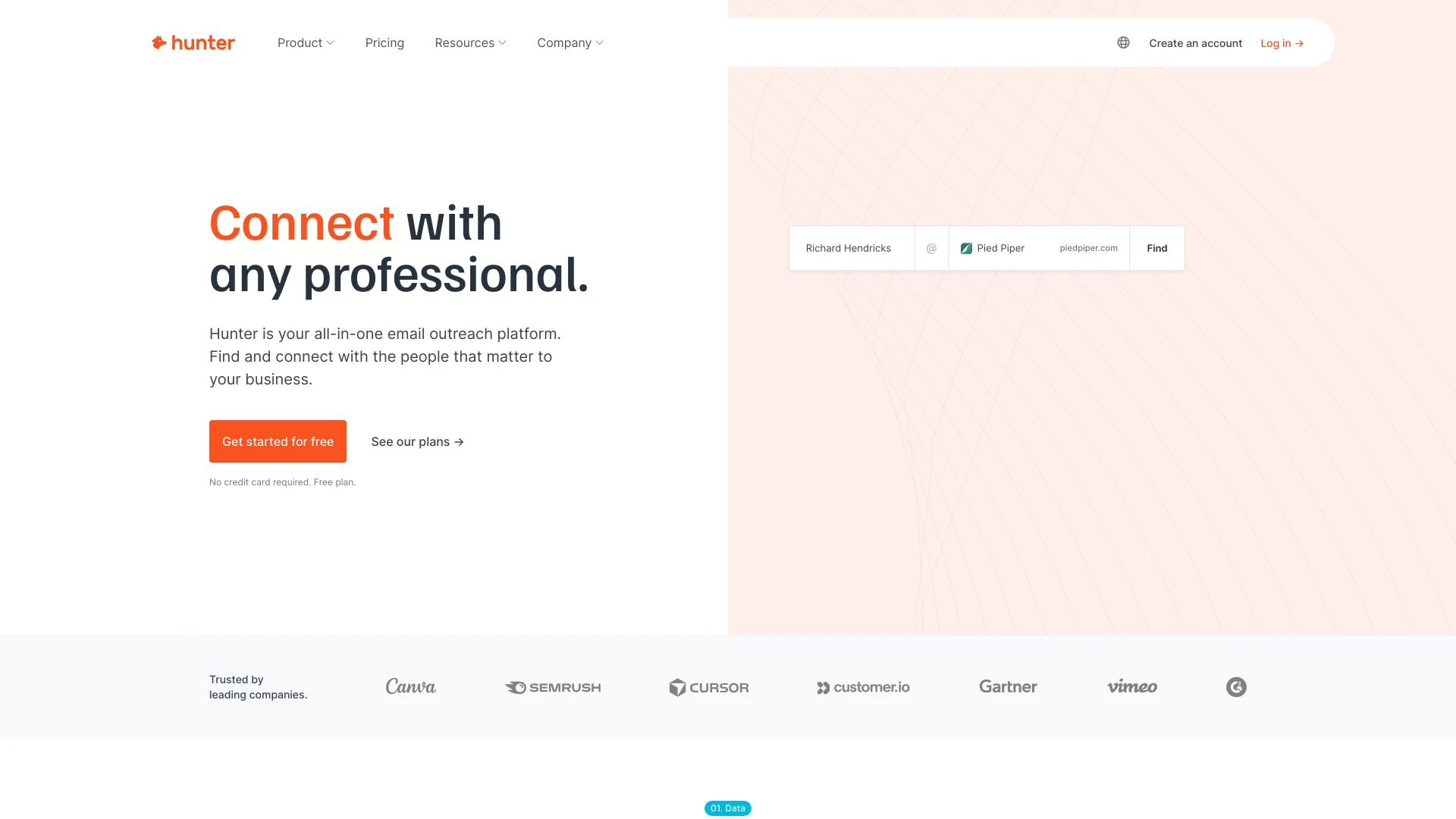
L'outil de recherche d'emails que tout le monde a essayé en premier, et toujours la référence pour les recherches par domaine.
Hunter, c'est l'outil sur lequel la plupart des gens apprennent. Donnez-lui un domaine, ou un nom et une entreprise, et il ressort des adresses avec un indice de confiance et une note sur l'endroit où il a vu le format.
Là où Anymailfinder est un point d'accès épuré, payé au résultat, Hunter est l'outil généraliste et bien intégré, avec une vraie offre gratuite et des sources citées auxquelles les commerciaux se fient. Pour des recherches par domaine simples, dans une grande entreprise, il fait très bien le travail.
Le hic, c'est la facturation. Hunter facture la tentative, pas le résultat. Chaque requête d'Email Finder consomme un crédit, que l'adresse revienne ou non, et la plupart ne reviennent pas.
Hunter ne publie aucun taux de réussite. Pour les outils facturés de cette façon, je raisonne donc sur notre propre chiffre : environ 30 % des recherches d'email renvoient une adresse. C'est notre hypothèse, pas la leur.
Sur cette base, 2 000 recherches font remonter à peu près 600 adresses. Les 1 400 autres sont payées quand même, et j'ai réglé assez de factures de ce genre pour savoir ce que ça donne en fin de mois. Comme la donnée est crawlée plutôt que trouvée en direct, sur les petites structures, les résultats sont maigres ou périmés. Et comme Anymailfinder, aucun numéro de téléphone.
Dans mes propres tests, les sources citées étaient le point fort : chaque adresse est accompagnée de sa source, donc on lui fait confiance avant d'envoyer.
Mais Enrow trouve chaque contact à jour, en temps réel, enchaîne plus de 10 contrôles avant de le compter, et ne facture que sur un résultat valide — une recherche qui ne trouve rien et une adresse qui échoue à la vérification ne vous coûtent rien, ni l'une ni l'autre.
Il ajoute aussi les portables européens que ni Hunter ni Anymailfinder n'ont, plus l'envoi du contact complet vérifié dans le CRM en un clic.
- +Mature, largement intégré, facile à adopter
- +Sources citées sur les emails trouvés, ce qui met en confiance
- +Vraie offre gratuite (50 crédits/mois, dépensés en recherches, pas en résultats)
- +Bons outils de recherche par domaine et en masse
- –Facturé à chaque recherche tentée, trouvée ou non, et les crédits mensuels ne se reportent pas
- –La donnée issue du crawl s'appauvrit sur les petites entreprises
- –Aucun numéro de téléphone, sur aucun forfait
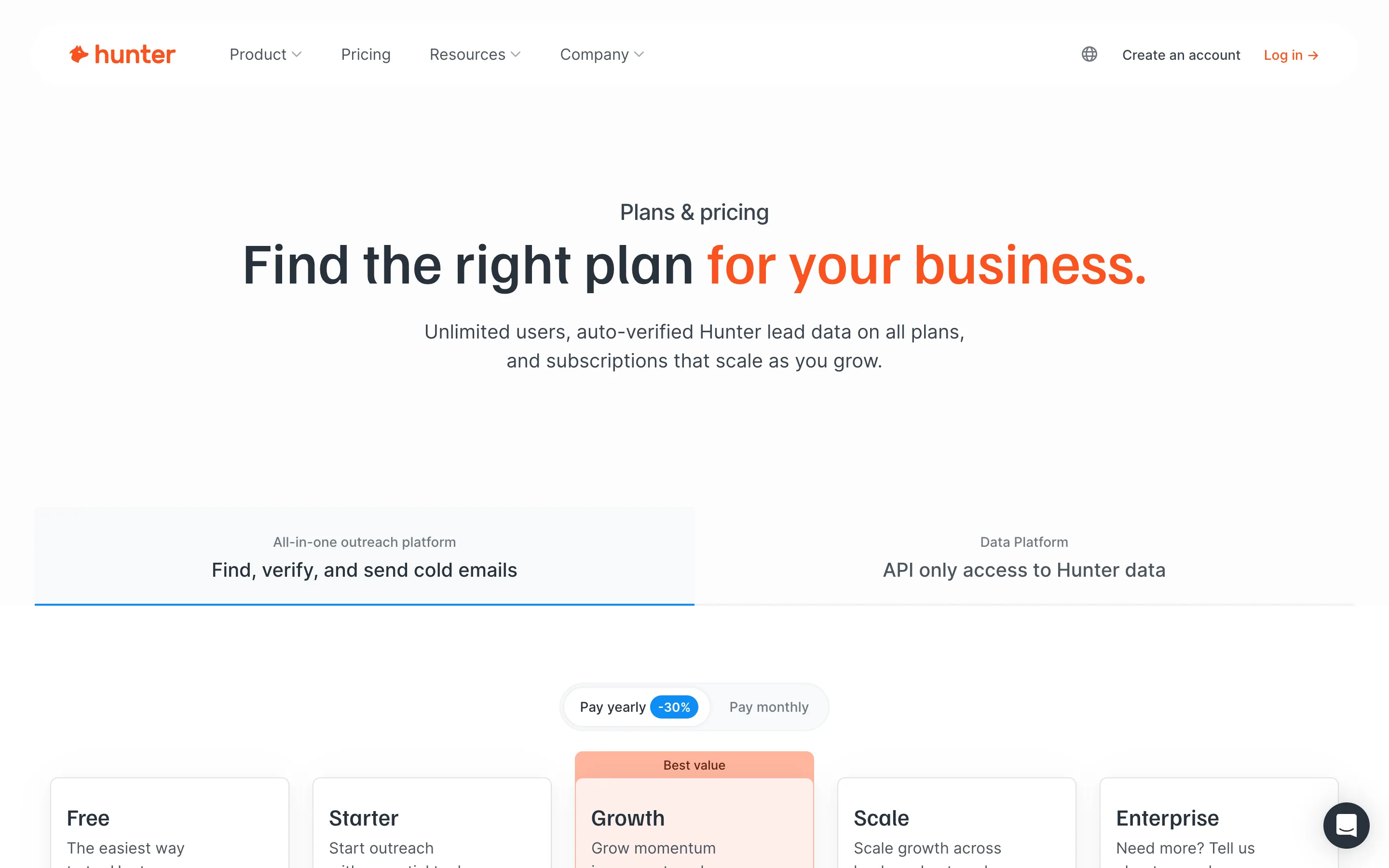
Hunter démarre à 49 €/mois pour 2 000 crédits (34 € en annuel), mais un crédit part à la recherche lancée, pas à l'adresse valide, et les crédits ne se reportent pas. Divisez les 0,0245 € d'une recherche par ces 30 % supposés : chaque email réellement obtenu revient à environ 0,082 € l'unité, soit environ 5,5× le Start d'Enrow et 11× le Pro. Si des crédits restent inutilisés en fin de mois, l'écart grandit encore. Aucun numéro, donc rien à chiffrer côté téléphone.
vs Enrow: Hunter facture la tentative, aboutie ou non ; Enrow ne facture que sur un résultat valide — une recherche ratée ne coûte rien, et les crédits se reportent sur Pro et Scale.
4. Prospeo
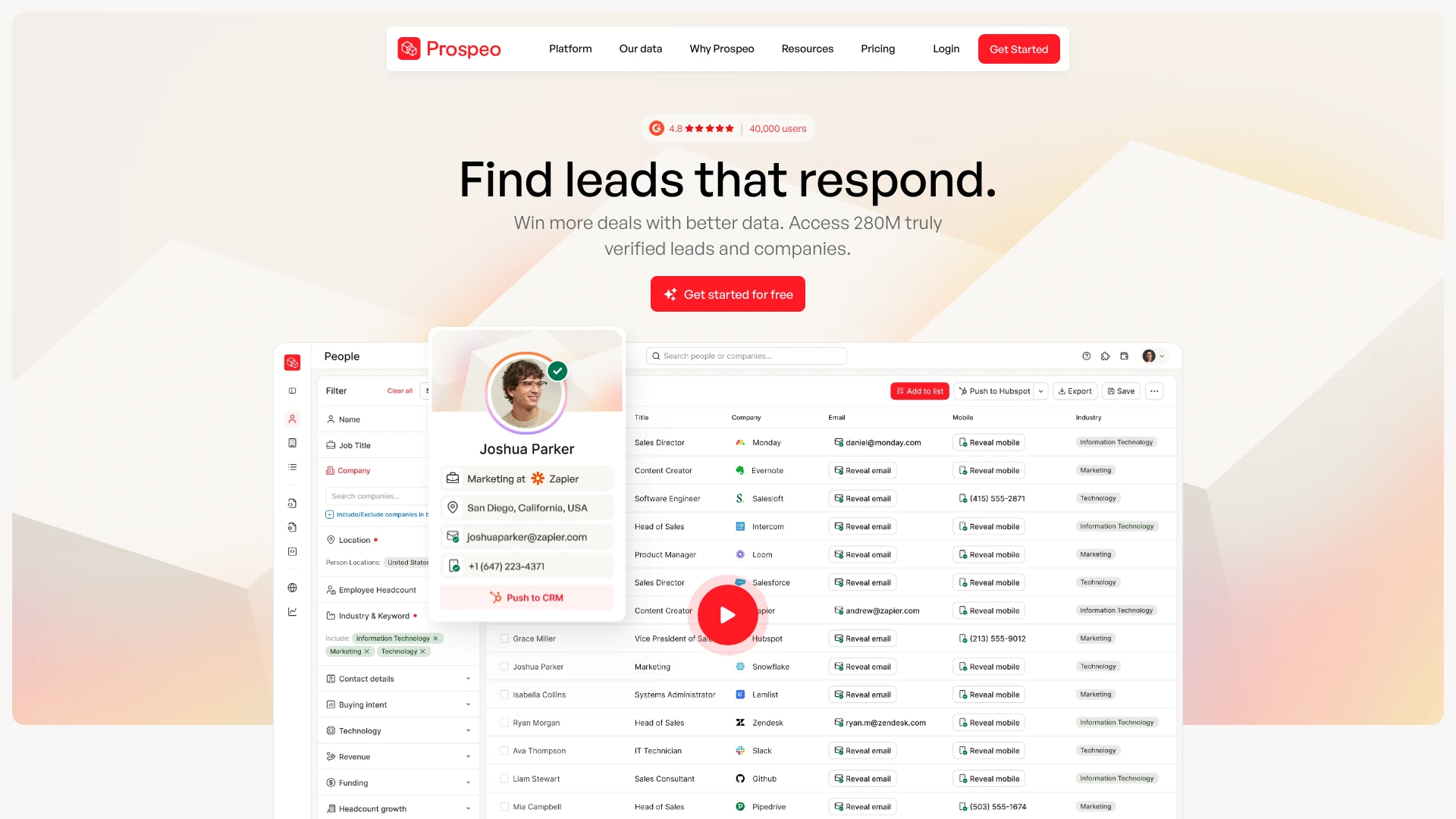
L'entrée la moins chère si votre prospection démarre sur LinkedIn.
Prospeo a une extension Chrome, un prix d'appel bien visible, et la vérification dans le même compteur de crédits. Il facture 1 crédit par email trouvé et rien quand il ne trouve rien, donc il facture au résultat, exactement comme Anymailfinder.
Son créneau, c'est l'email LinkedIn à volume faible ou moyen. Ce qui le limite, c'est la couverture, pas le compteur.
Le bémol, c'est la qualité et la régularité de la donnée. Poussez au-delà des petites tâches et les résultats deviennent irréguliers ; les numéros coûtent 10 crédits chacun sans couverture européenne documentée.
Pas de report non plus : ce que vous ne consommez pas chaque cycle disparaît au renouvellement. Et il faut être précis sur l'endroit où l'argent fuit, parce que ce n'est pas là qu'on croit.
Prospeo ne facture pas un raté, donc sa couverture mince vous coûte en contacts manqués, pas en budget. C'est l'expiration qui coûte du budget : un crédit payé et jamais dépensé se facture exactement comme un crédit utilisé.
À l'usage, l'extension était rapide, et l'offre gratuite m'a laissé essayer sans carte. Mais Enrow ne facture jamais un non-résultat, enchaîne plus de 10 vérifications avant qu'un email soit compté, dispose d'une couverture européenne pour les portables, et reporte les crédits sur Pro et Scale.
Le prix d'appel cesse de paraître abordable dès qu'on compte les crédits qui expirent inutilisés chaque mois.
- +1 crédit par email trouvé, 0 sur une recherche ratée (même logique qu'Anymailfinder), donc une couverture faible coûte des contacts, pas de l'argent
- +Recherche LinkedIn et par domaine avec une bonne extension Chrome
- +Vérification incluse dans le même compteur de crédits
- +Offre gratuite (100 crédits/mois)
- –Qualité de données irrégulière dès qu'on dépasse les petites tâches
- –Les numéros coûtent 10 crédits, sans couverture européenne documentée
- –Pas de report des crédits, ils expirent chaque mois ; facturation par utilisateur
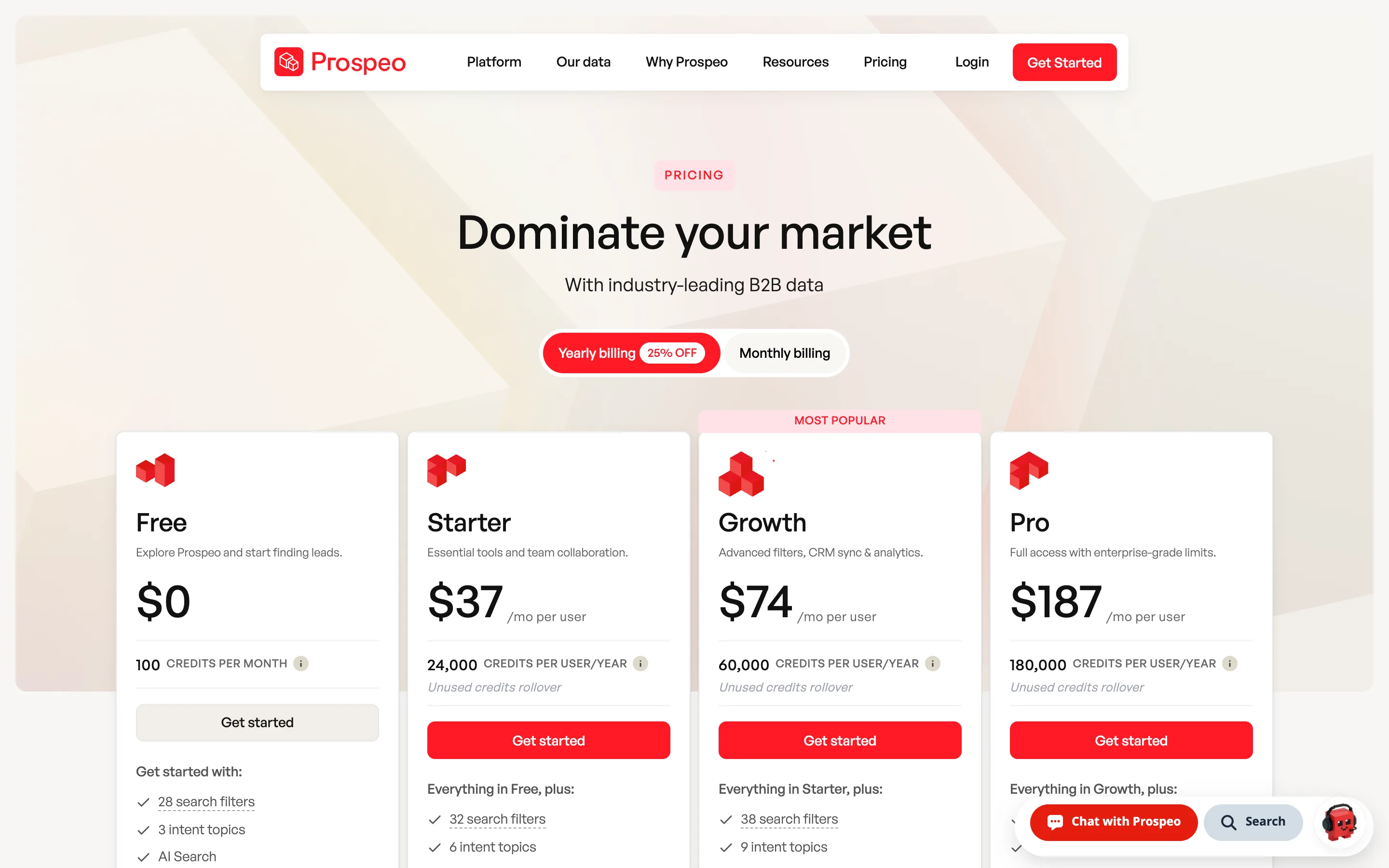
Prospeo démarre à 49 $/mois pour 2 000 crédits, par utilisateur, facturés sur les emails trouvés — soit environ 0,0245 $ l'email vérifié, déjà au-dessus des 0,017 $ d'Enrow au même volume. Un numéro coûte 10 crédits, sans couverture européenne documentée.
vs Enrow: Enrow vérifie plus sévèrement, fournit des numéros de portable européens, reporte les crédits sur Pro et Scale, et ne facture pas par utilisateur.
5. LeadMagic
Pensé pour ceux dont l'outil est une suite d'appels API.
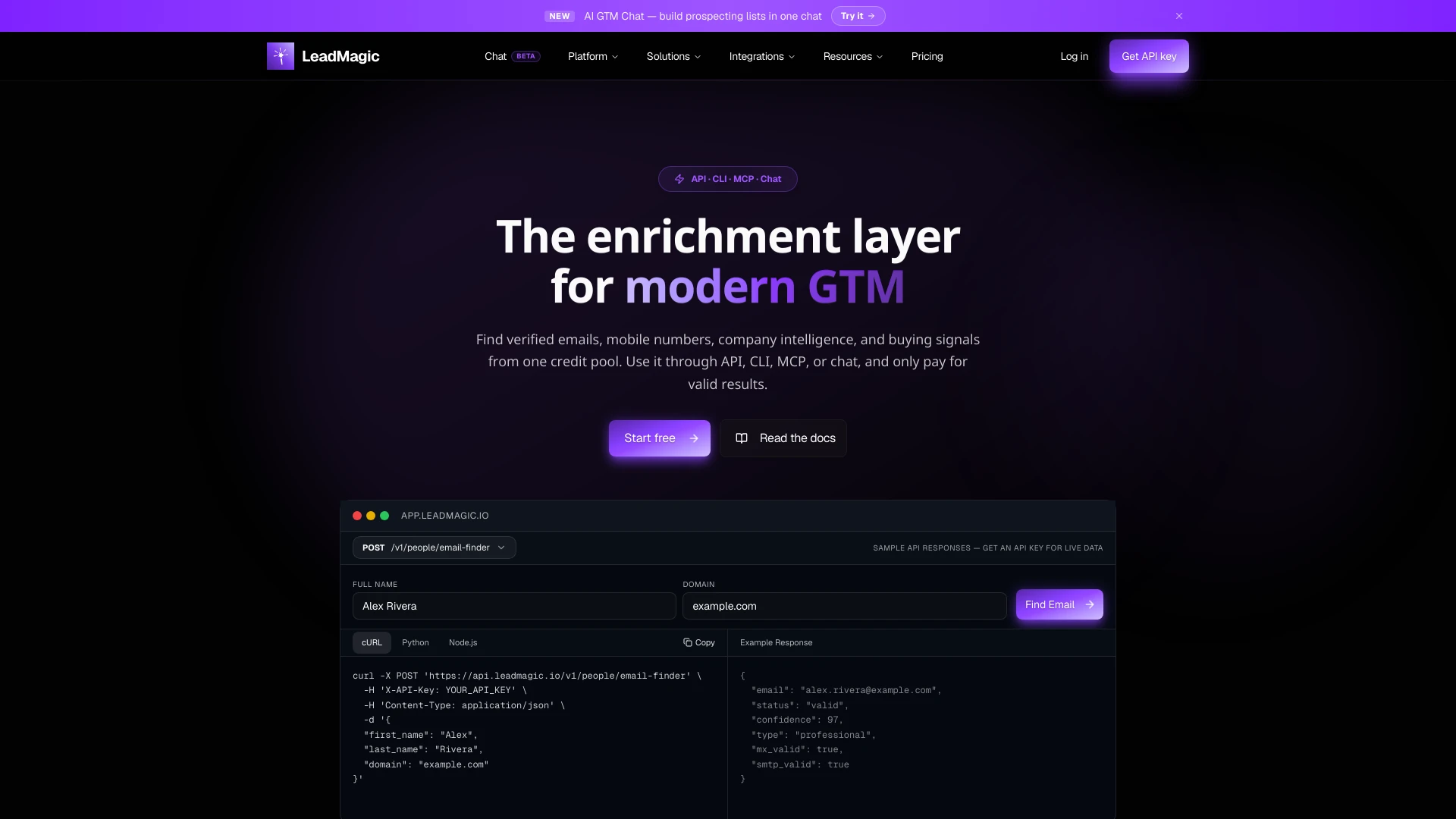
LeadMagic, c'est essentiellement une API : plus de 15 points d'accès (email, portable, entreprise, profil, changement de poste) qui puisent dans un compteur commun, plus une ligne de commande et un serveur MCP pour les agents IA.
Les crédits ne sont retirés qu'en cas de succès, donc comme Anymailfinder il facture au résultat, au même crédit par email. Il vise l'équipe RevOps qui préfère écrire un script plutôt que de cliquer dans une interface.
Je l'ai branché dans un script de test quelques jours. Un seul compteur pour tous les points d'accès rendait la dépense facile à lire, et le paiement au résultat est le bon réglage. Mais c'est une API, pas un produit qu'on met entre les mains d'un commercial.
Un non-développeur reste bloqué. Les portables coûtent 5 crédits chacun et la couverture européenne / RGPD n'est pas publiée, donc la fiabilité en Europe reste une question. Le report ne démarre qu'à partir d'Essential, donc sur le forfait d'entrée les crédits non dépensés expirent.
L'API d'Enrow est tout aussi scriptable. Elle s'accompagne aussi d'une vraie interface et d'une extension Chrome que vos commerciaux peuvent vraiment utiliser, et de crédits qui se reportent à partir de Pro. Programmable, sans faire de tout le monde un développeur.
- +Payé au résultat, 1 crédit par email, zéro sur un échec
- +Plus de 15 points d'accès sur un compteur de crédits unique
- +Outils pour développeurs : API, ligne de commande, serveur MCP
- +Recherche de numéros de portable incluse dans le même compteur
- –Pas de report des crédits sur le forfait d'entrée Basic
- –Les numéros coûtent 5× un email ; aucune information publiée sur la couverture européenne ou le RGPD
- –C'est plus une API qu'une interface à parcourir, donc sans développeur on reste bloqué
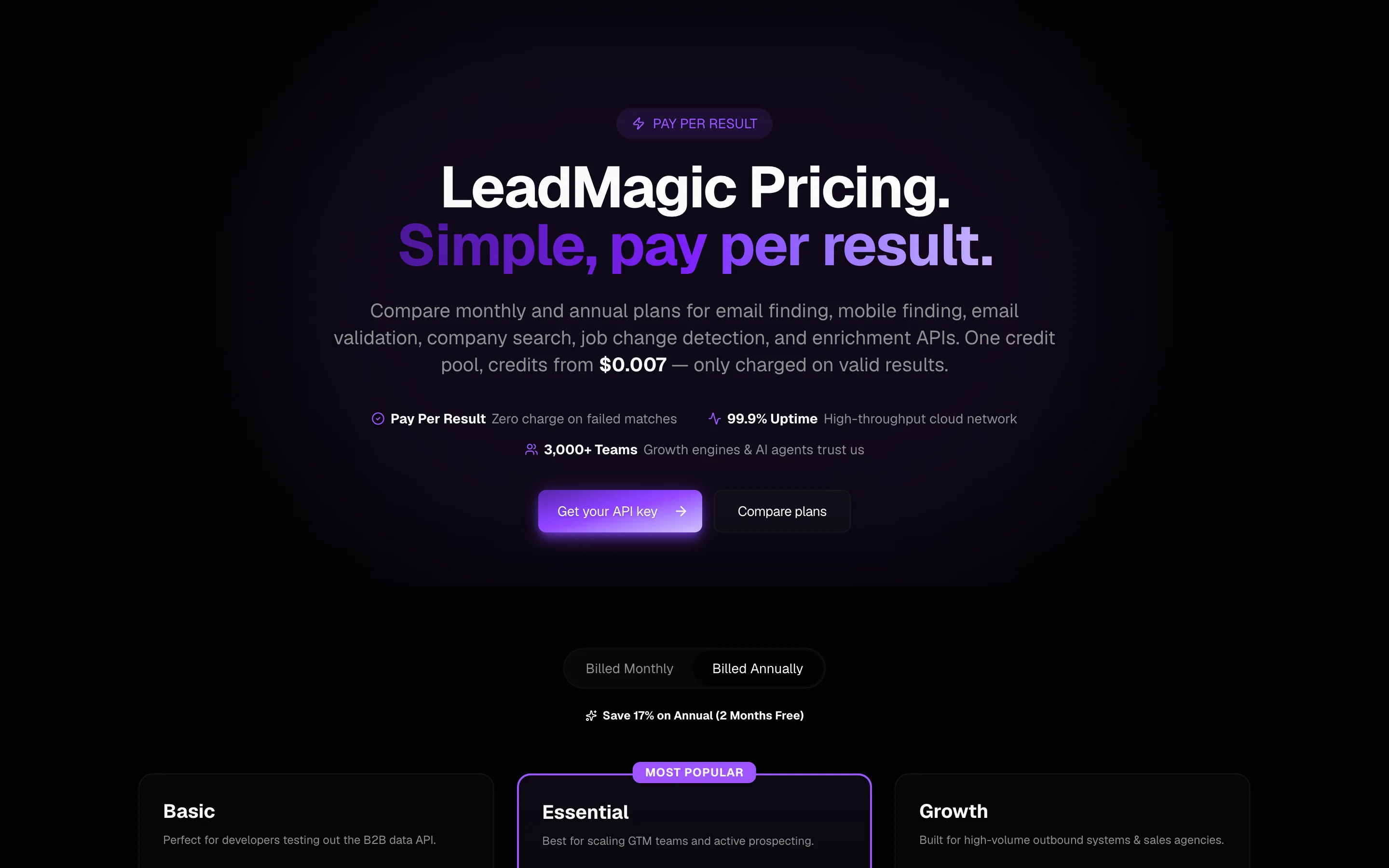
LeadMagic démarre à 45 €/mois pour 2 000 crédits (un email 1 crédit, un portable 5), retirés seulement en cas de succès — soit environ 0,022 € l'email vérifié, à peu près 1,4× les 0,015 € d'Enrow au même volume. Le report n'arrive qu'à 5 000 crédits, ce qui met les crédits réellement utilisés à l'entrée plus près de 0,029 €. Les numéros n'ont aucune couverture européenne publiée.
vs Enrow: les deux facturent au résultat et ont une vraie API, mais Enrow est moins cher à volume égal, reporte les crédits sur Pro et Scale, et ajoute une interface pour les commerciaux et l'export du contact complet vers le CRM.
6. Snov
Chercher, trouver, vérifier, envoyer. Un seul accès pour les quatre.
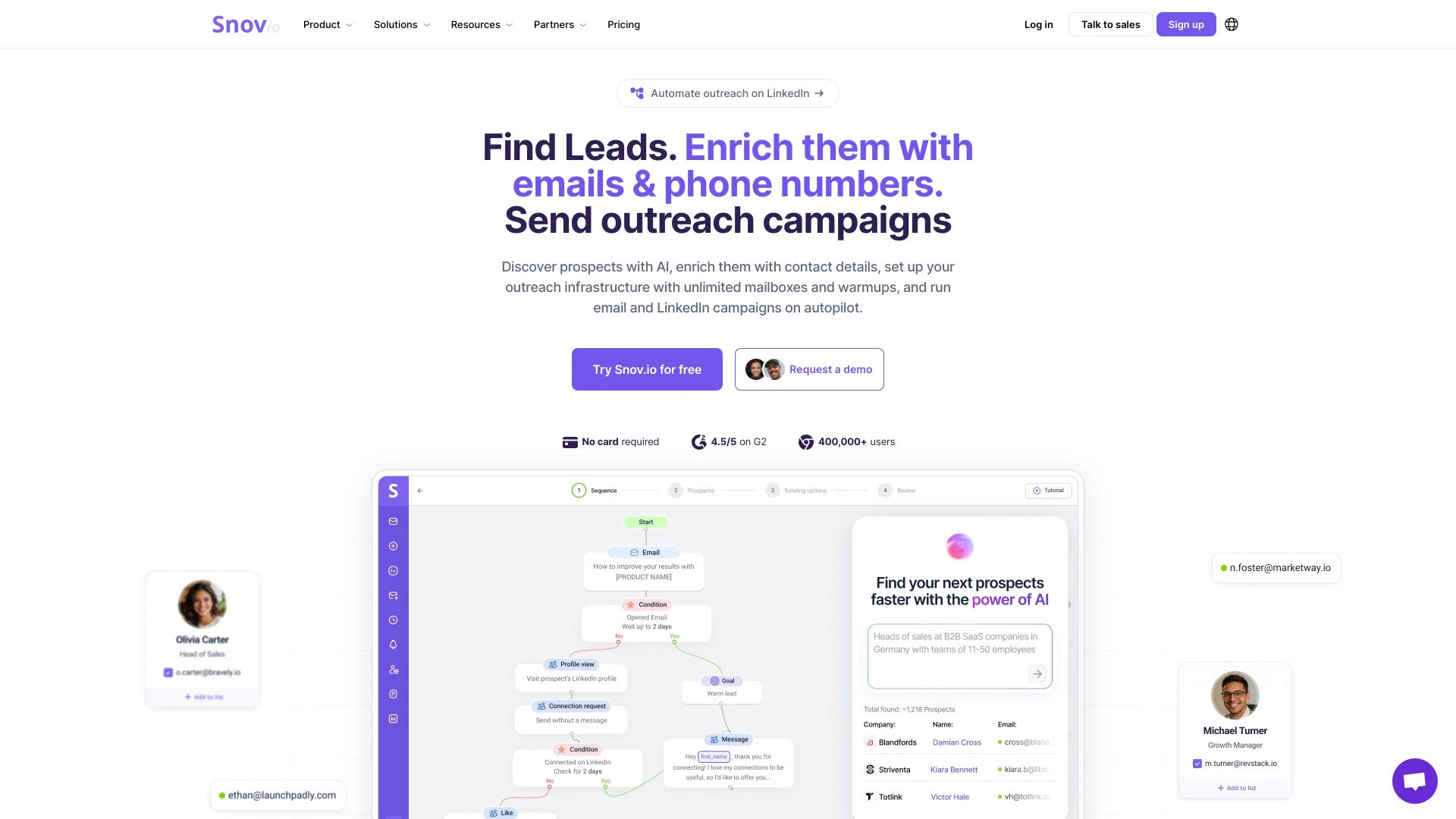
Snov range tout le workflow de prospection dans un seul abonnement : une base B2B à interroger, une recherche d'emails, un vérificateur en plusieurs étapes, puis des campagnes automatisées, un petit CRM et de l'automatisation LinkedIn. À côté d'Anymailfinder, c'est un tout autre produit.
Anymailfinder trouve un email vérifié à la fois. Snov, lui, vous laisse aussi bâtir la liste et lancer la séquence.
Il s'adresse à l'équipe qui veut un seul abonnement plutôt qu'un outil de recherche, un outil d'envoi et un CRM, et qui accepte de sacrifier un peu de qualité de données pour cette étendue.
Ce sacrifice est réel, et il commence dès la facturation. Snov facture la recherche, pas le résultat : le crédit part quand vous demandez, que l'adresse revienne ou non.
Snov s'appuie aussi sur une base stockée, et une ligne stockée n'est fraîche que jusqu'à la dernière mise à jour, donc, face à une vraie liste de prospects, il se montre moins précis que les spécialistes.
Vous payez pour beaucoup de fonctions que vous ne toucherez peut-être jamais si tout ce qu'il vous faut, ce sont des emails vérifiés, et il n'y a rien pour le portable européen.
Quand j'ai fait tourner ma liste, passer d'un filtre enregistré à un premier email dans le même outil était vraiment simple. Mais une bonne partie des adresses trouvées demandait une deuxième vérification. C'est la rançon de la base de données.
Enrow cherche chaque contact en temps réel, à la source, le vérifie avec plus de 10 contrôles, et ajoute les portables européens que Snov laisse de côté. Vous perdez l'outil de campagnes intégré, mais pour la donnée elle-même, la source d'Enrow est plus propre et plus fraîche.
- +Base de prospects consultable, plus recherche et vérificateur au même endroit
- +Campagnes automatisées, CRM et automatisation LinkedIn intégrés
- +Nombre d'utilisateurs illimité sur les forfaits payants
- +25 % de réduction en annuel
- –Facturé à la recherche, donc un crédit part, que l'adresse revienne ou non, et il ne se reporte pas
- –La donnée issue d'une base stockée vieillit, donc, sur une liste réelle, les outils de recherche dédiés sont plus précis
- –Beaucoup de fonctions inutiles si vous n'avez besoin que d'emails vérifiés
- –Aucune couverture des portables européens ; l'automatisation LinkedIn est une option payante
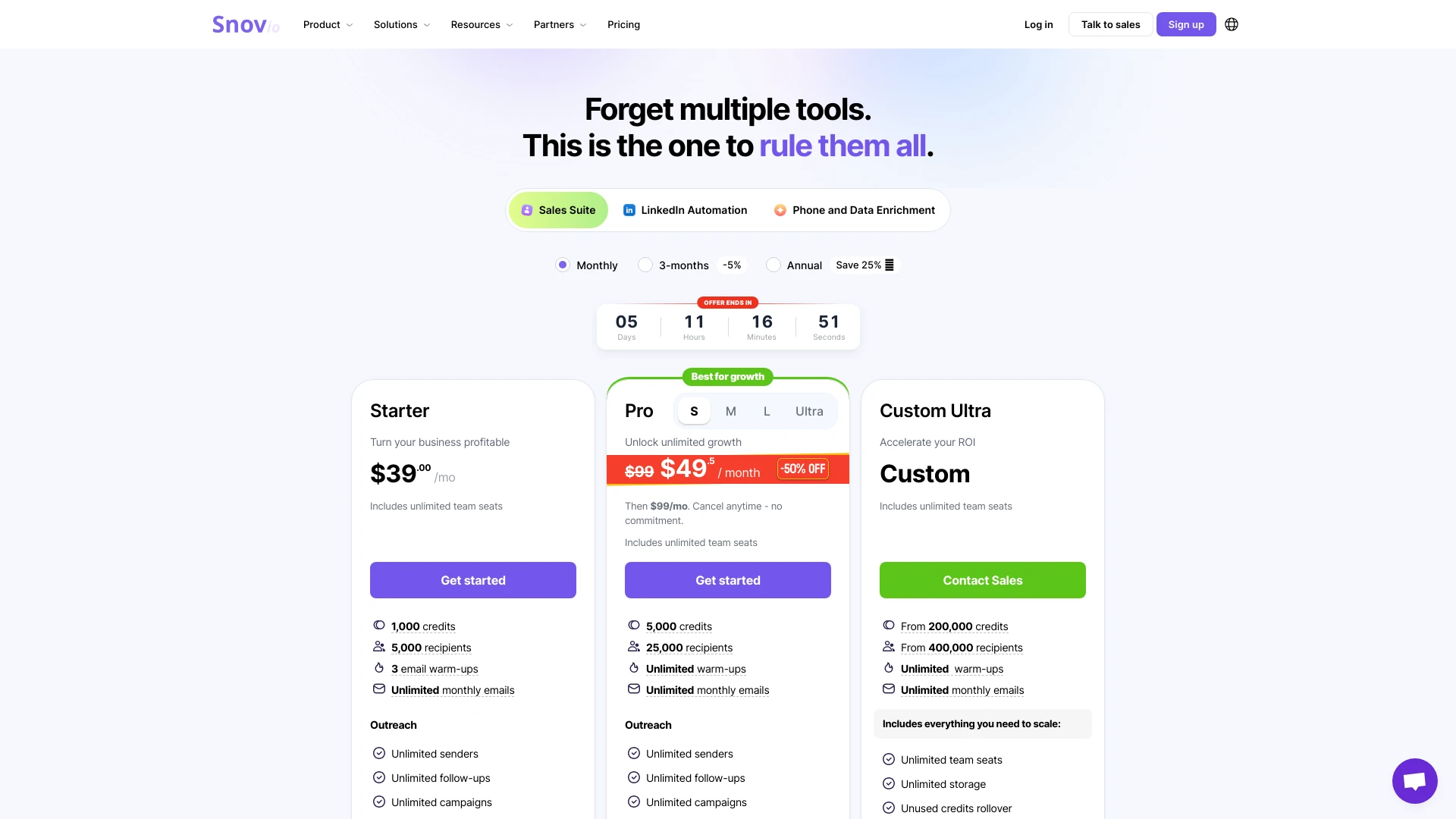
Snov démarre à 35 €/mois pour 1 000 crédits, mais un crédit se dépense à la recherche, pas sur une adresse vérifiée. En partant d'un taux de réussite d'environ 30 % (Snov n'en publie aucun, c'est notre hypothèse), plus les adresses périmées qui bouncent et les crédits sans report, l'adresse utilisable revient plutôt à 0,12 à 0,15 €, une dizaine de fois les 0,015 € d'Enrow au même volume. Le téléphone est un jeton à part, sans portable européen.
vs Enrow: Enrow trouve chaque contact en temps réel, ne facture que sur un résultat valide, reporte les crédits sur Pro et Scale, et ajoute des portables européens que Snov ne vend pas. Snov, lui, regroupe un outil d'envoi et une base qu'Enrow n'a pas ; c'est le compromis.
7. Apollo
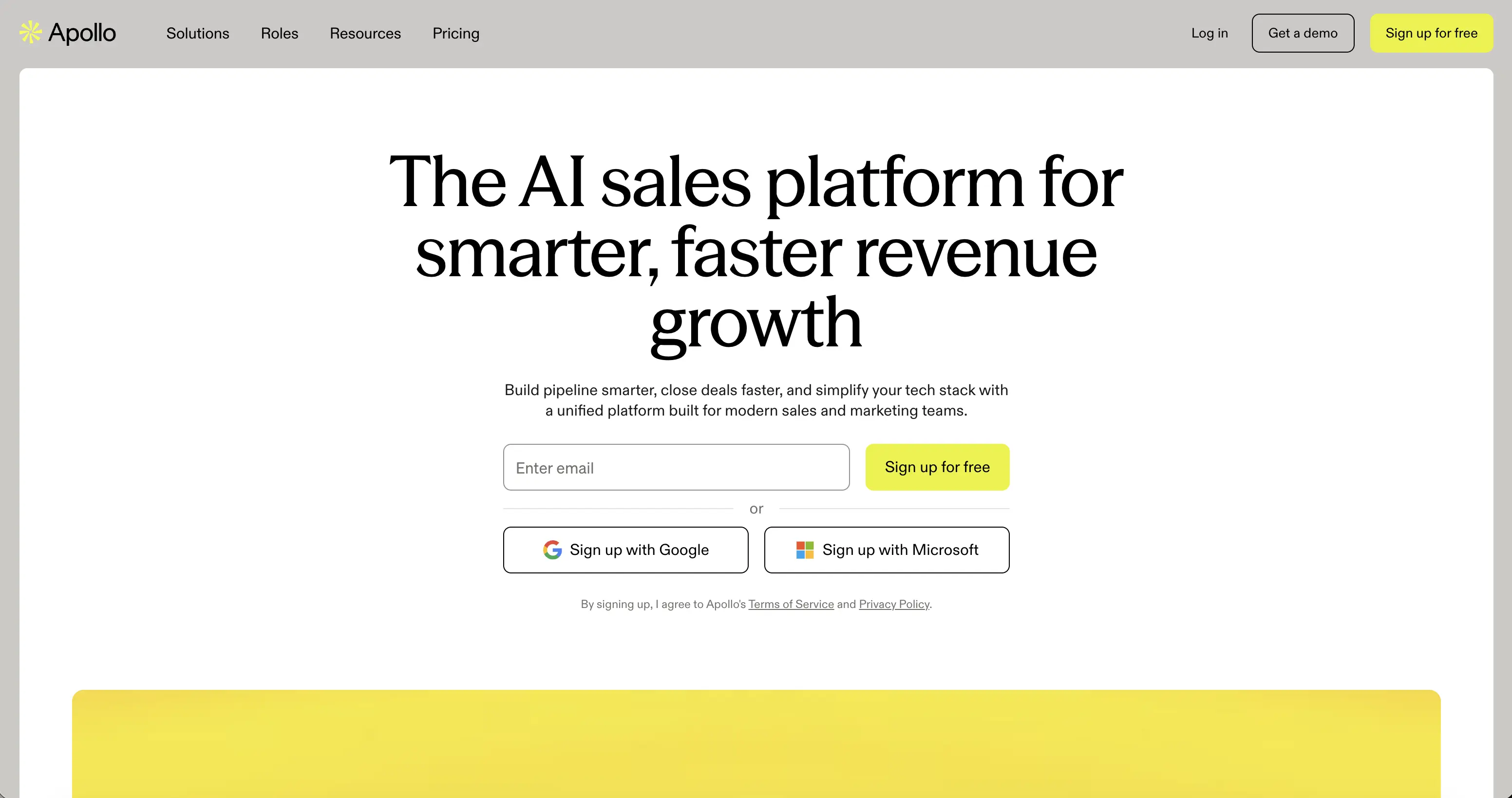
Une seule plateforme pour sourcer, enrichir et envoyer. Le pari du tout-en-un.
Apollo associe une énorme base B2B à des séquences, de l'enrichissement et une extension Chrome, le tout dans un abonnement par utilisateur. Là où Anymailfinder vous donne un seul email vérifié, Apollo vous donne toute la mécanique de prospection dans un seul onglet.
Cette étendue est l'attrait, et pour beaucoup de petites équipes, elle suffit vraiment à mener la prospection de bout en bout.
Le prix de cette étendue, c'est la fraîcheur de la donnée et le fonctionnement des crédits. Apollo est une base stockée, donc une fiche peut rester des mois sans contrôle pendant que son titulaire change de poste, et vous tomberez sur des contacts partis depuis longtemps.
Les crédits sont unifiés et répartis par utilisateur, un email en coûte 1 et un portable 8, ils expirent à la fin de chaque mois, et les plafonds d'export comme les griefs sur la qualité des données sont les deux points qui reviennent le plus dans les avis.
C'est un outil de workflow où la donnée est un composant, pas le cœur du sujet.
Sur mon test, un filtre enregistré est devenu une séquence prête à partir en quelques minutes sans quitter l'onglet. Impressionnant. Puis j'ai confronté la donnée à un vrai envoi, et le temps réel l'a emporté.
Enrow trouve et vérifie chaque contact au moment de la demande, fournit des portables européens que la base d'Apollo ne couvre pas de façon fiable, et ne facture que sur un résultat valide, sans calcul par utilisateur. Si vous voulez le tout-en-un, achetez Apollo et laissez Enrow lui fournir la couche de données propre.
- +Grande base B2B avec campagnes et enrichissement au même endroit
- +Extension Chrome et intégrations CRM
- +Offre gratuite pour tester le fonctionnement
- +Un seul outil pour sourcer, enrichir et envoyer
- –Base stockée, donc la donnée vieillit et la précision revient souvent dans les critiques
- –Crédits par utilisateur, qui expirent chaque mois sans report, et un portable en coûte 8
- –Les plafonds d'export et les griefs sur la qualité des données reviennent dans les avis
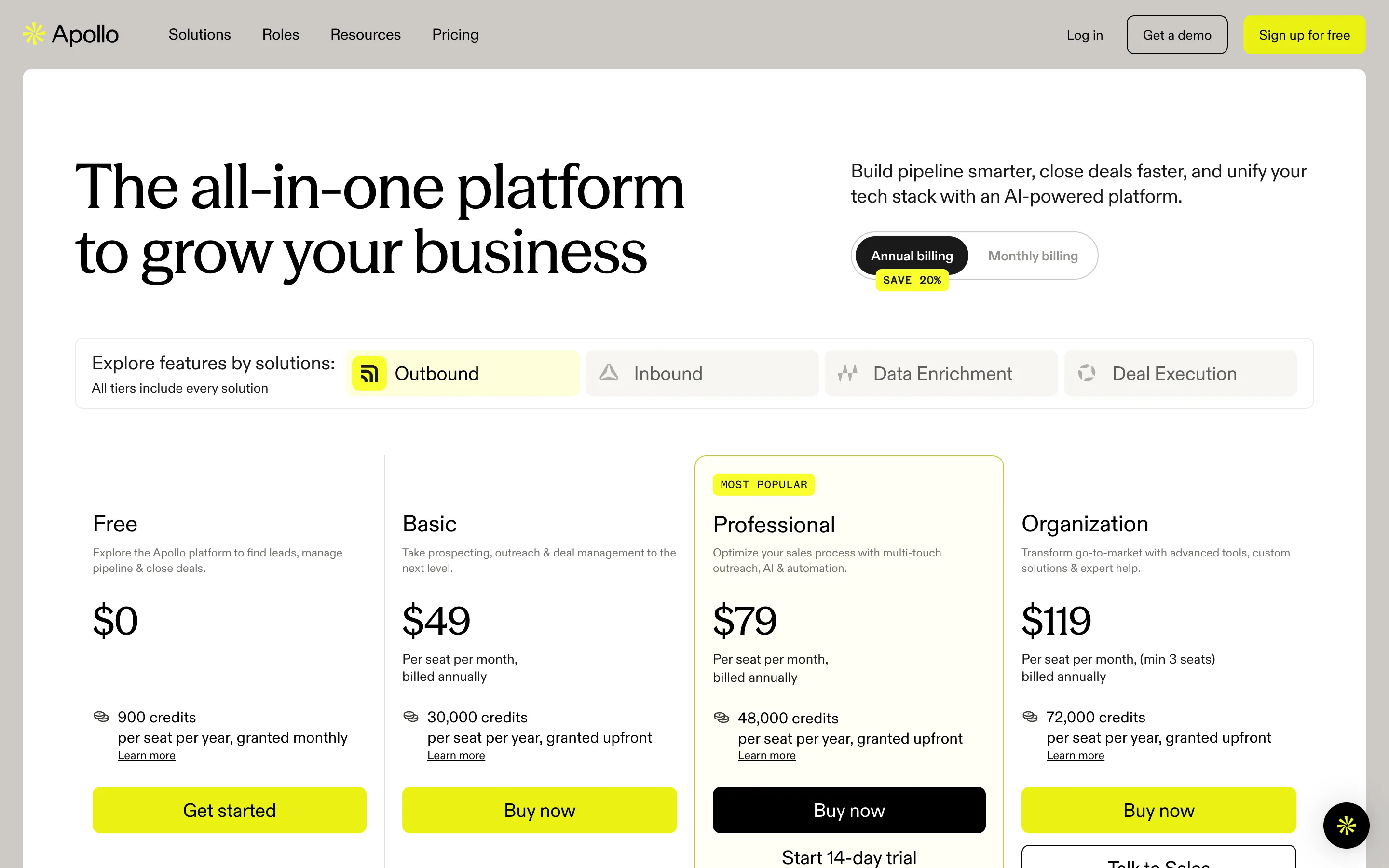
Apollo démarre à 45 €/utilisateur/mois en annuel (59 € au mois) pour 2 500 crédits unifiés qui expirent. À 78 % d'utilisation réaliste, l'email vérifié revient à environ 0,030 €, le double du Start d'Enrow et près de quatre fois le Pro — et le compteur est par utilisateur, donc cinq commerciaux, c'est ~295 €/mois avant le moindre contact. Les portables coûtent 8 crédits mais viennent d'une base stockée orientée US, sans produit européen conforme RGPD.
vs Enrow: Apollo est le tout-en-un ; Enrow est la couche de données, sans facturation par utilisateur, avec des portables européens et l'export vers le CRM. Faites tourner les deux si vous voulez la suite et la donnée propre.
8. Lusha
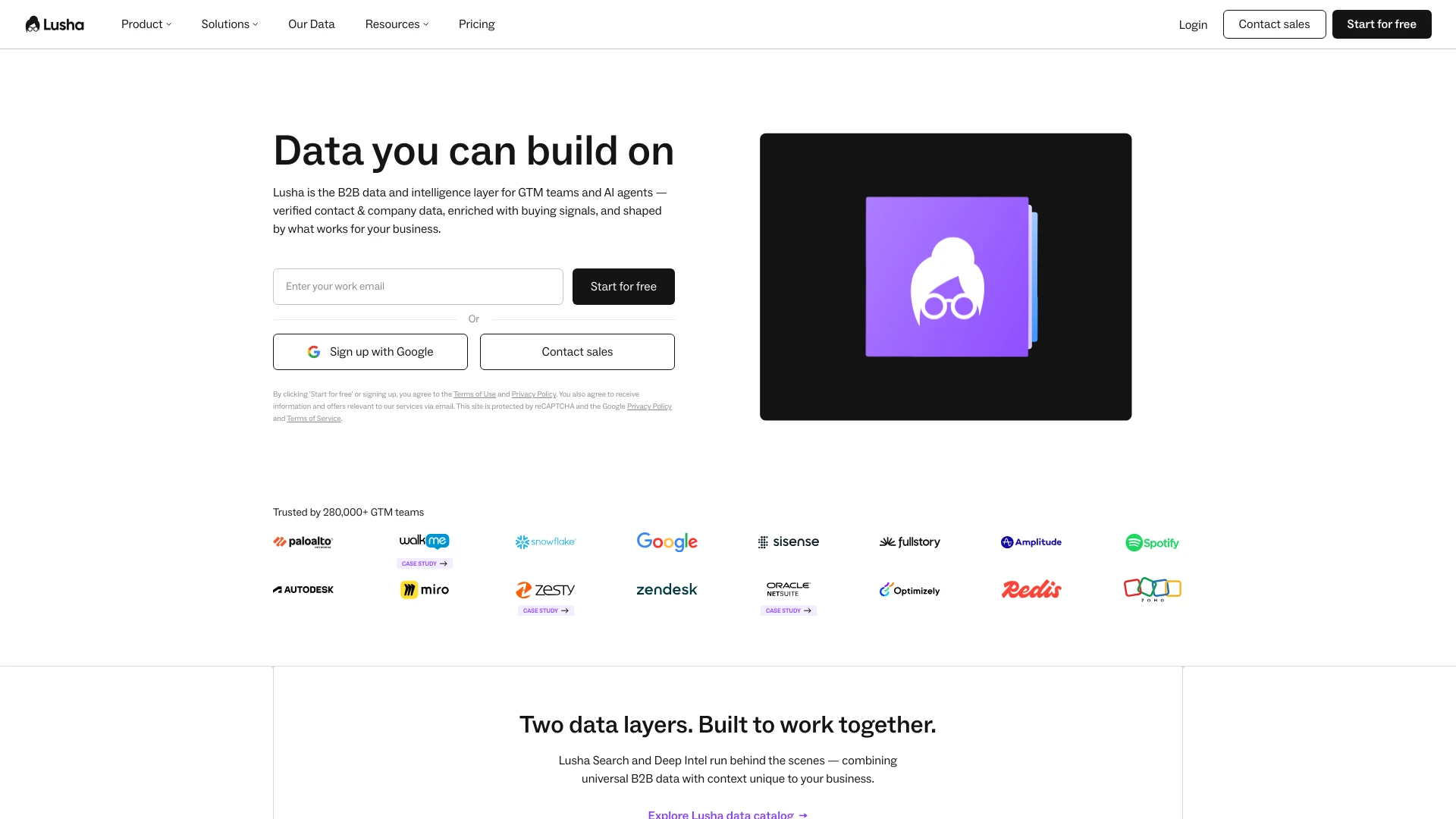
Quand tout se joue sur les portables nord-américains, c'est le spécialiste.
La réputation de Lusha s'est bâtie sur les numéros de téléphone, et pour les portables nord-américains, elle est méritée. Révéler un email coûte 1 crédit et révéler un numéro 5, dans un compteur commun, avec une extension de navigateur et des intégrations CRM.
Là où Anymailfinder n'a aucun numéro, la couverture mobile de Lusha est une vraie raison de s'y intéresser.
Les compromis, c'est la géographie et le modèle de base de données. Lusha est fort aux États-Unis et plus mince en Europe, donc les portables européens ne sont pas son terrain, et il vend depuis une base stockée dont les fiches vieillissent tranquillement jusqu'à la prochaine mise à jour.
Les crédits sont partagés, donc un usage intensif du téléphone grignote votre budget email, et inversement. C'est un outil de révélation, tarifé au crédit sur abonnement, pas un moteur de vérification en temps réel.
Sur mon lot américain, les numéros sonnaient juste ; le taux de portables corrects était bon.
Sur mes contacts européens, la couverture s'est vite amenuisée. C'est exactement là qu'Enrow est fait pour gagner : des numéros de portable dans tous les pays, Europe comprise, plus de 10 vérifications sur les emails, une facturation au résultat, et la fiche contact complète déposée dans votre CRM en un clic.
- +Forte qualité des numéros de portable nord-américains
- +Compteur de crédits partagé : 1 crédit par email révélé, 5 par numéro
- +Extension Chrome et intégrations CRM
- +Offre gratuite pour tester (40 crédits/mois)
- –Fort aux États-Unis, couverture des portables européens plus mince
- –Base stockée, donc une partie des fiches a vieilli au moment où vous les révélez
- –Crédits partagés, donc numéros et emails puisent dans le même budget
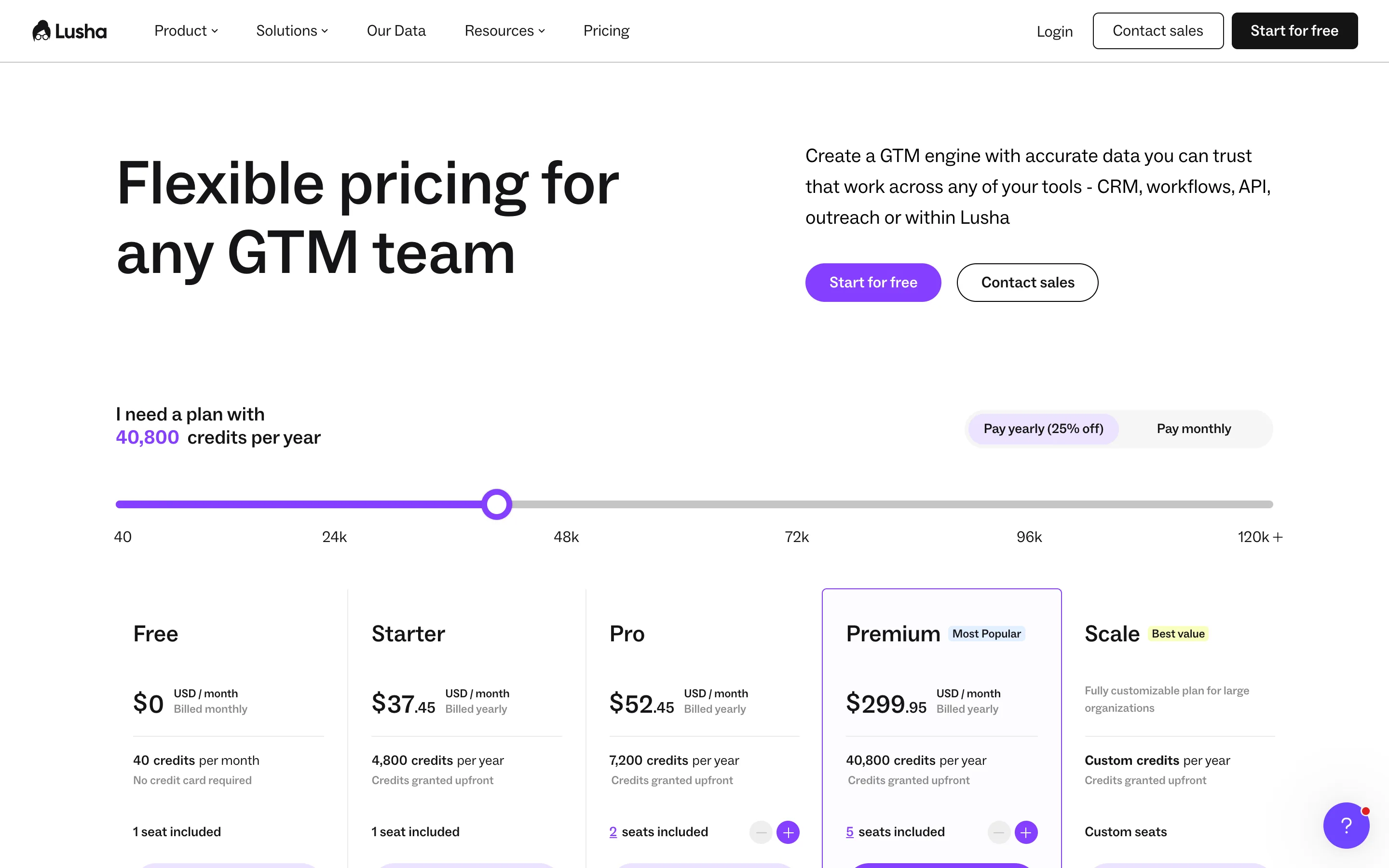
Lusha démarre à 45 €/mois, ou 34 € en annuel, pour 400 crédits, révélés depuis une base stockée (un email 1 crédit, un numéro 5). En annuel, ça met l'email autour de 0,085 € et le numéro à environ 0,43 € sur le papier (0,56 € au mois) — sauf que seules 50 à 70 % des fiches sont encore à jour, ce qui porte le numéro qui fonctionne vers 0,61 à 0,85 €, et le même compteur finance emails et numéros.
vs Enrow: Lusha gagne sur les portables nord-américains ; Enrow gagne sur les portables européens, la vérification en temps réel et une facturation au résultat plutôt que des crédits de révélation sur des fiches périmées.
9. Cognism
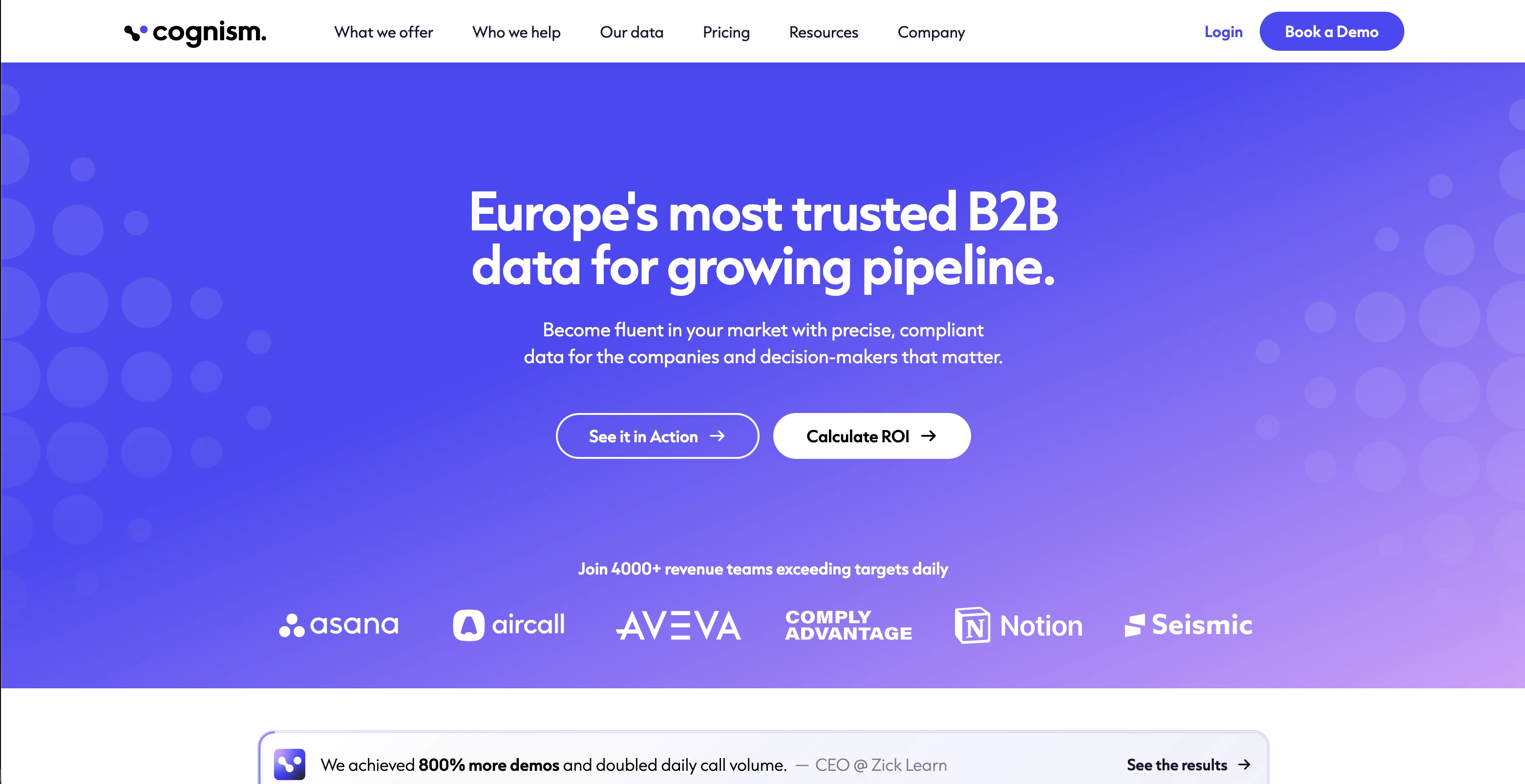
La solution grand compte pour les portables européens et les signaux d'intention.
Cognism est fait pour l'acheteur grand compte : une grande base B2B avec des numéros de portable vérifiés par téléphone (leur « Diamond Data »), une forte couverture européenne, et des données d'intention sur le palier Pro.
Là où Anymailfinder est un point d'accès email en libre-service, Cognism est une plateforme commerciale et opérationnelle, avec le volet conformité qui l'accompagne ; pour une grande équipe qui vend en Europe, c'est une option sérieuse.
Sur les portables européens en particulier, c'est l'un des rares acteurs à base de données à prendre la couverture au sérieux.
Le frein, c'est le modèle d'achat et la question de la fraîcheur. Le tarif est uniquement sur devis, donc pas d'entrée en libre-service ni de prix public à comparer : vous parlez à un commercial, vous signez un contrat annuel.
Et ça reste une base : les fiches y prennent la poussière, et un crédit part dès que vous débloquez un contact, utile ou non. C'est une plateforme lourde, tarifée et vendue comme telle.
Dans la donnée que j'ai regardée, les portables vérifiés par téléphone étaient fiables — vraiment bons pour une base — et la couverture européenne est réelle.
Mais Enrow vous donne des portables européens en temps réel, sans contrat annuel ni appel commercial, au résultat dès 15 €/mois, plus l'export du contact complet vers le CRM en un clic.
Pour une plateforme complète de grand compte, Cognism convient ; pour la couche de données fraîche et facturée honnêtement, c'est Enrow.
- +Portables vérifiés par téléphone, avec une forte couverture européenne
- +Données d'intention sur le palier Pro
- +Conformité et support au niveau des grands comptes
- +Intégrations Salesforce et outils d'envoi
- –Tarif uniquement sur devis, pas de libre-service ni de prix public
- –Contrats annuels, pas un compteur à l'usage
- –Base stockée, donc une partie de ce que vous débloquez a déjà vieilli
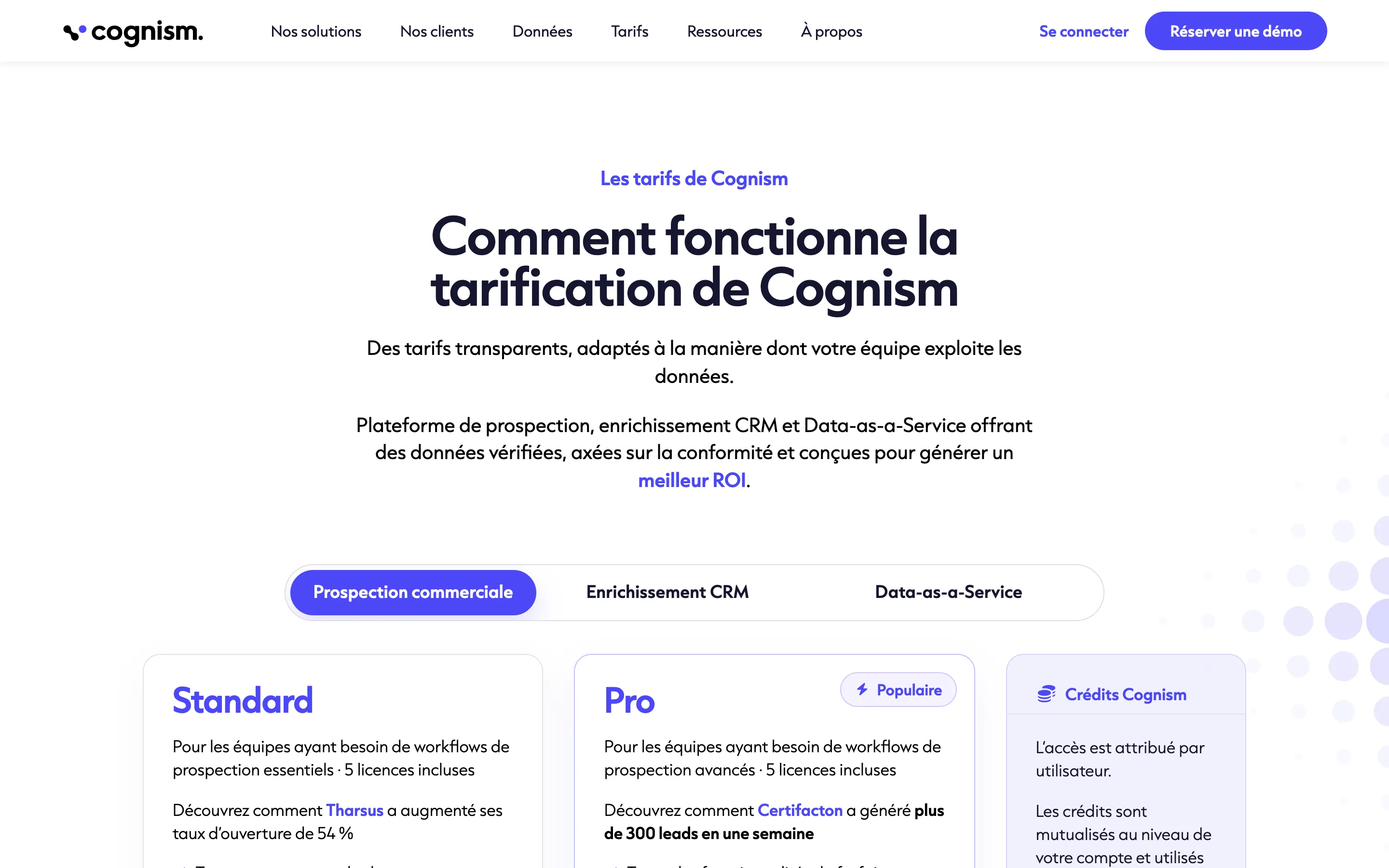
Cognism ne publie aucun prix : deux paliers (Standard et Pro), 1 crédit par contact débloqué, contrats annuels, un chiffre à demander au commercial. Sans tarif public, aucun coût réel par email vérifié à calculer — et vous signez un an avant même de voir un prix au contact.
vs Enrow: Cognism est une offre grand compte, accessible via un appel commercial ; Enrow est en libre-service dès 15 €/mois, avec un Pro autour de 0,0075 € l'email vérifié, en temps réel, au résultat, avec des portables européens et l'export vers le CRM.
10. Findymail
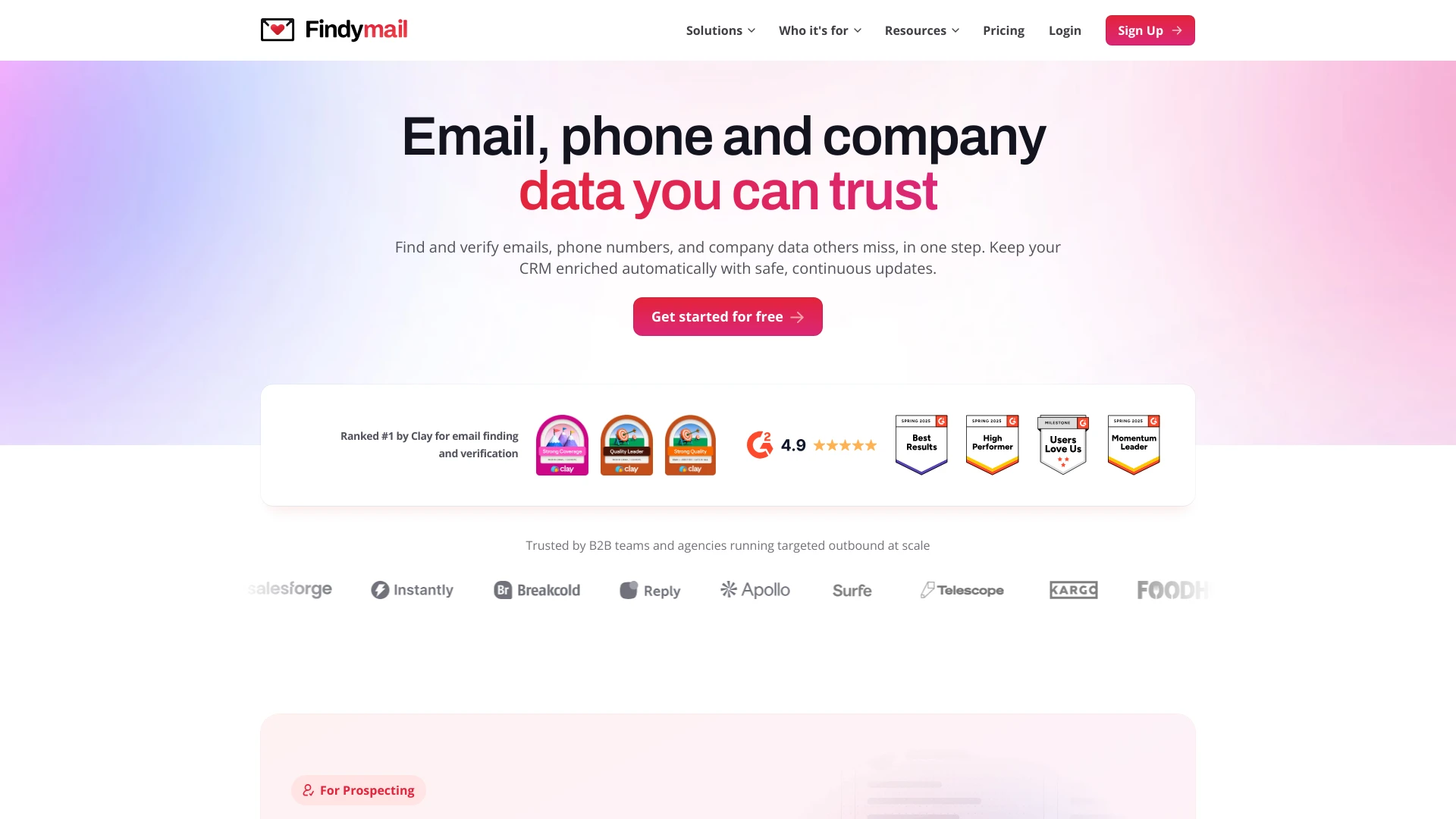
Des adresses US de cold email, facturées seulement quand il en trouve une. Rien d'autre, mais bien fait.
Findymail est un outil de recherche d'emails B2B pensé pour la prospection, et comme Anymailfinder, il facture sur le résultat trouvé, pas sur la recherche. Donnez-lui une liste LinkedIn ou un domaine, et il ressort des emails professionnels vérifiés.
Sur la seule précision des emails US, il est vraiment bon, l'un des meilleurs outils de la catégorie, et je le dis clairement. Un email trouvé coûte 1 crédit, la même unité qu'Anymailfinder, et les deux sont à peu près au même prix d'entrée (45 € pour 1 000).
Sa limite, c'est la géographie, et donc la couverture. Findymail ne renvoie aucun numéro pour les contacts européens — le RGPD le lui interdit — donc pour une équipe centrée sur l'Europe, c'est de fait de l'email seulement, comme Anymailfinder. Quant aux numéros, il n'en fournit qu'aux États-Unis.
Et vous êtes bloqué dans un abonnement où le report des crédits plafonne à 2× le quota du mois : si vous achetez en avance pour un gros trimestre, vous verrez le surplus expirer au renouvellement.
Mon lot de test a confirmé la réputation : des adresses US précises, et une facture qui ne bougeait que sur un résultat trouvé.
Mais Enrow égale cette facturation à 1 crédit l'email valide, puis ajoute ce que Findymail ne peut pas : des portables européens conformes RGPD, des catch-all livrées au lieu d'être écartées, et l'envoi du profil LinkedIn vers le CRM. Même philosophie de facturation, un champ plus large.
- +Facturé au résultat trouvé, 1 crédit par email, même logique qu'Anymailfinder
- +Recherche d'emails B2B américains précise
- +SOC 2 Type 2, conforme RGPD, hébergé en Europe
- +Intégrations natives HubSpot, Salesforce, Pipedrive, Instantly et lemlist
- –Numéros américains uniquement, aucun en Europe (bloqué par le RGPD)
- –Le report des crédits plafonne à 2× le quota du mois
- –Sur abonnement uniquement, pas de vraie offre gratuite
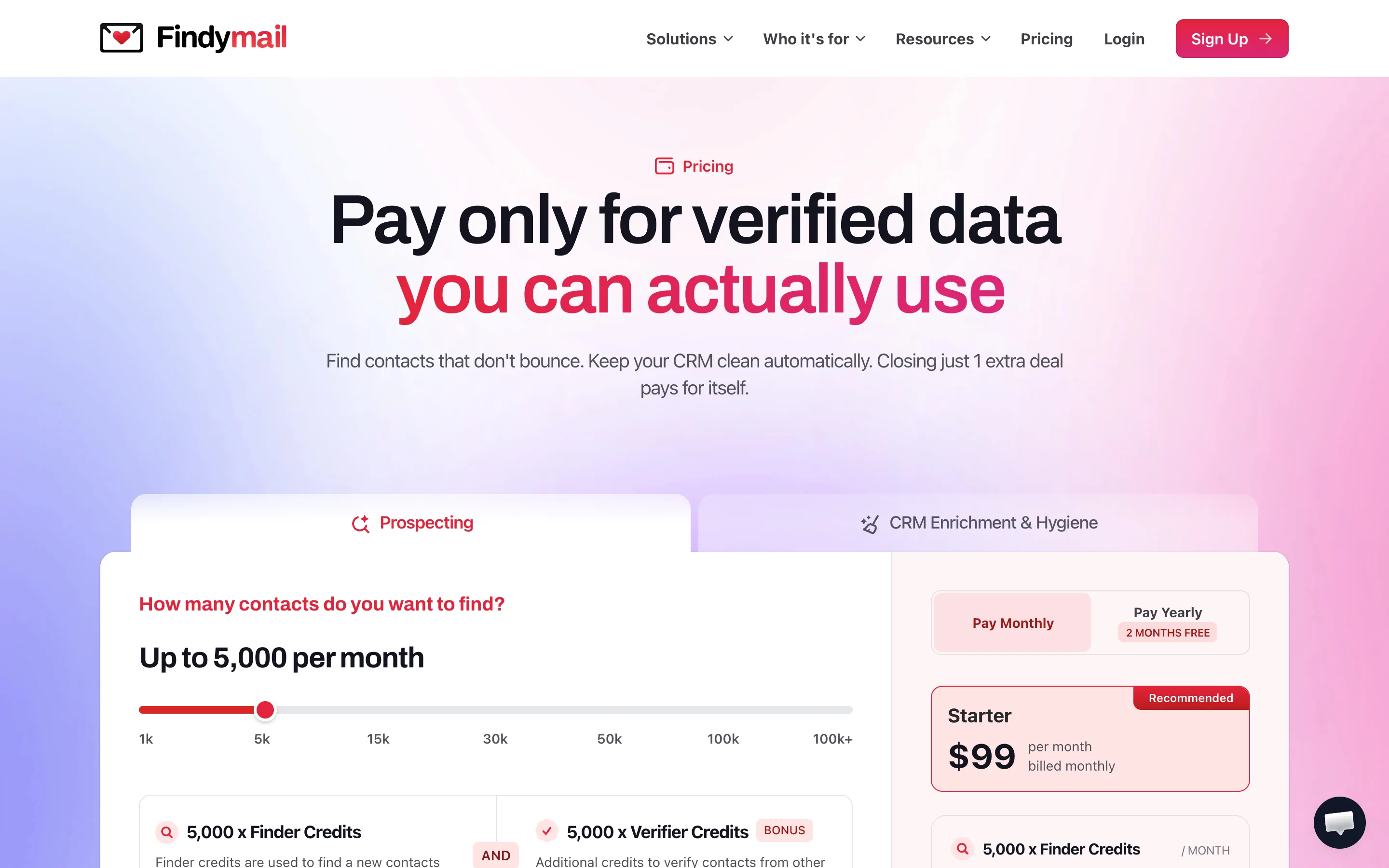
Findymail démarre à 45 €/mois pour 1 000 crédits de recherche, sur un seul forfait à curseur. Comme un crédit ne se dépense que sur une adresse trouvée, le prix affiché est le prix réel : environ 0,045 € l'email vérifié, soit trois à cinq fois les 0,015 € d'Enrow sur Start et 0,0075 € sur Pro. Les numéros coûtent 10 crédits, mais aucun portable européen (bloqué par le RGPD), donc ce chiffre au numéro reste théorique.
vs Enrow: même facturation au résultat, mais Findymail est nettement plus cher par email vérifié, reste bloqué à l'email en Europe, et démarre à 45 € là où Enrow commence à 15 €. Enrow ajoute les portables européens conformes RGPD, les catch-all livrées, et l'export du contact complet vers le CRM.
11. Dropcontact
Si la paperasse RGPD vous empêche de dormir, commencez par là.
Dropcontact génère et vérifie chaque email par algorithme au moment de la demande, au lieu de revendre des lignes tirées d'un fichier stocké, et il ajoute des informations légales françaises (SIREN, TVA) avec des emails dont la grande majorité sont valides.
Comme Enrow, il travaille en temps réel plutôt que sur un crawl, ce qui compte pour les fiches européennes. Là où Anymailfinder est un outil de recherche, Dropcontact est un outil d'enrichissement : sa spécialité, c'est nettoyer et compléter des fiches françaises et européennes dans HubSpot ou Pipedrive.
Les points faibles sont réels dès qu'on sort de cette spécialité. Le téléphone est faible, tiré seulement de l'extraction des signatures d'emails, donc il n'y a pas de vrai produit de recherche de numéros.
Il n'y a pas de base à parcourir, et le Starter à 19 € ne reporte pas ses crédits, contrairement au plan à 29 €. C'est d'abord de l'enrichissement, donc pour la recherche d'emails pure, c'est un tout autre type d'outil qu'Anymailfinder.
Sur mes fiches françaises, il a rempli des champs SIREN et TVA que je n'avais même pas demandés, ce qui montre où est son cœur de métier. C'est aussi la limite de ce qu'il sait faire.
Enrow trouve et vérifie en temps réel de la même façon, mais il livre vraiment des numéros de portable dans tous les pays, Europe comprise, enchaîne plus de 10 vérifications, ne facture que sur un résultat valide, et dépose le contact complet vérifié dans votre CRM en un clic.
Pour de l'enrichissement qui vous apporte aussi de nouveaux contacts, pas seulement du nettoyage, Enrow va plus loin.
- +Enrichissement RGPD en temps réel sur serveurs européens (pas une base crawlée)
- +Emails en grande majorité valides, bon sur les catch-all
- +Données françaises (SIREN, TVA)
- +Enrichissement natif dans HubSpot, Pipedrive, Salesforce, Zoho
- –Capacité téléphonique faible (seulement via les signatures d'emails)
- –Pas de base de données à parcourir pour constituer des listes
- –Pas de report des crédits sur le Starter à 19 €
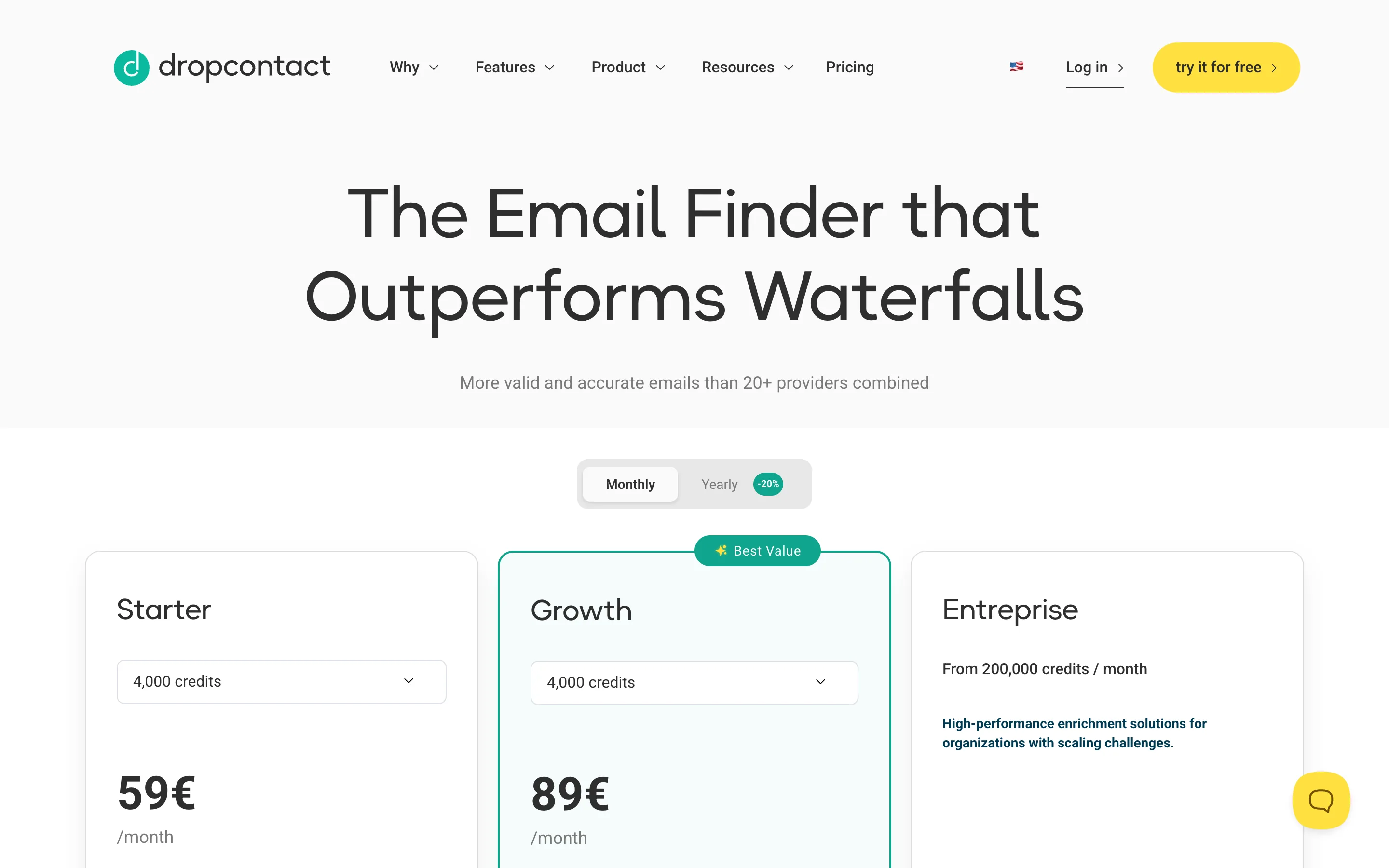
Dropcontact démarre à 19 €/mois pour 500 crédits sans report, ou 29 € avec report, au résultat (un email non trouvé est remboursé). Ça fait environ 0,038 € l'email vérifié au palier à 19 € (500 crédits, pas de report), soit 2,5 fois environ les 0,015 € qu'Enrow facture sur son Start, lui aussi dépourvu de report. Aucun coût au numéro : les téléphones viennent seulement des signatures d'emails.
vs Enrow: Dropcontact nettoie bien les fiches européennes mais fait à peine du téléphone, et reste au-dessus d'Enrow à chaque volume. Enrow trouve et vérifie en temps réel, ajoute de vrais numéros de portable dans tous les pays, Europe comprise, des crédits reportables et l'export vers le CRM, toujours au résultat.
Ne me croyez pas sur parole. Testez votre propre liste et comptez ce qui revient : 50 crédits gratuits, renouvelés chaque mois, sans carte. Comparez Enrow à l'outil que vous quittez.
Comparatif côte à côte
Verdict final
Ramenée à ce qu'un budget de prospection achète vraiment — des emails valides, des numéros de portable européens qu'on peut appeler, zéro dépense sur les ratés —, la décision place Enrow en tête. Anymailfinder facture aussi honnêtement, mais à environ 0,045 € l'email vérifié, il coûte près de trois fois le tarif d'Enrow au même volume, et n'a aucun numéro. Et personne d'autre ici ne franchit la dernière étape : un clic sur un profil LinkedIn ou Sales Navigator, et la fiche complète et vérifiée, numéro et email compris, arrive dans votre CRM via l'extension Enrow. Enrow n'est pas un tout-en-un, en revanche : pas de base à parcourir, pas de campagnes d'envoi, pas de données sur les technologies utilisées. Pour un seul outil qui réunit campagnes, enrichissement, signaux et CRM, achetez le tout-en-un et branchez Enrow pour la couche de données.
Ne me croyez pas sur parole. Testez votre propre liste et comptez ce qui revient : 50 crédits gratuits, renouvelés chaque mois, sans carte. Comparez Enrow à l'outil que vous quittez.
FAQ
Notre méthodologie
Je l'ai testé moi-même, et personne ne m'a payé pour ça : aucun sponsor, pas un seul lien affilié sur cette page. J'ai pris une liste de contacts B2B réels et je l'ai passée dans chaque outil la même semaine, puis j'ai réellement écrit à ces adresses pour mesurer ce qui bounce vraiment, pas ce qu'un validateur promet. J'ai regardé quatre choses : le taux de contacts trouvés, le bounce sur ce vrai envoi, le coût réel par contact vérifié une fois les crédits et les ratés comptés, et la couverture géographique, avec les numéros de portable européens obtenus légalement comptant le plus. Les prix et les fonctions des concurrents viennent des pages officielles de chaque éditeur, consultées le 02/07/2026.
utilisateur illimité
Prêt à passer à la vitesse supérieure
sans cb
aucun setup requis