dropcontact alternatives
Top 13 Dropcontact Alternatives & Competitors in 2026
So we evaluated 13 alternatives on the axes an outbound budget turns on: match rate, bounce on a live send, real cost per valid contact, and EU phone coverage that's legally sourced rather than scraped off a signature block. Same contact list, every tool, one week.
13 tools tested
updated October 6, 2026
18 min read
Actualizado el 6 de octubre de 2026
The alternatives at a glance
Enrow is the best overall Dropcontact alternative for teams that need verified emails and real EU phones and pay only when a result is valid. Start runs $17/month; Pro works out to about $0.0087 per valid email and $0.35 per valid phone ($87 for 10,000 credits = 10,000 emails or 250 phones). It's also the only tool here whose extension writes the complete verified contact into your CRM in a click. Findymail is a respectable email-only tool if you never dial and never sell into Europe; Cognism is enterprise intent data on an enterprise contract, a different purchase entirely. The rest each own a narrow niche below, and none of them takes the core job off Enrow.
Dropcontact cleans a French-heavy CRM well, and G2 users rate it 4.6/5 for exactly that.
It is still an enricher, not a finder or a phone tool: signature-scraped numbers, no searchable list, 500 credits for €19/month without rollover (€29 with it), which works out to about €0.038 per email found on the €19 plan, roughly two and a half times Enrow's Start rate, with no rollover on either side. Enrow is the switch when the point is reaching people.
Verified emails plus GDPR-cleared EU direct dials, 10+ checks per address, nothing charged unless the result is valid. Start runs $17/month; Pro brings that to about $0.0087 per valid email and $0.35 per valid phone.
And one thing nobody else on this page does: Enrow's Chrome extension moves the whole verified record, every field, from a LinkedIn profile into HubSpot, Salesforce or Pipedrive in a single click.
Why teams look for Dropcontact alternatives
People leave a tool this well-liked for three specific reasons, and they're all structural. If your whole job is cleaning a French-heavy HubSpot, Dropcontact is a fine answer. If you need phones, a finder, or more headroom per month, keep reading.
Conflict of interest disclosure
Let me put the obvious on the table before you read the ranking. Enrow is my company, this article ranks email finders, Enrow is an email finder, and I've placed us at #1. So read what follows with that in mind.
Being honest about it also means naming what Enrow does not do. We don't run outreach campaigns, so if you want to send from the same tool, Emelia or Snov on this page handle that. We don't do email warm-up. And we don't do waterfall enrichment.
None of that is on the roadmap either: I'd rather hunt down and verify each contact myself than pipe five vendors' databases through a cascade and average the guesses.
The flip side is that I stay confident about the one job Enrow is built for, which is finding and verifying accurate, fresh contact data and nothing else.
If you need campaigns, warm-up, or a single all-in-one suite, a tool further down this page will fit you better, and I'll say so where it does.
If what you actually need is the most accurate email and phone data you can get, that narrow focus is the whole point of Enrow.
The 13 best Dropcontact alternatives
1. Enrow
#1
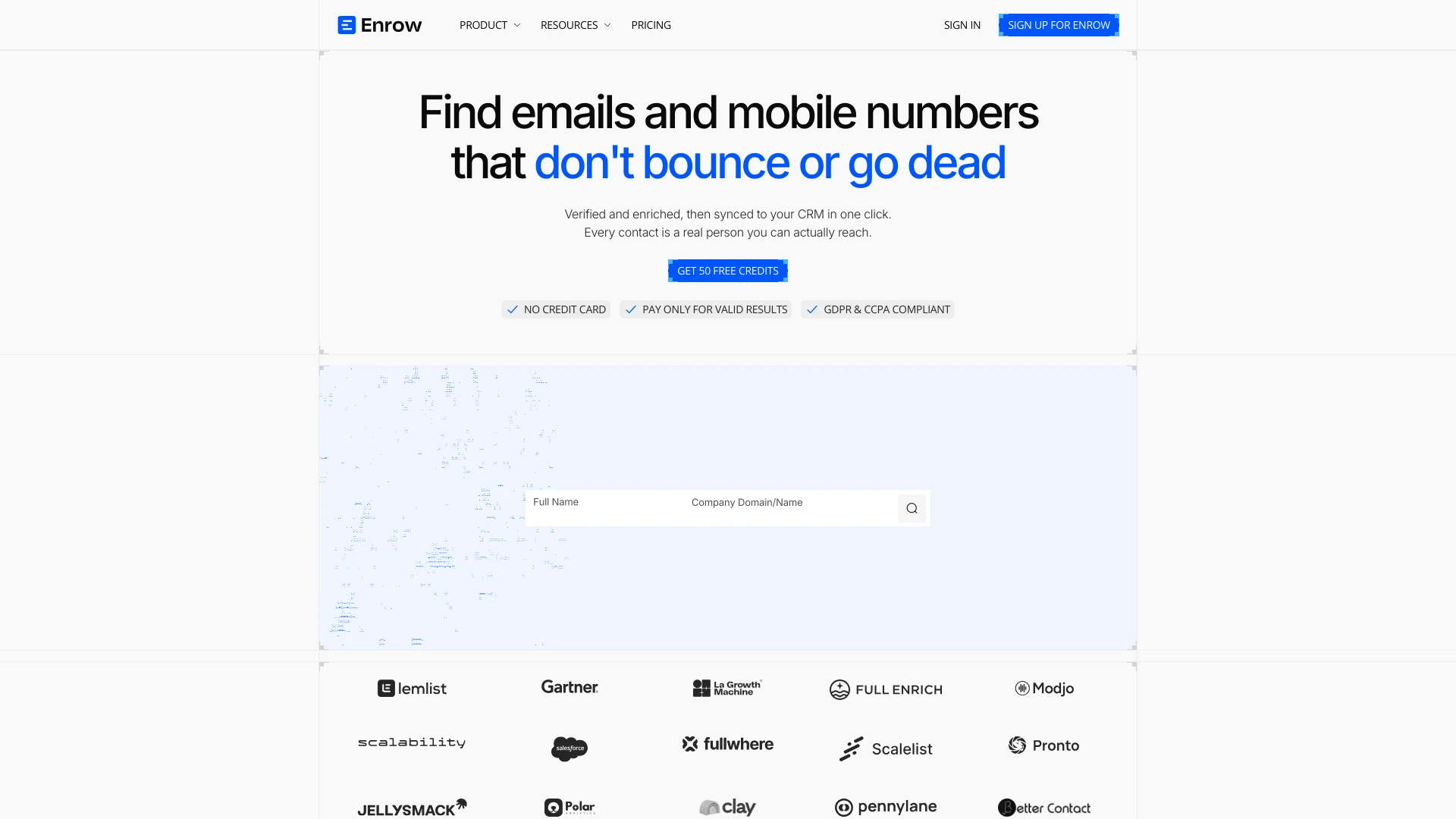
I built Enrow after years of feeding CSVs into enrichment tools: pay for the run, keep a fraction, own the bounces anyway.
Let me be fair to Dropcontact first, then show you the gap. Both of us do real-time, GDPR-compliant data, and both build records rather than resell them. So the thing people praise about Dropcontact, "European compliance," you don't give up by leaving.
Enrow is EU-compliant and delivers EU phone numbers. That's exactly where the two tools split. Dropcontact's phones are scraped from email signatures, so on my list the direct-dial coverage was patchy at best.
Enrow returns real direct dials in any country as an actual product, charged at 40 credits each, only when a valid number lands.
Now the rest of the gap, because it's wide.
Enrow is markedly cheaper per valid email: €15/month buys 1,000 valid emails at €0.015 each, where Dropcontact's €19 buys 500 emails found without rollover (€29 with it), €0.038 each, about 2.5 times Enrow, with neither plan carrying credits over. Enrow only spends a credit when the email is valid, not merely found. It finds, not just enriches.
It runs 10+ verification checks per email and delivers catch-all addresses instead of flagging them "risky" and quietly dropping them, which is how a lot of tools keep their bounce stats pretty. Credits roll over on Pro and Scale.
And it integrates natively with Clay, HubSpot, Salesforce and Pipedrive plus webhooks, a wider native set than Dropcontact's CRM connectors, which sit on a separate subscription.
Here's the part no other tool on this page can match. Hit Enrow's extension on any LinkedIn or Sales Navigator profile and the complete verified record lands in HubSpot, Salesforce or Pipedrive: email, phone, role, company, all of it, one click. And it lands as a create-or-update. When the contact is already yours it keeps its owner, its open deal and its lifecycle stage, and simply gains the fields it was missing; a blind insert would have handed you a blank twin with none of that attached. No copy-paste. No export-then-import.
Dropcontact enriches what's already in your CRM; Enrow puts the whole clean contact there for you.
On the live send, two things stood out. Bounce sat under 1%, and the EU mobiles connected to real desks instead of a number lifted off a two-year-old signature. One caution, in the spirit of being straight with you: that sub-1% bounce is an observed average, not a contract.
One more thing, for anyone building with AI agents. Enrow ships an official MCP server (the repo is github.com/EnrowAPI/enrow-mcp), so you can call Enrow's email finder and verifier, plus the direct-phone finder, straight from Claude, Cursor or Windsurf.
Fresh, verified emails and phones pulled into an agent workflow, with the same rule: nothing spent unless the result is valid. Small thing today, handy if you're wiring data into your own tooling.
- +A miss never costs a credit; you're billed on a hit, not an attempt
- +Real EU direct dials (GDPR-cleared), not signature-scraped phones
- +10+ verification checks per email; catch-all verified and delivered, not dropped
- +Real-time and GDPR-compliant, so you keep Dropcontact's compliance story and gain phones
- +Chrome extension writes the entire verified contact into HubSpot, Salesforce or Pipedrive in a single click, a thing none of the other twelve does
- +Cheaper at equal volume, with credit rollover on Pro and Scale
- –No searchable database, and that's a decision, not a backlog item. A stored list is only as fresh as the day it was built, and B2B contacts change jobs fast enough that an aging row often points at someone's old desk. Enrow looks each person up at the moment you ask, which is where the accuracy comes from. Source your lists in LinkedIn or Sales Navigator.
- –No sequencing, ever. Once the data's verified, hand it to Emelia first, La Growth Machine or lemlist after that.
- –No technographics, and no French SIREN/VAT registry depth. Company data is LinkedIn-level. For pure French firmographics, Dropcontact still has an edge.
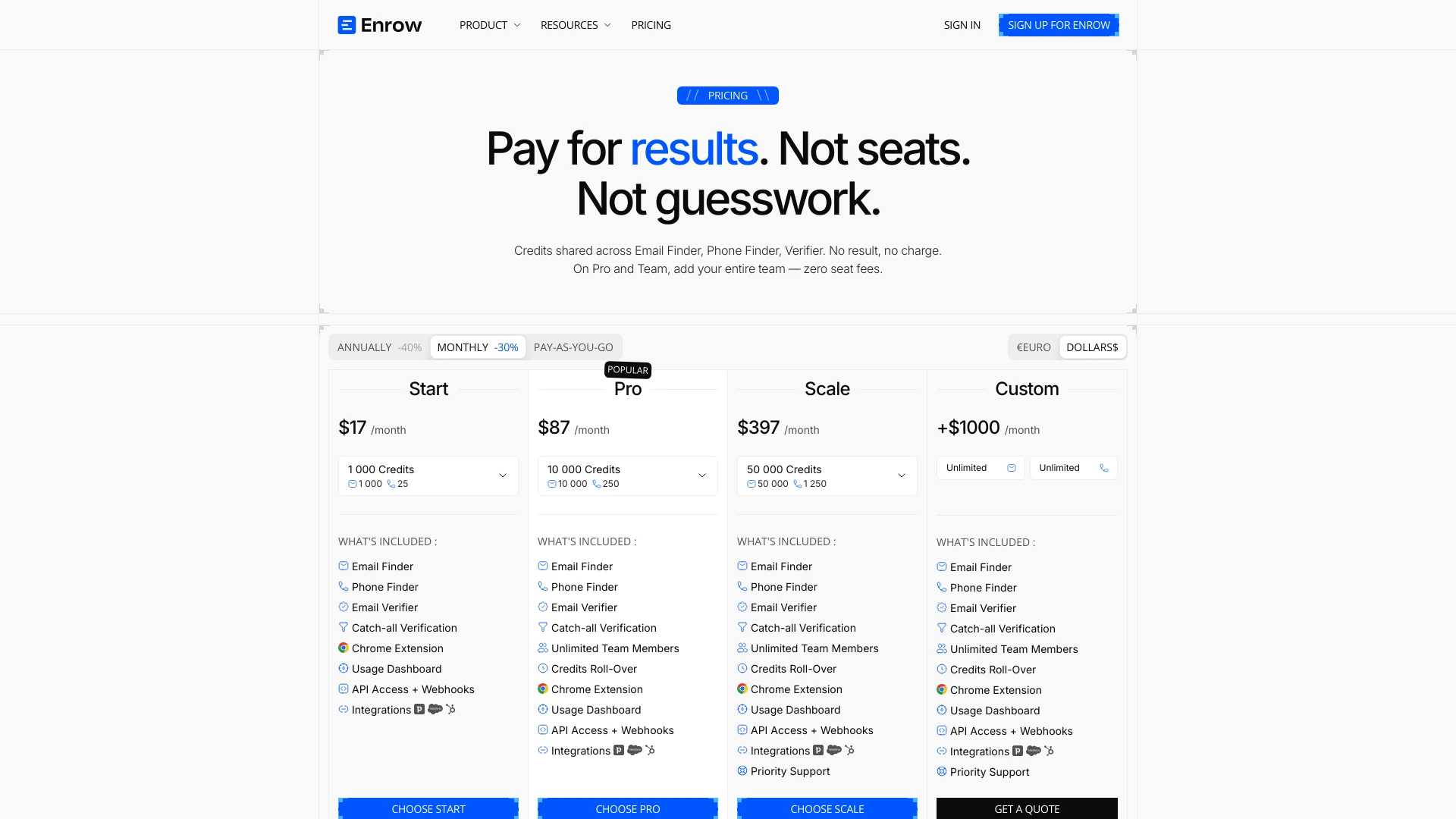
three self-serve tiers. Start: $17/mo for 1,000 credits or $47/mo for 4,000, monthly only. Pro: $87/mo for 10,000, $167 for 20,000, $247 for 30,000. Scale: $397/mo for 50,000, then $597/80,000, $997/140,000 and $1,397/200,000.
Pay annually on Pro and Scale and the price drops about 10%, which puts 10,000 credits near $78/mo and 50,000 near $357/mo. Custom is quote-based.
The meter itself: 1 email = 1 credit, 1 phone = 40 credits, verification 0.25, catch-all included, and a credit is only spent on a valid result. Rollover exists on Pro and Scale. Free tier: 50 credits every month, recurring, no card.
Enrow takes neither of the two penalties that inflate most of the bills on this page. A miss costs nothing. An address that fails verification isn't billed either.
Credits roll over on Pro and Scale, so nothing you paid for expires unspent, and what's on the price page is what you actually pay. The cleaner comparison base is Pro: $87 for 10,000 credits, meaning 10,000 valid emails at about $0.0087 each or 250 valid phones at about $0.35 each.
Start remains the smaller $17 entry tier, at $0.017 per valid email. Hold those numbers. Some tools below bill you for the search rather than for the answer, and their credits reset every month whether you spent them or not. You multiply their sticker to find the truth.
You never multiply Enrow's.
Dropcontact re-credits a miss; Enrow never bills one in the first place. Test that on your own CRM export, and note the free tier renews itself: 50 credits every month, no card.
2. Emelia.io
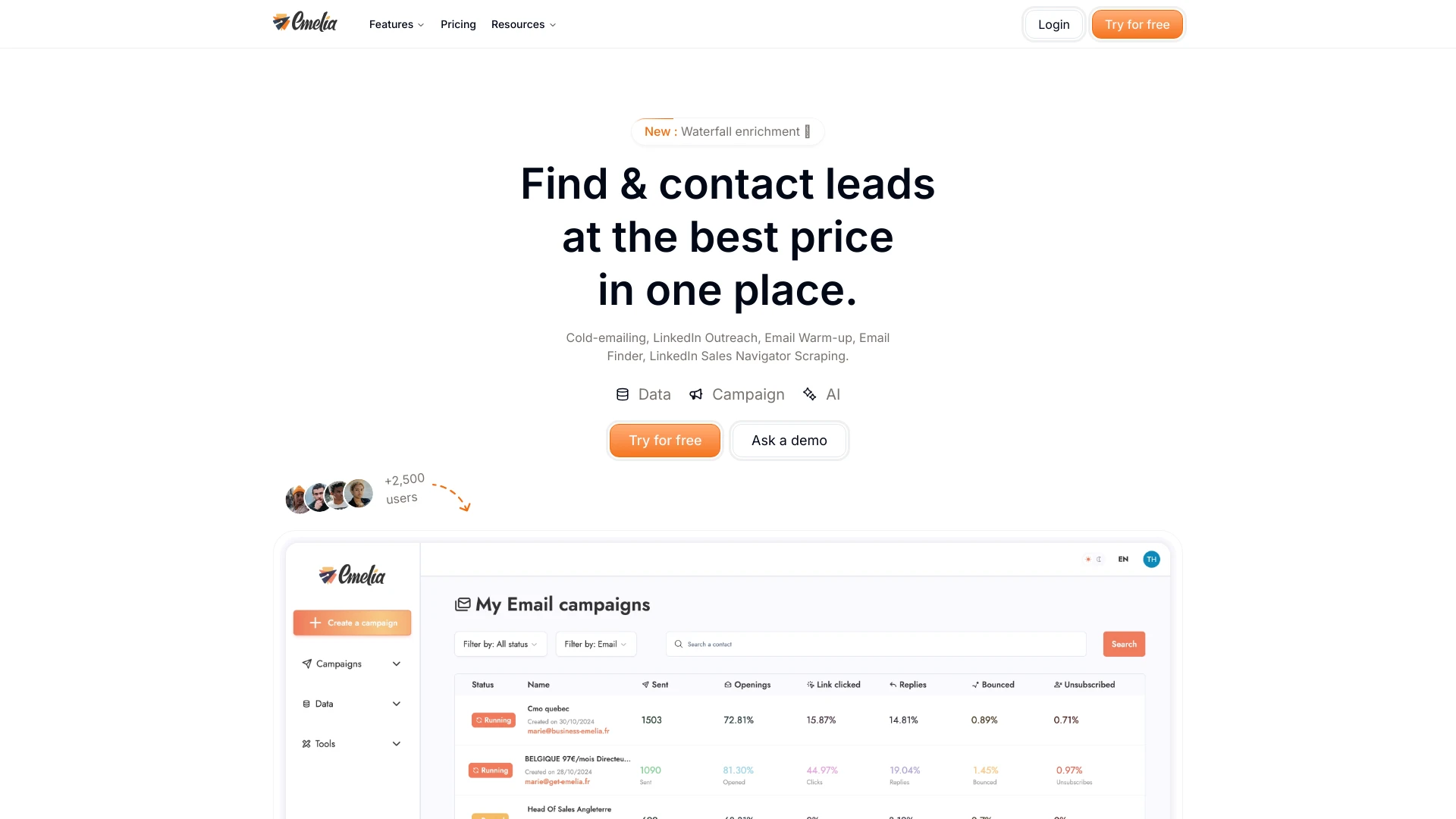
Finder and sender under one roof, which Dropcontact never tried to be.
Emelia is where finding and outreach live together: an email finder with waterfall enrichment, a verifier, LinkedIn Sales Navigator scraping, then cold email and LinkedIn sequences with warm-up built in. Dropcontact stops at the data and doesn't send at all. Emelia keeps going and runs the campaign.
For a small European team that wants one login instead of a cleaner plus a sequencer, that's a real pull, and it runs on the same GDPR-minded wavelength Dropcontact does.
On pure data, Emelia's finder is solid and credits only burn when an email is found. But its center of gravity is sending, not data depth. Phone coverage is thin. The richest finder and enrichment credits sit on add-ons, so heavy data users pay extra.
As a data source it's good, not specialist-grade, and nothing in it files a complete contact into your CRM the way Enrow's extension does. Full disclosure: Emelia is a partner we point people to for sequencing.
The cleanest setup pairs the two, Enrow for verified emails and EU phones, Emelia to send. One thing stood out when I used it. Warm-up and sending sat right next to the found contacts, so a list went from import to first touch without a second tool.
For the data layer itself, though, Enrow is the deeper, cheaper, phone-capable half of that pair.
- +Find, verify, enrich and send in one place (cold email + LinkedIn + warm-up)
- +Credits charged only when an email is actually found
- +Waterfall enrichment and Sales Navigator scraping built in
- +Unlimited sending and contacts on every plan; 7-day free trial
- –Thin phone coverage; it's not a dialing tool
- –Email-finding and enrichment credits lean on add-ons, so heavy data users pay extra
- –It's an outreach platform first, so the data depth trails the pure finders
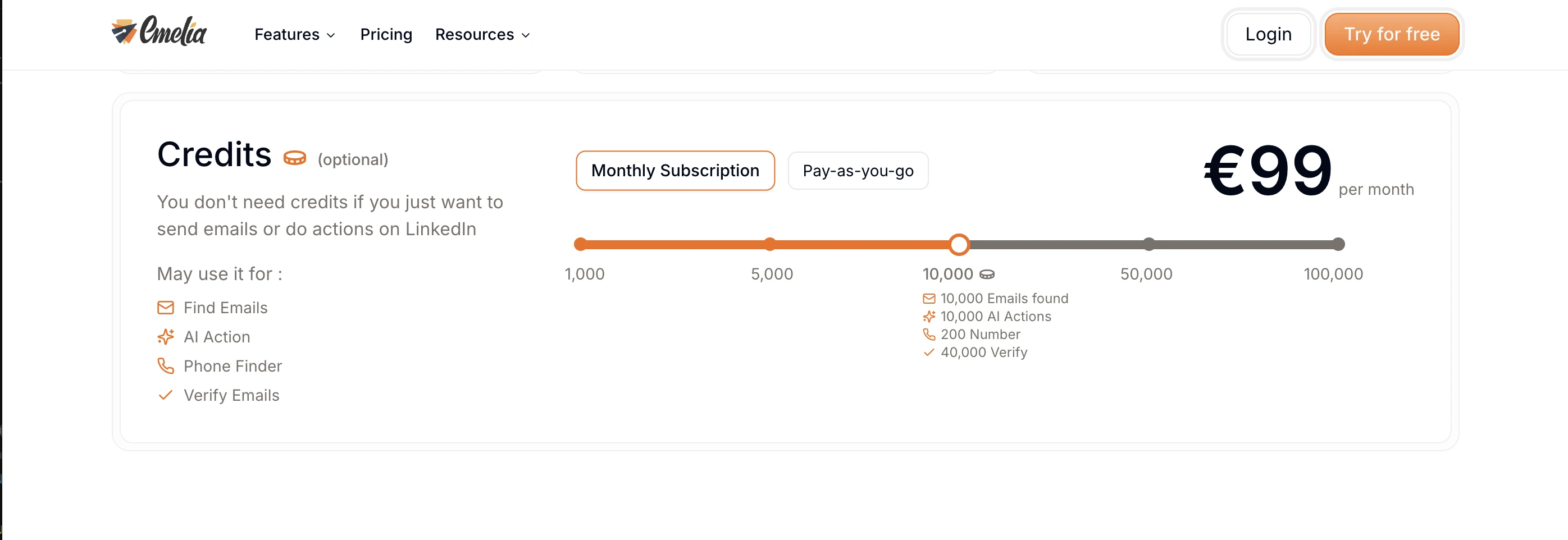
Emelia pricing. Sending plans from $44/mo (€37); the email-finder add-on is about $23/mo for 1,000 finds (€19), billed only when an email is found — roughly $0.0228 per valid email, about 1.3x Enrow's $0.017 at the same 1,000 volume. Phones are thin, so there's no dependable $/valid-phone here.
vs Enrow: Emelia is a sequencer at heart, a partner pick for sending, not a data rival; Enrow comes in cheaper per valid and adds EU direct dials and the full-record CRM export it doesn't. Pair the two: Enrow for the data, Emelia to send.
3. Prospeo
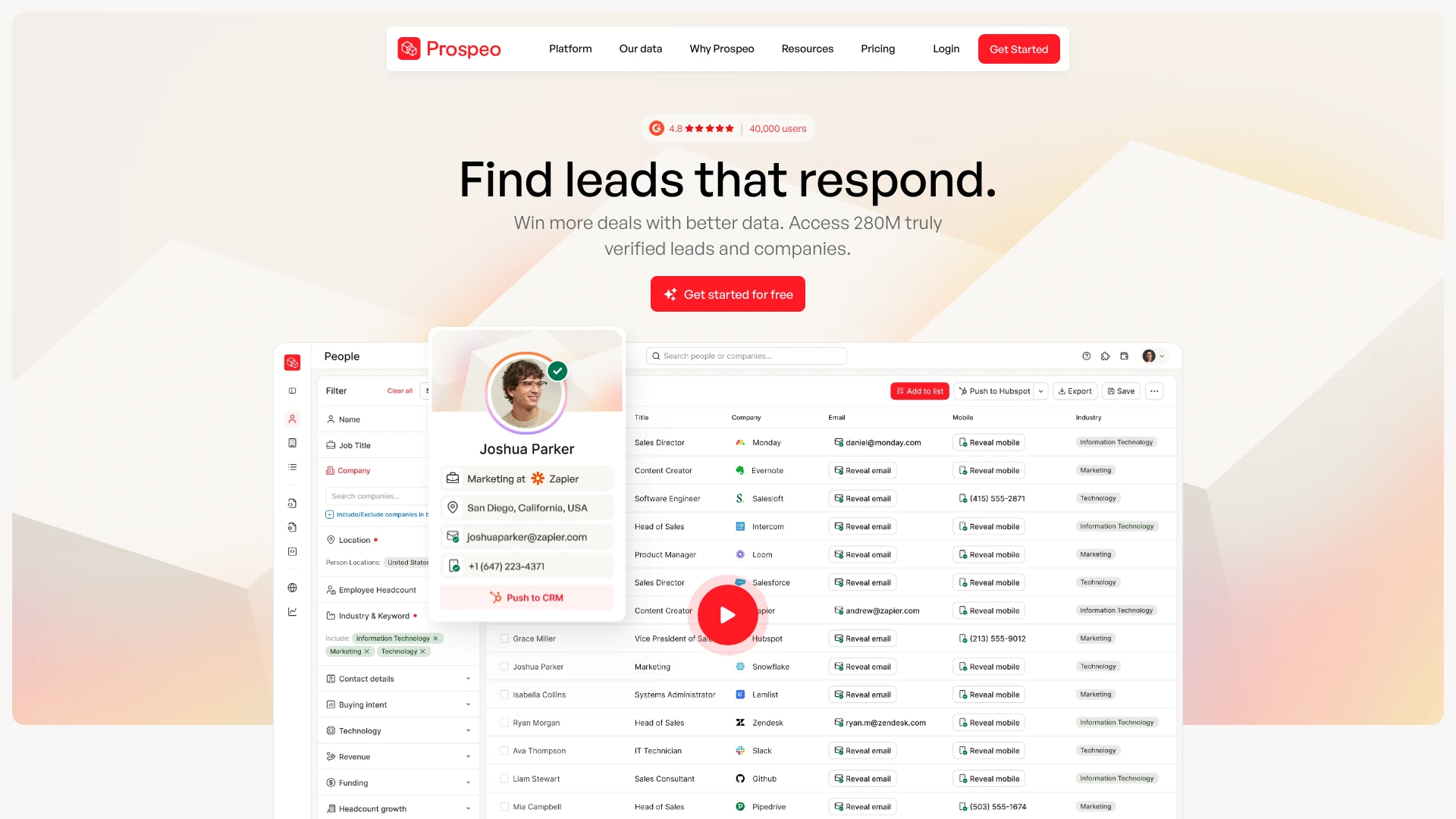
A headline entry point for LinkedIn-driven email, and that's about the size of it.
Prospeo has a solid Chrome extension and a decent email-accuracy reputation, with verification in the same credit pool.
Versus Dropcontact, it's a finder rather than an enricher: you point it at LinkedIn profiles instead of feeding it a CRM, and its entry tier lists 2,000 credits against the 500 in Dropcontact's entry plan.
On my Sales Navigator sample the extension was quick and the addresses mostly held up; the phone side I wouldn't lean on for a French list.
The asterisk isn't the "pay for valid" promise, which it keeps: a credit only goes on an email found. It's the yield, since bulk list runs leave plenty of contacts unfound per user reports. Phones exist via Mobile Finder at 10 credits each, with no documented EU coverage, and there's no rollover.
So against Enrow it's a narrower tool with a shakier yield, no real EU phone story, and nothing that writes a whole contact into your CRM for you. Fine for sticker-price email at low volume.
Not the tool you reach for when the result has to be right and the contact has to land in your CRM.
- +High-accuracy LinkedIn/B2B email finder with a headline entry sticker
- +Strong Chrome extension and domain search
- +Verification in the same credit pool
- +A real monthly free tier (100 credits) to test with
- –No credit rollover
- –Phones cost 10 credits with no documented EU coverage
- –Bulk runs leave many contacts unfound: the bill stays fair, the list stays short
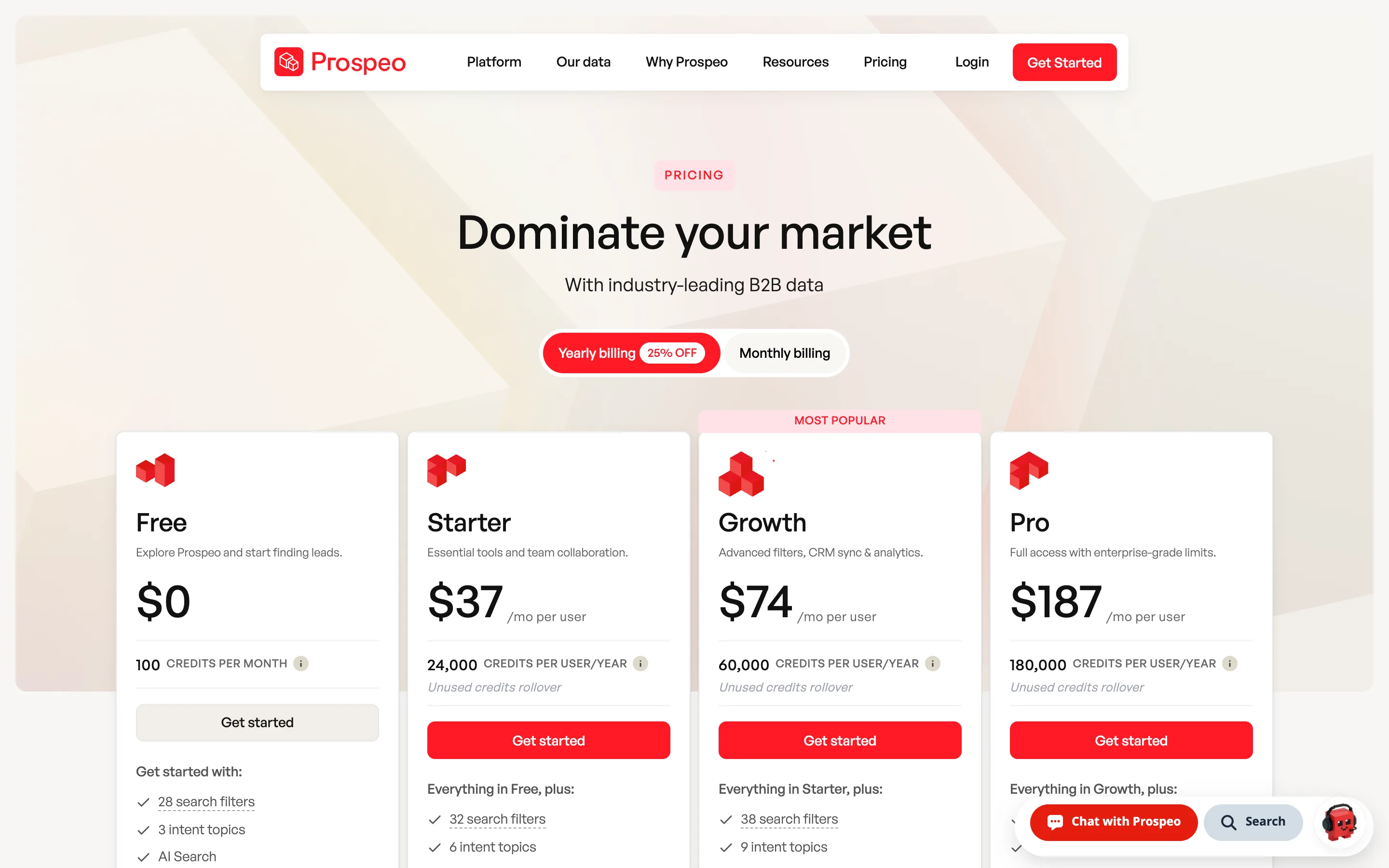
Prospeo pricing. USD, per user, from $49/mo for 2,000 credits, spent only on a found email — about $0.0245 per valid email, roughly 1.4x Enrow's $0.017. A mobile eats 10 credits with no published EU coverage, and there's no rollover.
vs Enrow: both meters click only on a found result, so the 1.4x is honest, not a sticker illusion; Enrow verifies harder with 10+ checks, rolls credits over on Pro and Scale, and writes the finished contact into your CRM. Prospeo's per-user pricing also stacks up on a team.
4. Hunter.io
Where most people start, and where a lot of them outgrow.
Hunter is email-first, mature, and already wired into whatever CRM you run. Against Dropcontact the difference is sourcing philosophy. Dropcontact builds each record fresh in real time, while Hunter leans on a crawled database of 100M+ professional addresses with public-source citations.
That makes Hunter fast to start and unusually transparent about where an email came from. I still keep a Hunter tab open for exactly that: when a domain's email pattern is ambiguous, seeing where an address was published settles the argument.
The flip side of a crawl is age and guesswork: more pattern-guessed addresses for small firms, and stored records only as current as the last crawl. Worse for the budget, Hunter bills the attempt, not the answer.
Fire a search, spend a credit, and whether an address comes back is not your call but is very much your invoice.
Hunter publishes no find rate, so I budget it the way I budget every per-search tool: on our own working assumption that about 30% of email searches return an address. That's my planning number, not Hunter's.
On that basis you pay for three searches or so to keep one address, and the low-confidence pattern guesses in the pile still have to survive your send. Nothing like Enrow's pay-only-when-valid.
Phones are close to absent, the same gap Dropcontact has. Hunter is emails only. You'll need a separate provider for dials, and there's no way to write a finished contact into your CRM from a profile.
The source citations are the best transparency feature in the category, and the free plan is decent, though Enrow now hands out the same 50 credits a month.
For the actual job of reaching people across Europe by email and phone, with credits spent only on valid results, Enrow is the upgrade.
- +Free plan (50 credits/mo) with no card
- +100M+ professional emails with public-source citations and confidence scores
- +Mature, widely-integrated API
- +Bulk finder and verifier in one place
- –No meaningful phone or mobile data
- –Billed per attempted search, found or not, so every miss is on your bill
- –Crawled sources mean stale or pattern-guessed emails for small firms
- –Subscription credits reset each cycle, they don't roll over
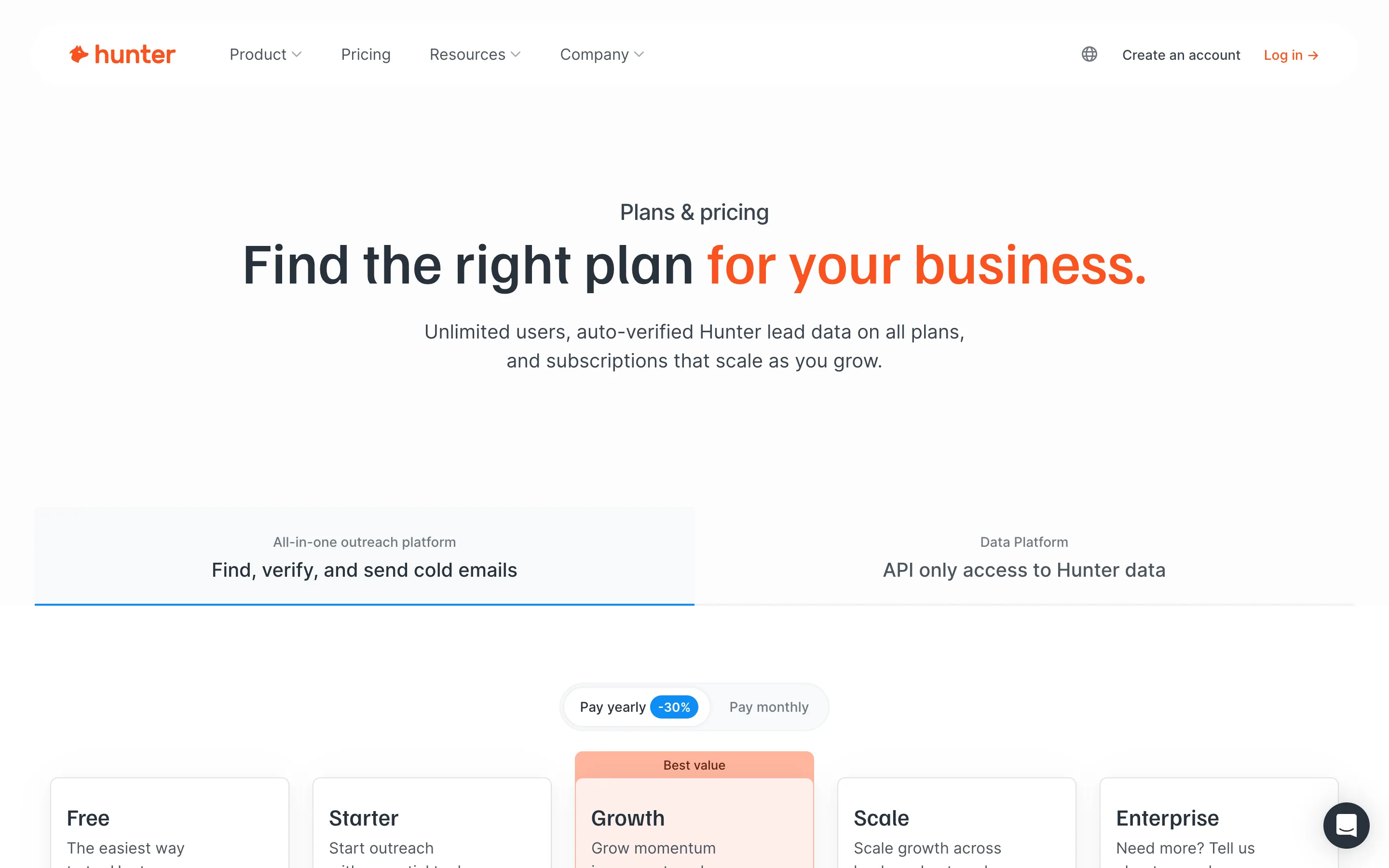
Hunter pricing. EUR charged 1:1 in USD, from $49/mo for 2,000 credits, with a free 50-credit tier. But a credit buys an attempted search, not an email: $0.0245 a search, so at that assumed ~30% find rate each email you actually hold costs about $0.082, roughly 4.8x Enrow's $0.017 on Start and 9.4x Pro, before unused credits reset. Hunter returns no phones.
vs Enrow: Hunter bills the attempt, not the result, and returns no phones at all; Enrow's meter only clicks on a result that's actually valid, so a miss never costs you a thing.
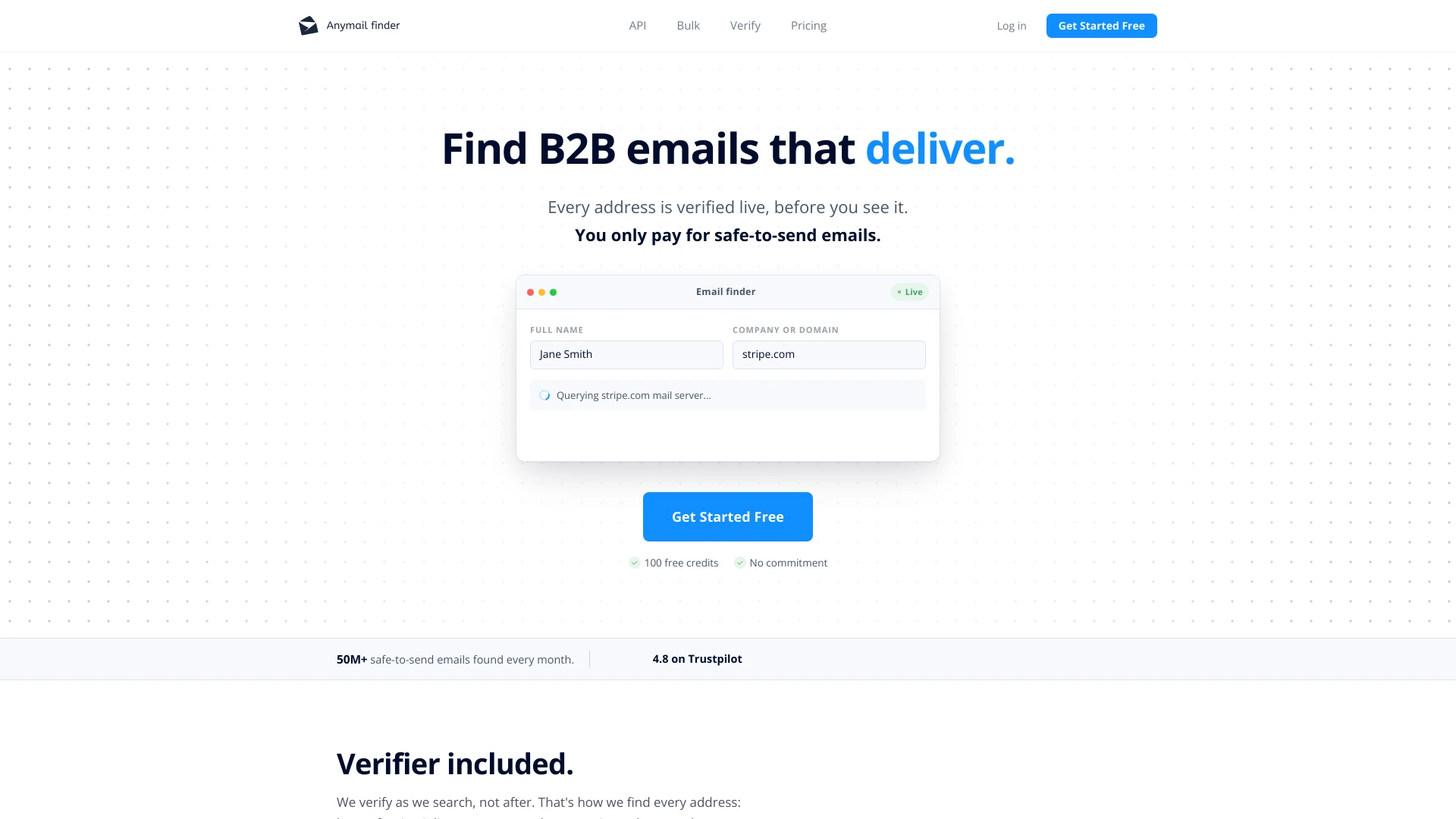
If you like Dropcontact's "only pay on success" ethos but want a finder stripped to one job, this is it.
Anymailfinder does live-verified B2B emails, charged only when the address passes SMTP verification, with a bounce-refund guarantee. It shares Dropcontact's pay-on-success spirit but skips the enrichment layer entirely: no CRM cleaning, no firmographics, no LinkedIn job-change detection. What you get is about the cleanest billing in the category.
Unused credits roll over without caps while you stay subscribed.
One thing mattered on the messy half of my test file: unverifiable searches cost nothing, which kept my bill honest. But it's narrow. No phones at all, no searchable database, no CRM write of any kind, and credits forfeit when you cancel. It's a find-and-verify endpoint, not a platform.
Enrow matches the clean billing, then adds the phones, the verification depth and an extension that files the whole record in your CRM, none of which Anymailfinder reaches for.
- +Charged only for emails confirmed valid against the mail server
- +Bounce-refund guarantee and strong catch-all handling
- +Unused credits roll over without caps while subscribed
- +Duplicate searches within 30 days are free
- –Email-only, no phone finding
- –No searchable prospecting database and no CRM enrichment or export
- –Credits forfeit when you cancel
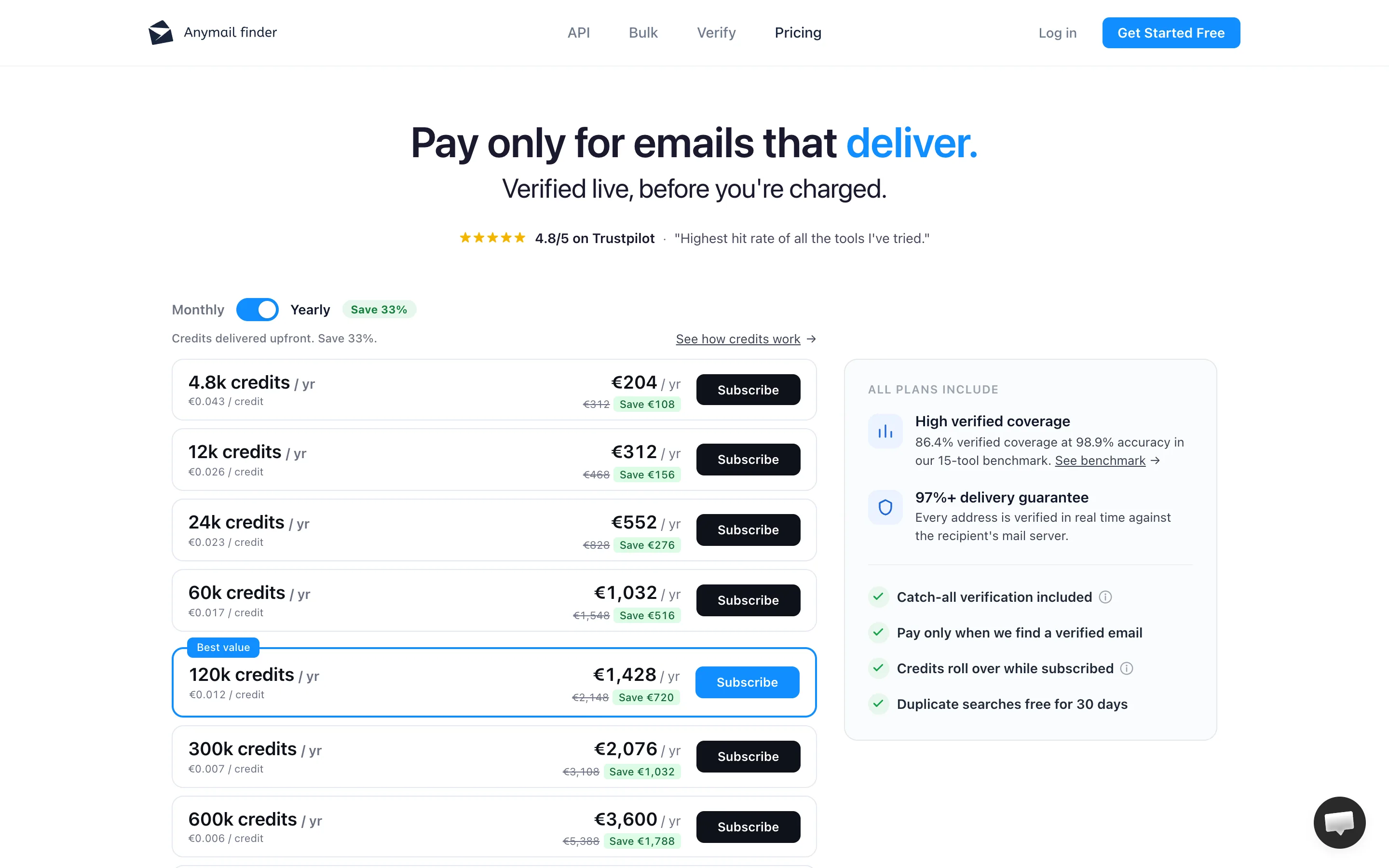
Anymailfinder pricing. Native USD, from $29/mo for 400 credits, billed only on emails that pass SMTP verification, so the number on the pricing page holds up — about $0.049 per valid email at 1,000 credits, dropping toward $0.01 at the top tiers. No phones at all.
vs Enrow: same pay-per-valid honesty, but Enrow's $0.017 undercuts it at the entry and it stays email-only; Enrow adds GDPR-cleared EU dials, deeper verification with catch-all delivered, and the full-record CRM export.
6. LeadMagic
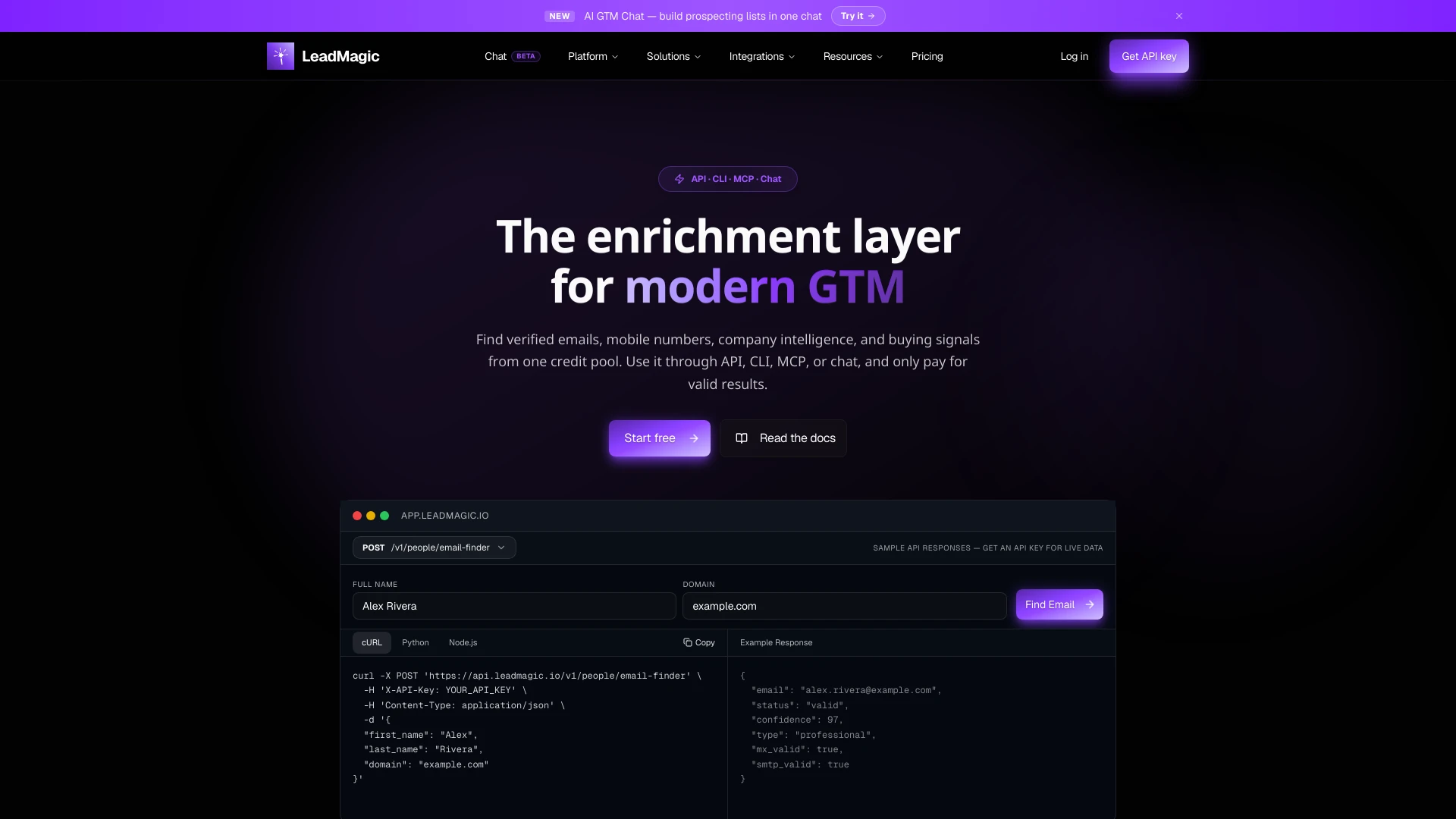
Less a product than a set of endpoints, and some teams want exactly that.
LeadMagic is API-shaped: 15+ enrichment endpoints (email, mobile, company, profile, job-change) drawing from a single shared credit pool, plus a CLI and an MCP server for AI-agent workflows. Versus Dropcontact, it trades the polished CRM-cleaning UI for raw programmability and a wider geographic spread.
It bills pay-per-valid, same principle as Dropcontact's pay-on-success. The difference is it's built for RevOps who'd rather write a script than click through an interface.
My test ran through its API rather than a UI, because that's what LeadMagic is. Budgeting stayed simple: one balance, every endpoint draws from it.
Mobiles cost 5 credits each and EU/GDPR phone coverage isn't published, so EU reliability is a question mark, and rollover only kicks in on Essential and above. As enrichment-as-code, it's a smart buy.
If you want a UI, verified EU phones you can trust, and the whole contact filed in your CRM before you've switched tabs, that's Enrow, and it's the same pay-per-valid principle without the developer prerequisite.
- +Pay-per-valid, zero charge on failed matches
- +15+ endpoints from one shared credit pool
- +Developer tooling: API, CLI/TUI, MCP server
- +Global B2B coverage with a mobile finder that claims above-standard rates
- –No rollover on the entry Basic plan, so unused credits die each cycle
- –Phones cost 5x an email; no published EU/GDPR phone detail
- –It's more an API than a browsable UI, so non-developers will struggle
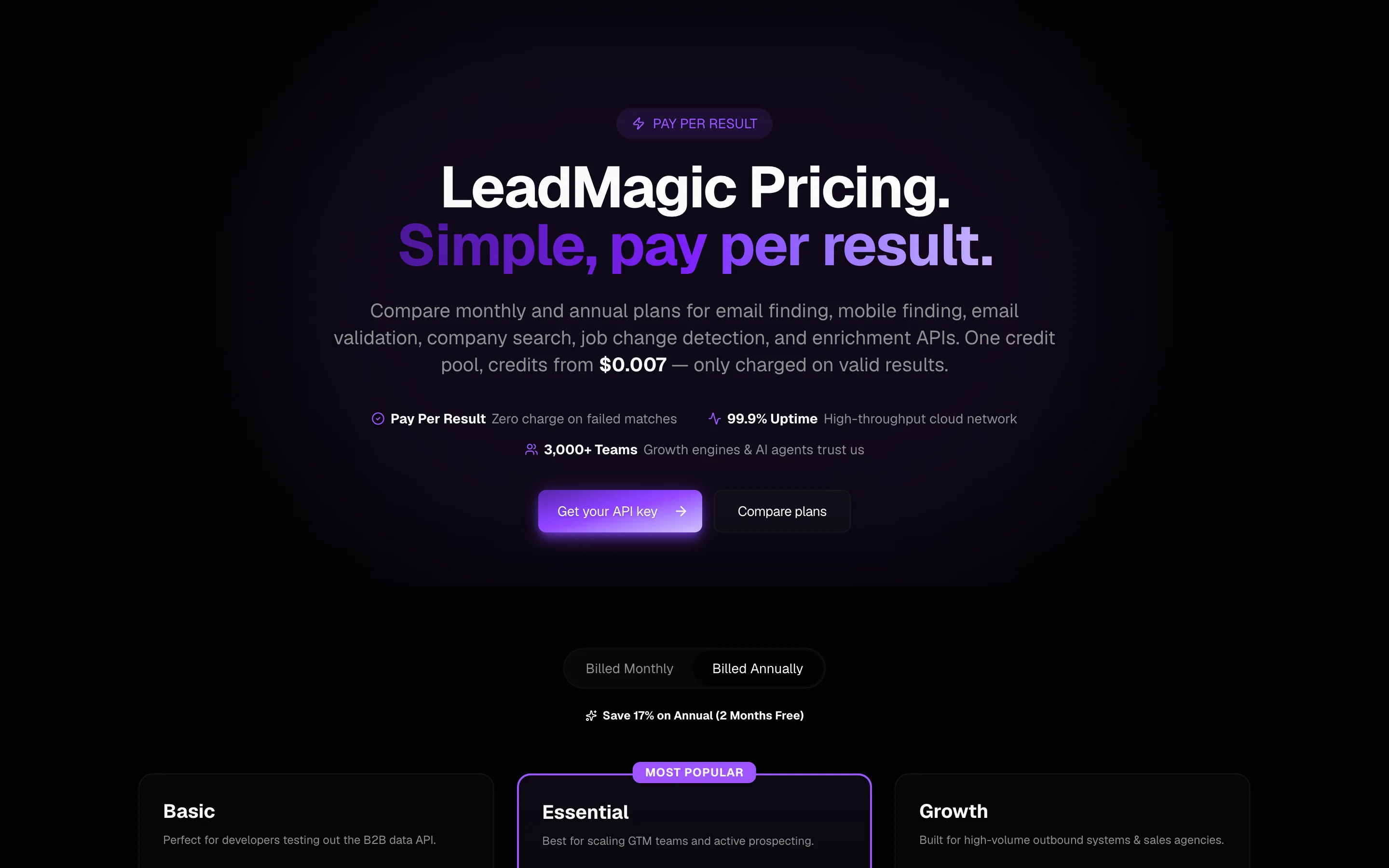
LeadMagic pricing. USD, from $49/mo for 2,000 credits (email 1 credit, mobile 5), deducted only on a successful result. That's about $0.0245 per valid email, and with no rollover on Basic the credits you actually use cost nearer $0.031, against Enrow's $0.017. No published EU/GDPR phone coverage.
vs Enrow: both are pay-per-valid with real APIs, but Enrow comes in lower; Enrow also adds a rep-friendly UI and the full-record CRM export an endpoint list can't do.
7. Snov.io
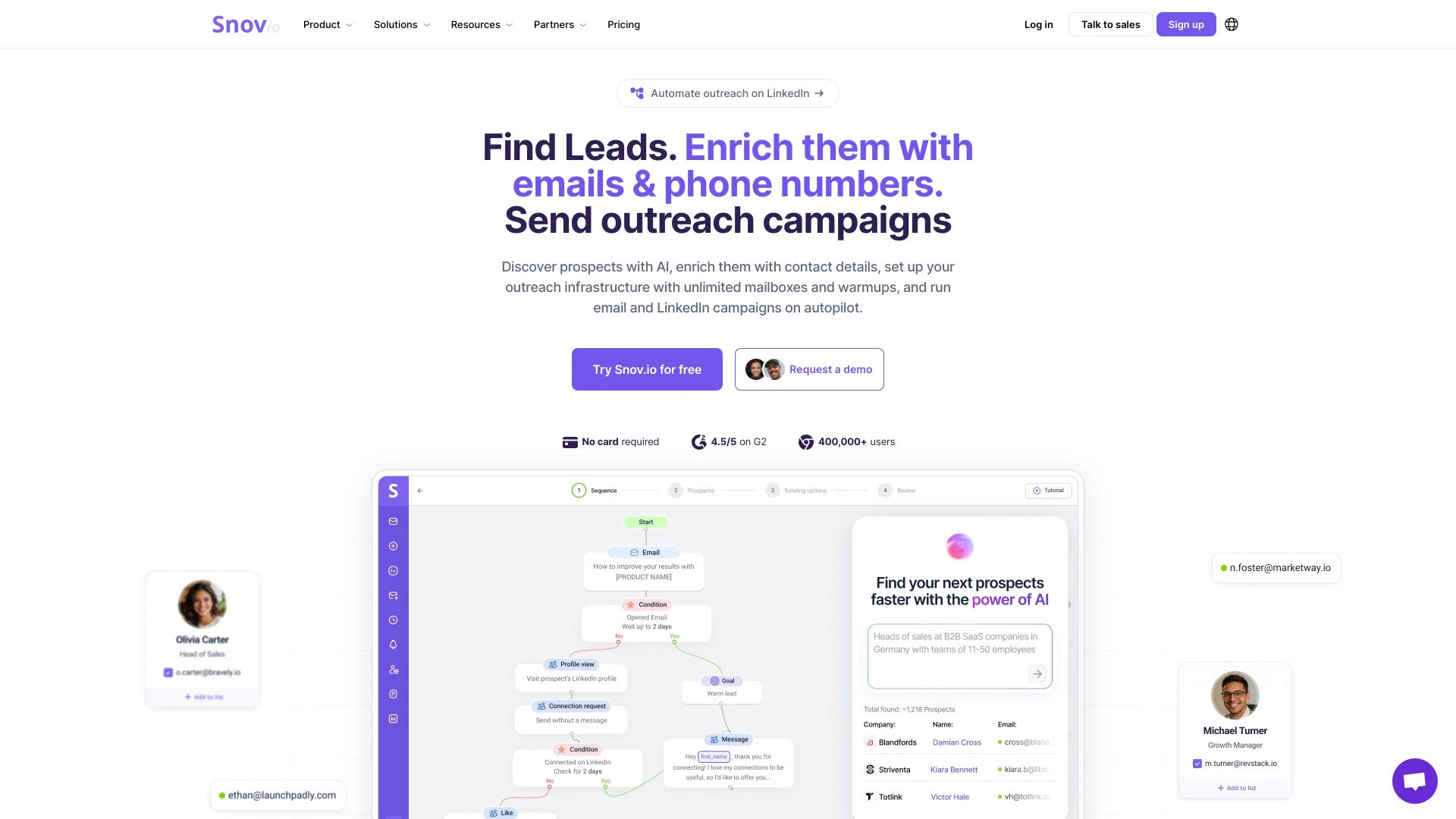
Everything under one login: database, finder, verifier, sequences. The opposite bet from Dropcontact's narrow focus.
Snov.io is a full sales-outreach stack: a searchable B2B database, an email finder and a 7-tier verifier, plus drip campaigns, a CRM and LinkedIn automation. Next to Dropcontact it's a different animal. Dropcontact enriches and verifies; Snov also builds the list and runs the sequence.
One subscription instead of three separate tools: that breadth is the draw.
The trade-off is the usual one for a stored database. Records drift as people change jobs, so finder accuracy on a live list trails real-time tools like Dropcontact and Enrow, and you pay for a lot of platform you may not touch if you only need clean data.
Then there's the meter. Snov charges for the search, not for the email. Run the lookup, spend the credit, and an empty result costs you exactly what a good one does. What does come back is only as current as Snov's last pass over the row, and old rows bounce.
Phones aren't in the plan at all; they're a separate token add-on. There's no EU phone play here, and no whole-contact handoff to your CRM. On my list a chunk of the found emails needed a second verification pass.
Enrow's real-time data is fresher, its verification deeper, and it bills only on valid results. So you're not funding a database that's already drifting.
- +Searchable B2B database plus finder and verifier in one place
- +Drip campaigns, CRM and LinkedIn automation built in
- +Free trial (50 credits) and unlimited team seats on paid plans
- +Annual billing knocks 25% off
- –Billed per search rather than per valid email, so misses come out of your allowance
- –Database-sourced data goes stale, so accuracy on a live list trails real-time tools
- –Credits reset each cycle rather than rolling over
- –It's a lot of platform if you only need clean emails
- –No EU phone coverage; LinkedIn automation is a paid add-on ($69/mo per slot)
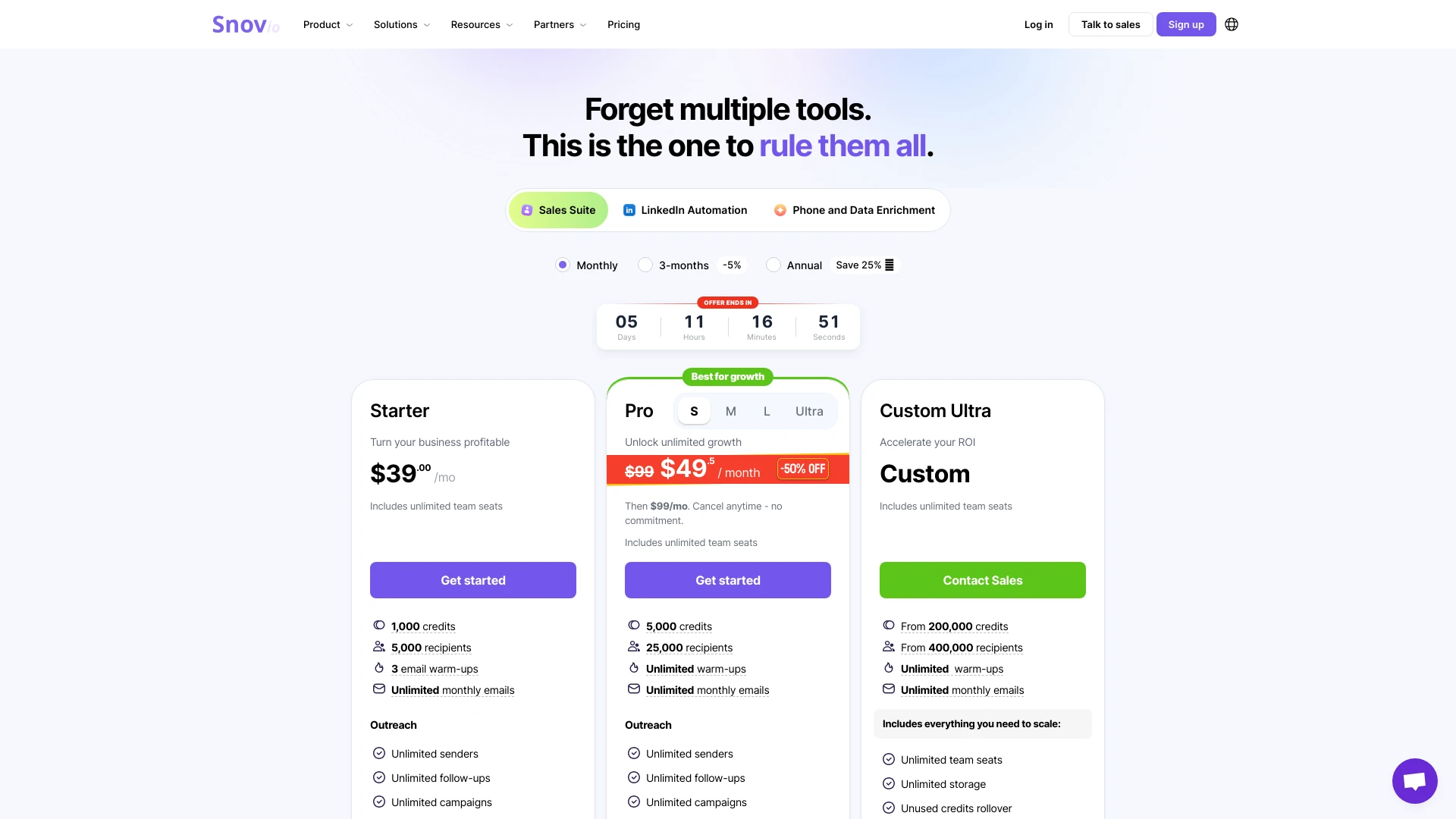
Snov.io pricing. USD, from $39/mo for 1,000 credits, but a credit buys the search, not the email. Assume a ~30% useful-return rate (our working figure, since Snov publishes none) plus stale-row bounce and no rollover, and a deliverable email runs about $0.17, roughly ten times Enrow's $0.017. Phones are a separate token add-on with no EU direct-dial story.
vs Enrow: Enrow runs the lookup live and only spends a credit when the result holds up — a miss costs nothing — and adds EU phones Snov doesn't sell. Snov bundles a sender and a database Enrow doesn't; that's the trade.
8. ContactOut
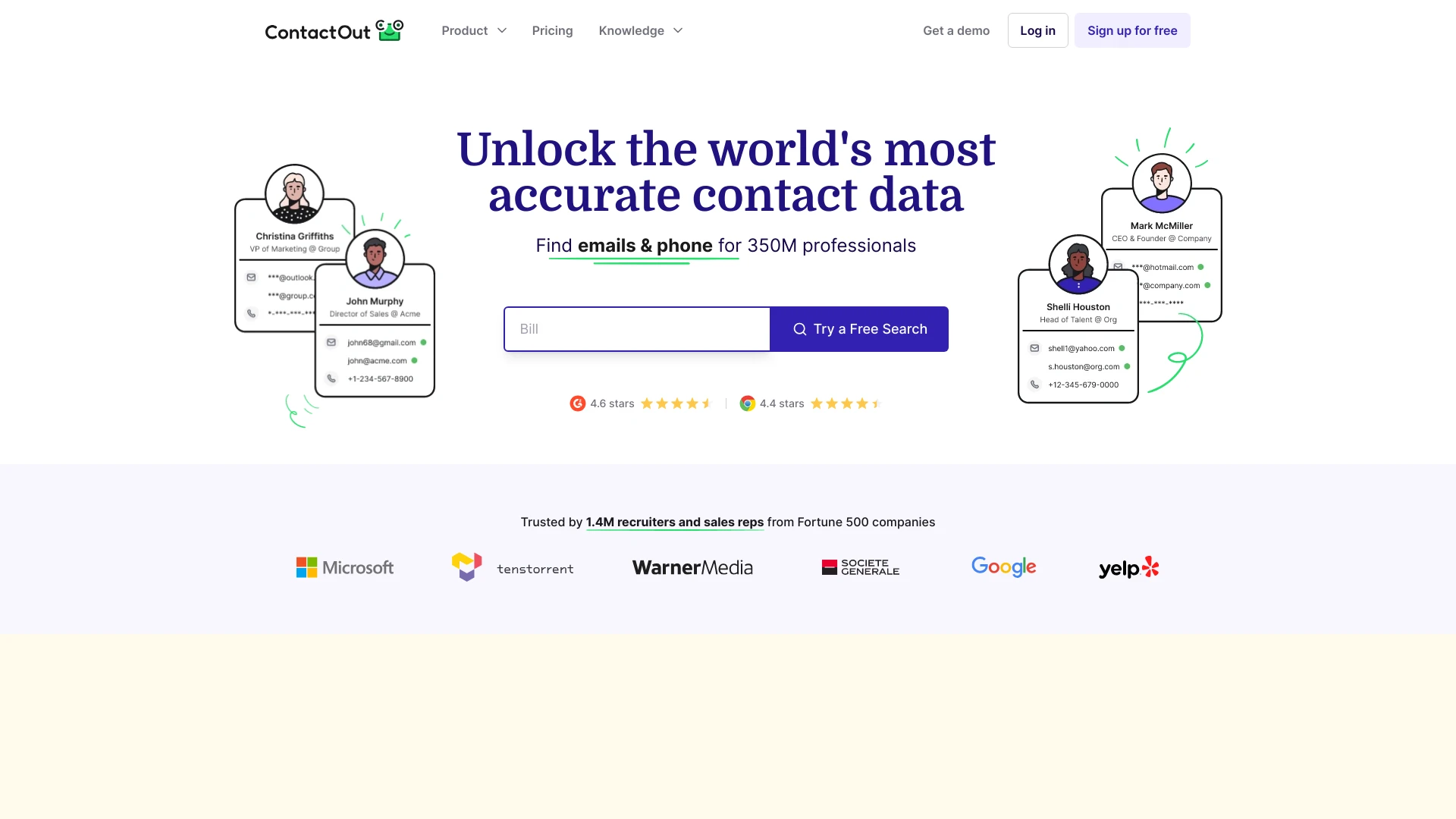
Built for sourcing humans, not cleaning a CRM.
ContactOut's strength is a ~300M+ profile database with both work and personal emails, plus deep LinkedIn Chrome-extension integration. Recruiters love it. Where Dropcontact rebuilds data in real time inside EU compliance, ContactOut is a stored database-and-export tool that skews North American.
Its calling card is personal emails, the kind Dropcontact's B2B-only model won't touch.
On my pass through it, the personal emails it surfaced were addresses no B2B-only tool returned; the French mobiles were the weak spot. The binding limit is exports per month, with no rollover or self-serve overage.
Phones (~100M direct dials) sit behind higher tiers, EU coverage is weaker than US, and the "Exclude US/UK Data 50% off" toggle tells you where the good data lives. It's a recruiter's sourcing tool.
For a sales team selling into Europe that needs verified EU dials, deep email verification and the finished record filed in the CRM for you, Enrow is the cleaner fit.
- +~300M+ profiles, work and personal emails
- +Strong LinkedIn Chrome extension and Search Portal
- +~100M direct dials in database
- +Popular and genuinely proven for recruiting
- –Export-capped, fair-use model with no rollover
- –Phones locked behind higher tiers; EU coverage weaker than US
- –Database-and-export model, weaker on EU/GDPR than Dropcontact, and no pay-per-valid billing
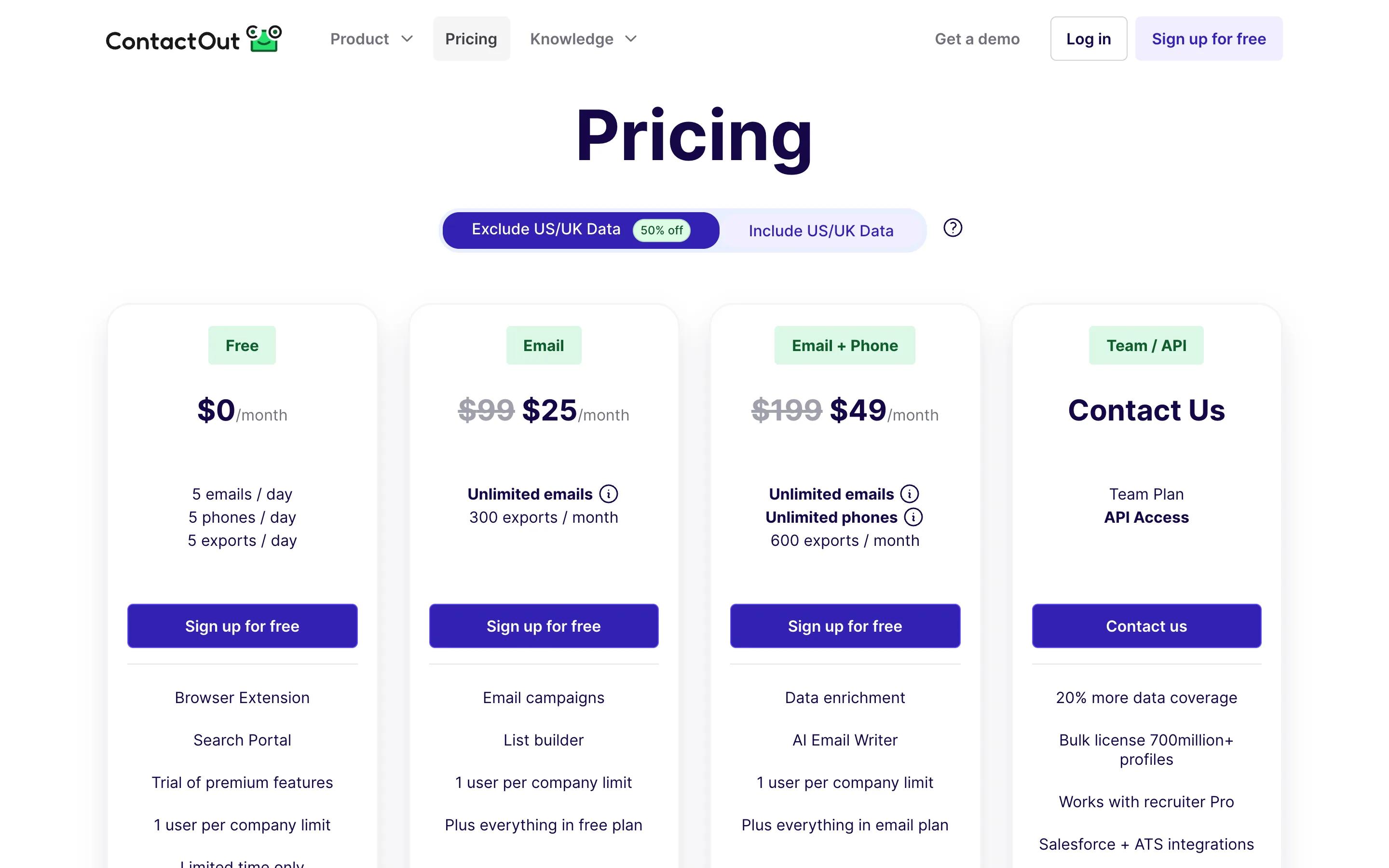
ContactOut pricing. USD, from $49/mo for the Email plan ($39 annual), capped at 300 exports with no rollover. It meters exports from a stored database rather than billing per verified result, so there's no clean $/valid figure — a rough 50-70% deliverable rate lifts the real cost well above the sticker on a live send. Phones sit behind the $99 tier, EU coverage weaker than US.
vs Enrow: ContactOut meters monthly exports from a stored pile; Enrow meters valid results, delivers EU direct dials where ContactOut is US-strong, and moves the entire contact card into your CRM in one motion, while ContactOut stays a recruiter's tool.
9. Kaspr
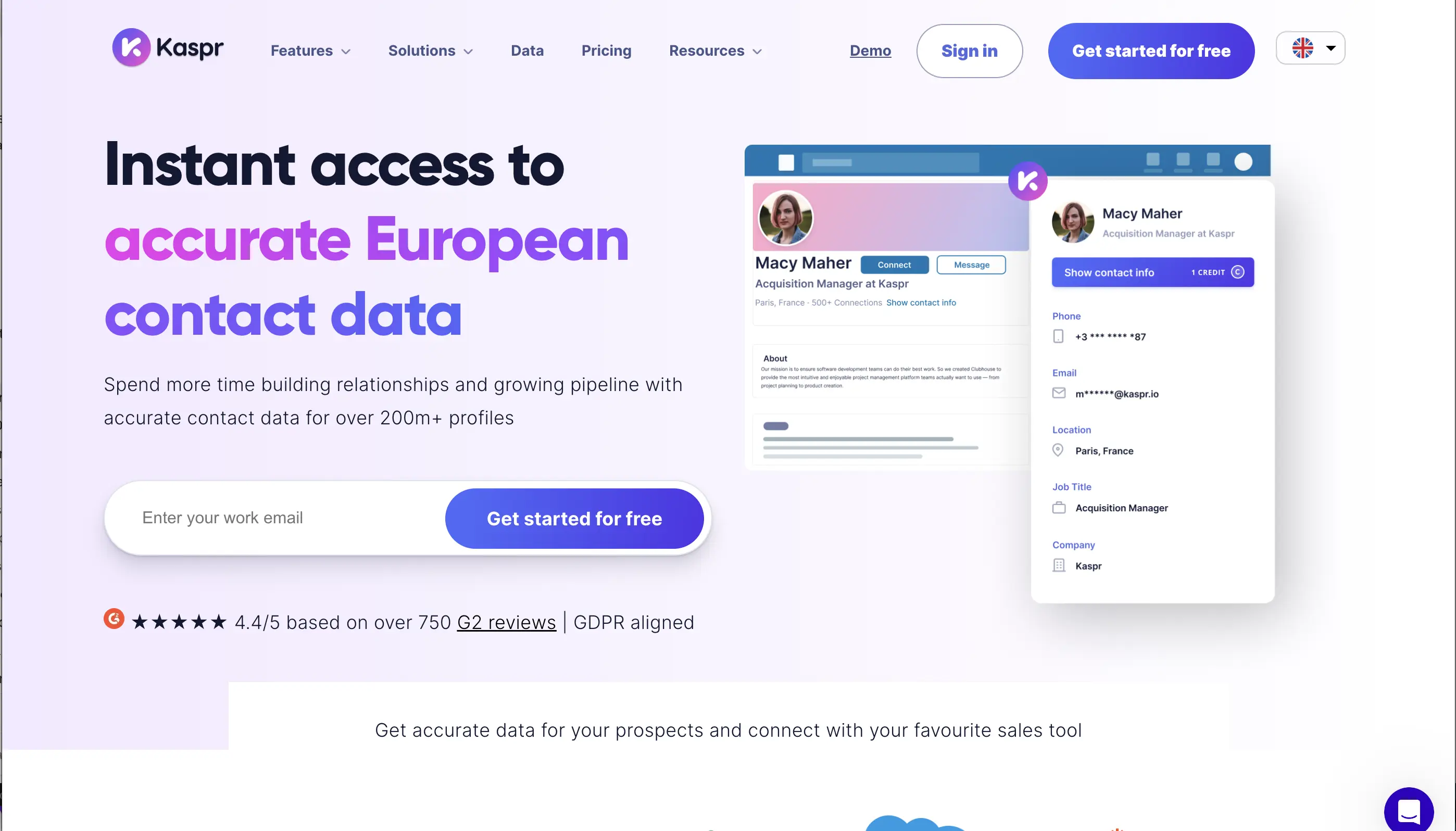
A LinkedIn-first reveal tool, European, and squarely aimed at phones.
Kaspr lives in a Chrome extension: open a LinkedIn profile, reveal the phone and email, push to the CRM. It's GDPR-and-CCPA aligned and part of the Cognism group, so the European angle is real, and unlike Dropcontact it actually treats phones as a headline rather than a signature by-product.
I worked through thirty-odd profiles with it one afternoon; it's quick, and a good slice of the month's phone ration was gone by the end.
The model differs from a pay-per-valid finder, though. Kaspr is per-seat, phone credits are metered (100/month on Starter, 200 on Business), and the "unlimited" B2B emails run into a fair-use ceiling of 10,000 emails per account per month, not per seat, per account.
The richer features and export volume sit on Business and up. It's a reveal tool for individual reps, not a bulk, billed-only-on-valid data engine.
Against Enrow you're paying per seat for capped phone credits, with no catch-all-delivered verification depth and nothing that writes every field into HubSpot, Salesforce or Pipedrive at once. Good for a single rep working LinkedIn. Less so for a team that needs volume and quality.
- +Fast LinkedIn Chrome-extension reveal for phone and email
- +European, GDPR/CCPA aligned, real phone focus
- +"Unlimited" B2B email on paid plans, fair-use capped at 10,000 emails per account per month
- +Free plan to try it
- –Per-seat pricing; phone credits are capped per month and the "unlimited" email is capped too, at 10,000 per account per month
- –Best features and export volume gated to Business and above
- –A one-at-a-time reveal tool, not a bulk pay-per-valid engine; no deep catch-all verification
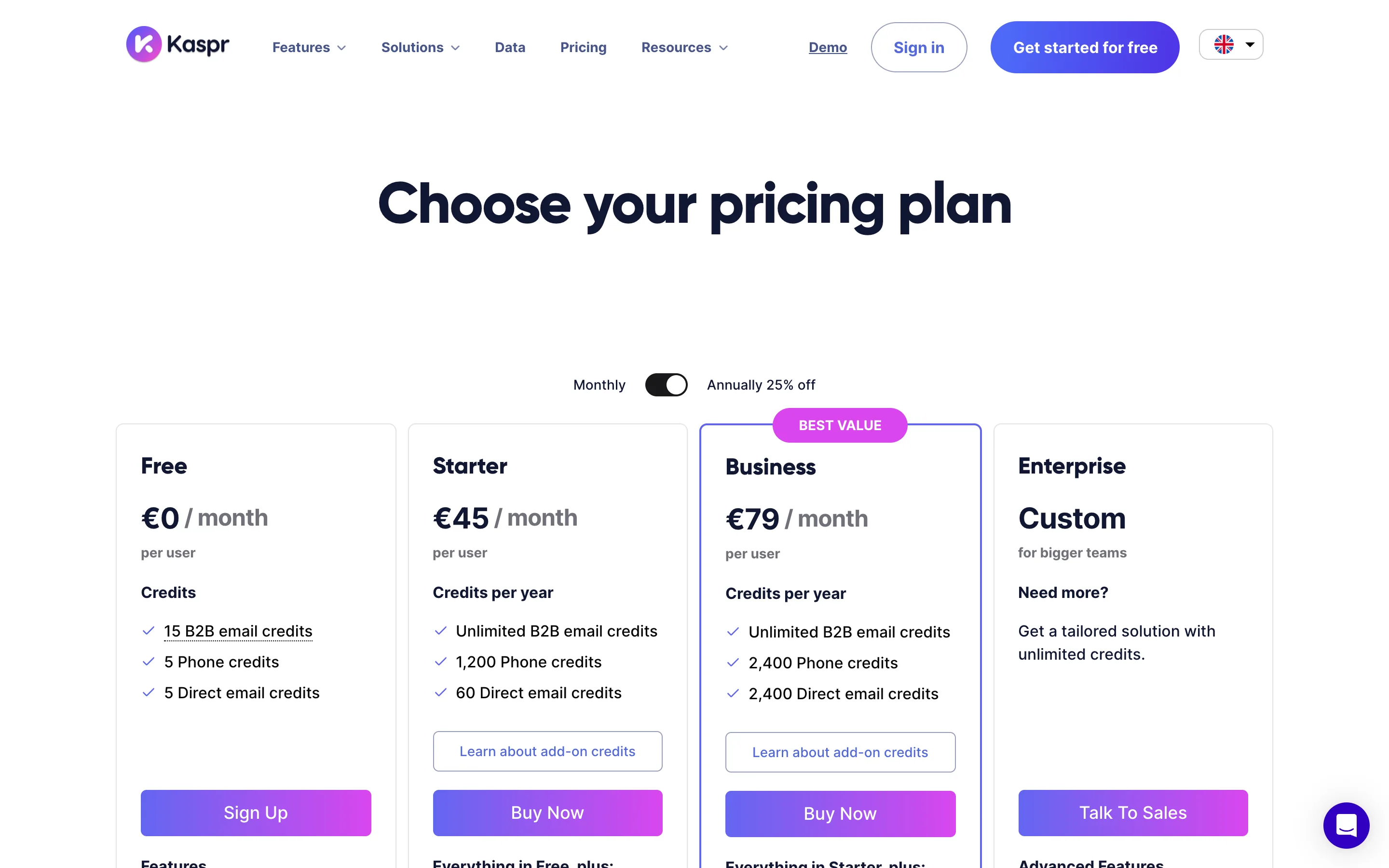
Kaspr pricing. In euros, per seat, from €59/mo per seat for 100 phone credits/mo, plus "unlimited" B2B email capped at 10,000 per account per month. It's a per-seat subscription, not a pay-per-valid meter, so there's no honest credit-based cost per email to compute — the phones are a fixed monthly ration that's gone once exhausted.
vs Enrow: Kaspr is a capped, per-seat reveal tool with no deep catch-all verification or complete-record CRM push; Enrow charges nothing for a miss, scales without seat math, and delivers EU direct dials in volume rather than a fixed ration.
10. Lusha
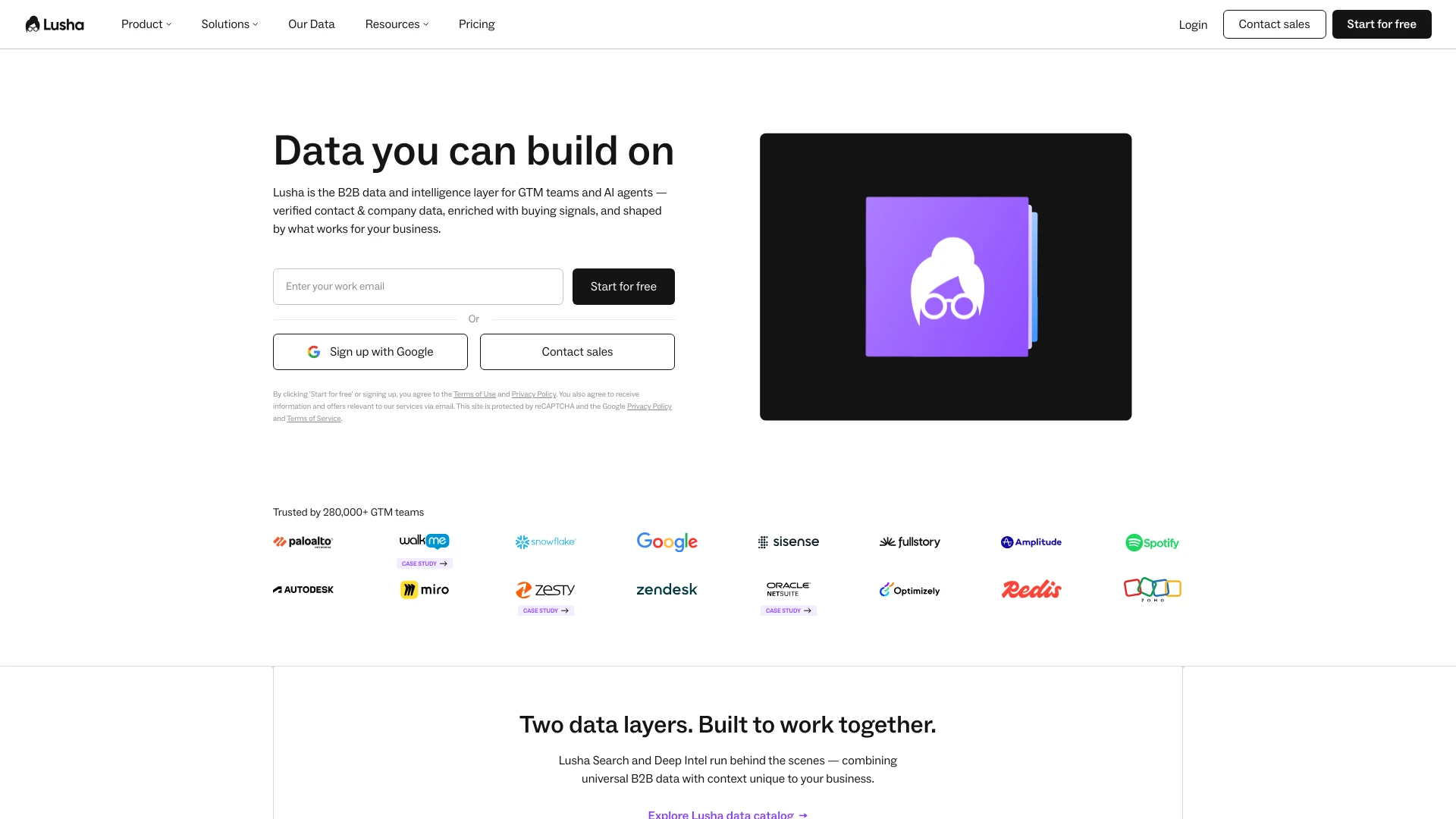
The mainstream, easy-to-adopt option, and priced like one.
Lusha is one of the better-known B2B data tools: a clean Chrome extension, a prospecting platform, CRM integrations, and a low barrier to entry. Against Dropcontact, it's database-backed rather than real-time enrichment, and it's more of a generalist contact-data tool than a French-firmographics specialist.
Of the thirteen, it was the fastest for me to set up, and the first where I hit a credit wall.
The economics are where it stings. Phone reveals cost 5 credits each, plans are credit-capped (400/month on Starter), rollover tops out at 2x, and the per-credit cost climbs fast if calling is your motion. $69.90/month buys just 600 credits on Pro.
And as a stored database, it serves you yesterday's org charts. Enrow's real-time data is fresher, a phone is 40 credits but only spent once a valid one comes back, verification runs 10+ checks with catch-all delivered, and the whole record arrives in your CRM by itself. Lusha is fine for occasional lookups.
For an outbound team that dials, it gets expensive quickly.
- +Easy, mainstream tool with a clean extension and CRM sync
- +Free tier (40 credits/month) to start
- +Broad B2B contact coverage and simple onboarding
- +Credits roll over up to 2x
- –Phone reveals cost 5 credits each; plans are credit-capped and get pricey at volume
- –Database-backed, so records age on the shelf
- –No pay-per-valid guarantee and no single-click whole-contact CRM write
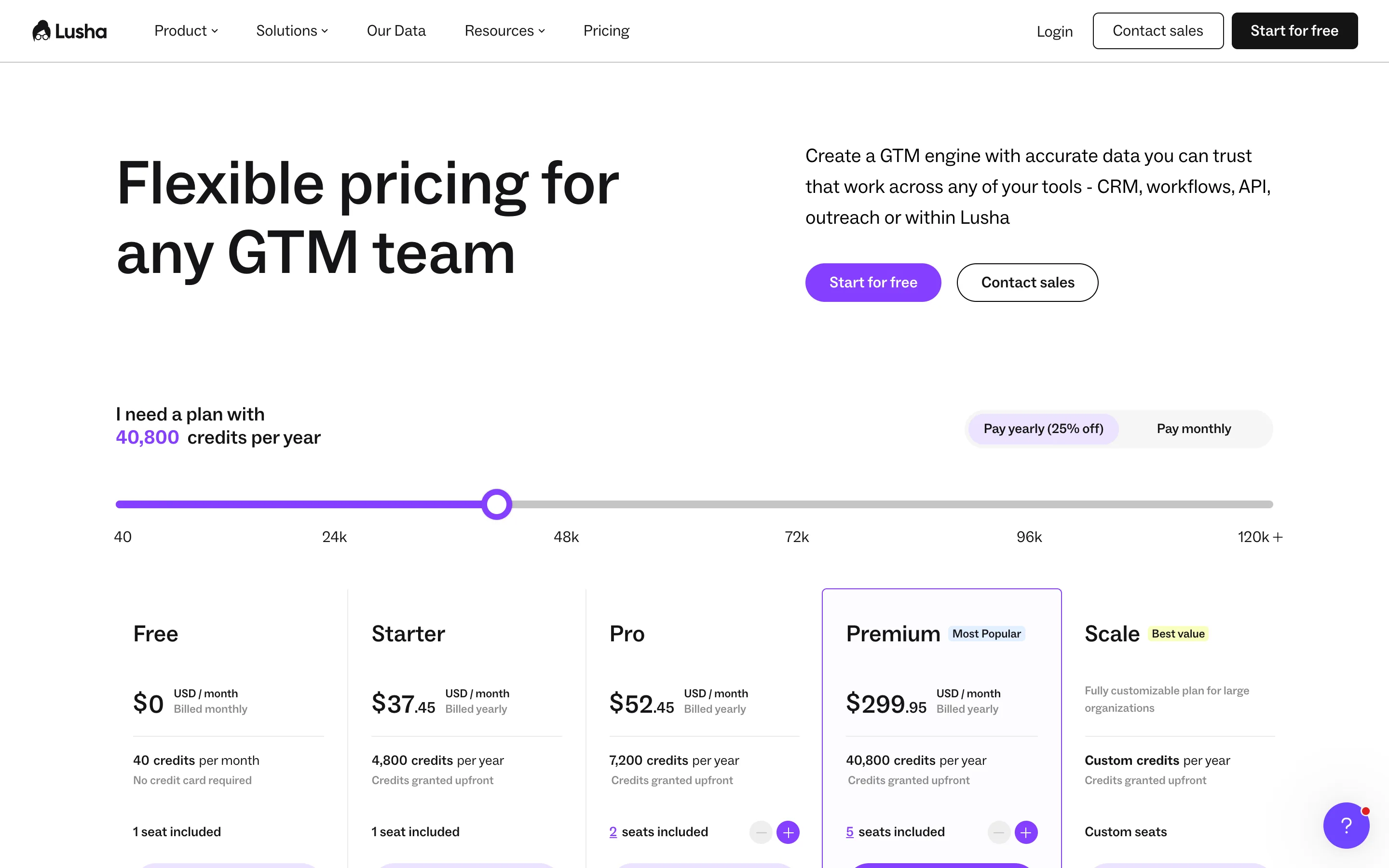
Lusha pricing. USD, from $49.90/mo ($37.45 annual) for 400 credits. A phone reveal costs 5 credits, so Starter buys just 80 phones at about $0.62 per phone on monthly billing, above Enrow's $0.47 per valid phone on the $47 monthly Start plan — and as a stored database a share of those reveals are stale on a live send (assume 50-70% deliver).
vs Enrow: Lusha's phones cost roughly double Enrow's per valid, its records age on the shelf, and there's no pay-per-valid guarantee or whole-record CRM write; Enrow's real-time data is fresher and its meter only runs on a valid result.
11. Cognism
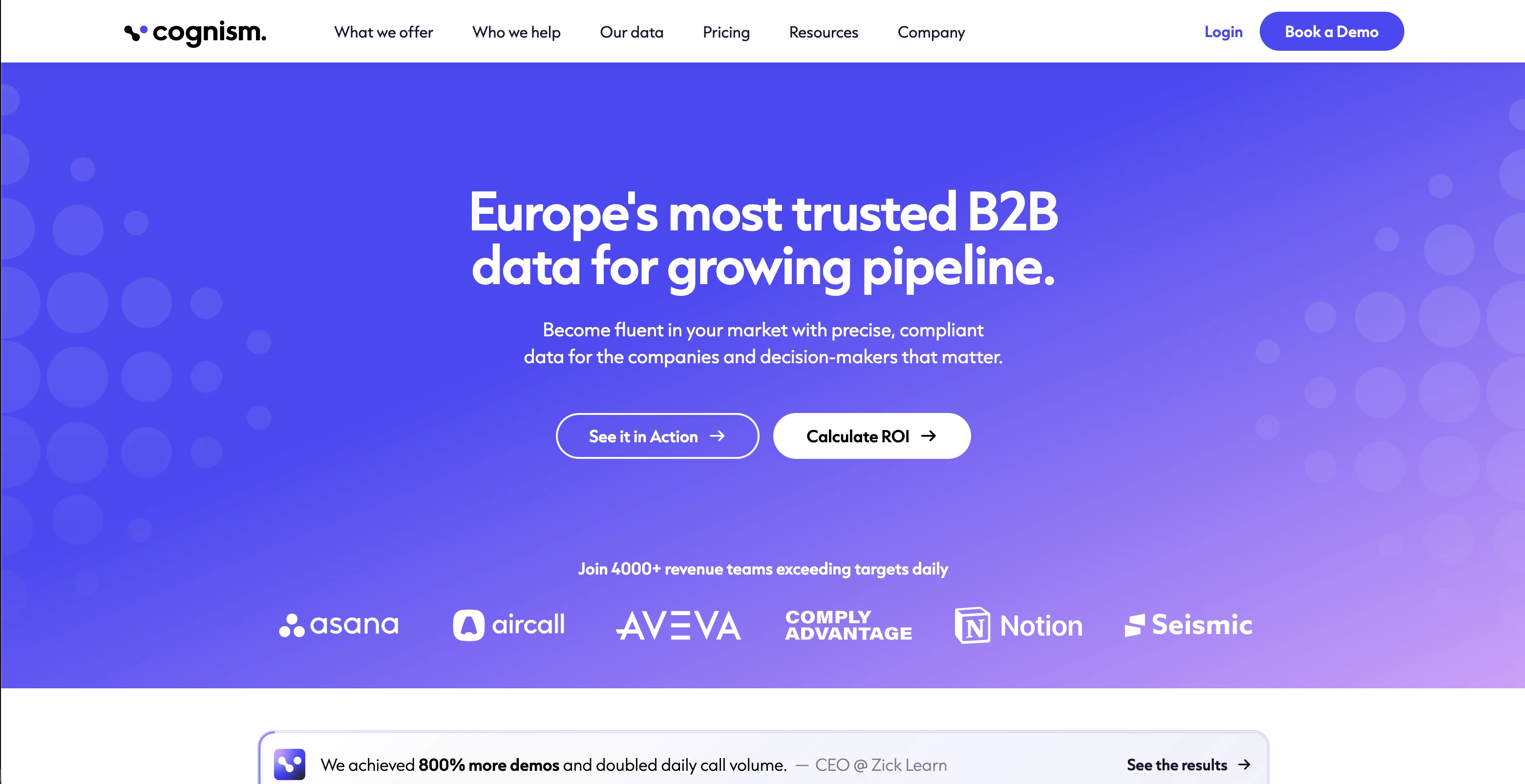
The enterprise heavyweight, with an enterprise price tag and an enterprise contract.
Cognism is a serious platform: phone-verified mobile numbers (its "Diamond Data," with a claimed high accuracy), Bombora-powered intent data, and broad international coverage including strong EU compliance.
If you're a larger sales org that wants verified mobiles plus buying-intent signals and has the budget for it, this is the grown-up option, and it does phones properly, unlike Dropcontact.
Full disclosure on the testing side: Cognism is the one entry I couldn't meter on my own list, because there's no self-serve way in, so this entry leans on published claims and pricing intel.
But it's a different universe of cost and commitment from a pay-per-valid finder. Cognism is quote-only, sold on annual contracts, per-seat, with platform fees that third-party sources put around $15,000-$25,000 a year before seats, and no self-serve or real free trial. There's no light way in.
For a team that wants verified EU phones and emails without an annual enterprise contract, without per-seat math, with nothing charged unless a result is valid, and delivered into the CRM without a copy-paste step, Enrow gets you the contact data at a fraction of the commitment.
Cognism wins only when intent data and enterprise scale are the actual requirement.
- +Phone-verified mobile numbers (Diamond Data) with strong claimed accuracy
- +Bombora-powered intent data and broad international coverage
- +Strong EU/GDPR compliance positioning
- +Built for enterprise scale and procurement
- –Quote-only, annual contracts, per-seat; platform fees ~$15k-$25k/yr before seats
- –No self-serve and no genuine free trial; heavy commitment to get started
- –Far more platform and cost than a team that just needs verified contact data
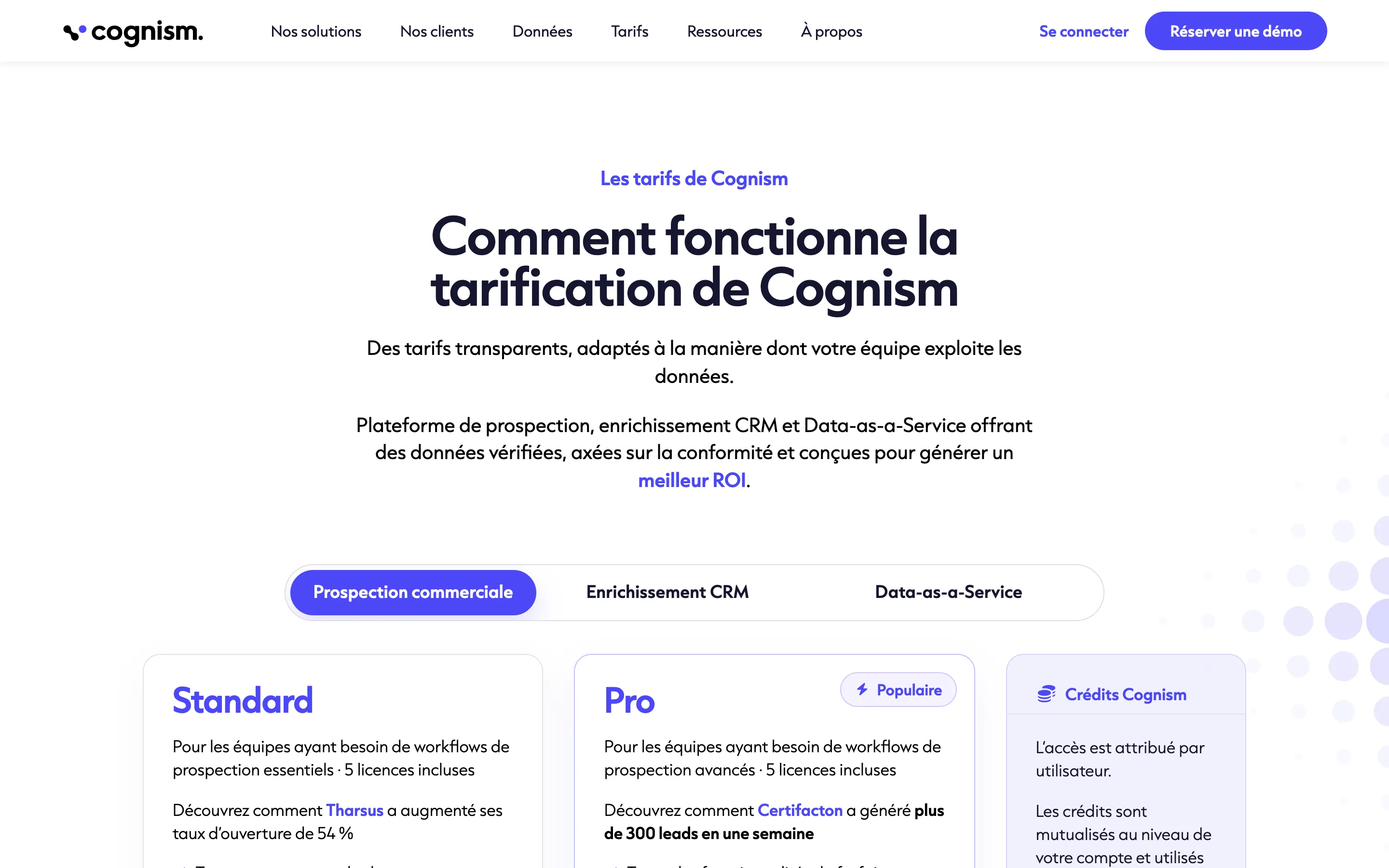
Cognism pricing is custom, quote-only, sold on annual contracts, with third-party estimates putting the platform fee around ~$15,000-$25,000/yr before seats. There's no honest per-valid figure to publish, but the entry commitment alone is orders of magnitude above Enrow's $17/mo.
vs Enrow: Cognism wins only when enterprise intent data and phone-verified scale are the actual requirement and the budget exists; for verified EU phones and emails where nothing is charged until the result is valid, at a fraction of the commitment and with the complete contact filed into your CRM, Enrow gets you the data without the contract.
12. Apollo.io
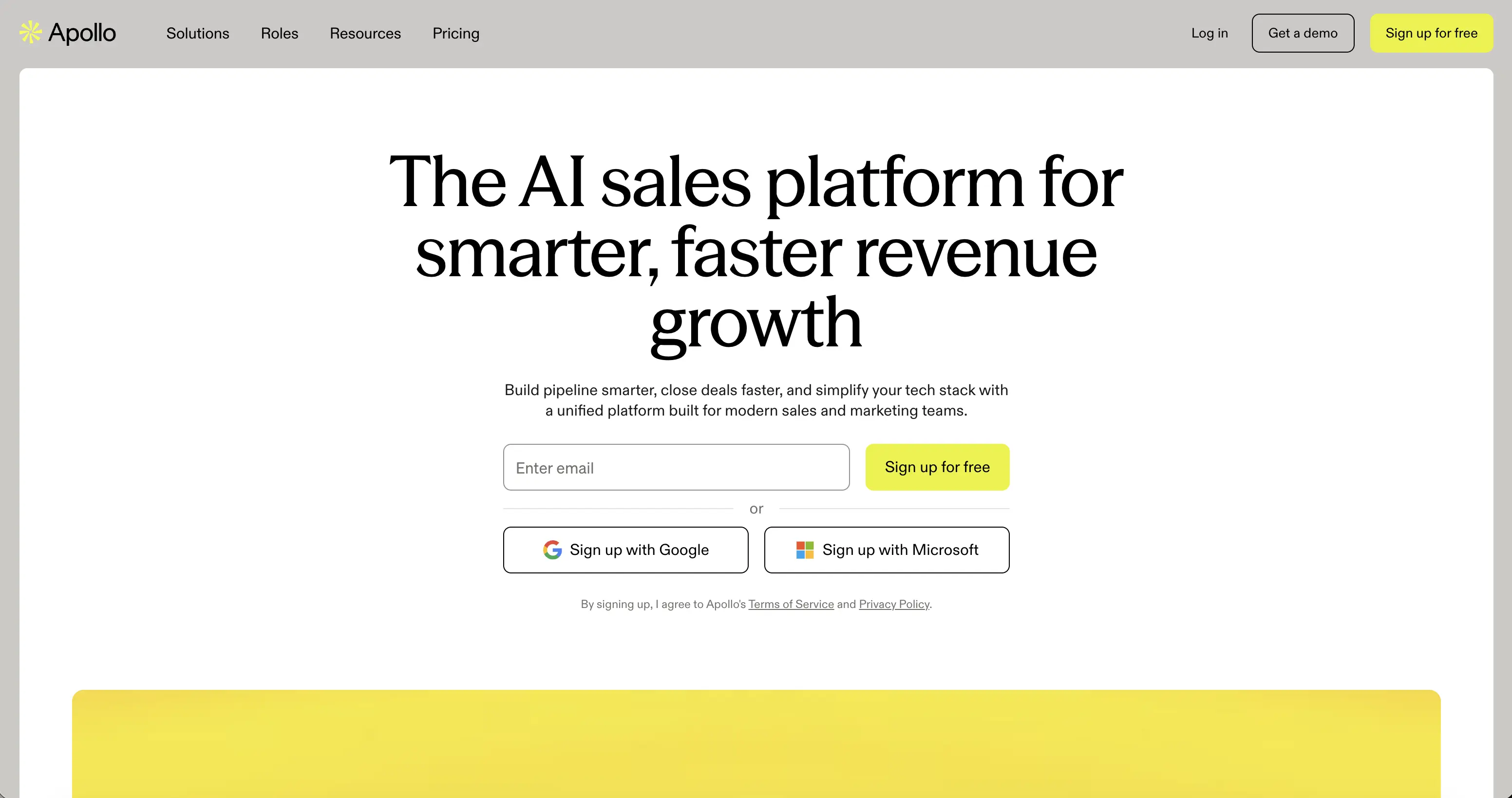
Browse, build, sequence, dial: Apollo wants to be your whole outbound office.
Apollo bills itself as "the AI sales platform for smarter, faster revenue growth," and that's a fair read of it. You get a large searchable B2B database, around 270M+ contacts, plus sequencing, a dialer, email and a built-in CRM. Against Dropcontact, that's the opposite philosophy.
Dropcontact rebuilds each record in real time and does one thing; Apollo hands you a stored list and a whole outbound stack to work it. A single login that finds, sequences and dials: that breadth is the draw.
The trade-off is the one every stored database carries. Apollo's data is a snapshot, already aging the day you export it, so on a live list its email accuracy trails the specialist finders and the real-time tools like Dropcontact.
When I rebuilt my list inside Apollo's own search, the big US accounts came out fine and the small European ones drifted. Phone data is largely unverified, EU coverage and DNC screening lean US/UK, and you can't lean on it for GDPR-cleared European dials.
Credits expire each cycle with no rollover, so unused allowance just evaporates. And it's per-seat, so the bill stacks up fast across a team.
One more gap matters here, on the CRM side. Apollo's extension can get a LinkedIn contact into HubSpot, Salesforce or Pipedrive, only not in one hop. The person is saved in Apollo's database first. Nothing moves on until an admin has connected the CRM (Apollo takes one per account) and written the rules for what gets pushed; from there Apollo creates or updates the record, but its default sync carries eight fields on HubSpot and Pipedrive, and the LinkedIn URL isn't one of them.
Enrow trades the giant stale database for fresh, verified, real-time data, EU dials included, with nothing spent until a result is valid, and the finished contact filed in your CRM for you. For accuracy, EU reach and clean CRM handoff, that's the better trade.
- +Large searchable B2B database (~270M+ contacts) to build lists inside one tool
- +Sequencing, a dialer and email built in, not just data
- +A built-in CRM, so a small team can run outbound without bolting on extra tools
- +Free plan to try the platform before you pay
- –The CRM sync waits on an admin to connect a single CRM per account and set push rules, contacts pass through Apollo first, and the stock fields leave out the LinkedIn URL
- –Database is a stored snapshot that ages on the shelf, so live-list email accuracy trails the finders
- –No GDPR-cleared EU direct dials; phones largely unverified and coverage/DNC screening lean US/UK
- –Per-seat pricing stacks up across a team, and credits expire each cycle with no rollover
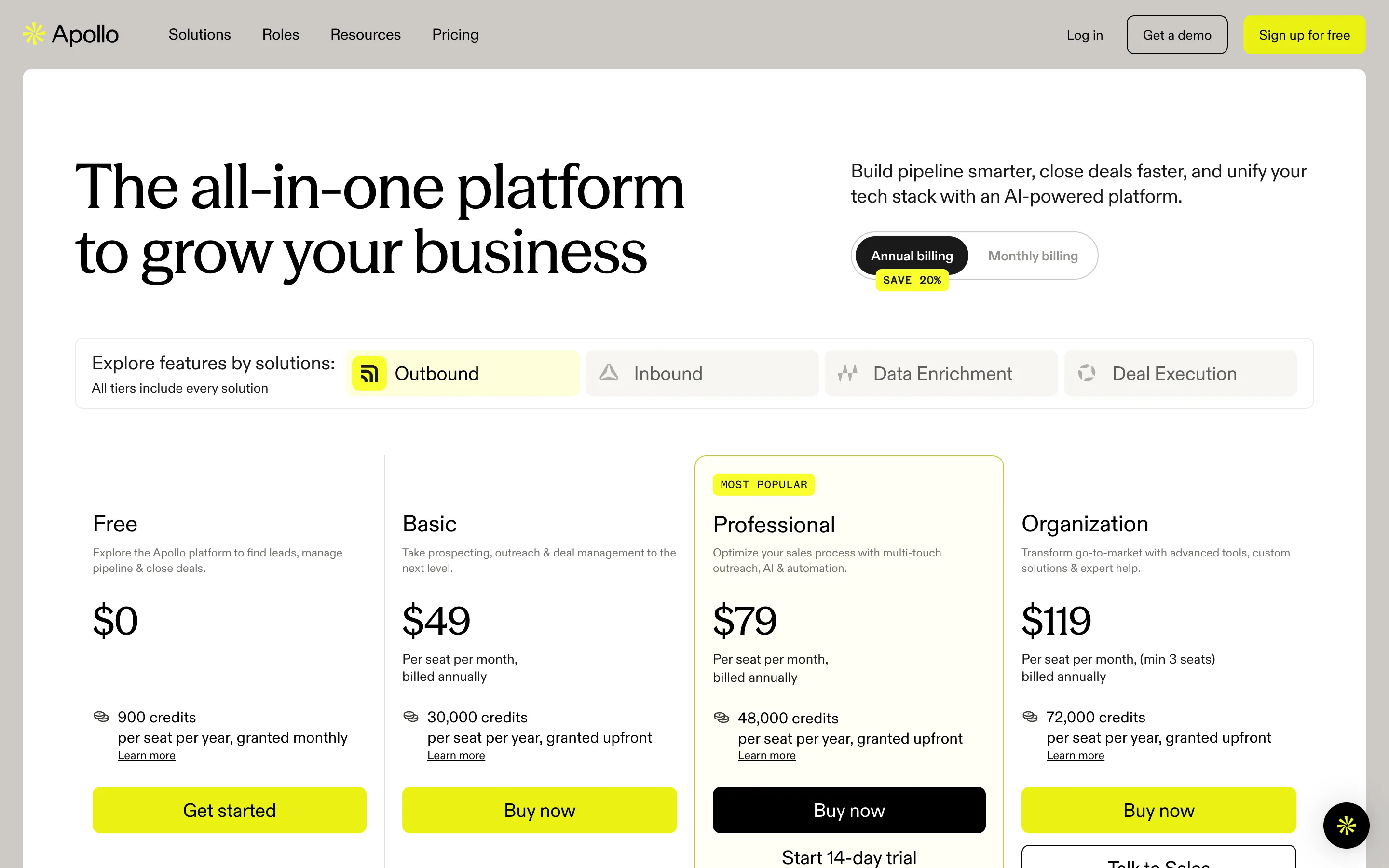
Apollo pricing. USD, per seat, from $65/seat/mo ($49 annual) for 2,500 unified credits (email 1 credit, mobile 8), which expire each cycle with no rollover. Price the waste in and an email lands at roughly $0.033 per valid address, about 2x Enrow's $0.017 on Start — and five reps on Basic is $325/mo before a single add-on credit.
vs Enrow: Apollo is the all-in-one; Enrow is the data layer. Its mobiles share one credit pool with email and come off a stored, US-leaning DB with no GDPR-cleared EU dials, where Enrow's data is real-time, spent only when the result is valid, and its extension files the full record into your CRM straight from the profile, with no stop in a second database and no push rules to write first.
13. Findymail
Email accuracy first, the US market second, everything else not at all.
Findymail points at a LinkedIn list or a domain and hands back verified business emails, billing only for the ones it finds. On the email side it's genuinely among the most accurate tools going, and that's the honest comparison with Dropcontact: both are credible on email, both bill around success.
Point it at fresh Sales Navigator lists and Findymail does more than Dropcontact, which is built to clean a CRM you already have.
But it hits the same wall Dropcontact does, harder. Findymail returns no phone data for EU contacts at all, because GDPR closes that door for them, and its numbers, at 10 credits each, cover the US only. Rollover caps at 2x. So you'd be trading one phone-weak tool for another.
Enrow breaks the pattern: real EU dials, plus emails that held up just as clean on my send, plus an extension that files the whole verified record in your CRM, which Findymail doesn't attempt. Findymail is a sharp email tool for a US-only motion. Past that, Enrow does more.
- +Among the most accurate email finders in the category
- +Charged only for emails it actually finds
- +Strong LinkedIn and Sales Navigator list extraction
- +SOC 2 Type 2 certified, GDPR compliant, EU-hosted
- –No EU phone data at all (GDPR); phone numbers cover the US only
- –Credit rollover caps at 2x your monthly allowance
- –Email finder only, no enrichment platform, no whole-record CRM handoff
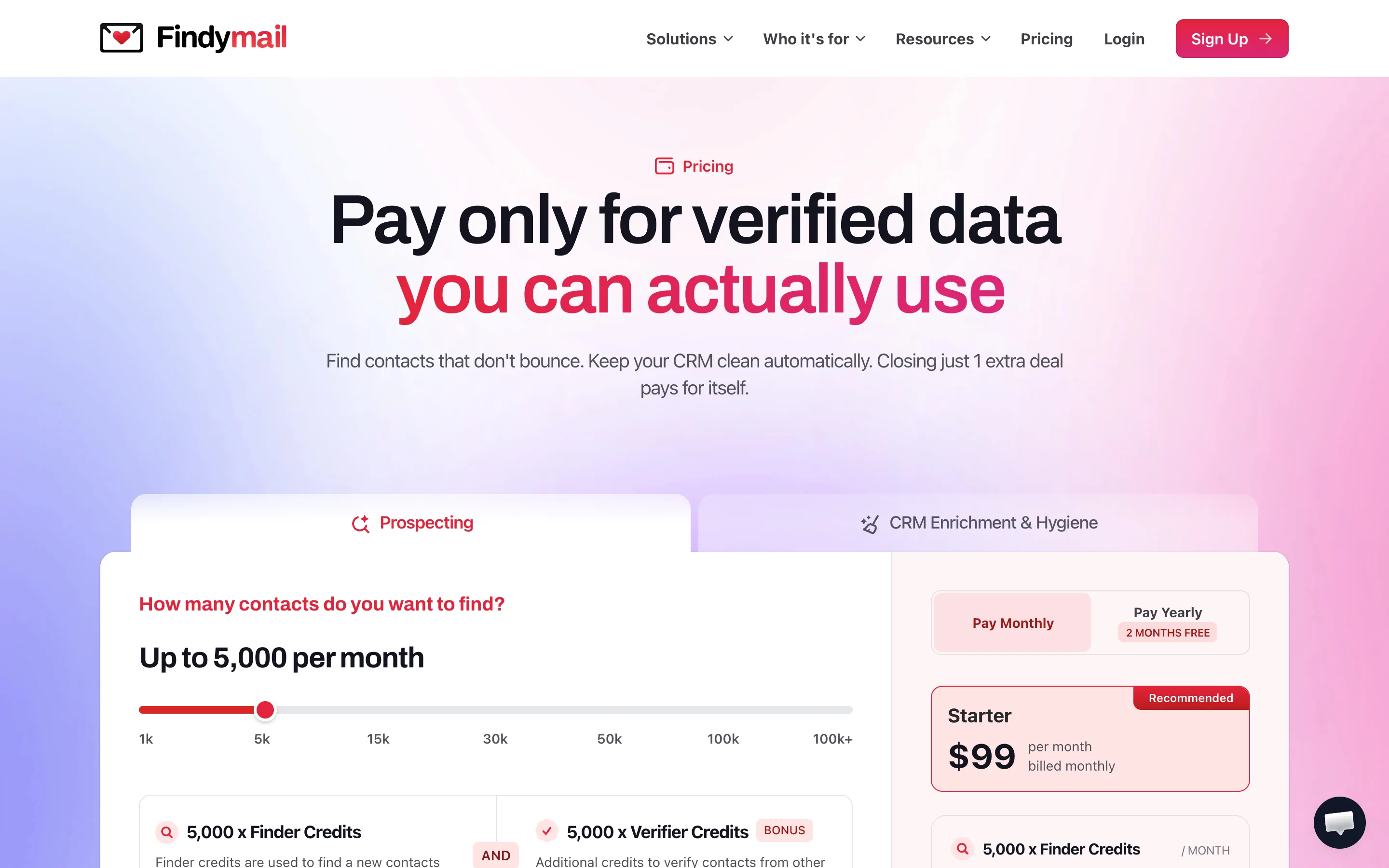
Findymail pricing. USD, from $49/mo for 1,000 finder credits, billed only on a found result, so the quoted price is close to what you'll actually pay — about $0.049 per valid email, roughly 3x Enrow's $0.017 on Start. Phones cost 10 credits but Findymail returns no EU mobiles at all (GDPR), so for a Europe list its per-phone number is academic.
vs Enrow: Findymail is a genuine quality near-peer on US email, but not the cheaper one; Enrow adds GDPR-cleared EU phones Findymail can't return, delivers catch-alls instead of dropping them, sends the complete card into the CRM, and opens at $17 against Findymail's $49 floor.
Dropcontact re-credits a miss; Enrow never bills one in the first place. Test that on your own CRM export, and note the free tier renews itself: 50 credits every month, no card.
Side-by-side comparison
Final Verdict
Strip Dropcontact back to the job it dodges — finding people, phoning people, paying only for data that's real — and Enrow wins this list. You keep the real-time, GDPR-compliant data people value and gain what Dropcontact can't do: real EU direct dials instead of signature scraps, at €0.015 per valid email on Start against the €0.038 of its no-rollover Starter, about two-fifths of the cost. And the part nobody else here matches: from a LinkedIn profile, one click, and the complete verified record sits in HubSpot, Salesforce or Pipedrive, updated on the contact you already had rather than duplicated beside it. Enrow isn't an all-in-one, though — no database, no sequencing, no SIREN/VAT depth, and that last one is where Dropcontact still beats us. But for the data layer underneath, landing in your CRM already complete, the answer here is Enrow.
Dropcontact re-credits a miss; Enrow never bills one in the first place. Test that on your own CRM export, and note the free tier renews itself: 50 credits every month, no card.
FAQ
How we evaluated these tools
No sponsor picked the winner here, and no link on this page earns me a commission. I ran it myself: one list of real B2B contacts, fed through every self-serve tool in the same week so nobody drew an easier set of names, then mailed to a live inbox to see what actually bounced (Cognism, quote-only, gets judged on its published claims instead). I ranked four things: match rate, bounce on that live send, the real cost per valid contact once the billing tricks are stripped out, and geographic reach, with legally-sourced EU phones carrying the most weight. Competitor pricing and features come straight from official pages read on 2026-07-02.
¿listo para dejar de perder el tiempo?
Conectado en minutos.
Data verificada en segundos.
sin tarjeta
sin configuración