apollo.io alternatives
Top 13 Apollo.io Alternatives & Competitors in 2026
So we tested thirteen alternatives. The yardsticks were the things that actually decide an outbound budget: match rate, bounce on a live send, real cost per valid contact, and geographic coverage, especially legally-sourced EU phones. Every tool below chewed on the same list inside a single week.
13 tools tested
updated October 2, 2026
18 min read
Actualizado el 2 de octubre de 2026
The alternatives at a glance
Enrow is the best overall Apollo.io alternative for teams that want verified emails and EU phones and want to pay only for valid results. Plans open at $17/month, and Pro works out to about $0.0087 per valid email and $0.35 per valid phone ($87 for 10,000 credits = 10,000 emails or 250 phones). Emelia is the route if you'd rather find and send from one tool; Hunter is for pulling emails off a domain with source citations; Findymail for pure US cold-email addresses; Snov if you still want an all-in-one database and sequencer; Lusha and Cognism for mobile-heavy motions. The rest each own a clear niche below.
Apollo.io is the tool most teams try first: one seat, a big database, sequences, a real free plan.
The catch is that the database is stored, so a slice of any cold list has already changed jobs, credits are per seat and expire unused at the end of every month, and EU phones run thin.
If you sell into Europe or dial as much as you email, Enrow is the fix at the data layer: verified emails plus GDPR-cleared EU phones found live, billed only on valid results. Start runs $17/month; Pro brings that down to about $0.0087 per valid email and $0.35 per valid phone.
Bounce on my live send stayed under 1% (an observed average, not a guarantee). And one workflow shortcut: a single click in Enrow's Chrome extension turns a LinkedIn or Sales Navigator profile into a complete verified record, every field filled, inside HubSpot, Salesforce or Pipedrive, with no third tool to save it in first.
The twelve tools below each win a niche. None is the better overall buy.
Why teams look for Apollo.io alternatives
Apollo is a fine place to start outbound, yet people still leave it for one of three reasons. If your whole motion is US email with the occasional sequence, and you're fine with a database, Apollo can hold. If it isn't, keep reading.
Conflict of interest disclosure
Cards on the table before the ranking. I built Enrow, Enrow sells contact data, and I've ranked it first on a page about contact data. Factor that in as you read.
In the same breath, the concessions: Enrow runs no outreach campaigns (Emelia and Snov below do, and so does Apollo itself), no mailbox warm-up (same two tools), and no waterfall enrichment (that's Emelia or LeadMagic territory). None of that is an accident.
Stacking six vendors' databases behind a slider hides the misses; finding and verifying every contact ourselves means owning them.
The claim I'll defend is narrower and harder: on the single job of producing accurate, fresh emails and phones, Enrow is the strongest tool on this page. Campaigns or a full suite aren't it, a tool below fits you better there, and I'll point you at it.
The data itself is what we do all day.
The 13 best Apollo.io alternatives
1. Enrow
#1
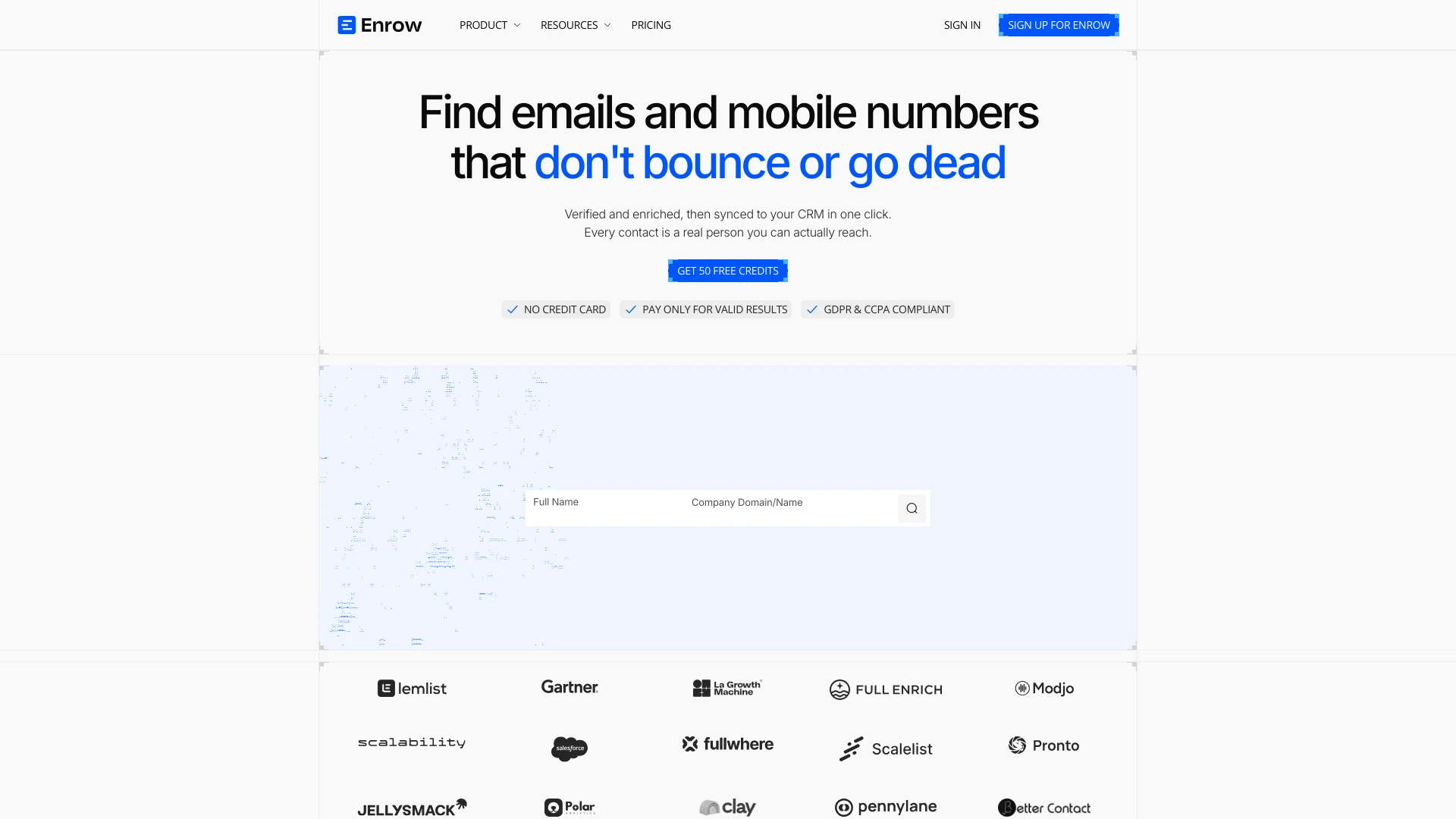
Enrow exists because per-search billing used to mean paying for misses: look up 10,000 names, keep 1,000, watch some of those bounce anyway. So I built the tool that charges only when the answer is real.
The split with Apollo is clean, and it starts with the data itself.
Apollo serves you rows from a stored database, and a stored row is only as young as its last refresh; on any cold list, someone has already handed in their notice. Enrow finds each contact fresh in real time, then runs 10+ verification checks before an address counts: multiple SMTP passes, catch-all checks across servers in different regions.
That's the difference between a name that was accurate last quarter and one that's accurate today. And you pay only when the result is valid. No valid email, no charge, so you stop funding the guesses.
Then there's the meter. Apollo's credits sit in a team pool granted per seat: email draws on it, mobiles draw on it, so a rep who dials hard drains the email budget just the same, and every new seat is another subscription. Enrow charges per credit, not per seat, with up to 10 team members on Pro and unlimited on Scale.
On phones, Apollo's coverage is US-leaning; Enrow returns direct dials in any country, Europe included. On my list, the EU rows were exactly where Apollo's export left blanks and Enrow came back with numbers that rang.
Catch-all emails get verified and delivered too, not flagged "risky" and quietly dropped.
On the live send, one thing jumped out. Bounce sat under 1%, and the EU mobiles put me through to the actual person rather than a reception desk. Discovery ran around 60% on a mixed list.
One caution to be straight about: that sub-1% is an observed average, not a contract.
And there's a workflow edge, the one reps notice first. Enrow's Chrome extension reads a LinkedIn or Sales Navigator profile and writes the whole verified record into HubSpot, Salesforce or Pipedrive: email, phone, every field populated. No copy-paste. No half-filled record. And the write is a create-or-update, so the extension looks for that person before it saves anything. Someone already in the base picks up the missing fields; someone new gets created. The calls, the notes and the emails your team logged over the past year stay attached to one contact instead of splitting across two.
Apollo's extension reaches a CRM too, by a longer road. It saves the LinkedIn contact into Apollo first; once an admin has connected HubSpot, Salesforce or Pipedrive (one CRM per Apollo account) and set push rules, Apollo creates or updates the record there, on a default field set (eight fields on HubSpot and Pipedrive) that leaves out the LinkedIn URL. Enrow skips the stopover and the setup: the click on the profile is the write.
One more thing, for the AI-agent crowd. Enrow ships an official MCP server (the repo is github.com/EnrowAPI/enrow-mcp), so you can call the email finder, verifier and direct-phone finder straight from Claude, Cursor or Windsurf. Fresh, verified emails and phones pulled into an agent workflow, still pay-per-valid.
Niche today, but if you're wiring up agents it saves you a scraper.
- +Pay only for a valid result; a miss never costs a credit (Apollo spends credits on records that may be stale)
- +Direct-dial phones in any country, EU included (Apollo's mobiles are US-leaning)
- +10+ verification checks per email; catch-all verified and delivered, not dropped
- +Native CRM integrations: Clay, HubSpot, Salesforce, Pipedrive, plus webhooks, and a genuinely good API
- +One click on a LinkedIn or Sales Navigator profile and the Chrome extension lands the complete verified record, all fields, in HubSpot, Salesforce or Pipedrive, created or updated, with no stop in a third tool
- +Credit rollover on Pro and Scale; no per-seat fees, up to 10 team members on Pro and unlimited on Scale
- –No searchable database. Deliberate: a stored list starts aging the day it's compiled, and you end up pitching people who quit last spring. Enrow looks every contact up live instead, which is exactly why the results hold up. Source your lists in LinkedIn or Sales Navigator.
- –No outreach sequencing, and none planned. For sending, go Emelia first, then La Growth Machine, then lemlist.
- –No technographics. Company data is LinkedIn-level; tech-stack detection isn't there.
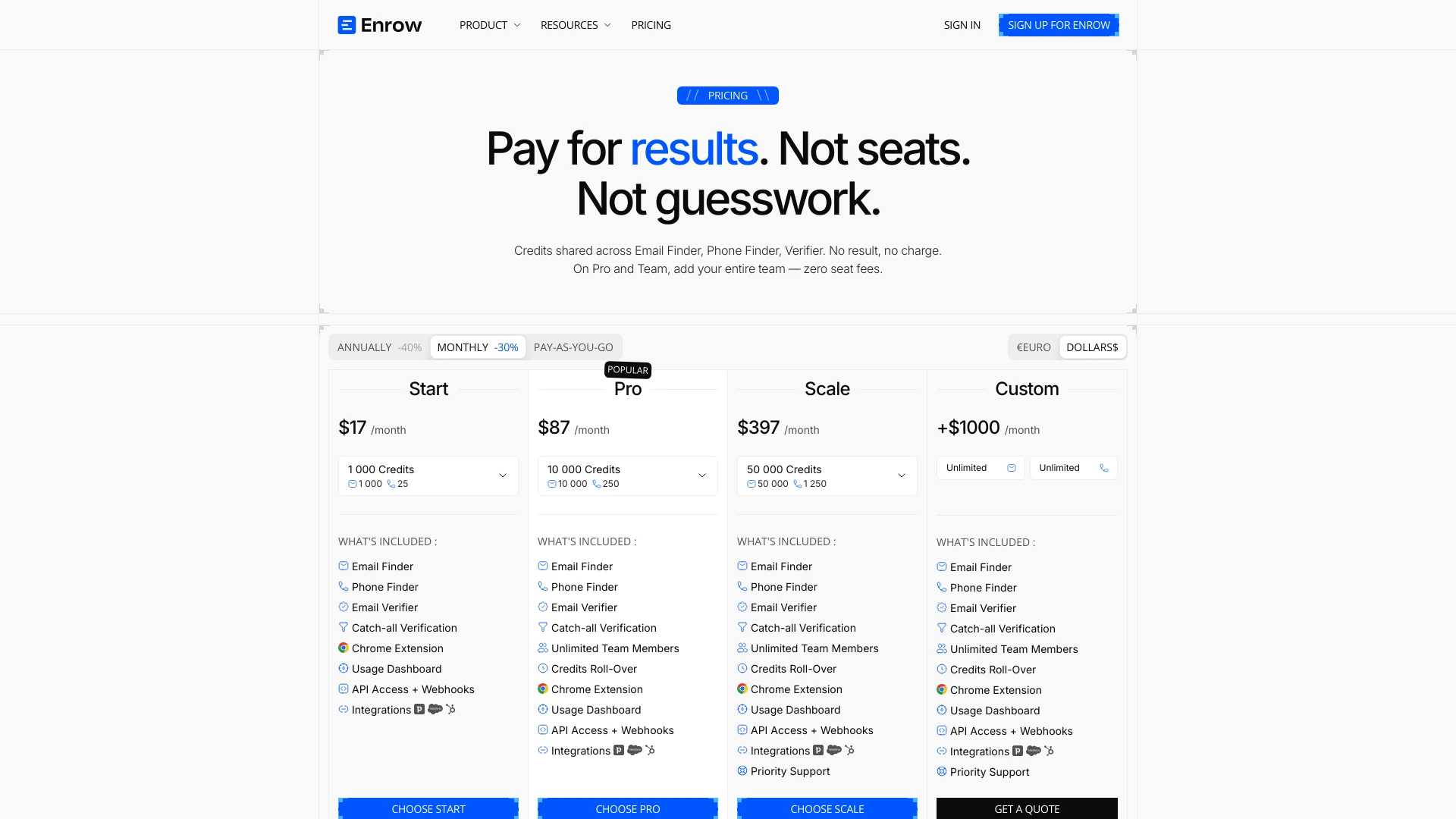
Three subscription tiers. Start at $17/mo for 1,000 credits or $47 for 4,000 (monthly only). Pro runs $87/mo for 10,000 credits, $167 for 20,000, $247 for 30,000. Scale goes from $397/mo for 50,000 up to $1,397 for 200,000.
Pay annually on Pro and Scale and the bill drops about 10%: 10,000 credits come to roughly $78/mo, 50,000 to about $357/mo. The credit math: 1 email = 1 credit, 1 phone = 40, a verification 0.25, catch-all included, and nothing is charged unless the result is valid.
Spend a 10,000-credit plan entirely on email and it's 10,000 addresses; entirely on phones, 250 numbers. Credits roll over on Pro and Scale. Free tier: 50 credits every month, recurring, no card needed.
Because a credit only spends on a valid result, the price on the label is the price you actually pay. Enrow skips the two penalties that inflate almost every other bill on this page: a miss costs nothing, so you never fund the lookups that come back empty, and an address that fails verification isn't billed either.
And credits roll over on Pro and Scale, so nothing you bought dies at the end of the month. The cleaner comparison base is Pro: $87 for 10,000 credits, meaning 10,000 valid emails at about $0.0087 each or 250 valid phones at about $0.35 each.
Start is the smaller $17 entry tier, $0.017 per valid email. Hold those two numbers.
A few tools below put an eye-catching number up front, but that number only means something when the meter runs on valid results.
Don't take a founder's word for his own tool. Enrow hands you 50 free credits every month, recurring, no card, enough to put a slice of your own list through it before a cent changes hands.
2. Emelia.io
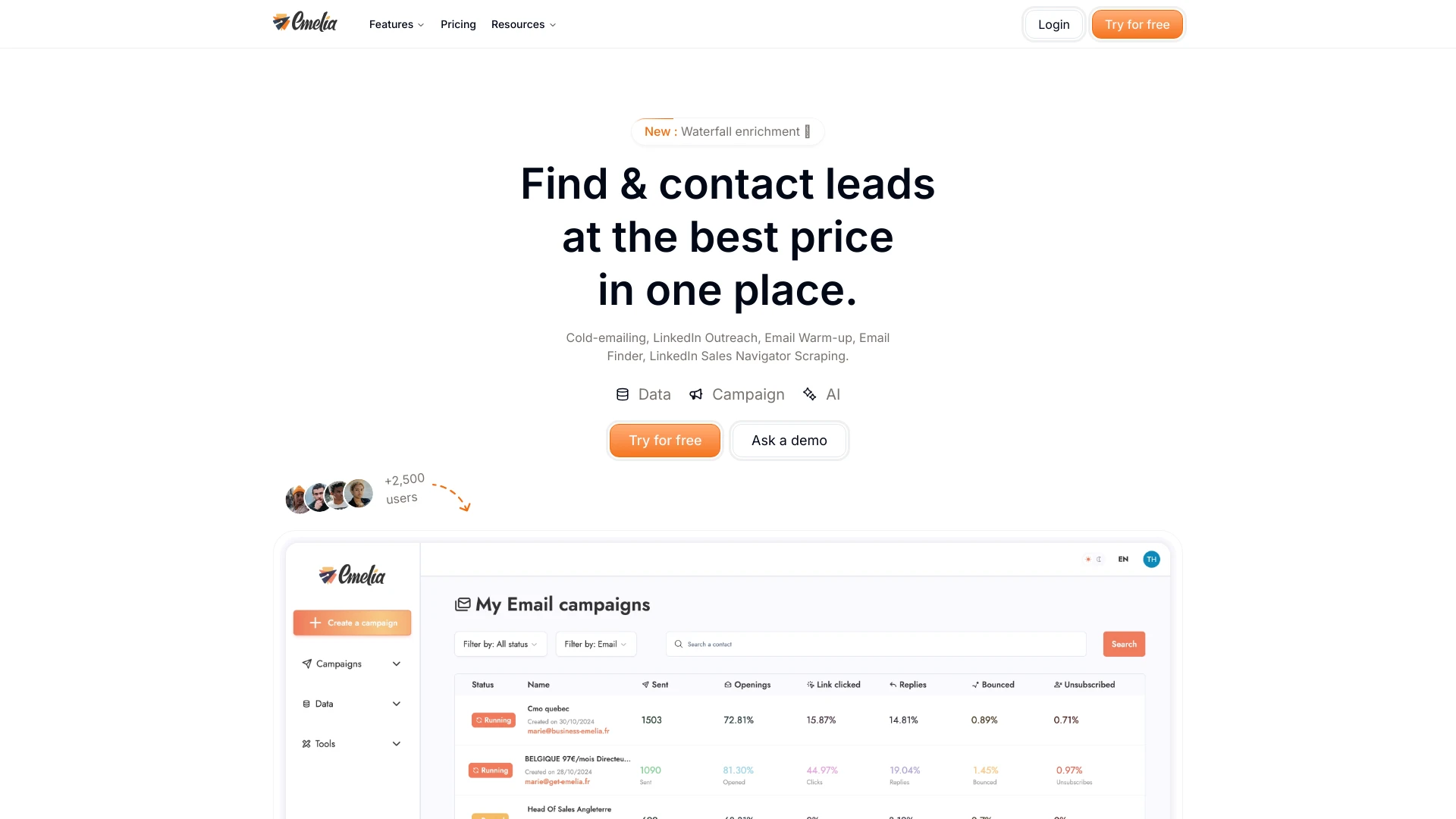
If Apollo's appeal was one login for everything, Emelia is that idea rebuilt around sending instead of a stored database.
Emelia is where finding and outreach live together: an email finder with waterfall enrichment, a verifier, LinkedIn Sales Navigator scraping, then cold email and LinkedIn sequences with warm-up built in.
Where Apollo bolts a huge stored database onto its sequencer, Emelia keeps the finder lightweight and puts the weight on sending. For a small team that wants one login for finding and campaigns, and doesn't want to pay for a 200-million-row database it barely queries, that's the niche it fills.
But it's a sequencing tool first, and the data side shows it. The finder is fine, and credits burn on results, not blind searches, which already beats a per-seat database meter. Yet Emelia's center of gravity is sending, not data depth. Phone coverage is thin.
The heavier finder and enrichment credits sit on add-ons rather than the base plans, so a heavy data user pays twice.
Full disclosure. Emelia is the partner we point people to for sequencing, because we don't build it and won't. So this isn't a head-to-head, it's the other half of the stack. The cleanest setup pairs them: Enrow for the verified emails and EU phones, Emelia to send.
Running it, I liked how warm-up and sending sat one tab away from the found contacts. But for the data itself, match rate, EU phones, price per valid, Enrow is the layer you'd feed it, not the other way round.
- +Find, verify, enrich and send in one place (cold email + LinkedIn + warm-up)
- +Credits charged on results found, not per blind search
- +Waterfall enrichment and Sales Navigator scraping built in
- +Unlimited sending and contacts on paid plans
- –Thin phone coverage; it's not a dialing tool
- –Email-finding and enrichment credits lean on add-ons, so heavy data users pay extra
- –It's an outreach platform first, so the data depth trails the pure finders
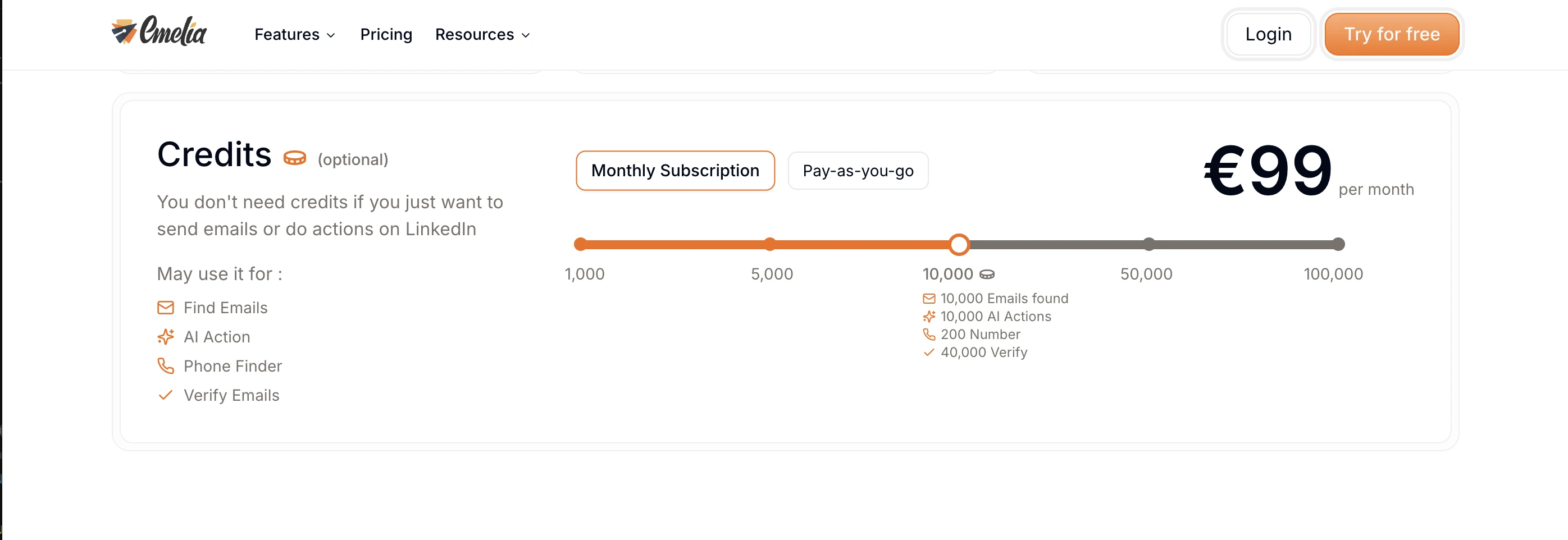
Emelia pricing (EUR +20% to USD) starts at about $44/mo (3 mailboxes, 1 LinkedIn account, 500 one-time credits); finder and phone credits come via a separate slider purchase, so a clean per-valid rate isn't published.
vs Enrow: not a price fight — Emelia is the sequencer we point people to, so pair them. For the data itself Enrow is the deeper, fresher source, anchored at $0.017 per valid email on Start and about $0.35 per valid phone on Pro, with EU direct dials Emelia doesn't cover.
3. Hunter.io
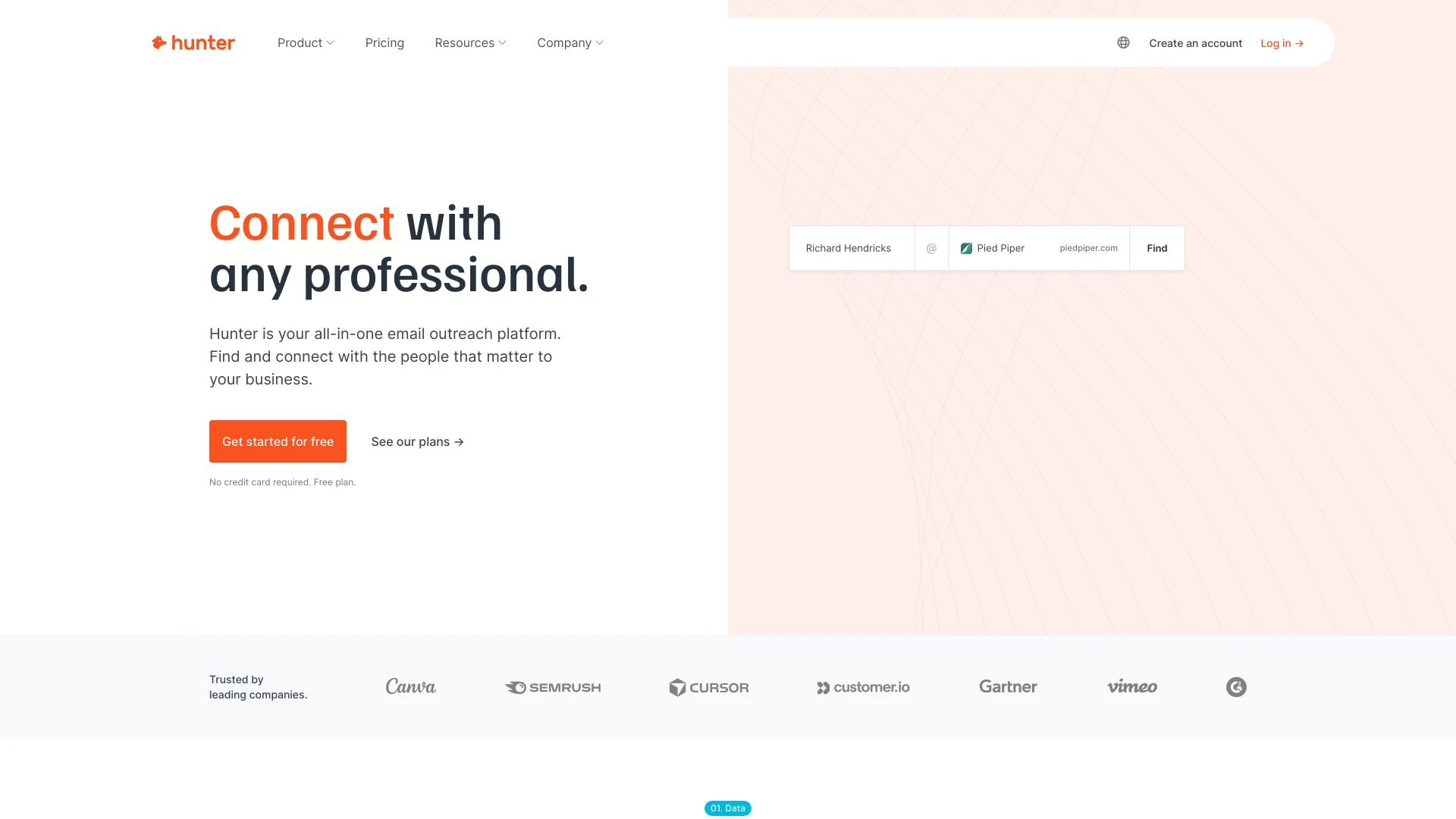
Domain in, addresses out, each with a note on where the pattern was seen. That's the whole product.
Hunter is a mature, self-serve email finder and verifier. Feed it a domain or a name and a company, and it returns addresses with a confidence score and a citation showing where it saw the pattern.
Where Apollo hands you a whole prospecting motion, Hunter does the narrow job well and stays out of your way. It plugs into most CRMs, and it has a genuine free plan. For plain domain-level lookups it does that one job cleanly.
But watch what the billing model does to the bill. Hunter charges you for the search, not for the answer. Run 2,000 lookups and 2,000 credits leave your account, whether or not a single address came back.
That's the first penalty, and it's the expensive one. Hunter publishes no find rate I'd lean on, so I assume about 30% of searches return an address, the default I use for every per-search tool. The second penalty arrives later, in your bounce report.
Underneath, the data is crawled and pattern-matched, so smaller companies come back thin or stale, the same shelf-life question Apollo's database raises. And there are no phone numbers. None. If dialing is part of your motion, Hunter is only half a tool.
The citations earned their keep in my run; seeing the source page tipped a few judgment calls on doubtful patterns.
But Enrow finds each contact fresh, verifies it with 10+ checks, bills only on a valid result rather than on every attempt, adds the EU phones Hunter skips entirely, and can write the whole verified record into your CRM from a profile page.
Hunter keeps things simple; Enrow keeps things simple and the meter honest.
- +Clean domain and name-based email finding with source citations
- +Mature product with wide CRM and tool integrations
- +Genuine free plan (50 credits/month)
- +Simple, self-serve, easy to learn
- –Billed on the attempted search: a lookup that returns nothing still spends a credit
- –No phone data at all
- –Crawled, pattern-guessed data goes thin for smaller companies, and a guessed pattern can still bounce
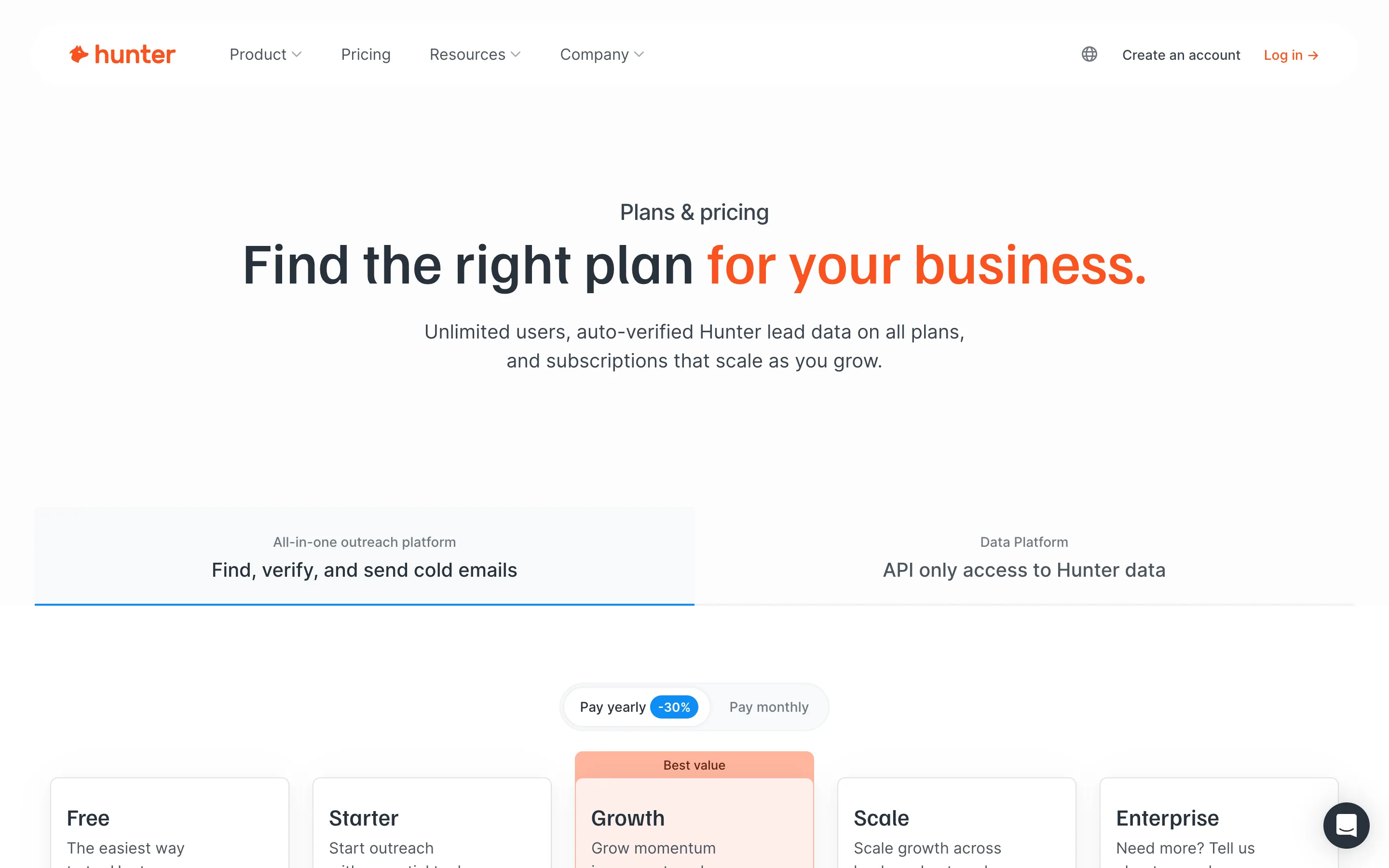
Hunter pricing (EUR 1:1 USD) starts at $49/mo for 2,000 credits, with a free 50-credit tier. But Hunter bills the attempted search, not the result — assume a ~30% find rate (my default for per-search tools, not a Hunter figure) plus monthly credit expiry, and a found email costs about $0.105 before a single bounce is counted, roughly 6x Enrow's $0.017 at Start.
vs Enrow: Hunter bills the attempt and returns no phones at all. Enrow bills only on a valid result, so a miss never costs you, and it adds direct dials in any country; Hunter has none.
4. Prospeo
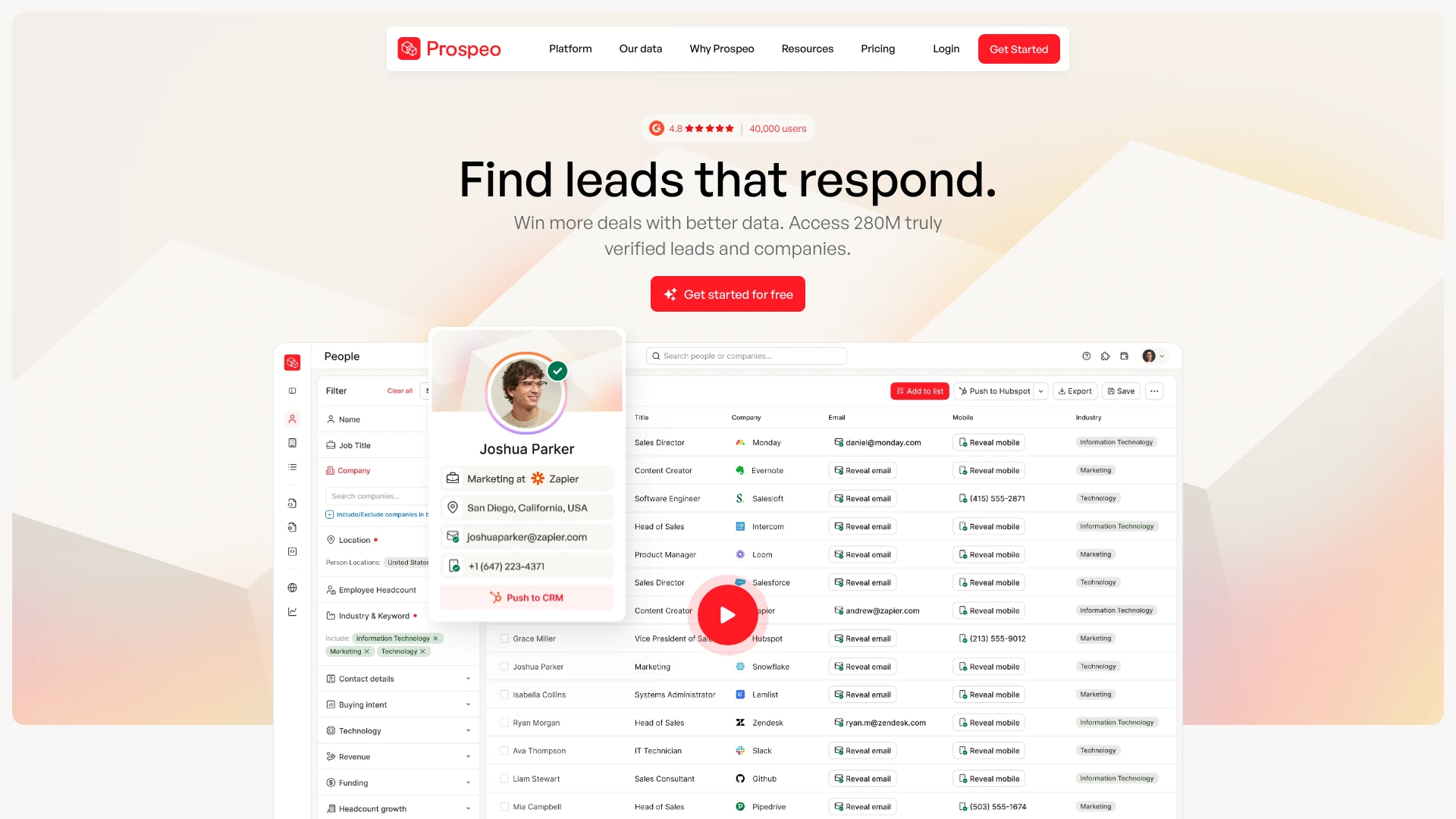
The headline entry point for LinkedIn-driven email.
Prospeo pairs a Chrome extension with a low advertised starting price, plus verification in the same credit pool. It charges 1 credit per email found and nothing when it finds nothing, so unlike Apollo's per-seat credits, you're paying for results, and unlike Hunter or Snov you aren't funding the empty lookups.
Its niche is LinkedIn email at low-to-mid volume, the opposite end of the market from an all-in-one platform.
The asterisk is data quality and consistency. Push past small jobs and the results get uneven, and phones cost 10 credits each with no documented EU coverage. There's no rollover, so anything you don't burn each cycle is gone.
Be precise about where that hurts: Prospeo's find rate runs low, and because the meter only moves on a found email, what a miss costs you is reach, not money. Same list, fewer people at the end of it.
I found the extension quick on test profiles, and the free tier let me poke around without a card. Prospeo doesn't charge for a non-match and neither does Enrow, so the meters agree; the price doesn't.
Enrow runs 10+ verification checks before an email counts, rolls credits over on Pro and Scale, and comes in below Prospeo per valid email at every matched volume.
- +1 credit per email found, 0 on a miss (no per-seat math like Apollo, no per-search meter like Hunter)
- +LinkedIn and domain finder with a solid Chrome extension
- +Verification in the same credit pool
- +Free plan (100 credits/month)
- –Uneven data quality once you push past small jobs, and a low find rate leaves contacts on the table
- –Phones cost 10 credits with no documented EU coverage
- –No credit rollover; per-user pricing
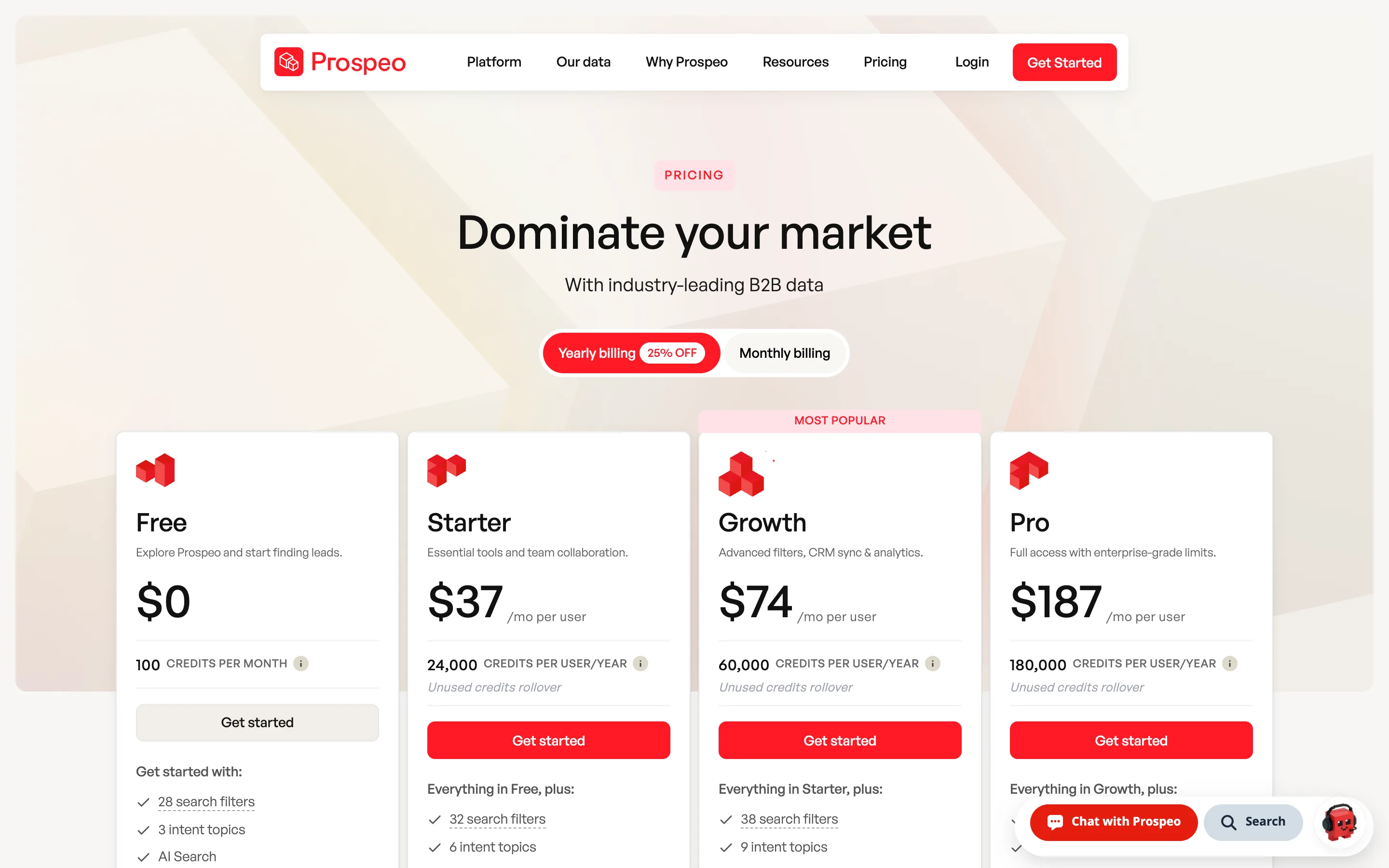
Prospeo pricing (USD, per user) starts at $49/mo for 2,000 credits, spent only on found emails, so what you see on the pricing page is what you actually pay: about $0.0245 per valid email, roughly 1.4x Enrow's $0.017 on Start. There's no rollover, and a mobile eats 10 credits with no published EU coverage.
vs Enrow: both meters move only on a found email, a clean like-for-like, and Enrow comes in under Prospeo at every matched volume: it verifies harder with 10+ checks, and its credits roll over on Pro and Scale. Prospeo's per-user pricing also stacks up fast on a team.
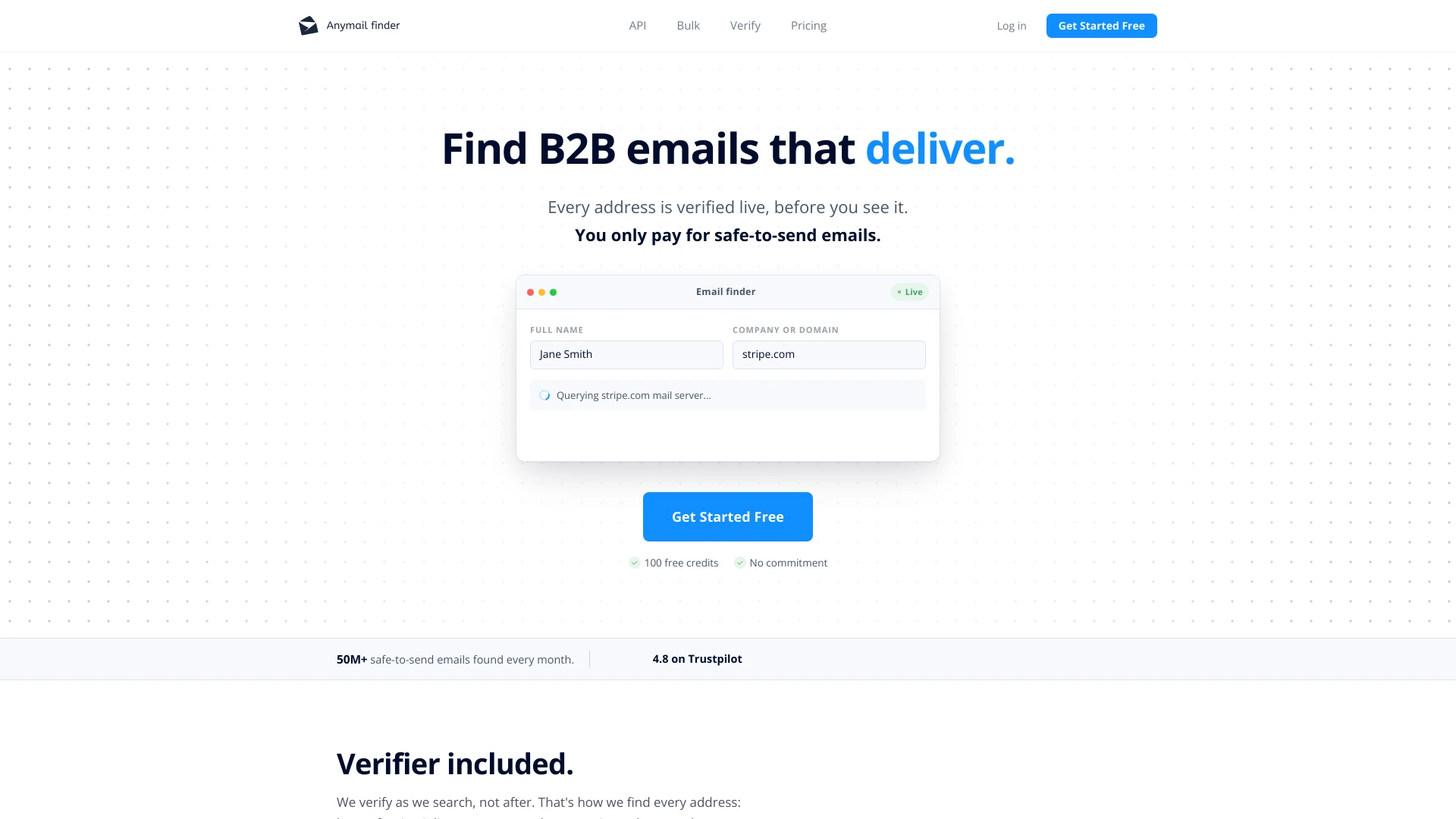
Apollo's data job, minus the platform: this is the narrow version.
Anymailfinder does one thing: live-verified B2B emails, charged only when the address passes verification (1 credit a find, 0.2 to check an external email). No per-search waste, no per-seat pool.
It's far narrower than Apollo, no database to browse, no outreach, no sequencer, but the meter is honest and unused credits roll over while you stay subscribed.
The catch is how narrow it is. No phones at all, no searchable database, no CRM push. It's a find-and-verify endpoint, not a workflow. On my messiest list, the unverifiable rows cost me nothing, which kept the bill clean.
But Enrow matches the pay-per-valid billing and then does what Anymailfinder can't: GDPR-cleared EU phones, native CRM integrations, a LinkedIn-to-CRM export that arrives with every field intact, and catch-alls verified and delivered rather than left on the table.
- +Charged only for emails confirmed valid, never per seat like Apollo
- +Strong catch-all handling and bounce protection
- +Unused credits roll over while subscribed
- +Simple single, bulk or API access
- –Email-only, no phone finding
- –No searchable prospecting database
- –No CRM push or full-contact export
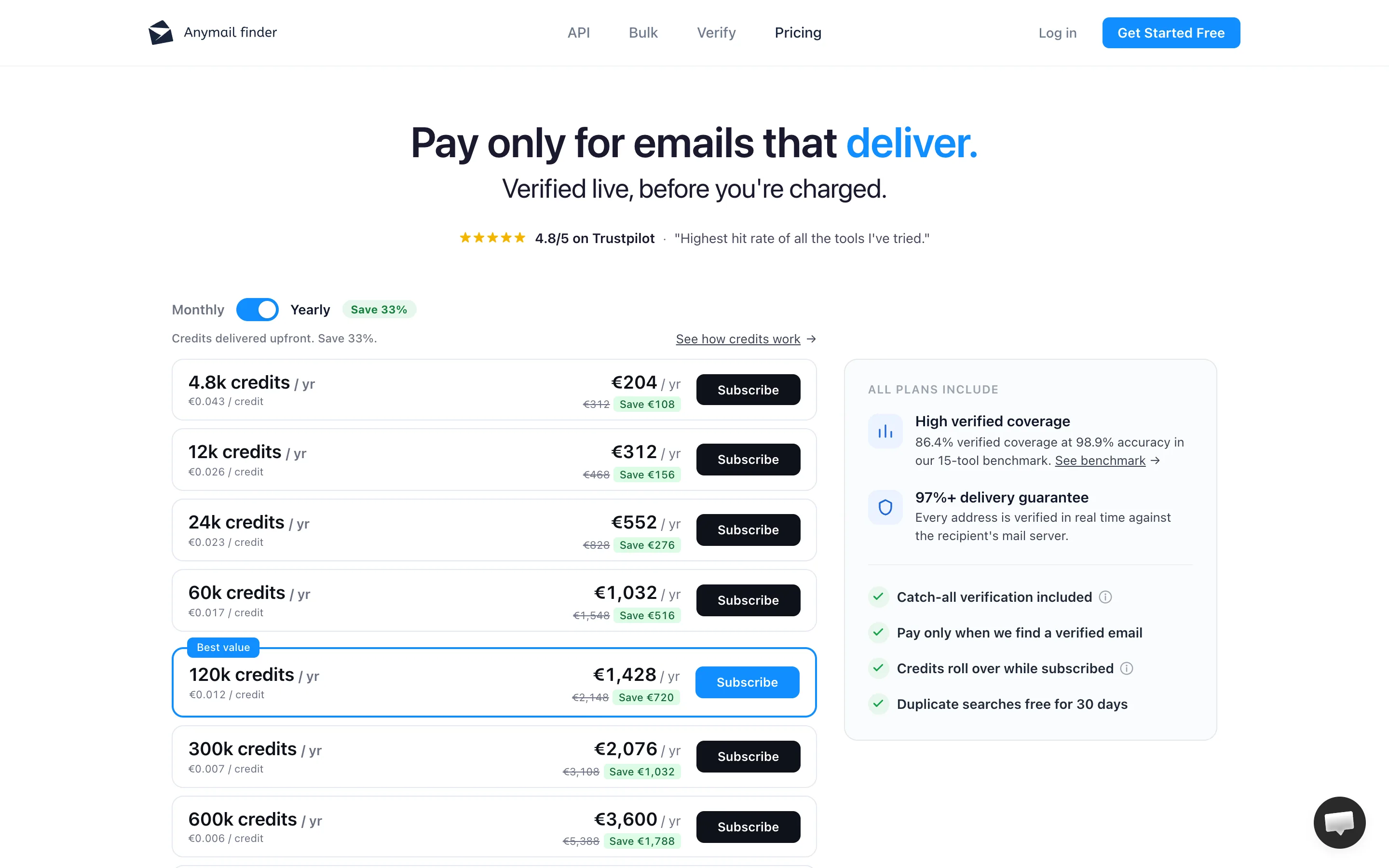
Anymailfinder pricing (native USD) starts at about $29/mo for 400 credits, billed only on emails that pass verification, so the number on the page holds up as the real cost: about $0.049 per valid email at 1,000 credits, nearly three times Enrow's $0.017 on Start. There are no phones at all.
vs Enrow: same pay-per-valid honesty, but the meter reads higher at every matched volume and it stays email-only. Enrow adds GDPR-cleared EU phones, native CRM sync, and the full-record LinkedIn-to-CRM export.
6. LeadMagic
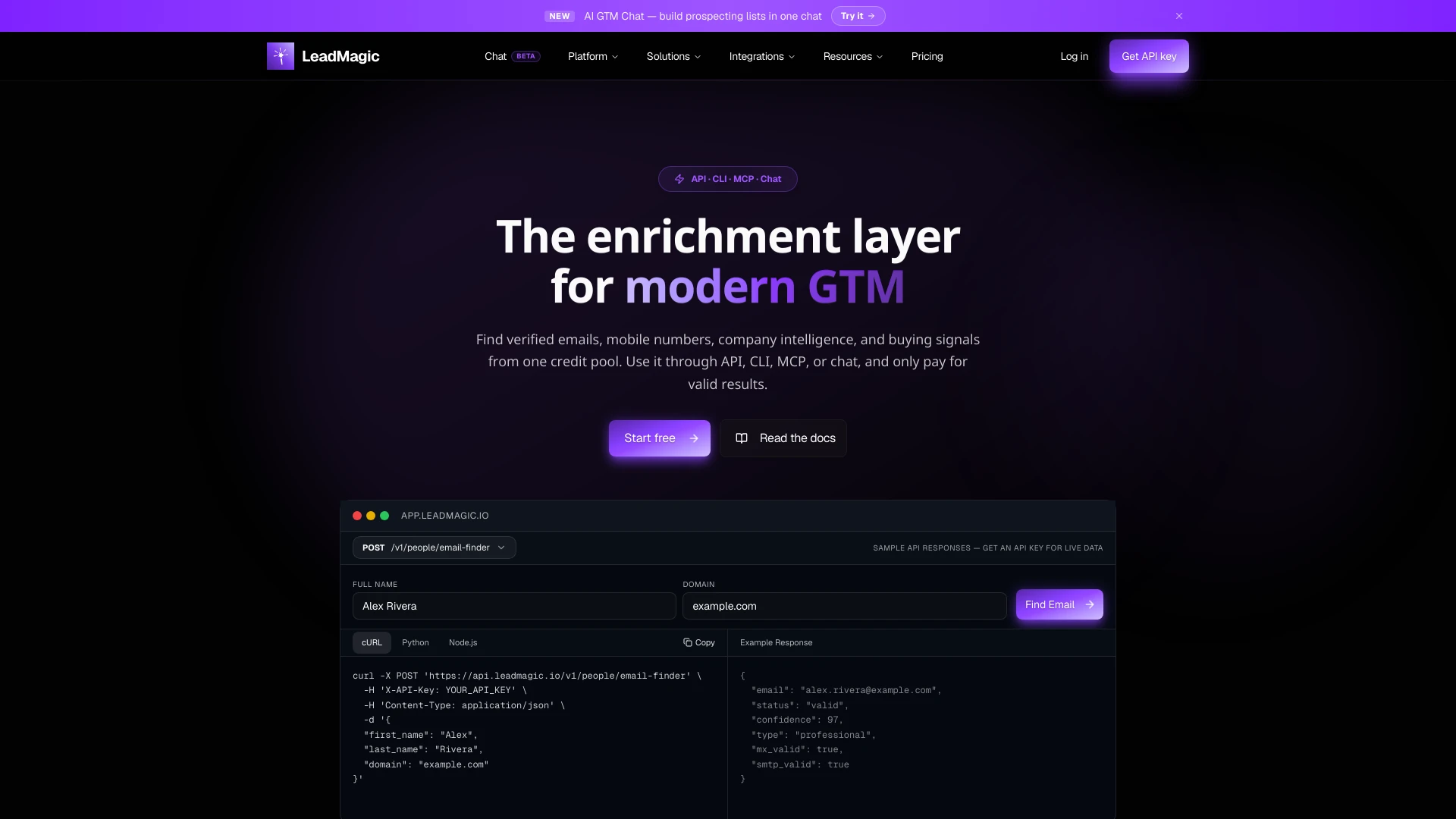
For teams whose "tool" is a repo and a cron job.
Everything about LeadMagic assumes you'll script it: 15+ enrichment endpoints (email, mobile, company, profile, job-change) drawing on one shared credit balance, a CLI, and an MCP server for AI-agent workflows. Credits leave the balance only on successful results, which sidesteps Apollo's per-seat model entirely.
The audience is RevOps teams who'd rather write twenty lines of code than click through a platform UI.
One balance across all the endpoints makes the accounting easy to reason about, and pay-per-valid is the right default. But it's an API, not a product you'd hand to a sales rep. Non-developers will stall.
Mobiles cost 5 credits each and EU/GDPR phone coverage isn't published, so EU reliability is a question mark. Rollover only kicks in on Essential and above.
Enrow's API is just as scriptable. It also ships a real UI and a Chrome extension your reps can actually use, and credits that roll over from Pro up. Programmable, without making everyone a developer.
- +Pay-per-valid, zero charge on failed matches (no per-seat pool like Apollo)
- +15+ endpoints from one shared credit pool
- +Developer tooling: API, CLI/TUI, MCP server
- +Mobile finder included in the same pool
- –No rollover on the entry Basic plan
- –Phones cost 5x an email; no published EU/GDPR phone detail
- –It's more an API than a browsable UI, so non-developers will struggle
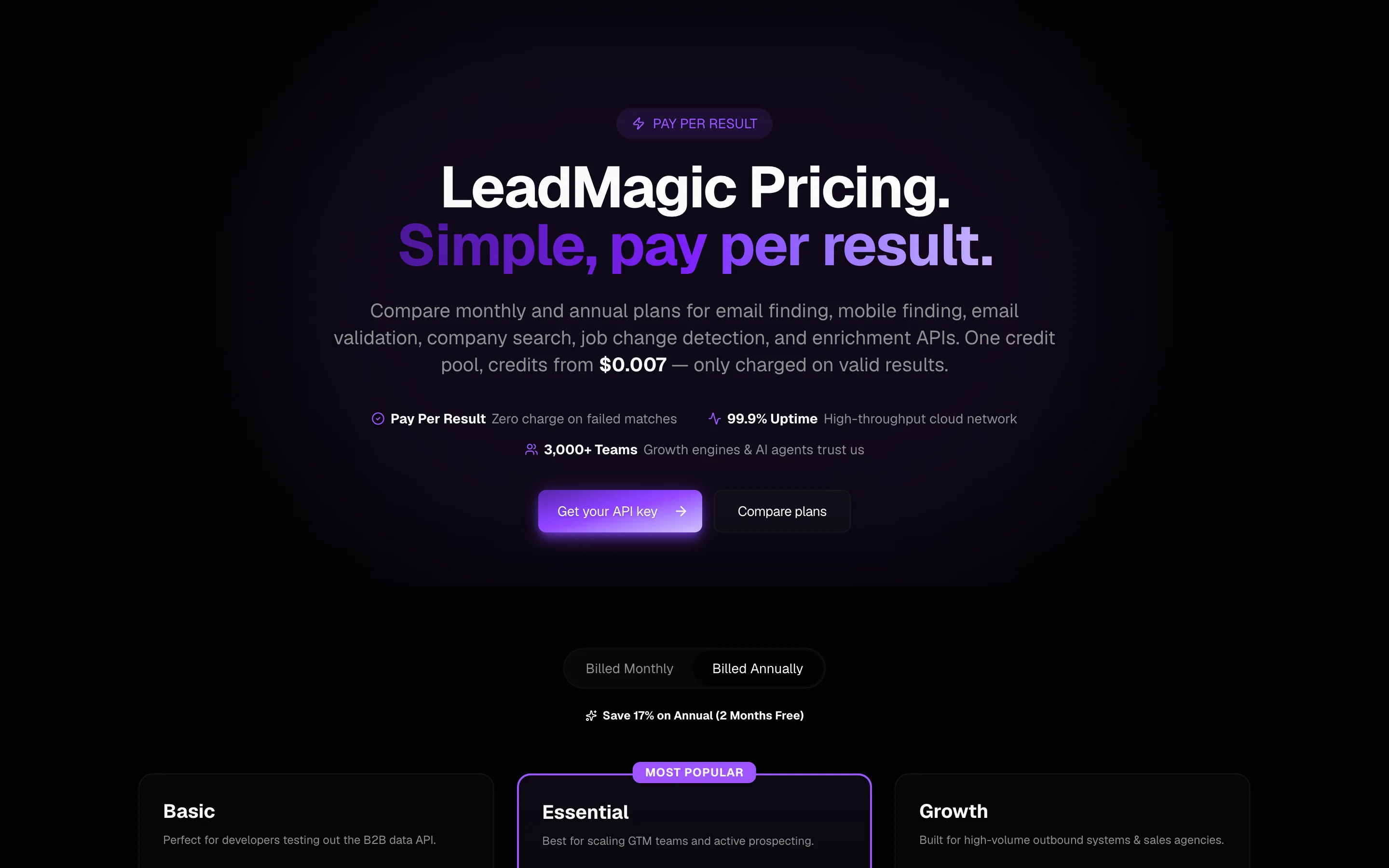
LeadMagic pricing (USD) starts at $49/mo for 2,000 credits (email 1 credit, mobile 5), deducted only on a successful result — about $0.0245 per valid email. Basic has no rollover, so unused credits expire, which lifts the real figure to about $0.031 per valid email, against Enrow's $0.017.
vs Enrow: both are pay-per-valid with real APIs, but Enrow comes in lower. Enrow also adds a rep-friendly UI and the full-record CRM export an endpoint list can't do.
7. Snov.io
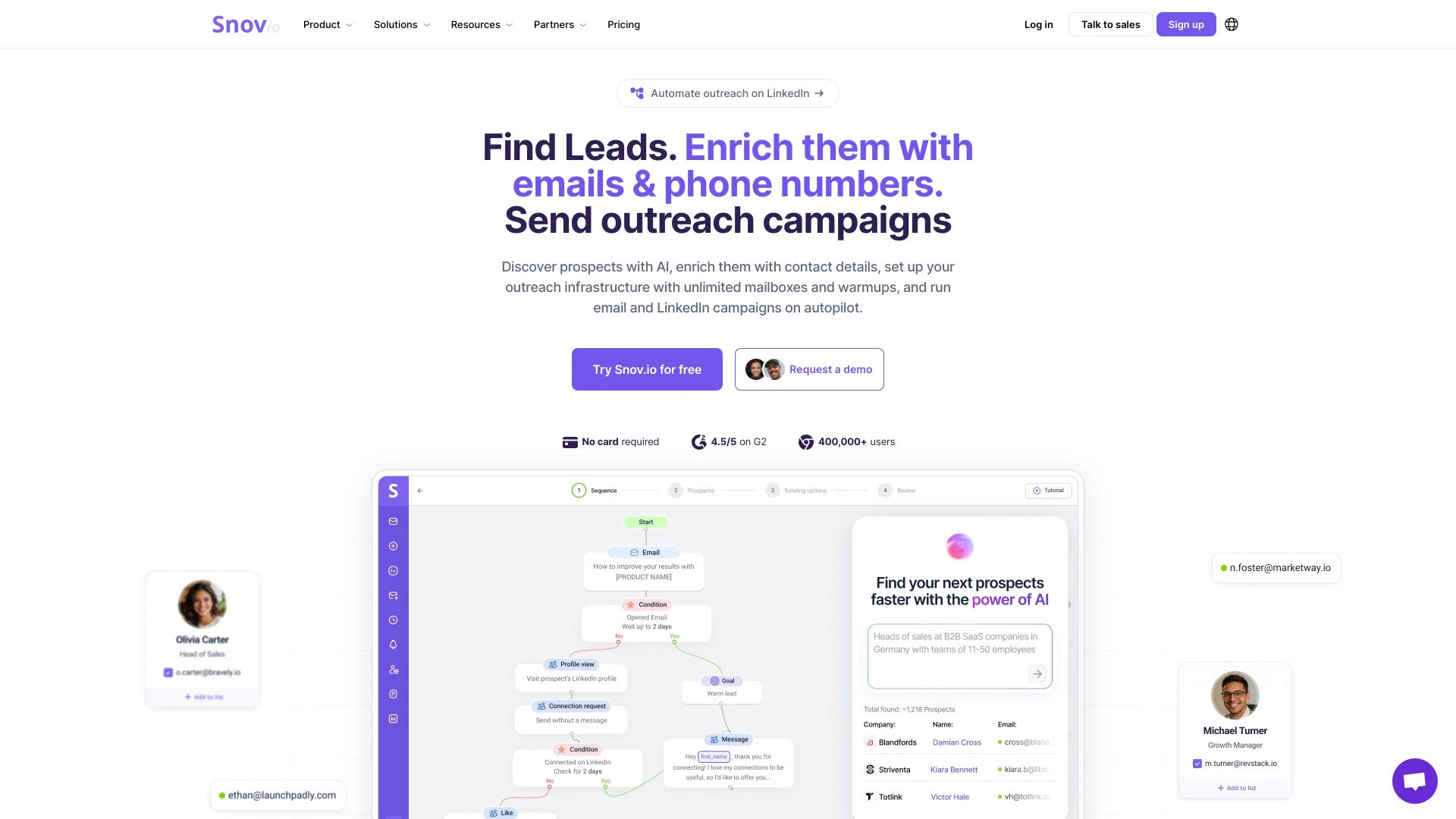
The closest like-for-like swap if you still want the all-in-one.
Snov.io covers Apollo's square footage: searchable B2B database, email finder, multi-step verifier, drip campaigns, a light CRM, LinkedIn automation. Same pitch, one subscription instead of three tools. Where it undercuts Apollo is price, plus a credit model that isn't strictly per seat.
The buyer it fits wants Apollo's breadth for less and will trade some data depth to get it.
That trade is real. Snov leans on a stored database, and stored rows drift out of date the way Apollo's do, so finder accuracy on a live list trails the specialists. Worse for the invoice, the credit leaves your balance on the search, not on a verified deliverable.
You fund every attempt, keep only the fraction that returns something, and then watch part of that fraction bounce. You also pay for a lot of product you may never touch if all you need is verified emails, and there's no EU phone play here.
Filter to first email took me minutes, and the built-in campaign builder deserves the credit for that. But a chunk of the found emails on my list needed a second verification pass. That's the database tax, and Apollo pays it too.
Enrow finds each contact fresh in real time, verifies it with 10+ checks, and adds the EU phones Snov skips. You give up the built-in sequencer, but for the data itself it's the cleaner, fresher source.
- +Searchable B2B database plus finder and verifier in one place
- +Drip campaigns, CRM and LinkedIn automation built in
- +Unlimited team seats on paid plans
- +Annual billing knocks 25% off
- –Billed per search rather than per deliverable, so lookups that return nothing still spend credits
- –Database-sourced rows go stale, accuracy on a live list trails the pure finders, and it's a lot of platform if all you need is verified emails
- –No EU phone coverage; LinkedIn automation is a paid add-on
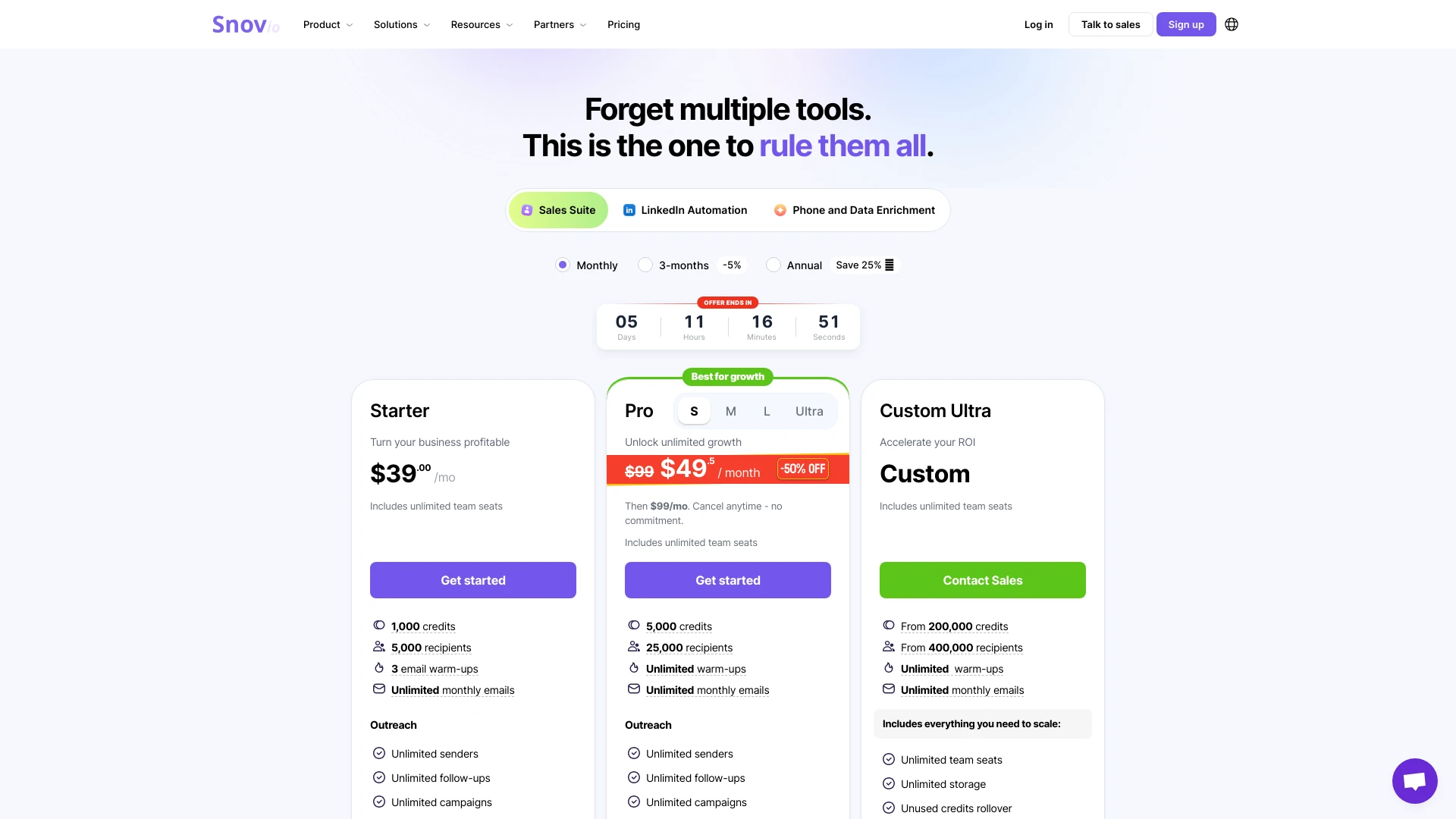
Snov.io pricing (USD) starts at $39/mo for 1,000 credits, but a credit spends on the attempted search, not the result. Assume a ~30% useful-return rate (Snov publishes no benchmark) plus stale-row bounce and monthly expiry, and a deliverable email runs past $0.16, nearly 10x Enrow's $0.017. Phones are only a separate token add-on with no EU direct-dial story.
vs Enrow: Enrow runs the lookup live and bills only on a valid result — a miss costs nothing — and adds EU phones Snov doesn't sell. Snov bundles a sender and a database Enrow doesn't; that's the trade.
8. Cognism
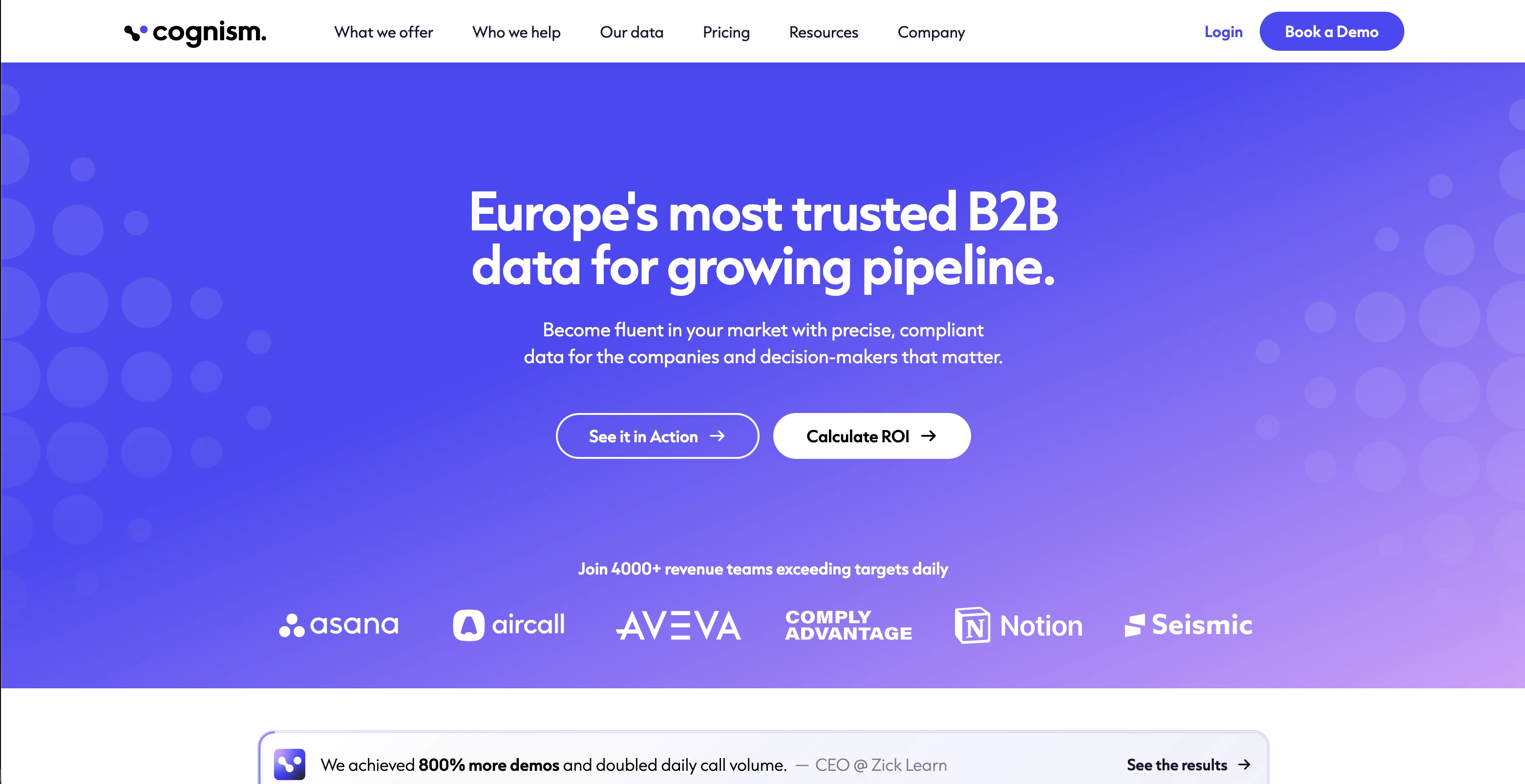
Enterprise budget, European pipeline: that's the Cognism buyer.
Cognism is built for the enterprise buyer: a large B2B database with phone-verified mobile numbers (their "Diamond Data"), strong European coverage, and intent data on the Pro tier.
Where Apollo is self-serve and volume-priced, Cognism is a sales-and-ops platform with a compliance story to match, and for a large team selling into Europe it's the more serious database. On EU phones specifically, it's one of the few database players that takes coverage seriously.
The friction is the buying model and the freshness question. Pricing is quote-only, so there's no self-serve entry and no public number to compare, you talk to sales, you sign an annual contract.
And it's still a database: the rows sit while the people move, and a credit is gone the moment you unlock a record, used or not. It's a heavyweight platform, priced and sold like one.
On the EU names I spot-checked, the phone-verified mobiles held up, legitimately good for a database, and the EU coverage is real.
But Enrow gets you EU direct dials in real time, no annual contract and no quote call, pay-per-valid from $17/month, plus the click that moves a finished contact card into your CRM.
For the enterprise all-in-one, Cognism fits; for the fresh, honestly-billed data layer, Enrow does.
- +Phone-verified mobiles with strong European coverage
- +Intent data on the Pro tier
- +Enterprise-grade compliance and support
- +Salesforce and outreach integrations
- –Quote-only pricing, no self-serve or public numbers
- –Annual contracts, not a pay-as-you-go meter
- –Stored database, so a record's accuracy depends on when it was last refreshed
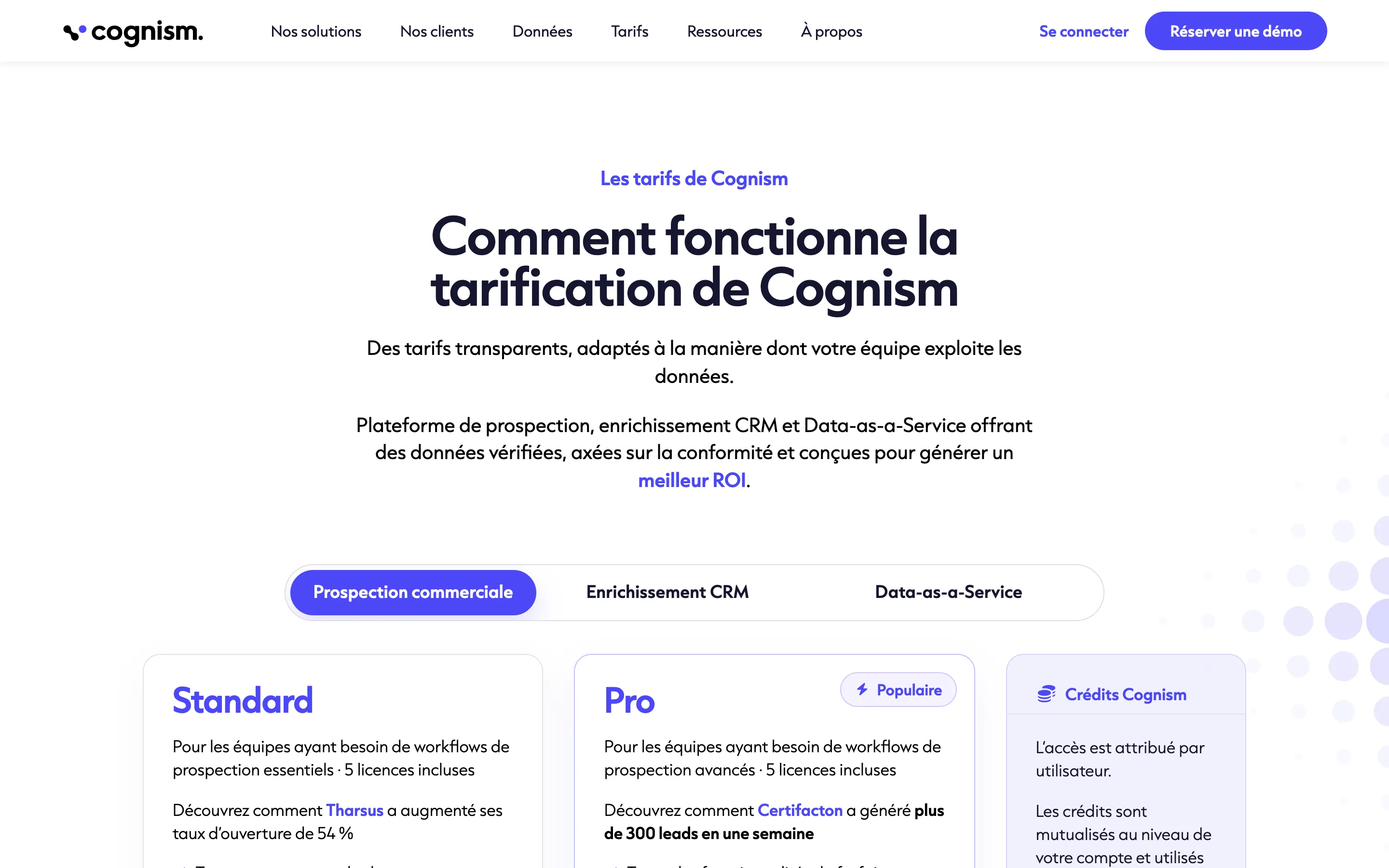
Cognism pricing is quote-only, with no public numbers: two tiers (Standard and Pro), a credit per contact unlock, annual contracts. No public price means no honest $/valid you can compute, and the credit goes on a stored record that may no longer be current.
vs Enrow: Cognism is an enterprise platform behind a sales call; Enrow's real cost is knowable up front — about $0.0087 per valid email and $0.35 per valid phone on Pro, charged only when valid, self-serve from $17/month with EU direct dials and CRM export.
9. Kaspr
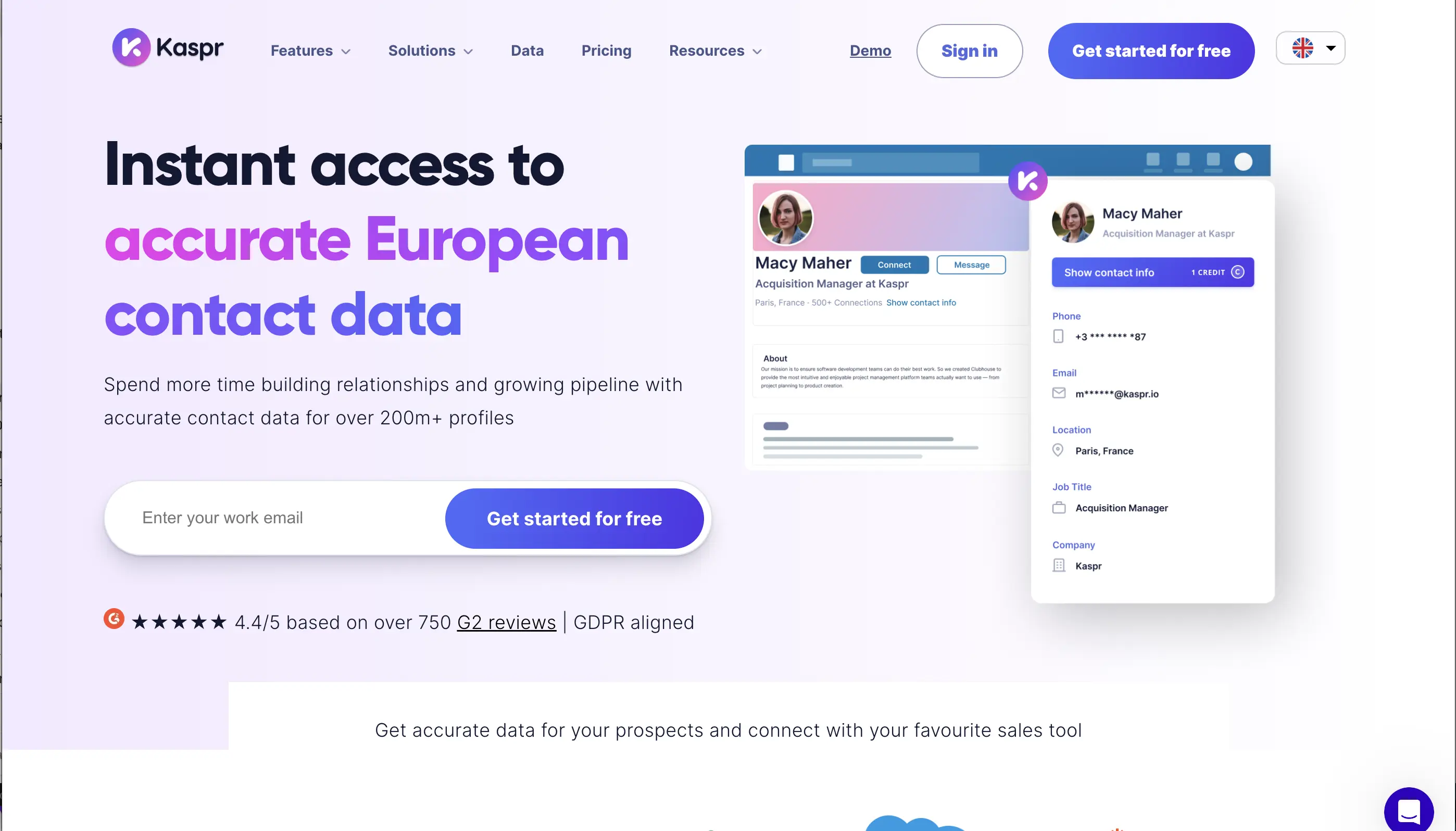
Reps who spend their day inside Sales Navigator tend to end up here.
Kaspr is a LinkedIn Chrome extension that pulls emails and phone numbers off profiles, with "unlimited" B2B email credits on paid plans and a monthly allowance of phone and direct-email credits (100 phone credits on Starter, 200 on Business).
Read the terms before you plan around that word: the unlimited email is fair-use capped at 10,000 emails per account per month, and the cap sits on the account, not the seat, so adding reps doesn't raise the ceiling.
For a rep working a Sales Navigator list one profile at a time, it's fast, and it skips the browsing-a-database step Apollo is built around. It leans European, which some teams want.
The limits show up at scale and on the meter. It's per user, so a team adds up, and because you're buying seats rather than credits there's no honest cost-per-valid-email to compute from the outside.
Phone and direct-email credits are capped per seat each month, EU phone quality is decent but not documented the way it should be, and it's an extension workflow, not a bulk data engine or an API-first tool.
Whether unsuccessful lookups burn a credit isn't clearly stated, which is exactly the ambiguity pay-per-valid removes.
Working profiles one at a time, I found the extension quick and unfussy.
But Enrow finds and verifies in bulk as well as one-by-one, bills clearly on valid results only, and writes the complete verified record into your CRM in one click, created or updated.
- +"Unlimited" B2B email credits on paid plans, up to the 10,000-per-account-per-month fair-use cap
- +Fast LinkedIn Chrome extension for emails and phones
- +European coverage is a strength
- +Free plan to start (15 email, 5 phone credits/month)
- –Per-user pricing that adds up on a team, while the "unlimited" email stops at 10,000 per account per month
- –Phone and direct-email credits capped per seat each month
- –Whether failed lookups are charged isn't clearly stated
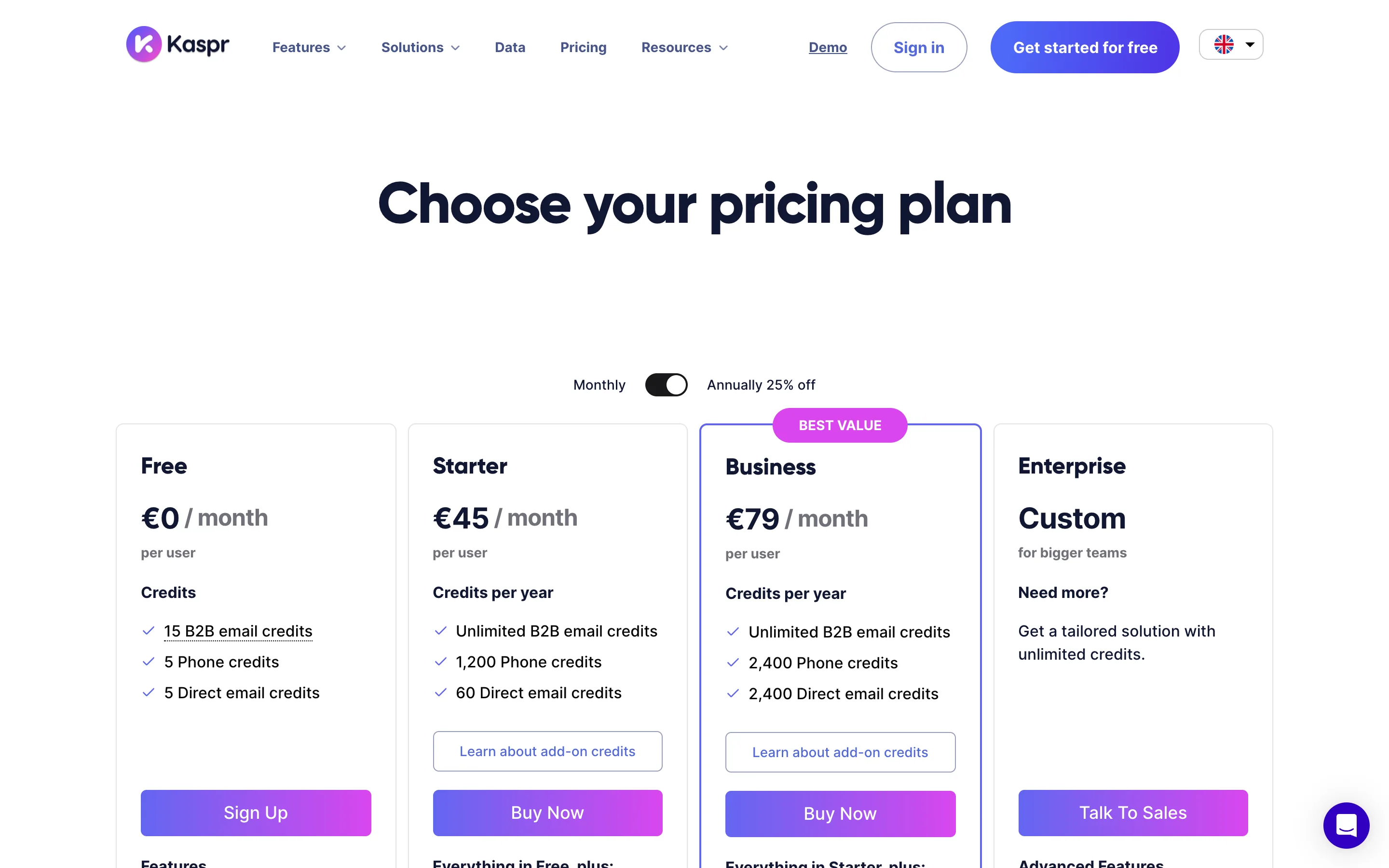
Kaspr pricing (in euros, per user) starts at €59/mo, with "unlimited" B2B email fair-use capped at 10,000 emails per account per month (kaspr.io/terms) and 100 phone credits a month per seat (200 on Business at €99). Priced per seat, not per credit, so there's no honest cost per valid email to publish, and Kaspr doesn't say whether a failed lookup burns a credit.
vs Enrow: Kaspr is a per-seat LinkedIn extension; Enrow is a per-credit data engine with a real API, clear pay-per-valid billing (€0.30 per valid phone on Pro), and the one-click export that lands a complete verified record in the CRM.
10. ContactOut
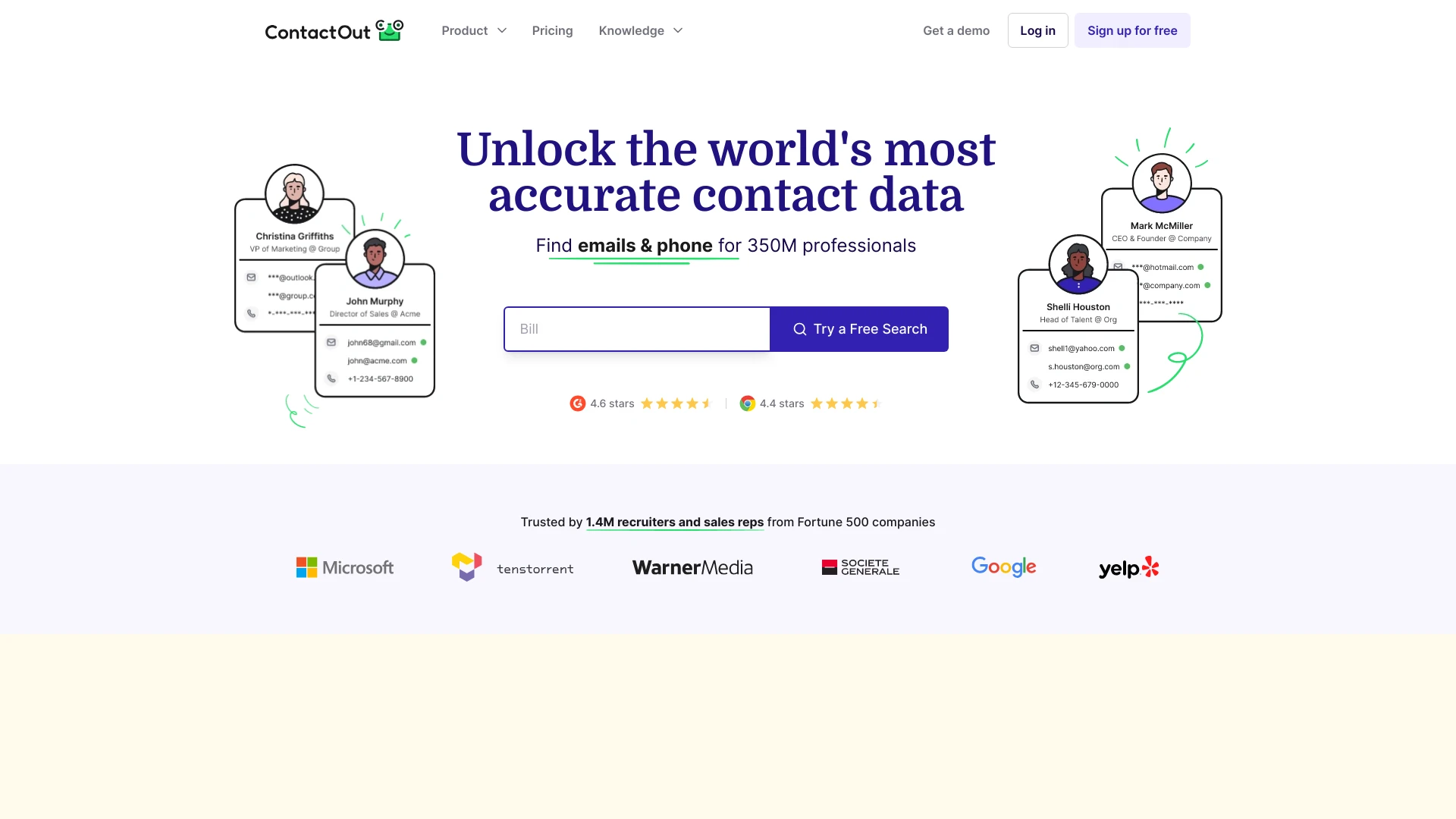
Built for sourcing humans, not closing deals.
ContactOut's strength is a large profile database with both work and personal emails, plus a LinkedIn Chrome extension and a search portal. Its niche is recruiting: surfacing personal emails to reach people their employer's inbox won't.
Where Apollo is aimed at B2B sales, ContactOut's personal-email angle points at a different job. It's a database-and-export tool, though, metered by daily and monthly quotas rather than a clean per-valid meter.
For B2B sales the cons stack up. It's a stored database, so the staleness tax applies, the same problem as Apollo. Phones sit behind higher tiers, EU coverage is weaker than US, and the export caps bind harder than the lookups do.
In my run the personal emails reached people a work-address tool couldn't touch, useful for recruiters, off-target for outbound sales.
For a sales motion, Enrow finds verified work emails and EU direct dials fresh in real time, charges only when they're valid instead of metering exports, and lands the whole verified card in your CRM straight from the profile page. It's a sales data layer, not a recruiter's export list.
- +Large profile database, work and personal emails
- +Strong LinkedIn Chrome extension and search portal
- +Direct dials available in the database
- +Genuinely proven for recruiting
- –Export-capped quota model, not a clean per-valid meter
- –Phones locked behind higher tiers; EU coverage weaker than US
- –Stored database, with the shelf life that implies
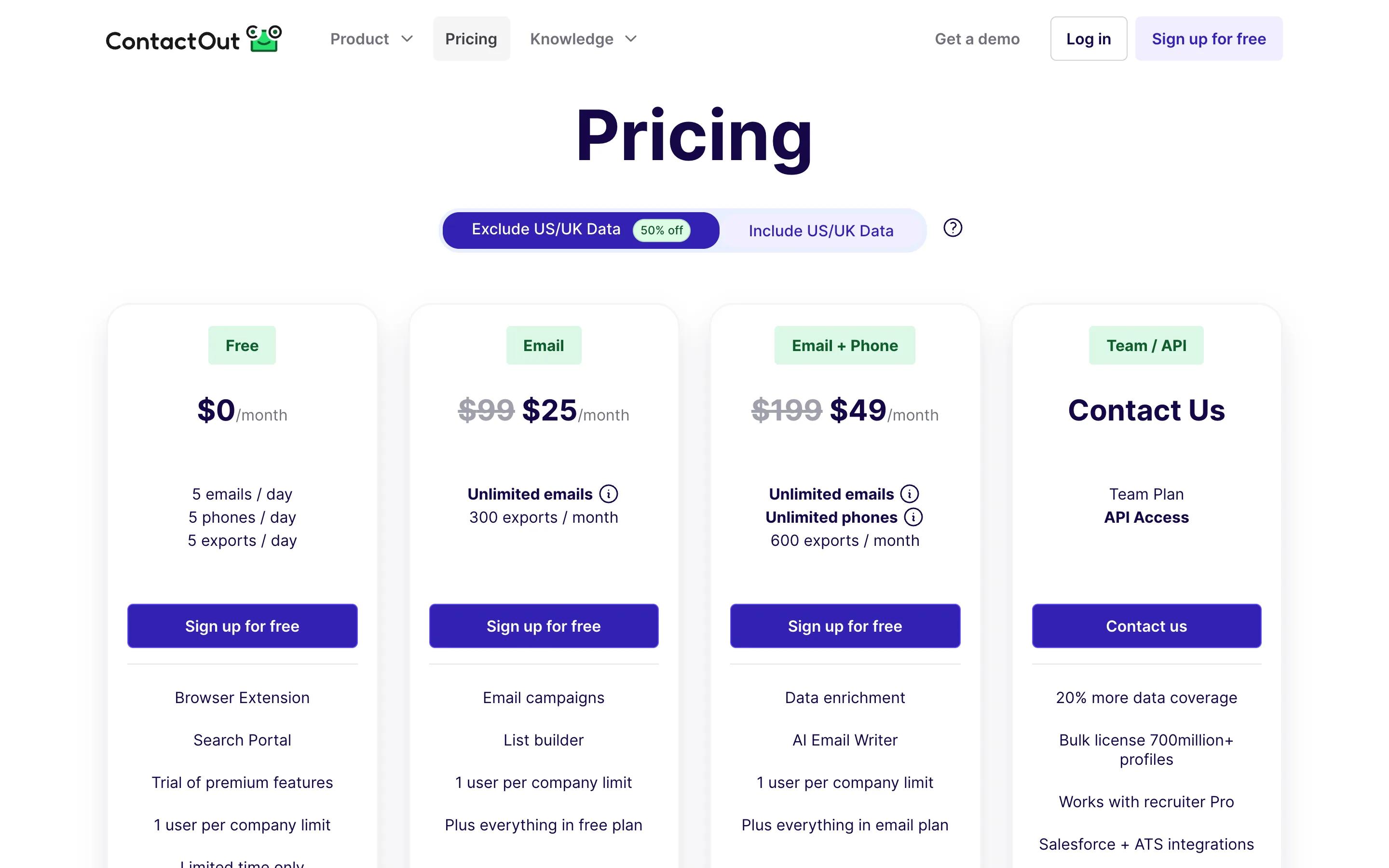
ContactOut pricing (USD) starts at about $49/mo for the Email plan (about $39 annual), an export-capped quota on a stored database, not a per-valid credit — a monthly cap unlocks records whether or not each is still current, so there's no honest $/valid to compute.
vs Enrow: ContactOut is a recruiter's export database; Enrow is a real-time sales data layer with EU phones and pay-per-valid billing, knowable at $0.017 per valid email and $0.35 per valid phone on Pro, plus a CRM push that fills every field.
11. Lusha
When the brief reads "get me US mobiles," Lusha is the name that comes up.
Lusha's reputation is built on phone numbers, and for North American direct dials the reputation is earned. That's a specific job, though, and a different one from fresh verified contact data.
A credit reveals an email; a phone now costs 5 credits, drawn from the same pool, with a browser extension and CRM integrations. Where Apollo's mobiles are a component of a bigger platform, Lusha makes them the point, and its US mobile coverage is a real reason to look.
The trade-offs are geography and the database model. Lusha is US-strong and thinner in Europe, so EU direct dials aren't its home turf, and its records live in the same kind of stored pile as Apollo's, aging on the shelf.
Credits are shared, and a phone reveal eats 5 of them, five times an email, so heavy phone use still drains the budget fast. It's a reveal tool, priced per credit on a subscription, not a real-time verification engine.
My US rows hit at a good rate.
The EU rows thinned out fast, which is exactly where Enrow is built to win: direct dials in any country (Europe included), 10+ verification checks on the emails, pay-per-valid billing, and a complete verified record pushed into your CRM from the profile.
- +Strong North American mobile-number quality
- +Chrome extension and CRM integrations
- +Free plan to test (40 credits/month)
- +Simple reveal workflow off LinkedIn and the web
- –US-strong, thinner EU direct-dial coverage
- –Stored records that drift out of date between crawls
- –A phone reveal costs 5 credits from a shared pool, five times an email, so mobiles drain the budget fast
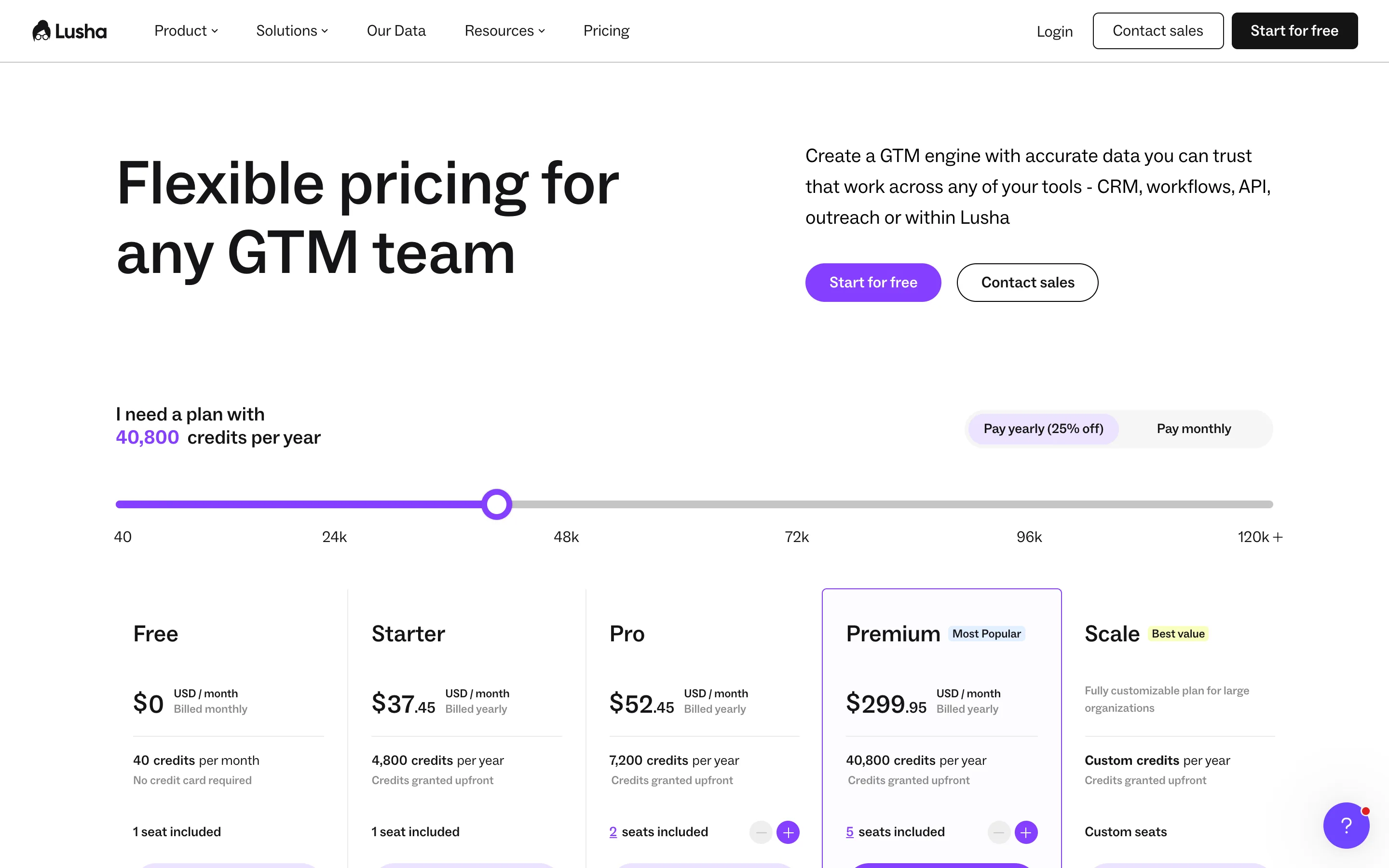
Lusha pricing (USD) starts at $49.90/mo for 400 credits (about $37.45 annual); a credit reveals an email, a phone costs 5. But a reveal isn't a valid contact — the credit goes on a stored row that may be dead, so a deliverable email runs $0.18-0.25, over ten times Enrow's $0.017. Phones look closer on the sticker: $49.90 buys 80 phone reveals, about $0.62 each, while Enrow's $47 Start tier buys 100 valid phones found live ($0.47 each), and Pro takes that to $0.35. On annual billing, Lusha's $37.45 works out near $0.47 a reveal, against about $0.31 per valid phone on Enrow Pro annual (Start has no annual plan).
vs Enrow: Lusha wins North American mobiles; Enrow wins EU direct dials, real-time email verification, a lower real cost per valid phone, and pay-per-valid billing rather than shared reveal credits on a stored database.
12. Findymail
US cold-email addresses on a meter you can trust. That's the entire pitch, and it holds.
Findymail is a B2B email finder built for outreach, and it fixes the two things that push people off Apollo: no stale database, and no per-seat math. It bills on the found result, not a search or a seat, so a miss doesn't cost you.
Point it at a LinkedIn list or a domain and it returns verified business emails. On pure US email accuracy it's genuinely strong, one of the better finders in the category, and I'll say that plainly.
The wall is geography and reach. Findymail returns no phone numbers for EU contacts, GDPR closes that off for them, so for a Europe-focused team it's effectively email-only. Its phones cover the US only.
And you're locked into a subscription where credit rollover caps at 2x your monthly allowance, so buy ahead for a big quarter and watch the surplus die at renewal.
In my test the pay-per-found meter did what Apollo's per-seat credits never do: kept the invoice tied to results. Enrow matches that billing and then adds what Findymail can't, GDPR-cleared EU phones, catch-alls delivered instead of dropped, and the profile-to-CRM export with every field filled.
Equal on the meter, wider on the map.
- +Bills on the found result, not per seat like Apollo
- +Strong, accurate US B2B email finding
- +SOC 2 Type 2, GDPR compliant, EU-hosted
- +Native HubSpot, Salesforce, Pipedrive, Instantly and lemlist integrations
- –No EU phone data (GDPR); phones are US only
- –Credit rollover caps at 2x your monthly allowance
- –Subscription-only, no meaningful free plan
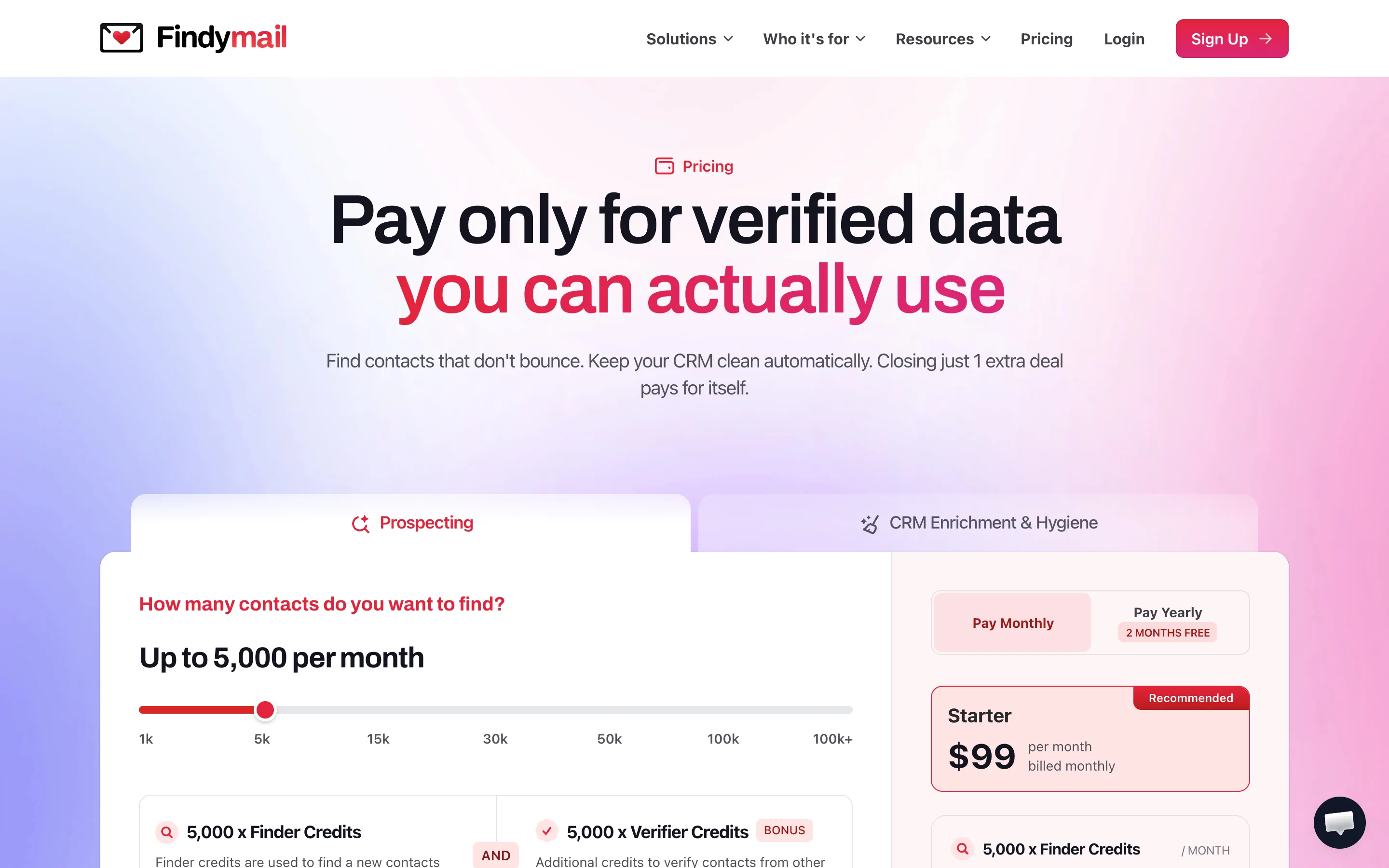
Findymail pricing (USD) opens at $49/mo for 1,000 credits on a per-found meter, so the sticker is honest — $49 buys 1,000 emails, about $0.049 per valid email, roughly 3x Enrow's $0.017 on Start. A direct phone costs 10 credits, but Findymail returns no EU mobiles at all (GDPR closes that door).
vs Enrow: Findymail is a genuine quality near-peer on US email, but not cheaper, and Enrow opens at $17 for a 1,000-email plan against its $49 floor. Enrow also returns the GDPR-cleared EU phones Findymail can't, delivers catch-alls instead of dropping them, and pushes a complete verified record into the CRM from a LinkedIn profile.
13. Dropcontact
The European compliance hawk's choice.
Dropcontact computes and verifies its data algorithmically at request time instead of reselling rows from a warehouse, with French firmographics (SIREN, VAT) and high email validity. Against Apollo that matters: European records date quickly, and a live computation doesn't.
Its niche is narrow and clear: cleaning and enriching French and EU records inside HubSpot or Pipedrive.
The cons are real once you step outside that niche. Phones are weak, pulled only from email-signature extraction, so there's no genuine direct-dial product. There's no searchable database, and keeping unused credits costs €29 instead of €19 a month. It's enrichment-first, not a finder, and not a prospecting platform the way Apollo is.
The French firmographics were the strongest thing in my run, and also the border of what it does well.
Enrow finds and verifies in real time the same way, but it actually delivers direct-dial phones in any country, Europe included, runs 10+ verification checks, bills only on a valid result, and lands the finished contact in your CRM in a click.
For enrichment plus reach, not just cleaning, Enrow is the wider tool.
- +GDPR-compliant, EU-server real-time enrichment (not a stored DB like Apollo)
- +High email validity, strong on catch-all
- +French-specific data (SIREN, VAT)
- +CRM-native enrichment across HubSpot, Pipedrive, Salesforce, Zoho
- –Weak phone capability (signature-extraction only)
- –No searchable database for list-building
- –Credits lapse monthly on the €19 entry plan
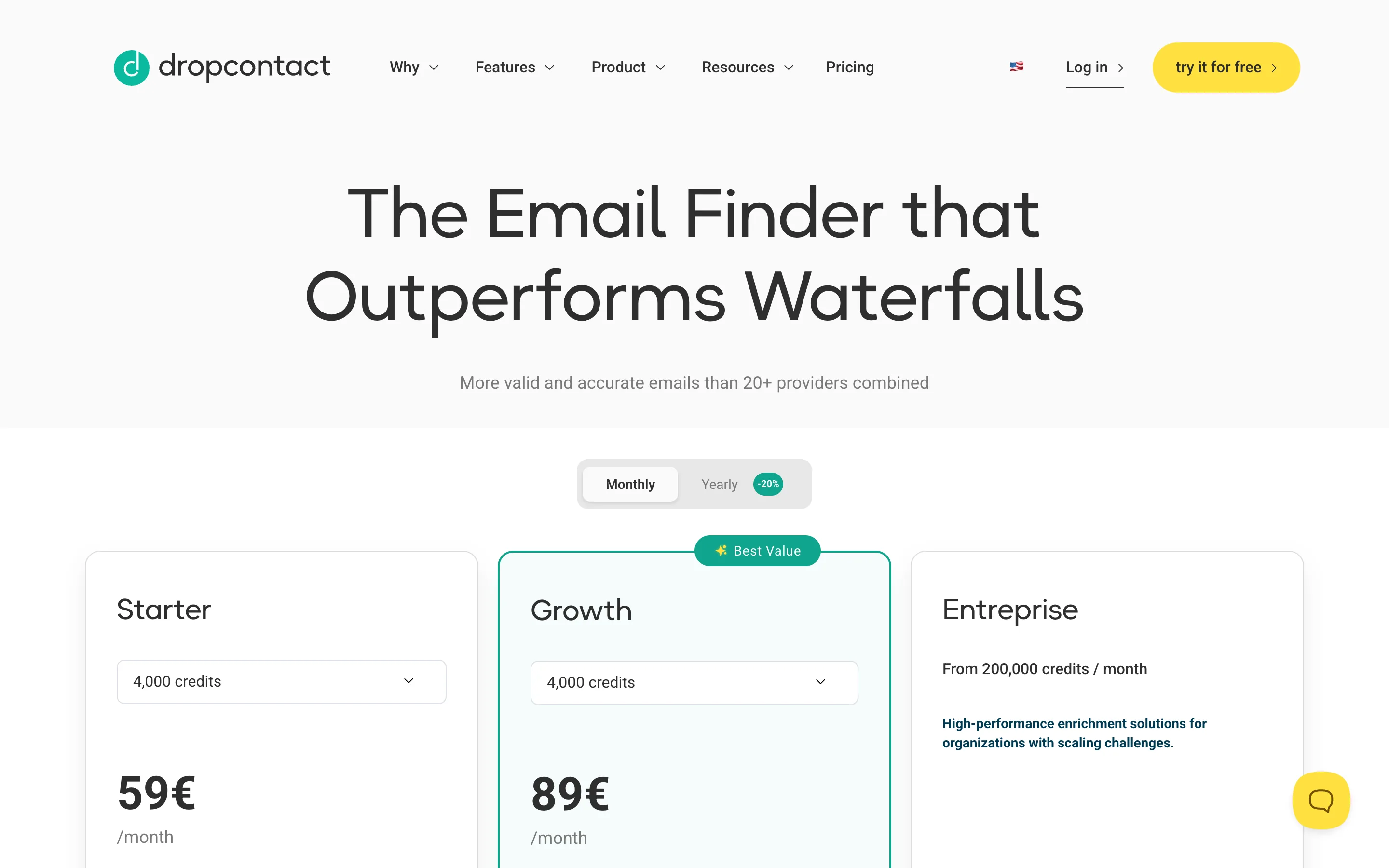
Dropcontact pricing (in euros) opens at €19/mo for 500 credits on a pay-on-success model, so a credit spends only on a found email — about €0.038 per valid email on that entry plan without carry-over, about 2.5 times Enrow's Start rate, which carries nothing over either, with both billed monthly.
vs Enrow: Dropcontact cleans EU records well but barely does phones (signature extraction only), and stays above Enrow at every matched volume. Enrow adds real direct dials in any country, Europe included, and the full-record CRM export.
Don't take a founder's word for his own tool. Enrow hands you 50 free credits every month, recurring, no card, enough to put a slice of your own list through it before a cent changes hands.
Side-by-side comparison
Final Verdict
Strip away the category noise and the test is simple: contacts that are valid today, at a price you can defend on the ones that aren't. Enrow wins this list. Apollo bills per seat against stored rows that age on the shelf; Enrow finds each contact live, charges nothing on a miss, and lands at $0.017 per valid email against Apollo's effective ~$0.033, with GDPR-cleared EU direct dials Apollo's database can't reliably match. Then the workflow piece: one click on a LinkedIn or Sales Navigator profile and Enrow's Chrome extension writes the entire verified record, every field, into HubSpot, Salesforce or Pipedrive, with no stop in a third tool and no admin push rules to set first. The honest part: Enrow is no all-in-one — no searchable database, no sequencing, no technographics. If browsing a giant cold list is your starting point, that's Apollo's turf; source in LinkedIn or Sales Navigator, then hand those profiles to Enrow for the data layer it does best.
Don't take a founder's word for his own tool. Enrow hands you 50 free credits every month, recurring, no card, enough to put a slice of your own list through it before a cent changes hands.
FAQ
How we evaluated these tools
Nobody paid to sit here: no affiliate links, no sponsored slots, and no tool bought its way up the order. I ran it myself — one list of real B2B contacts through all thirteen tools in a single week, then out to a live inbox to see what actually bounced. Four things set the ranking: match rate, bounce on a real send, cost per valid contact once the dead searches and expired credits are priced back in, and geographic reach — EU phones I can source legally carried the most weight. Competitor pricing and features come straight from each vendor's official pages, read on 2026-07-02.
¿listo para dejar de perder el tiempo?
Conectado en minutos.
Data verificada en segundos.
sin tarjeta
sin configuración