Key takeaway To find someone's cell phone number for business you have eight routes: ask them, read a signature, open LinkedIn's contact panel, run a search operator, call the switchboard, search your own CRM, query a live phone finder, or pull the number into your CRM from a browser extension. Only the last two hand back a verified mobile in seconds. Enrow charges 40 credits for one, which works out at $0.35 a valid number on the $87 Pro tier, and nothing at all when the search comes up empty. On a hundred LinkedIn profiles that emptiness hits eight times: 92 return a mobile, measured internally on our own runs. Four objects hide inside a field marked "Phone": switchboard, extension, direct dial, mobile. Two of them reach a person. France's Bloctel register closed on 11 August 2026. Every guide still telling you to screen against it is describing a service that no longer exists. The US business carve-out at 16 CFR § 310.6(b)(7) covers manual dialling. It does not cover an autodialer or a prerecorded voice aimed at a cell phone: 47 CFR § 64.1200(a)(1)(iii) handles that separately, and strictly. Honest note: 50 recurring Enrow credits buy exactly one phone lookup a month. lemlist gives 25 free phone finds. On free phone volume, we lose.
Two searches share almost the same words and want opposite things. One person holds a number and wants the name behind it. You hold the name, and you want the number that rings in their pocket. Everything below serves the second direction, for business contact. Reverse lookup is not something Enrow does, and we sell no people-search product either, so if you arrived here after a missed call from an unknown number, this is the wrong page.
I run Enrow, which finds and verifies B2B emails and mobiles, so two of the eight methods are ours and six cost nothing. Reading the live results on August 29, 2026: the pages holding the top slots name GDPR, TCPA and the Do-Not-Call registry as bare acronyms, and not one quotes a statute. Every legal line here carries its instrument and its read date.
The 8 methods, costed
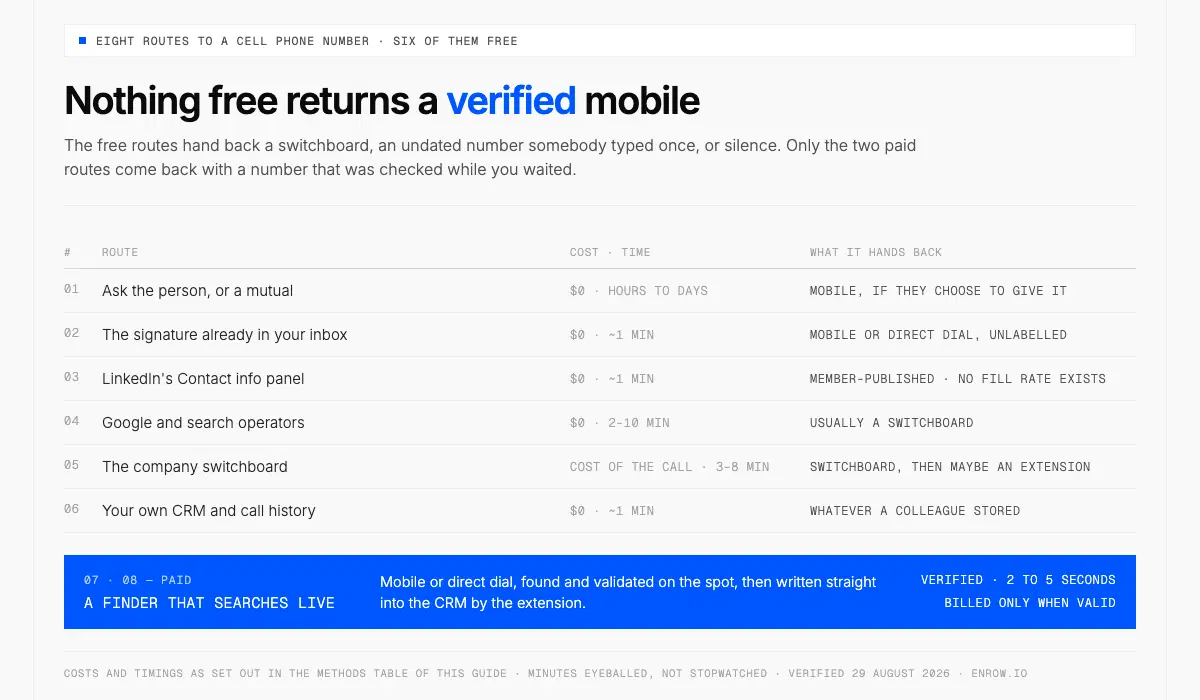
Nothing free returns a verified mobile — only the two paid routes check the number while you wait.
Nothing free returns a verified mobile. The free routes give you a company switchboard, an unlabelled number typed into a signature at an unknown date, or silence. The paid ones give you a number that was checked while you waited.
| # | Method | What it costs | What kind of number you get | What it actually returns | Where it breaks |
|---|---|---|---|---|---|
| 1 | Ask the person, or a mutual | $0 · hours to days | Mobile, if they choose to give it | The number, plus tacit permission to use it | About five a day, and it needs a relationship you already have |
| 2 | The signature already in your inbox | $0 · ~1 min | Mobile or direct dial, unlabelled | Whatever they typed, on the date they typed it | Signatures carry no revision date; most senders publish no number |
| 3 | LinkedIn's Contact info panel | $0 · ~1 min | Mobile, member-published | A number only if the member added one and shares it with you | Member-controlled, visibility-gated, no published fill rate exists |
| 4 | Google and search operators | $0 · 2–10 min | Usually a switchboard | Conference programmes, PDFs, press pages, old decks | Only reaches people who publish; the hit is a company line |
| 5 | The company switchboard | Cost of the call · 3–8 min | Switchboard, then maybe an extension | A receptionist deciding whether to transfer you | Reaching the building is not reaching the person |
| 6 | Your own CRM and call history | $0 · ~1 min | Whatever a colleague stored | A row from a deal that closed or died | A reassigned number still rings, so the row looks alive |
| 7 | A phone finder that searches live | $0.68/valid number (Start, $17/mo) · $0.35 (Pro, $87/mo) | Mobile or direct dial, verified | A number found and checked in 2–5 seconds, on 92 of every 100 LinkedIn profiles by our own count, billed only when valid | No searchable database to browse first |
| 8 | Chrome extension on a LinkedIn profile | Lookup billed as in #7; writing to the CRM adds $0 | Same as #7 | Whole contact card, created or updated in HubSpot, Salesforce or Pipedrive | Needs the profile open in the tab |
The minute counts against the free methods are eyeballed from my own use, not stopwatched. Where a percentage would help and nobody publishes one, the cell says so rather than inventing it.
1. Ask, and ask the right person
The best mobile number in your CRM was handed over voluntarily. Nobody writes guides about this because it does not scale, and it beats everything that does. Ask at the end of a call that went well. Ask a customer for the introduction rather than the digits.
One rep can chase maybe five a day. Use it on the twenty accounts that matter.
2. The signature you were already sent
Search your inbox for the company domain before you buy anything. B2B signature blocks often carry a mobile under the job title, and that number arrived inside a conversation you were already having.
Two cautions. A signature has no revision date, so a number pasted into a template in 2022 looks identical to one added last week. And most senders publish nothing, which makes the miss rate high and unmeasurable. The same sweep is also the cheapest first step for finding an email address.
3. LinkedIn's Contact info panel
The panel can hold a phone number, but the member types it in and controls who sees it, and the platform's default is first-degree connections. For a stranger it is usually empty apart from a profile URL.
No fill rate exists. Klenty's guide puts it at 15–25%, sourced to nothing, and I will not repeat a figure a vendor invented. A field the prospect left blank cannot be scraped into existence, which is why extensions promising "the number from any profile" are quietly querying a data provider behind it.
4. Google, and what it really surfaces
Operators work on people who publish. Run the name with site: on the company domain, then with filetype:pdf, then against a conference or press directory. Speaker bios, investor decks and event programmes are where numbers leak.
What comes back is nearly always a company line, occasionally a founder's mobile on a five-year-old pitch page. Google teaches you a company's phone format. It rarely reaches a named person on their cell.
5. The switchboard, and why it is a different object
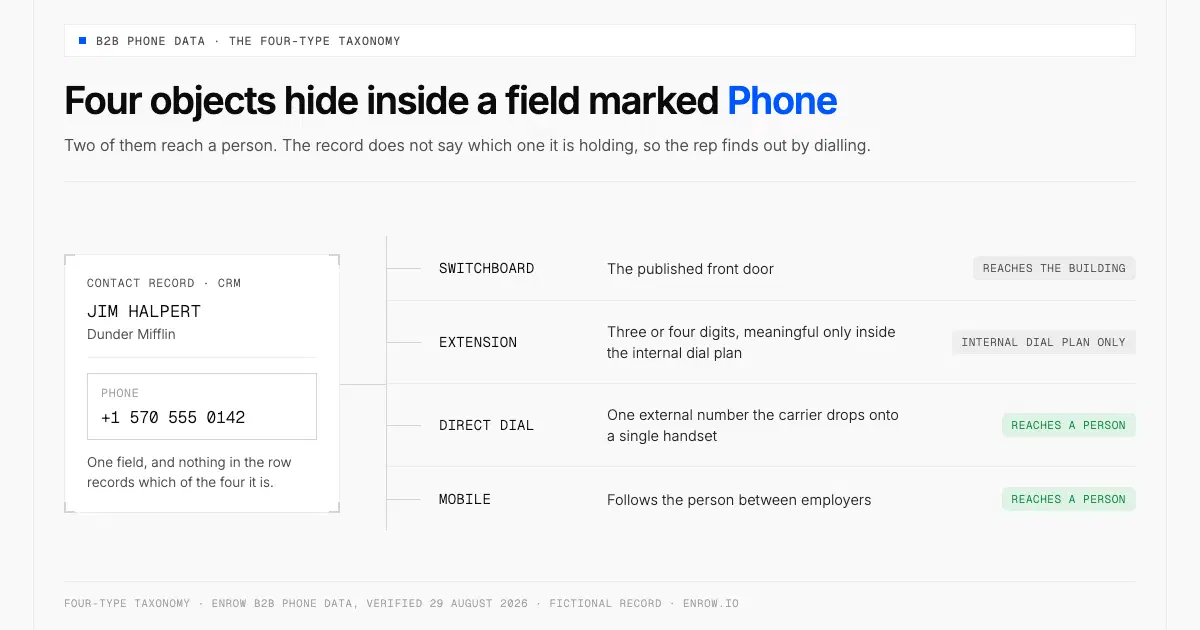
Only the direct dial and the mobile reach a person, and the record never says which one it holds.
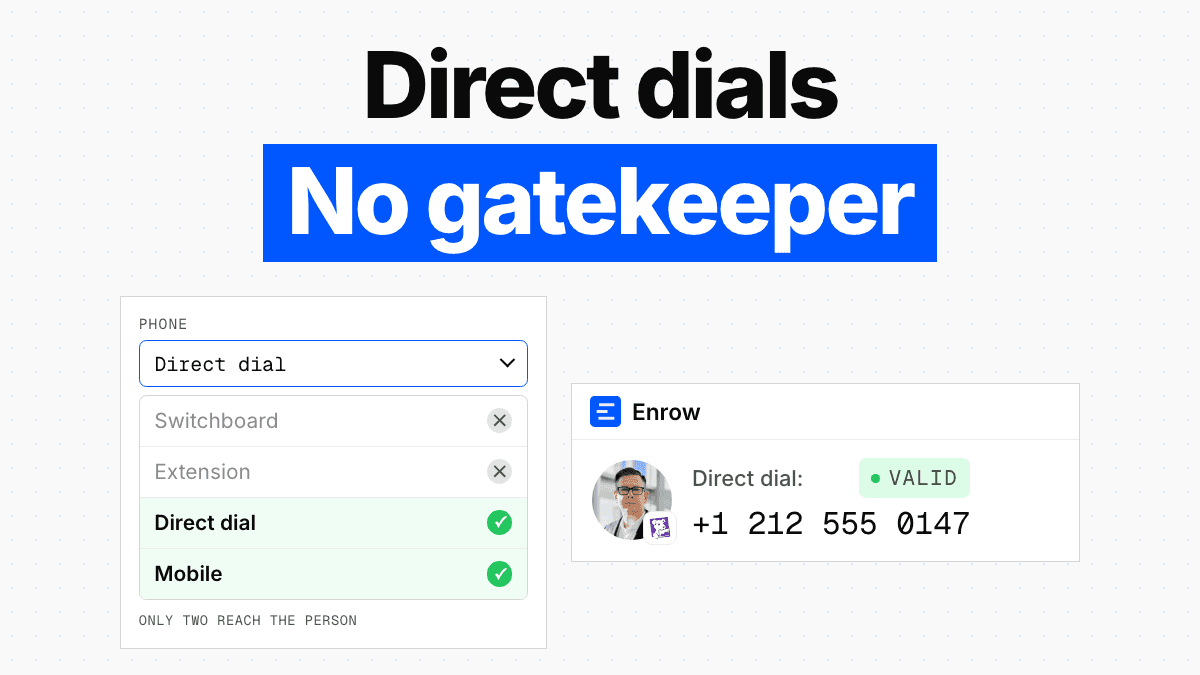
Four things get filed under "Phone" in B2B data. A switchboard is the published front door. An extension is three or four digits meaningful only inside the internal dial plan. A direct dial is one external number the carrier drops onto a single handset. A mobile follows the person between employers. The full taxonomy and its routing mechanics sit in a separate piece, because getting that wrong is how a rep spends a morning talking to menus.
Calling it still earns its place on accounts worth the eight seconds a receptionist takes to judge you. Give the full name, say why, accept the transfer or the voicemail. What you will not get is a mobile, because handing one out is not their job and usually breaches their own policy.
The UK regulator draws a legal line in the same spot. The ICO's business-to-business guidance, accessed August 29, 2026: if "you do not know the name of the person you are sending direct marketing to at a business, then you are not processing personal data and the UK GDPR does not apply". Ask the switchboard for the IT department and no personal data is in play. Dial a named person's mobile and it is, because identifying an individual "will constitute personal data even if they are acting in their business capacity".
6. Your own CRM, before you spend anything
Somebody at your company has already spoken to this person, or to their predecessor. Search the CRM, the call logs and the shared inbox first.
The failure mode here is specific to phones. An email to someone who left bounces. A direct dial that got reassigned rings normally and a stranger answers, so the row passes every freshness check you own. Treat any stored number older than a year as a hypothesis.
7. A phone finder that goes and looks while you wait
You give a full name plus a company domain, or a LinkedIn URL, and the provider searches live sources and validates the result before returning it. Enrow's Direct Phone Finder answers in 2 to 5 seconds, covers EU mobiles and is strong across the US, with no country restriction.
The billing model deserves a second read. One mobile draws 40 credits out of the same pool the emails come from, where an address is 1 credit and a re-check 0.25. No second phone budget exists alongside it; the two draw down the same balance. Credits move on a valid result and on nothing else, so a miss is free. A reveal model spends the credit the instant a stored row appears on screen, whether that row still connects or was scraped out of a signature in 2021.
Pay-per-valid only means something if the thing actually finds. Run a hundred LinkedIn profiles through the Direct Phone Finder and 92 of them yield a mobile, which is Enrow's own internal measurement on that input, signed off 2026-08-29 and never a benchmark or anybody else's figure. Eight yield nothing. Nothing is free.
But the input carries a lot of that result. A LinkedIn profile gives the search far more to work with than a bare name and an employer typed into a form, and a find rate quoted without saying what went into it is close to meaningless. So take the claim apart on profiles you already know. Fifty credits arrive free every month and no card is asked for, but a phone eats 40 of them, so what that buys is a single number: enough to see what comes back, not enough to argue about a rate. A month on Start costs $17 and gets you 25 tries. That is a sample somebody can push back on.
8. The extension that writes the number into the CRM
Copy-pasting a number from a tool into HubSpot is where data quality dies. Enrow's Chrome extension runs the lookup from an open LinkedIn or Sales Navigator profile and pushes the whole contact card into HubSpot, Salesforce or Pipedrive as a create-or-update, so an existing record is enriched rather than duplicated. Only the lookup draws credits.
The same numbers reach a spreadsheet through CSV, an API, webhooks, or the MCP server at github.com/EnrowAPI/enrow-mcp if your reps work inside Claude. Native connections cover Clay, Cargo, lemlist, Smartlead, Instantly, Make, Zapier and n8n; Attio, Close CRM, Salesloft and Outreach go through third-party routes.
The legal ground, starting with a register that no longer exists
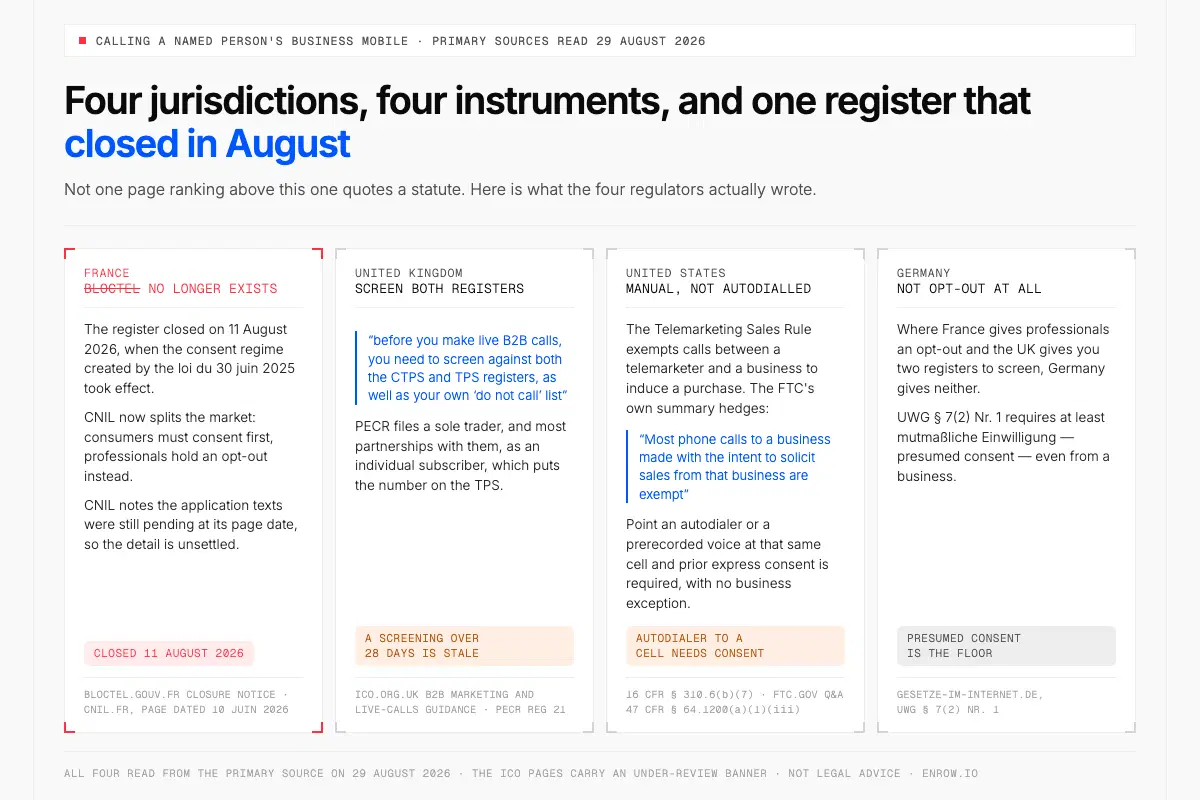
Each jurisdiction draws the line in a different place, and France's Bloctel register closed on 11 August 2026.
Every ranking guide now gets France wrong. Bloctel is gone. Fetched 2026-08-29, bloctel.gouv.fr is 599 characters of closure notice: the service "a pris fin avec l'entrée en vigueur au 11 août 2026 du régime de démarchage téléphonique fondé sur le recueil préalable du consentement du consommateur, conformément à la loi du 30 juin 2025". The CNIL's register of French opposition lists, updated 12 août 2026, no longer names it either.
What replaced it splits the market. The CNIL, on a page dated 10 juin 2026: consumers must consent first, while "les professionnels disposeront quant à eux de la possibilité de s'y opposer" — an opt-out, not a consent gate. And the regulator's worked example is this exact use case, B2B prospecting resting on legitimate interest, "par exemple, un appel présentant les mérites d'un logiciel au directeur informatique d'une entreprise". CNIL notes the application texts were still pending at that date, so the operative detail is unsettled.
What your provider has to be able to tell you
GDPR Article 6(1)(f) supplies the lawful basis, legitimate interest, "except where such interests are overridden by the interests or fundamental rights and freedoms of the data subject". A balancing test.
Article 14 decides which vendor you can safely buy from, because it bites whenever the data did not come from the person. Sub-point 14(2)(f) requires you to disclose "from which source the personal data originate, and if applicable, whether it came from publicly accessible sources". A provider who cannot document where a given mobile came from leaves you unable to satisfy 14(2)(f), and no contract clause repairs that. Article 14(3)(a) sets the outer limit at "one month"; 14(3)(b) pulls it forward to "the time of the first communication", which for a cold call means before or during the call. The escape hatch at 14(5)(b) enumerates archiving, research and statistics. Commercial prospecting is not on that list.
Then Article 21(4), which almost nobody implements: at the latest at the first communication, the right to object must be "explicitly brought to the attention of the data subject and shall be presented clearly and separately from any other information". Once they object under 21(2), 21(3) ends the processing outright, with no balancing left to do. CNIL says the same about third-party numbers — the person must have been informed their number could be used for prospecting, and be able to refuse.
The UK: screen two registers, and mind the sole trader
PECR Regulation 21 bans unsolicited marketing calls to a line whose subscriber has told you to stop, or whose number sits on the register kept under regulation 26, with a 28-day grace period at 21(3). The ICO's instruction: "before you make live B2B calls, you need to screen against both the CTPS and TPS registers, as well as your own 'do not call' list."
PECR treats a sole trader, and most partnerships alongside them, as an individual subscriber. Their numbers go on the TPS rather than the CTPS. File a one-person consultancy as a company, screen the corporate register alone, and that is where your complaint comes from. On bought lists the ICO gives a hard deadline: a screening older than 28 days is stale, because that is how long a registration takes to activate. Publication is not permission either. "Just because a telephone number is publicly available or appears in a telephone directory does not mean it overrides a TPS or CTPS registration."
Both ICO pages carried a banner on 2026-08-29 saying the guidance is under review after the Data (Use and Access) Act. Quoted as the regulator's current position, not settled law.
The US: the carve-out stops where the autodialer starts
The Telemarketing Sales Rule exempts "telephone calls between a telemarketer and any business to induce the purchase of goods or services" at 16 CFR § 310.6(b)(7), with the misrepresentation rules at § 310.3(a)(2) and (4) still live. The FTC's own summary hedges: "Most phone calls to a business made with the intent to solicit sales from that business are exempt." Most.
Here is the provision that matters on a page about mobiles, and that nothing currently ranking mentions. 47 CFR § 64.1200(a)(1) bars any call placed "using an automatic telephone dialing system or an artificial or prerecorded voice" without prior express consent, and (a)(1)(iii) applies that to any number assigned to cellular telephone service. No business-versus-residential distinction appears anywhere in (a)(1). A rep manually dialling a business mobile sits outside the TSR. The same number, dialled by a power dialer or answered by an AI voice, does not.
Two more. A personal cell number can sit on the National Do-Not-Call Registry — the FTC has said so since 2005, registrations take effect within 31 days and, after a later statutory change, never expire. And § 64.1200(e) extends the (c) and (d) rules to wireless numbers. Germany is not opt-out at all: UWG § 7(2) Nr. 1 requires at least mutmaßliche Einwilligung, presumed consent, even from a business. None of this is legal advice, and these four jurisdictions are the ones I checked today.
What a mobile number costs
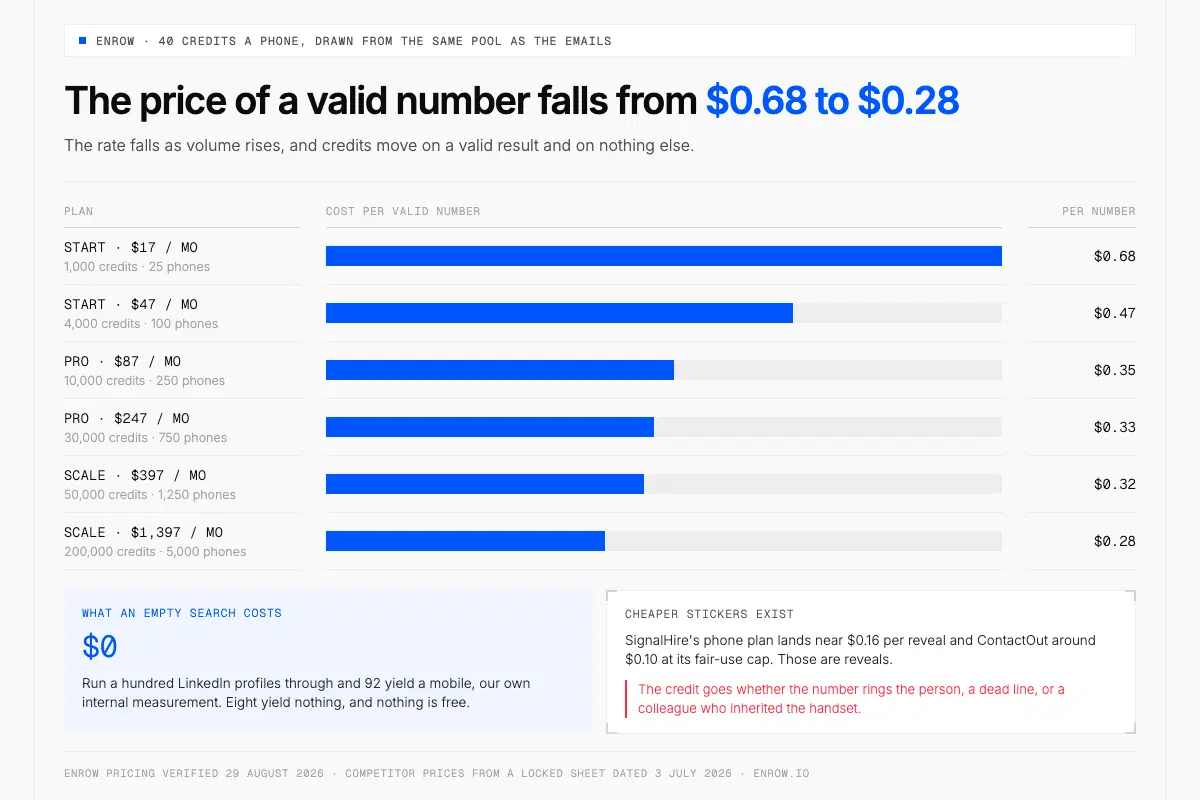
Volume takes a valid number from $0.68 down to $0.28, and a search that finds nothing costs nothing.
At 40 credits per phone from a shared pool, Enrow's rate falls from $0.68 to $0.28 per valid number as volume rises, and a failed lookup is never billed.
| Plan | Price/month | Credits | Phones | Cost per valid number |
|---|---|---|---|---|
| Free | $0 | 50/mo, recurring, no card | 1 | — |
| Start | $17 | 1,000 | 25 | $0.68/valid number |
| Start | $47 | 4,000 | 100 | $0.47/valid number |
| Pro | $87 | 10,000 | 250 | $0.35/valid number |
| Pro | $247 | 30,000 | 750 | $0.33/valid number |
| Scale | $397 | 50,000 | 1,250 | $0.32/valid number |
| Scale | $1,397 | 200,000 | 5,000 | $0.28/valid number |
Annual billing takes 10% off Pro and Scale: 10,000 credits at $78.30/mo is $0.31 a valid number, 50,000 at $357.30/mo is $0.29. Start has no annual option and no rollover.
Most phone vendors I compete with charge more per number than that, and the only honest way to show it is to price an identical monthly volume at each. FullEnrich, a waterfall, also bills a mobile only when it finds one, at 10 credits, so its $55 monthly plan of 1,000 credits buys 100 numbers at $0.55 each; Enrow's $47 Start tier buys the same hundred at $0.47. At 5,000 numbers a month FullEnrich asks $1,950, or $0.39 a number, where our $1,397 tier works out at $0.28. Kaspr prices its seats in euros, so Enrow's euro rates go next to them: €59 per user per month for 100 phone credits is €0.59 a number, against €0.42 for a hundred on Start at €42. Its €99 Business seat brings 200 credits, just under €0.50 each, while €75 on Pro covers 250 numbers at €0.30. Enrow charges nothing per seat: Pro takes up to 10 team members, and Scale doesn't cap headcount.
Findymail is the useful outlier: a phone costs 10 credits there, and its numbers cover the US only, with nothing at all for Europe. No Findymail price for a European mobile exists at any volume. Cognism sells on quote only, under annual contracts that bundle five seats. The one figure on record is third-party: an archived Vendr page put that entry package at about $22,500 a year, a commitment signed before a single number is found rather than a price per number.
Where Enrow will not help you
There is no database inside Enrow to search. Numbers are not warehoused and re-cut two or three times a year; each one is found and validated the second you ask, which is what keeps the number you get from us current and equally what stops you filtering your way to a roster of German CTOs in our product. Source the names in Sales Navigator or plain LinkedIn, then push them through.
No reverse lookup, as said at the top. No sequencing — Emelia, La Growth Machine and lemlist do that job properly. No technographics; company data stops at what LinkedIn would show you.
And the free tier is weak here, which is the fair thing to admit on a page about phones. Fifty recurring credits come out of one pool, so a single mobile lookup at 40 leaves ten emails behind it and nothing else. lemlist hands out 25 free phone finds a month, Kaspr gives 5, so on free volume alone we are not the answer. One lookup is enough for a control test, and no more.
ready to stop wasting time?
Connected in minutes.
Verified data in seconds.
FAQ
Can you find someone's cell phone number by their name?
Not on its own, in most cases. Pair the name with a company domain or a LinkedIn profile URL and a B2B phone finder can search live sources and return a validated mobile in about 2 to 5 seconds. The input decides the hit rate: working from LinkedIn profiles, Enrow's own internal measurement is 92 mobiles per hundred contacts, and a bare name typed in cold does far worse. Name plus city, with no employer attached, is consumer people-search territory and outside what a business data provider does.
Are cell phone numbers public information?
No. A generic company switchboard published on a website is not personal data at all according to the ICO, since no individual is identified. A named person's mobile is personal data under UK and EU GDPR even in a business context, which brings the Article 14 source-disclosure duty and the Article 21 objection right with it. Publication somewhere does not create permission to call.
Is there a free way to look up cell phone numbers?
Free routes exist and none returns a verified mobile. Your inbox, your CRM, LinkedIn's contact panel and search operators cost nothing and hand back unlabelled or stale numbers. Free vendor allowances are small: lemlist offers 25 phone finds a month, Kaspr 5, and Enrow's 50 recurring credits stretch to exactly one phone lookup.
Is it legal to call a prospect's mobile number?
In the US, a manually dialled business-to-business sales call falls under the TSR exemption at 16 CFR § 310.6(b)(7). Point an autodialer or a prerecorded or AI voice at that same cell number and 47 CFR § 64.1200(a)(1)(iii) requires prior express consent, with no business exception. UK callers must screen the TPS and CTPS first. Germany requires at least presumed consent under UWG § 7(2) Nr. 1.
Do I still need to screen against Bloctel in France?
Bloctel no longer exists. The French government's site confirms the service ended on 11 August 2026, when the consent regime created by the loi du 30 juin 2025 took effect, and the CNIL has removed it from its list of opposition registers. Under the new split, consumers must consent before being called and professionals hold an opt-out right instead.
How do I find someone's mobile number in the UK for free?
Free UK routes are the same as anywhere: an existing signature, your own CRM, LinkedIn's contact panel, a published bio. Before dialling anything you find, screen it against both the TPS and the CTPS, because PECR files a sole trader, and most partnerships with them, as an individual subscriber, which puts the number on the TPS. A screening more than 28 days old is treated as out of date.