alternatives à skrapp
Les 10 meilleures alternatives à Skrapp pour les équipes commerciales B2B en 2026
J'ai donc testé dix alternatives. Les critères sont ceux qui décident vraiment d'un budget de prospection : le taux de contacts trouvés, le bounce sur un vrai envoi, le coût réel d'un contact utilisable, et la couverture géographique — surtout les numéros de portable européens obtenus légalement.
10 outils testés
mis à jour le 6 octobre 2026
15 min de lecture
Mis à jour le 6 octobre 2026
Les alternatives en un coup d'œil
pour des emails et des numéros de portable vérifiés que vous ne payez que lorsqu'ils fonctionnent, Enrow est la meilleure alternative à Skrapp, à partir de 15 €/mois. Emelia si vous préférez chercher et envoyer depuis un seul outil ; Hunter pour la recherche par domaine avec les sources ; Findymail pour des adresses de cold email américaines ; Apollo ou Snov pour un tout-en-un base et campagnes ; LeadMagic si votre flux de travail est en réalité un script. Les autres couvrent chacun un besoin plus étroit, détaillé plus bas.
Skrapp ne trouve que des emails, aucun numéro de téléphone, et ses adresses sortent d'une base stockée qui n'est rafraîchie que de temps en temps. Sur un vrai envoi, ça bounce plus que de la donnée trouvée en direct.
Et la facturation est moins généreuse qu'elle n'en a l'air : Skrapp facture chaque recherche lancée, pas l'email qui arrive vraiment. Vous payez la tentative, que l'adresse fonctionne ou non, et seule une partie d'une liste stockée s'avère exploitable.
Enrow fait le choix inverse : des emails vérifiés et des numéros de portable européens obtenus légalement, trouvés en temps réel et facturés seulement quand ils fonctionnent, à partir de 15 €/mois. Sur mon vrai envoi, le bounce est resté sous 1 % (chiffre constaté, pas une garantie). Et là où l'extension de Skrapp récupère une adresse sur un profil LinkedIn, celle d'Enrow dépose la fiche contact complète — email, numéro, tous les champs — directement dans HubSpot, Salesforce ou Pipedrive en un clic. Aucun autre outil de cette page ne fait ça. Les neuf outils ci-dessous couvrent chacun un besoin plus étroit ; aucun n'est un meilleur choix global.
Pourquoi les équipes cherchent des alternatives à Skrapp
Skrapp est un point de départ correct, et pourtant on le quitte pour trois raisons. Si tout votre travail, c'est de l'email B2B en masse depuis une base et que vous ne décrochez jamais le téléphone, Skrapp peut suffire. Sinon, continuez.
Transparence : notre conflit d'intérêts
Commençons par l'évidence. Enrow est un outil de recherche d'emails, cette page classe des outils de recherche d'emails, et j'ai mis Enrow en premier. C'est mon produit. Gardez-le en tête à chaque ligne.
Maintenant la concession, tout de suite. Enrow n'envoie pas de campagnes : pour les séquences, prenez Emelia ou Snov dans cette liste. Il ne met pas non plus les boîtes en chauffe — là encore, Emelia ou Snov. Pas d'enrichissement en cascade, et c'est le rôle d'Emelia et de LeadMagic.
Et ce n'est pas une base que vous filtrez et parcourez, ce qui est le terrain de Skrapp, d'Apollo et de Snov. Aucun de ces manques n'est un oubli.
Nous préférons trouver et vérifier un contact nous-mêmes plutôt que de le tirer d'une base mise à jour pour la dernière fois il y a un trimestre.
Voici ce que j'assume sans détour : sur le seul métier d'Enrow — trouver et vérifier une donnée de contact fraîche et exacte —, il soutient la comparaison avec tous les outils de cette page, justement parce qu'il ne fait que ça.
Vous voulez des campagnes, de la mise en chauffe, ou une liste à prospecter à froid ? Un outil plus bas vous conviendra mieux, et je vous y enverrai.
Mais si ce qu'il vous faut, c'est la donnée email et téléphone la plus exacte possible, ce périmètre étroit est toute la raison d'être d'Enrow.
Les 10 meilleures alternatives à Skrapp
1. Enrow
#1
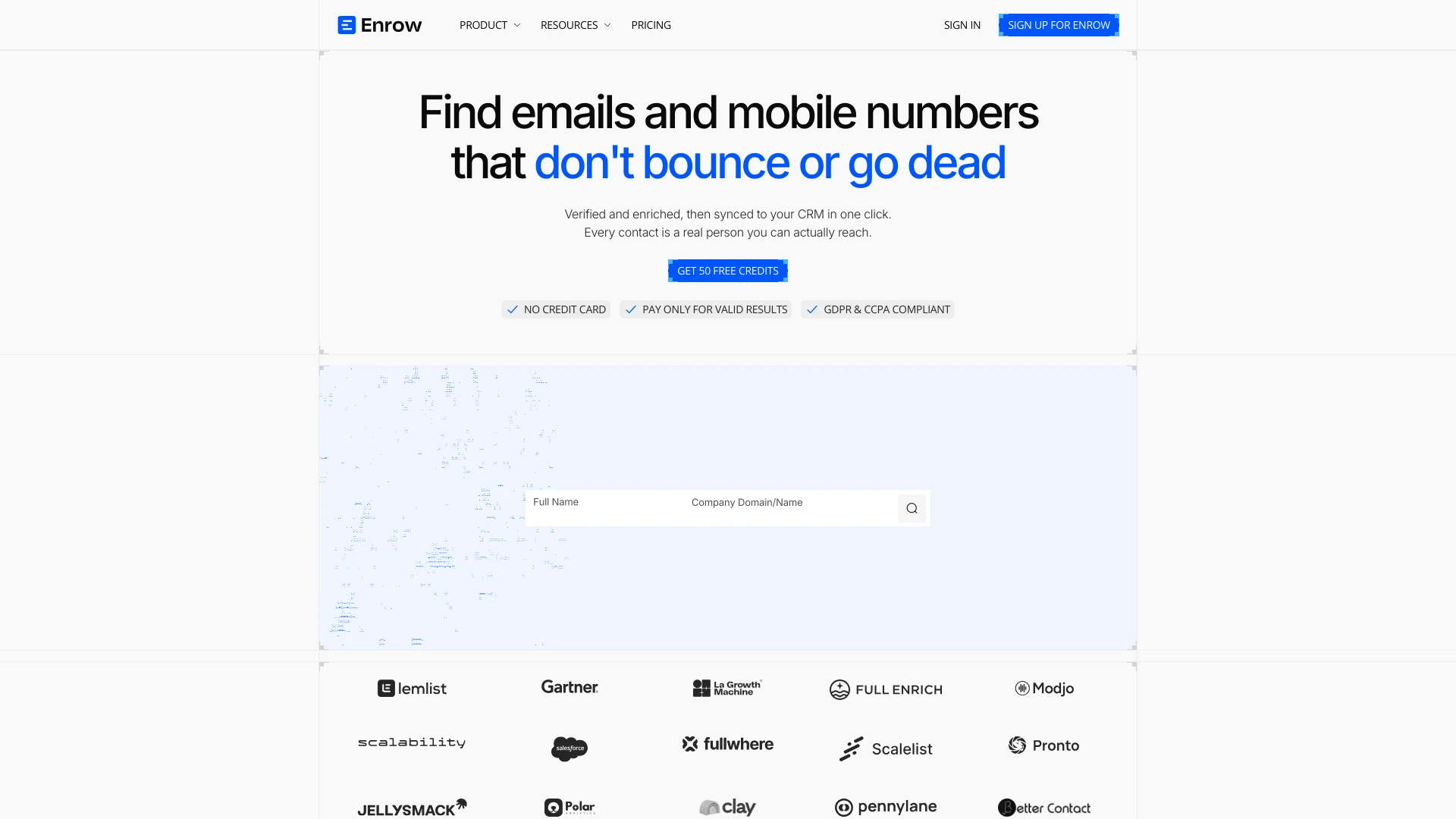
Je l'ai construit après un mois de trop passé à payer pour enrichir un fichier, à n'en récupérer qu'une partie, puis à en voir une partie bouncer quand même.
Le premier écart avec Skrapp, c'est la facturation. Skrapp facture chaque recherche lancée : vous payez la tentative, que l'adresse soit délivrable ou non. Enrow ne facture que sur un résultat valide — une recherche qui ne trouve rien ne coûte rien.
Ensuite, l'origine de la donnée creuse le fossé. Skrapp puise dans une base stockée et consultable, rafraîchie par cycles.
Enrow trouve chaque contact au moment où vous le demandez, puis lui fait passer plus de 10 vérifications, plusieurs tests SMTP et des contrôles catch-all sur des serveurs situés dans différentes régions avant de le considérer comme valide. Une liste stockée ne vaut que ce que valait sa dernière reconstruction.
Une recherche en direct est à jour par définition — et c'est pour ça qu'elle bounce moins sur un vrai envoi.
Vient le manque que Skrapp ne peut pas combler : le téléphone. Il n'en a aucun. Le Direct Phone Finder d'Enrow renvoie des numéros de portable dans tous les pays, Europe comprise.
Sur ma liste, c'était la différence entre appeler un directeur commercial français et écrire dans une boîte partagée que personne ne lit.
Les adresses catch-all ressortent vérifiées et livrées, pas signalées « à risque » puis écartées en douce — la méthode qui aide beaucoup d'outils à garder un joli taux de bounce.
Le vrai envoi a vite montré une chose : le bounce est resté sous 1 %, et quand j'ai appelé les portables européens, la personne qui décrochait était bien celle de la liste, pas un standard qui récite un organigramme périmé.
Le taux de contacts trouvés tournait autour de 60 % sur une liste mixte. Une réserve, pour être franc : ce sous-1 % est une moyenne constatée, pas un engagement.
Et il y a l'avantage que rien d'autre ici n'égale. Ouvrez un profil LinkedIn ou Sales Navigator, cliquez une fois, et l'extension Chrome d'Enrow enregistre la fiche contact complète et vérifiée — email, numéro, tous les champs — directement dans HubSpot, Salesforce ou Pipedrive.
Pas de copier-coller, pas de fiche à moitié remplie. L'extension de Skrapp sait faire remonter une adresse depuis ce même profil, mais elle s'arrête là ; elle ne dépose pas une fiche contact complète et vérifiée dans votre CRM comme celle-ci le fait.
Une dernière chose, plus récente. Enrow propose un serveur MCP officiel (dépôt public sur github.com/EnrowAPI/enrow-mcp) : la recherche, la vérification et le Direct Phone Finder répondent directement depuis Claude, Cursor ou Windsurf.
Confiez un nom à un agent, récupérez un email vérifié ou un numéro de portable frais, ne payez que si c'est valide ; tout est détaillé sur la page API. Détail modeste aujourd'hui. Il ne le restera pas.
- +Payé seulement sur un résultat valide ; une recherche ratée ne coûte jamais de crédit
- +Numéros de portable dans tous les pays, Europe comprise (Skrapp n'a aucun téléphone)
- +Recherche en temps réel et plus de 10 vérifications par email ; les catch-all sont vérifiées et livrées, pas écartées, ni laissées à vieillir dans une base stockée
- +Intégrations natives Clay, HubSpot, Salesforce, Pipedrive, plus des webhooks et une vraie API
- +L'extension Chrome dépose la fiche contact complète et vérifiée, tous les champs, d'un profil LinkedIn ou Sales Navigator dans votre CRM en un clic (aucun rival de cette liste ne le fait)
- +Serveur MCP officiel (dépôt : github.com/EnrowAPI/enrow-mcp) : des emails et numéros vérifiés et frais dans Claude, Cursor ou Windsurf, toujours au résultat valide
- –Pas de base à parcourir, et c'est le compromis assumé. Dès qu'un outil stocke ses contacts, les fiches commencent à dériver ; Enrow interroge en direct, et c'est pour ça qu'il trouve souvent une adresse fraîche là où une fiche stockée a déjà changé. Pour constituer la liste elle-même, prospectez dans LinkedIn ou Sales Navigator.
- –Il n'envoie pas vos campagnes, et ça n'arrivera pas. Pour ce travail, voyez Emelia en premier, ou bien La Growth Machine et lemlist.
- –Pas de données sur les technologies utilisées. Vous avez le niveau de détail entreprise de LinkedIn, mais rien sur la stack technique d'un prospect.
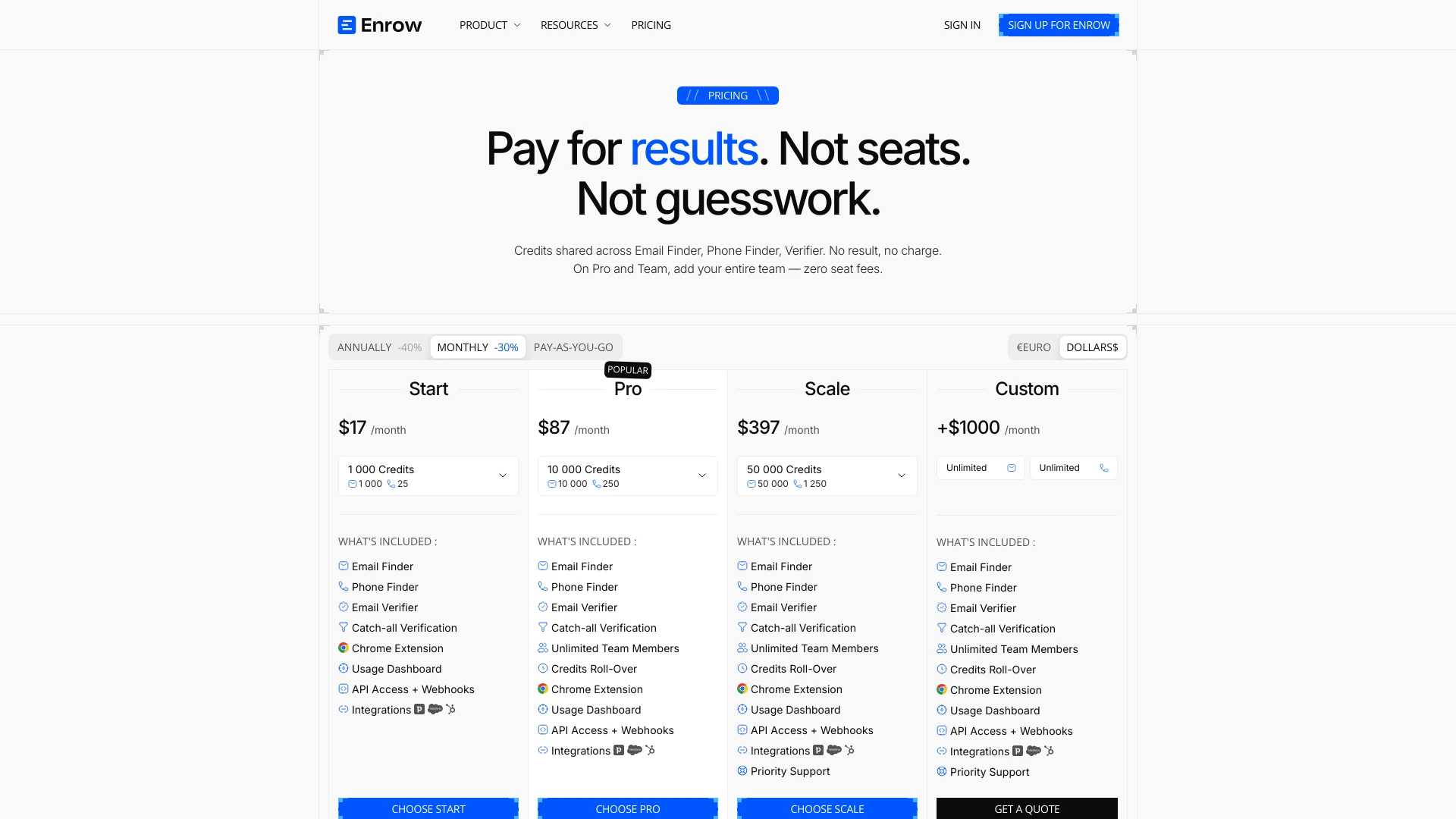
Trois paliers, facturés au mois. Start : 1 000 crédits pour 15 €, ou 4 000 pour 42 € (au mois uniquement). Pro : 10 000 pour 75 €, 20 000 pour 150 €, 30 000 pour 220 €.
Scale : 50 000 pour 360 € jusqu'à 200 000 pour 1 250 €. L'engagement annuel réduit Pro et Scale d'environ 10 %, ce qui met les 10 000 crédits autour de 68 €/mois et les 50 000 autour de 324 €/mois.
Le calcul des crédits reste simple : 1 email = 1 crédit, 1 numéro de portable = 40 crédits, une vérification 0,25, catch-all comprise, et aucun crédit ne part tant que le résultat n'est pas valide. Un forfait de 10 000 crédits achète 10 000 emails ou 250 numéros.
Pro et Scale reportent les crédits inutilisés. Gratuit : 50 crédits chaque mois, renouvelés, sans carte.
Voici le chiffre qui compte, celui auquel chaque bloc ci-dessous est comparé.
Comme vous ne payez que sur un résultat valide, le prix affiché d'Enrow est son coût réel : environ 0,015 € l'email vérifié sur Start, qui tombe à près de 0,0075 € sur Pro (10 000 pour 75 €) et autour de 0,006 € au sommet en annuel. Les numéros, à 40 crédits, reviennent à environ 0,30 € le portable vérifié, quel que soit le pays, sur Pro (10 000 crédits = 250 numéros).
Aucun taux de réussite à déduire, aucun frais à la recherche, puisqu'une recherche ratée est gratuite. Gardez ces deux chiffres en tête : la plupart des rivaux ci-dessous paraissent moins chers à l'affichage et coûtent plus par contact réellement utilisable.
Ne me croyez pas sur parole. Passez votre propre liste dans Enrow et comparez le bounce vous-même. 50 crédits gratuits chaque mois, renouvelés, sans carte.
2. Emelia
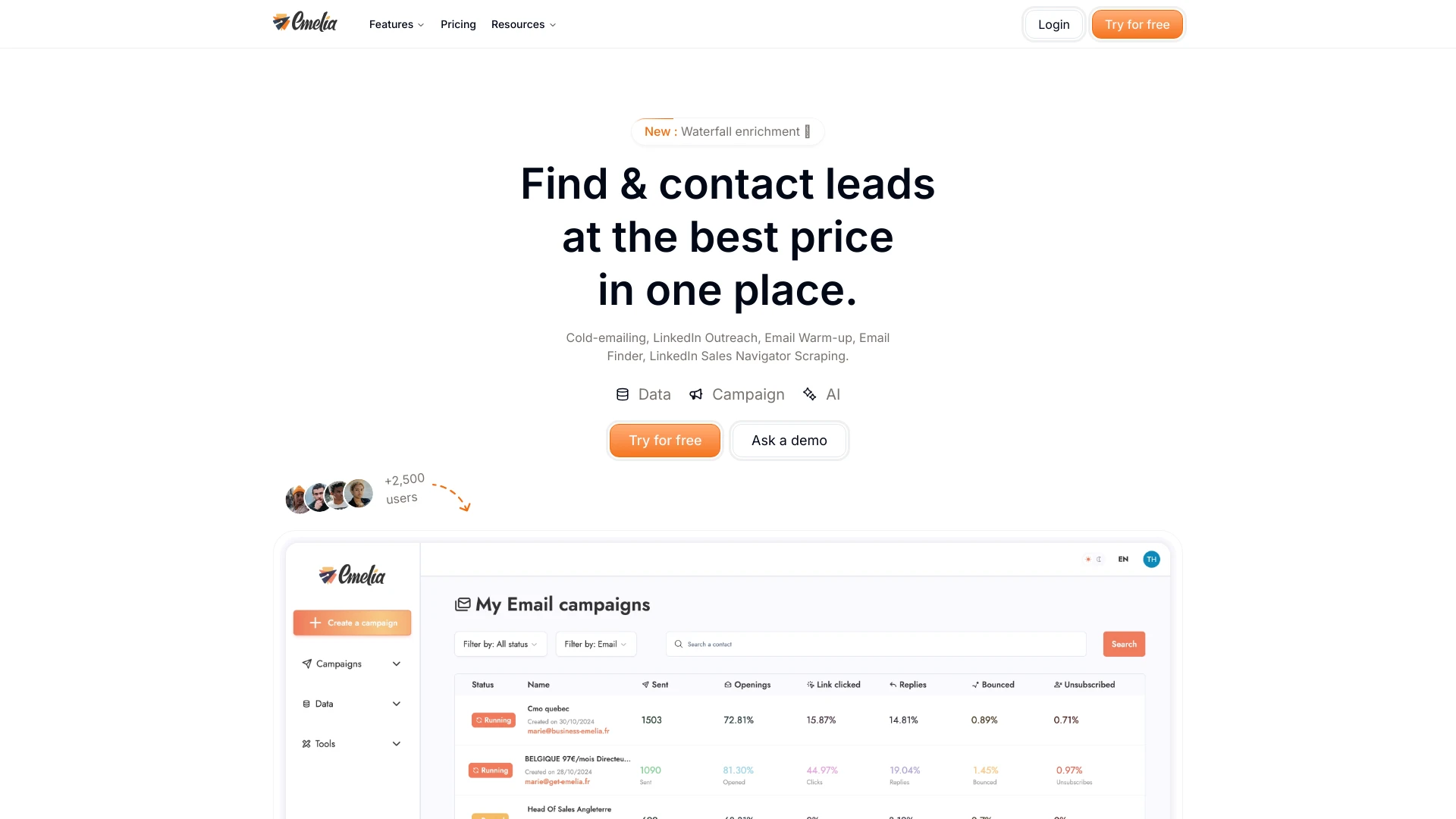
Le choix quand vous ne voulez pas brancher un outil d'envoi séparé sur votre recherche de contacts.
Emelia réunit la recherche et l'envoi : un outil de recherche d'emails avec enrichissement en cascade, un vérificateur, l'extraction de Sales Navigator, puis des séquences de cold email et LinkedIn avec mise en chauffe intégrée.
Skrapp trouve et vérifie dans sa base, puis passe la main à l'outil d'envoi que vous avez branché. Emelia, elle, va jusqu'à l'envoi.
Pour une petite équipe qui veut un seul accès plutôt qu'un outil de recherche plus un outil de campagnes, c'est le créneau — et Skrapp n'y joue pas.
C'est d'abord un outil de campagnes, et le côté donnée s'en ressent. La recherche est correcte. Les crédits partent sur les résultats, pas sur des recherches à l'aveugle. Mais le centre de gravité d'Emelia, c'est l'envoi, pas la finesse de la donnée. La couverture téléphonique est faible.
Pour un usage plus intensif, les crédits de recherche et d'enrichissement passent par des options en plus des forfaits de base, donc un gros consommateur de données paie deux fois.
Je joue franc jeu : Emelia est le partenaire vers qui nous envoyons les gens pour les séquences, parce que nous ne construisons pas cette partie et ne la construirons pas. Ce n'est donc pas un face-à-face, c'est l'autre moitié de l'ensemble.
La combinaison la plus propre les associe : Enrow pour les emails et les numéros de portable européens vérifiés, Emelia pour envoyer. Ce que j'ai apprécié à l'usage, c'est de voir la mise en chauffe et l'envoi juste à côté des contacts trouvés.
Mais sur la donnée elle-même — taux de contacts trouvés, portables européens, prix au résultat valide —, Enrow est la couche que vous lui donnez à envoyer, pas l'inverse.
- +Chercher, vérifier, enrichir et envoyer au même endroit (cold email + LinkedIn + mise en chauffe)
- +Les crédits sont comptés sur les résultats trouvés, pas sur des recherches à l'aveugle
- +Enrichissement en cascade et extraction de Sales Navigator inclus
- +Envois et contacts illimités sur les forfaits payants
- –Couverture téléphonique faible ; ce n'est pas un outil pour appeler
- –Les crédits de recherche et d'enrichissement reposent sur des options en plus, donc un gros consommateur de données paie davantage
- –C'est d'abord une plateforme d'envoi, donc, sur la donnée, les outils de recherche spécialisés vont plus loin
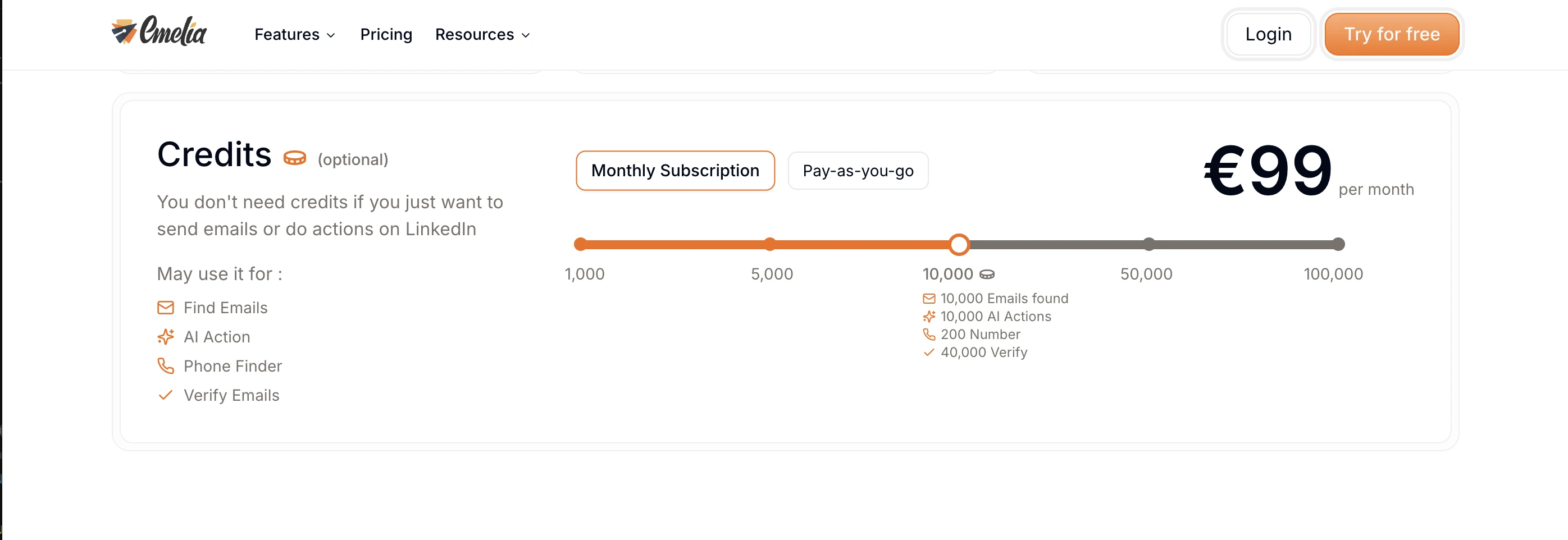
Converti en euros. Start autour de 37 €/mois (3 boîtes mail, 1 accès LinkedIn) ; les crédits de recherche passent par des packs séparés, à partir d'environ 19 € les 1 000 crédits.
Emelia facture la recherche sur les résultats trouvés (1 crédit par email), donc la facturation est honnête : environ 0,019 € l'email vérifié à l'entrée, soit à peu près 1,3× les 0,015 € d'Enrow au même volume. Pas de vrai produit de portable européen à chiffrer.
vs Enrow: Emelia envoie et Enrow non, donc c'est un duo complémentaire, pas un face-à-face sur la donnée ; sur la seule recherche, Enrow livre l'email vérifié moins cher et ajoute les numéros de portable européens qu'Emelia n'a pas. La raison de prendre Emelia, c'est la couche d'envoi — associez-la donc à Enrow pour la donnée.
3. Hunter
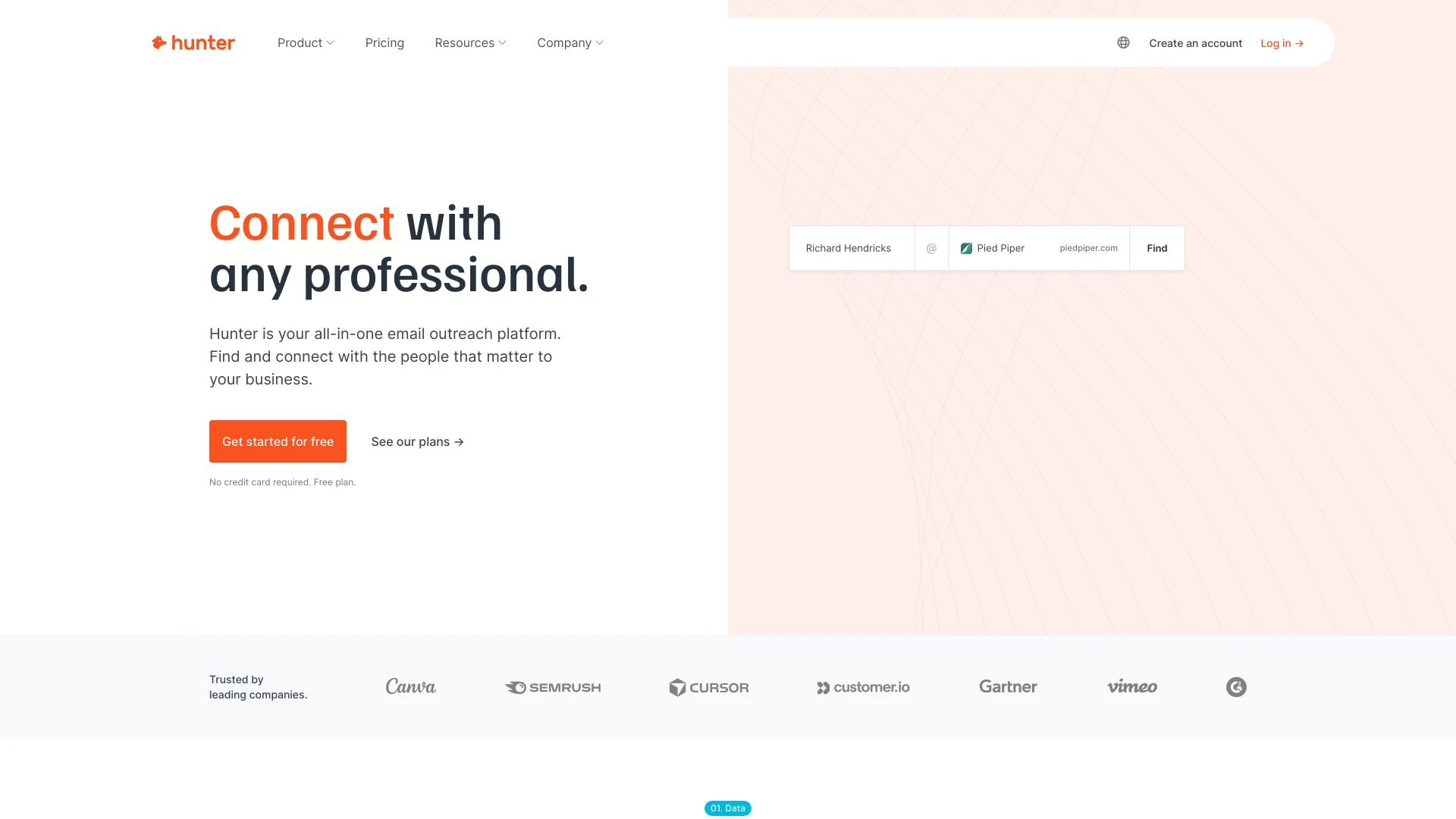
À utiliser quand le travail, c'est trouver des emails à partir d'un domaine et voir d'où vient chacun.
Hunter, c'est l'outil sur lequel la plupart des gens apprennent à trouver des emails. Donnez-lui un domaine, ou un nom plus une entreprise, et il renvoie des adresses avec un indice de confiance et une note sur l'endroit où il a repéré le format.
Cette vue des sources est pratique, et c'est ce que Hunter montre plus proprement que la base de Skrapp. Vraie offre gratuite aussi, 50 crédits par mois.
Le plafond est le même que celui de Skrapp. Les adresses de Hunter sont issues d'un crawl et déduites d'un format, donc les résultats sur les petites entreprises sont maigres ou périmés — le même problème de vieillissement qu'une base.
Et Hunter facture la recherche, pas l'email qui arrive : c'est là que se cache le coût réel. Deux pénalités s'additionnent.
Vous payez chaque recherche lancée, et Hunter ne dit pas combien renvoient une adresse. Nous tablons sur environ 30 % pour les recherches d'email, une hypothèse à nous et non un chiffre de Hunter : la facture vaut donc déjà à peu près trois fois l'affichage avant le moindre envoi.
Ensuite, une partie de ce qui revient n'est qu'un format deviné, qui bounce à l'envoi : vous avez payé des adresses qui n'allaient jamais arriver. Vous payez beaucoup, pour peu, et une partie de ce peu ne fonctionne même pas. La vérification puise dans le même compteur, à 0,5 crédit. Et zéro numéro de téléphone.
Si appeler compte, Hunter est un demi-outil, comme Skrapp.
À l'usage, les liens vers les sources ont mérité leur place : facile de vérifier un format avant de lui faire confiance. Ces indices de confiance cachent pourtant un piège.
À l'affichage, le Starter de Hunter est à environ 0,0245 € le crédit (2 000 pour 49 €), déjà 1,6× les 0,015 € d'Enrow à un volume d'entrée comparable.
Mais appliquez à ce prix la première peine seule, 0,0245 € ÷ 0,30, et le coût réel d'un email trouvé approche 0,082 €, environ 5,5× le Start d'Enrow et près de 11× le Pro. Les crédits qui expirent chaque mois sans avoir servi et les adresses devinées qui bouncent le font encore monter.
Et c'est avant l'écart de couverture. Hunter n'a aucun numéro, une vérification plus faible qu'un vrai vérificateur en temps réel (ses adresses supposées bouncent ; Enrow applique plus de 10 vérifications), pas de donnée vérifiée en direct, et pas d'export complet du contact vers le CRM en un clic.
Enrow trouve chaque contact frais, vérifie avant de valider une adresse, et ajoute les numéros de portable européens que ni Hunter ni Skrapp ne proposent. Même travail sur l'email, plus de couverture, moins de bounces à payer en aval.
- +Recherche par domaine et par nom, avec indices de confiance et sources
- +Vraie offre gratuite (50 crédits/mois)
- +Nombreuses intégrations et API propre
- +Interface simple et connue, vite prise en main
- –Donnée issue d'un crawl et déduite d'un format : maigre sur les petites entreprises, et une adresse « supposée » peut bouncer
- –La vérification se paie sur les mêmes crédits (0,5 crédit)
- –Aucune donnée téléphonique
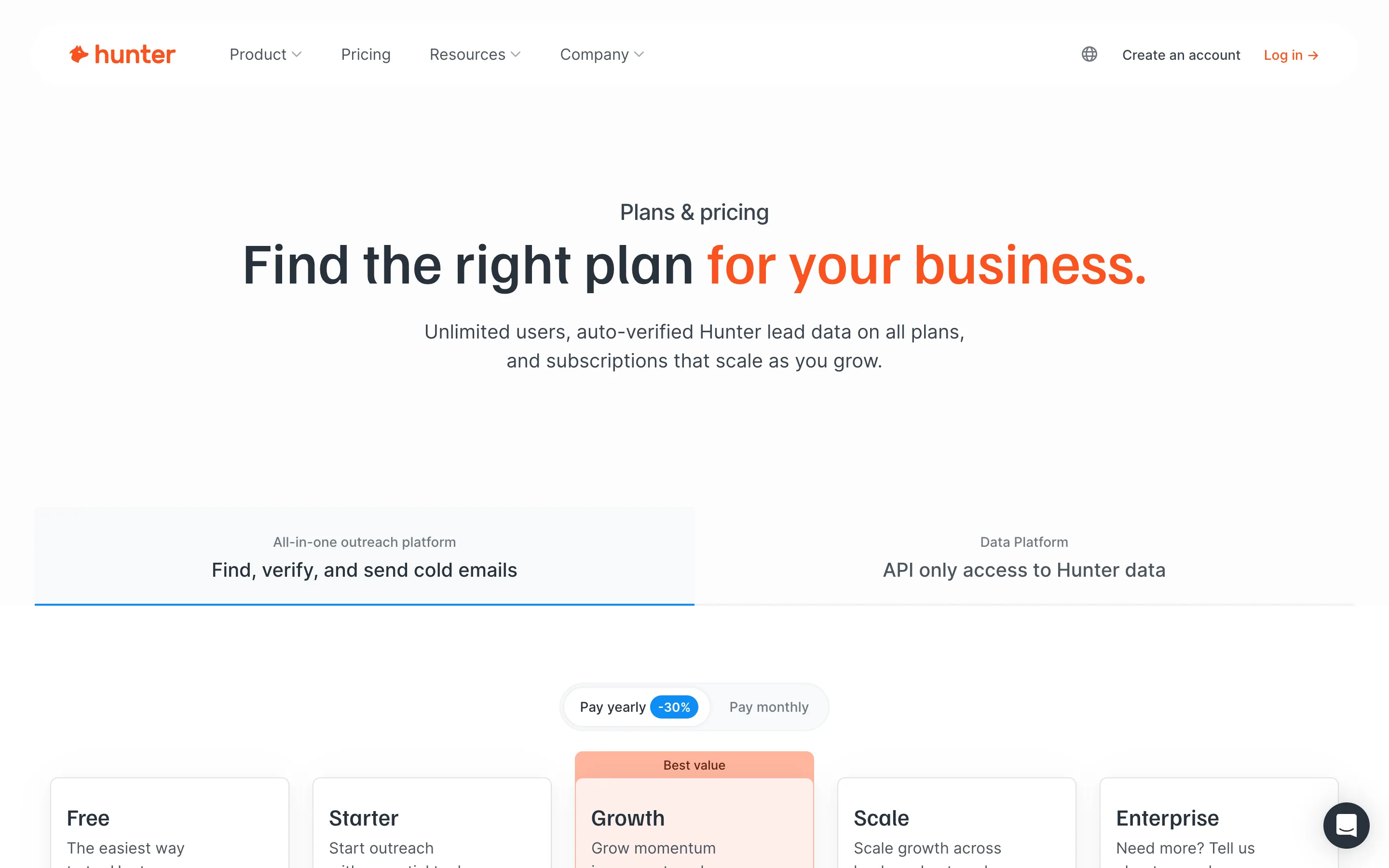
En euros, à parité avec l'affichage. Gratuit 50 crédits/mois. Starter 49 €/mois pour 2 000 crédits (34 €/mois en annuel), la vérification prenant 0,5 crédit sur le même solde.
Hunter facture la recherche lancée, pas l'email qui arrive, et ses crédits repartent de zéro chaque mois. Avec notre hypothèse de travail, 30 % de recherches d'email qui aboutissent, chaque adresse réellement obtenue revient à près de 0,082 €, environ 5,5× le Start d'Enrow (0,015 €) et 11× le Pro (0,0075 €). Aucun numéro à chiffrer.
vs Enrow: Hunter facture chaque tentative et n'a aucun numéro ; Enrow ne facture que sur un résultat prouvé valide, de 0,015 € (Start) à 0,0075 € (Pro), reporte les crédits sur Pro et Scale, ajoute les numéros de portable européens que Hunter ne propose pas, et pousse le contact complet dans votre CRM en un clic.
4. Prospeo
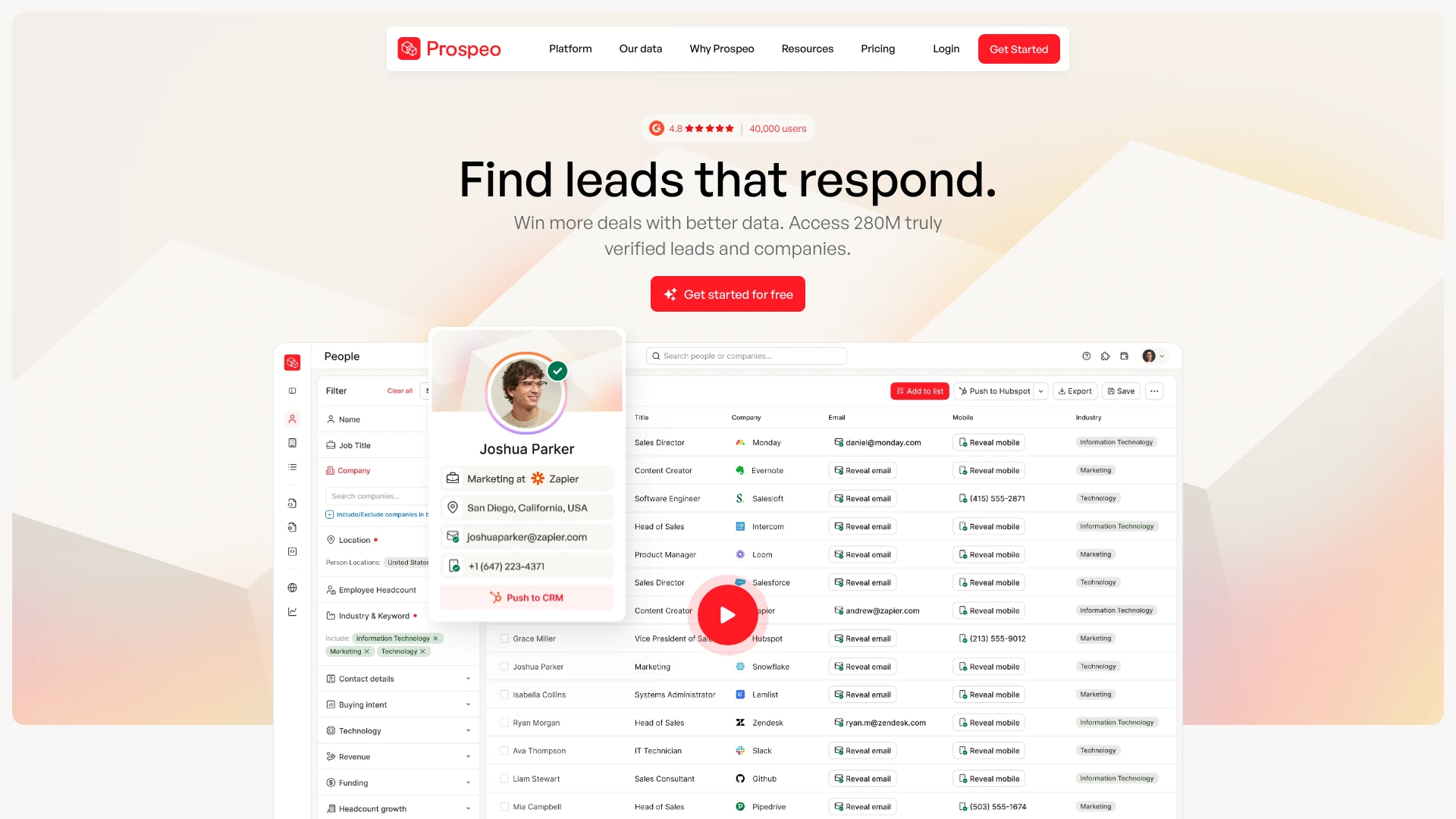
Le point d'entrée pour l'email tiré de LinkedIn.
Prospeo a une extension Chrome, un prix d'entrée bas, et une vérification comprise dans ses crédits.
Il compte 1 crédit par email trouvé et rien quand il ne trouve rien : contrairement à Skrapp, qui facture à la recherche, il ne facture donc que sur un résultat valide, une recherche ratée est vraiment gratuite.
Son créneau, c'est l'email LinkedIn à volume faible ou moyen, et le hic est du côté de la couverture, pas du prix : un faible taux de réussite veut dire moins de contacts trouvés, pas un prix plus élevé sur ceux qui le sont.
La qualité et la régularité de la donnée, c'est le bémol. Poussez au-delà des petits volumes et les résultats deviennent irréguliers, donc vous récupérez moins de contacts utilisables. Les numéros coûtent 10 crédits chacun, sans couverture européenne documentée.
Pas de report non plus, donc ce que vous ne consommez pas dans le cycle est perdu — un point où le report mensuel de Skrapp l'emporte discrètement.
La facturation au résultat, elle, est honnête ; le vrai compromis, c'est la couverture et les crédits qui s'évaporent en fin de mois.
J'ai passé un lot d'URL LinkedIn françaises et britanniques, et le constat a confirmé sa réputation : l'extension est rapide, les petits lots ont bien donné, puis le taux de réussite a glissé dès que la liste a grossi et s'est étoffée de contacts européens.
C'est le compromis du prix d'appel. Face à ça : Enrow ne facture lui aussi que sur un résultat valide, soumet chaque email à plus de 10 vérifications avant de le valider, et reporte les crédits sur Pro et Scale.
Les recherches ratées de Prospeo ne vous coûtent pas d'argent, mais elles vous coûtent des contacts, et ses crédits inutilisés expirent chaque mois là où ceux d'Enrow se reportent sur Pro et Scale.
- +1 crédit par email trouvé, 0 sur une recherche ratée
- +Recherche LinkedIn et par domaine avec une bonne extension Chrome
- +Vérification incluse, sur les mêmes crédits
- +Offre gratuite (100 crédits/mois)
- –Qualité de donnée irrégulière dès qu'on dépasse les petits volumes
- –Les numéros coûtent 10 crédits, sans couverture européenne documentée
- –Pas de report des crédits ; facturation par utilisateur
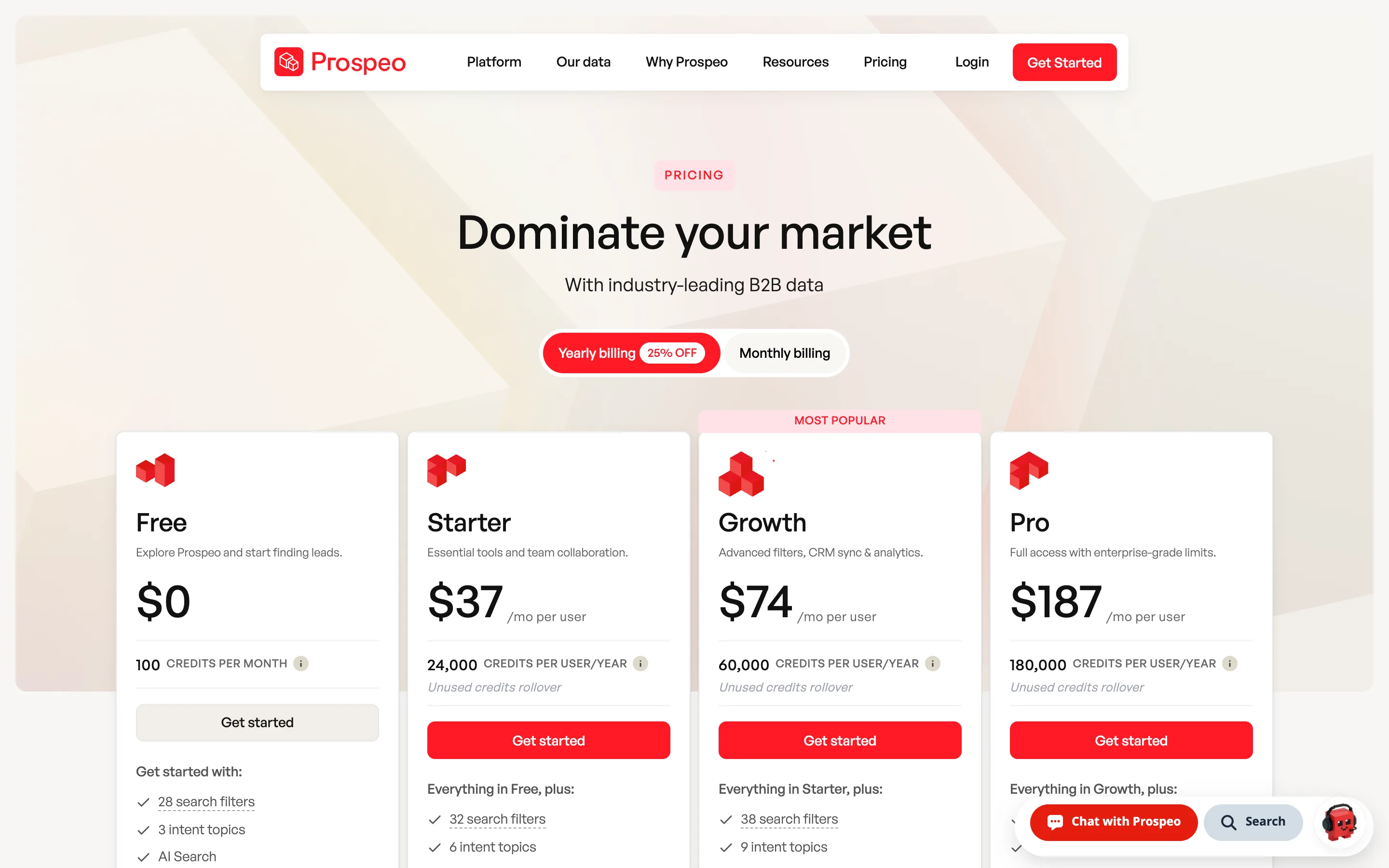
En dollars, par utilisateur. Gratuit 100 crédits/mois. Starter 49 $/mois (2 000 crédits), 1 crédit par email trouvé et 0 sur une recherche ratée ; un numéro coûte 10 crédits.
L'affichage est donc proche du coût réel : environ 0,0245 $ l'email vérifié au Starter, à peu près 1,4× les 0,017 $ d'Enrow à volume comparable. Son faible taux de réussite ne gonfle pas ce prix : Prospeo renvoie simplement moins de contacts.
vs Enrow: les deux ne facturent que sur un résultat trouvé, donc la facturation est honnête des deux côtés ; Enrow livre simplement l'email valide moins cher à chaque volume (0,017 $ au Start, 0,0087 $ sur Pro) et reporte les crédits sur Pro et Scale là où ceux de Prospeo expirent.
5. Snov
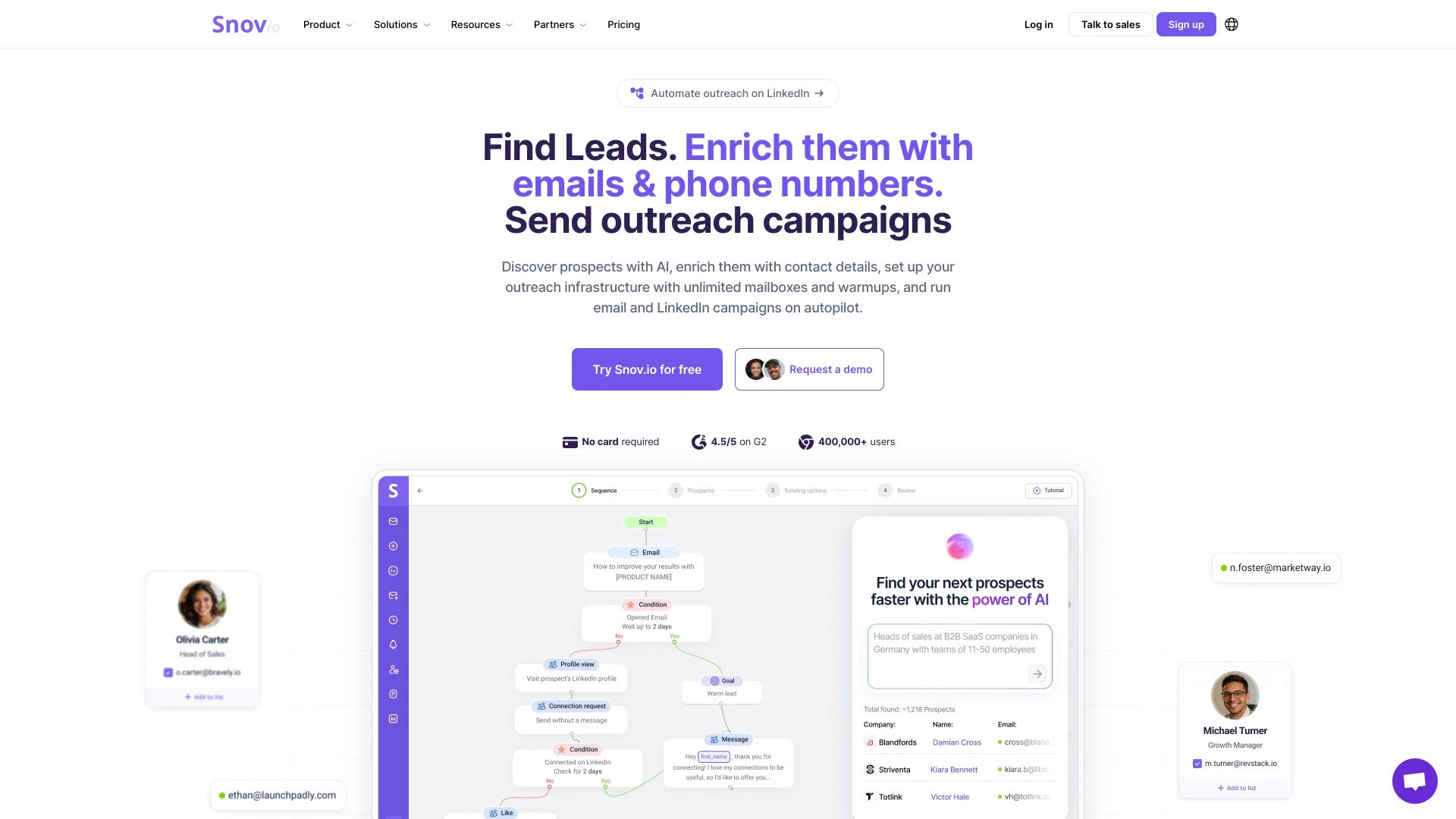
À prendre si vous voulez chercher, trouver, vérifier et envoyer depuis un seul endroit.
Snov, c'est un ensemble complet de prospection : une base B2B consultable, un outil de recherche d'emails et un vérificateur en plusieurs étapes, plus des campagnes automatisées, un CRM et de l'automatisation LinkedIn. À côté de Skrapp, c'est l'outil le plus complet. Skrapp trouve, vérifie et laisse parcourir une liste.
Snov fait tourner en plus la séquence et le CRM. Son créneau, c'est l'équipe qui veut un seul abonnement au lieu d'un outil de recherche, d'un outil d'envoi et d'un CRM, et qui accepte de céder un peu de qualité de donnée pour cette étendue.
Le compromis est réel. Snov s'appuie sur une base stockée, et une ligne stockée ne vaut que ce qu'elle valait à la dernière reconstruction, donc la précision de la recherche sur une liste réelle n'atteint pas celle des spécialistes — le même problème que Skrapp.
Ses crédits partent quand vous enregistrez et révélez un prospect, pas sur un envoi prouvé délivrable. Une fiche dont vous avez payé la révélation peut donc rester une adresse inutilisable. Vous payez beaucoup de fonctionnalités que vous n'utiliserez peut-être jamais si vous ne voulez que des emails vérifiés.
Et aucun produit de portable européen ici.
La recherche de prospects et le générateur de campagnes réunis permettaient de passer facilement du filtre au premier email. Ça, ça marchait. Mais une part des emails révélés sur ma liste demandait une deuxième vérification, et une part a quand même bouncé.
C'est le coût caché de la base : vous payez pour révéler une ligne stockée, qu'elle fonctionne ou non. Enrow trouve chaque contact frais en temps réel, ne le valide qu'au bout de plus de 10 vérifications, et ajoute les numéros de portable européens que Snov laisse de côté.
Vous perdez l'outil de campagnes intégré. Mais sur la donnée elle-même, Enrow est une source plus propre et plus fraîche.
- +Base B2B consultable plus outil de recherche et vérificateur au même endroit
- +Campagnes automatisées, CRM et automatisation LinkedIn intégrés
- +Nombre d'utilisateurs illimité sur les forfaits payants
- +25 % de réduction sur l'annuel
- –Donnée issue d'une base qui vieillit, donc, sur une liste réelle, la précision est moindre qu'avec les outils de recherche spécialisés
- –Un outil surdimensionné si vous n'avez besoin que d'emails vérifiés
- –Aucune couverture téléphonique européenne ; l'automatisation LinkedIn est une option payante
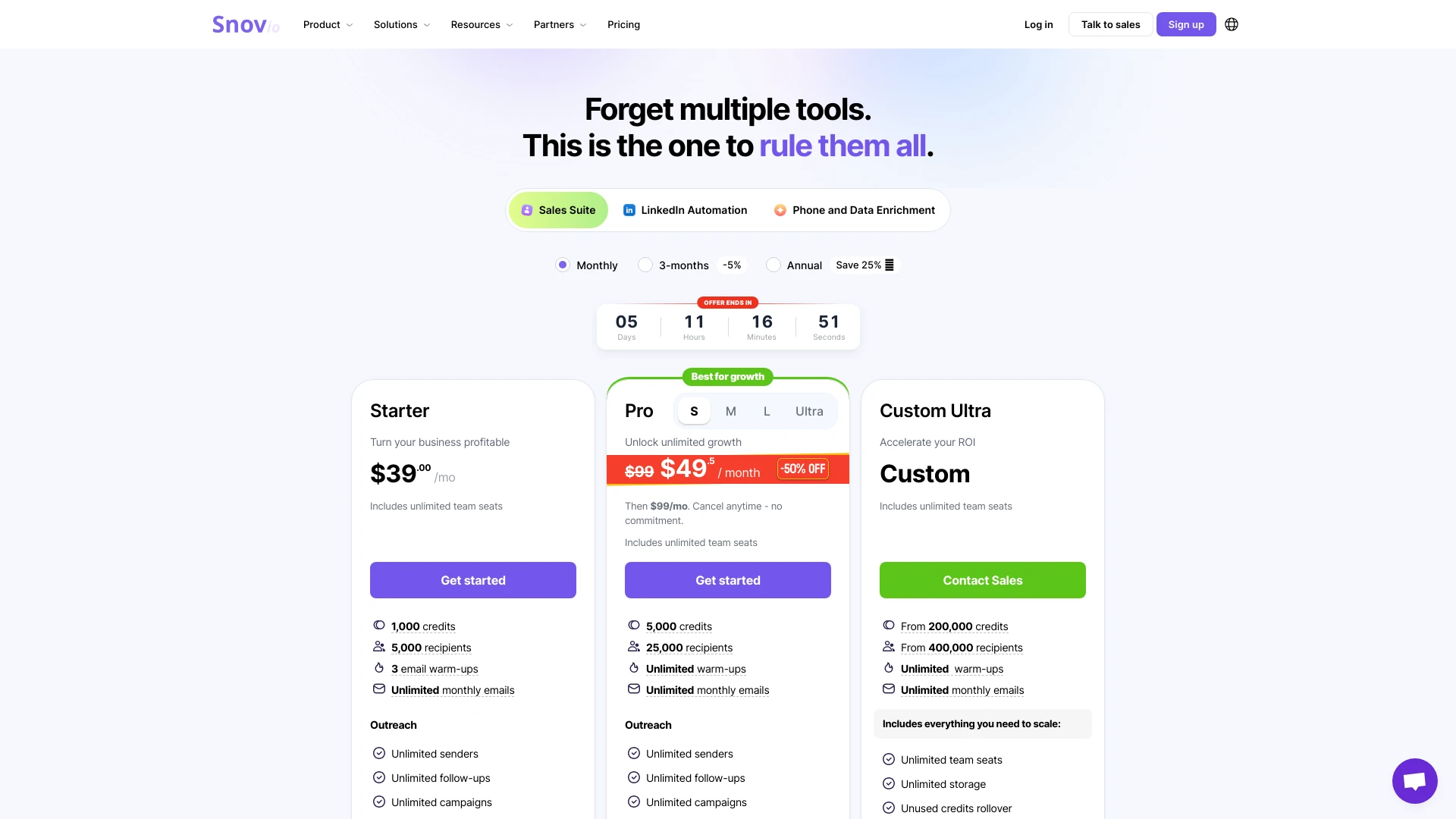
En euros. Essai gratuit 50 crédits. Starter 35 €/mois pour 1 000 crédits (25 % de moins en annuel) ; les numéros passent par des jetons séparés au paiement à l'usage (~0,018 € pièce, sans produit de portable européen).
Le crédit achète une recherche, pas une adresse qui arrive : Snov le dépense pour révéler une ligne stockée, et comme il ne publie aucun taux de réussite, je pars sur notre hypothèse d'environ 30 %, ce qui porte le coût réel autour de 0,12 € l'email utilisable, près de 8× le Start d'Enrow — avant même les adresses périmées qui bouncent et les crédits qui repartent de zéro chaque mois.
vs Enrow: Snov réunit un outil d'envoi et une base ; Enrow non. Mais sur la seule donnée, Enrow trouve des contacts à jour en temps réel, soumet ses adresses à plus de 10 vérifications, ne facture que sur un résultat prouvé valide (0,015 € au Start, 0,0075 € sur Pro), et réunit les numéros de portable européens — auxquels Snov n'a pas de réponse — sur le même solde.
6. Apollo
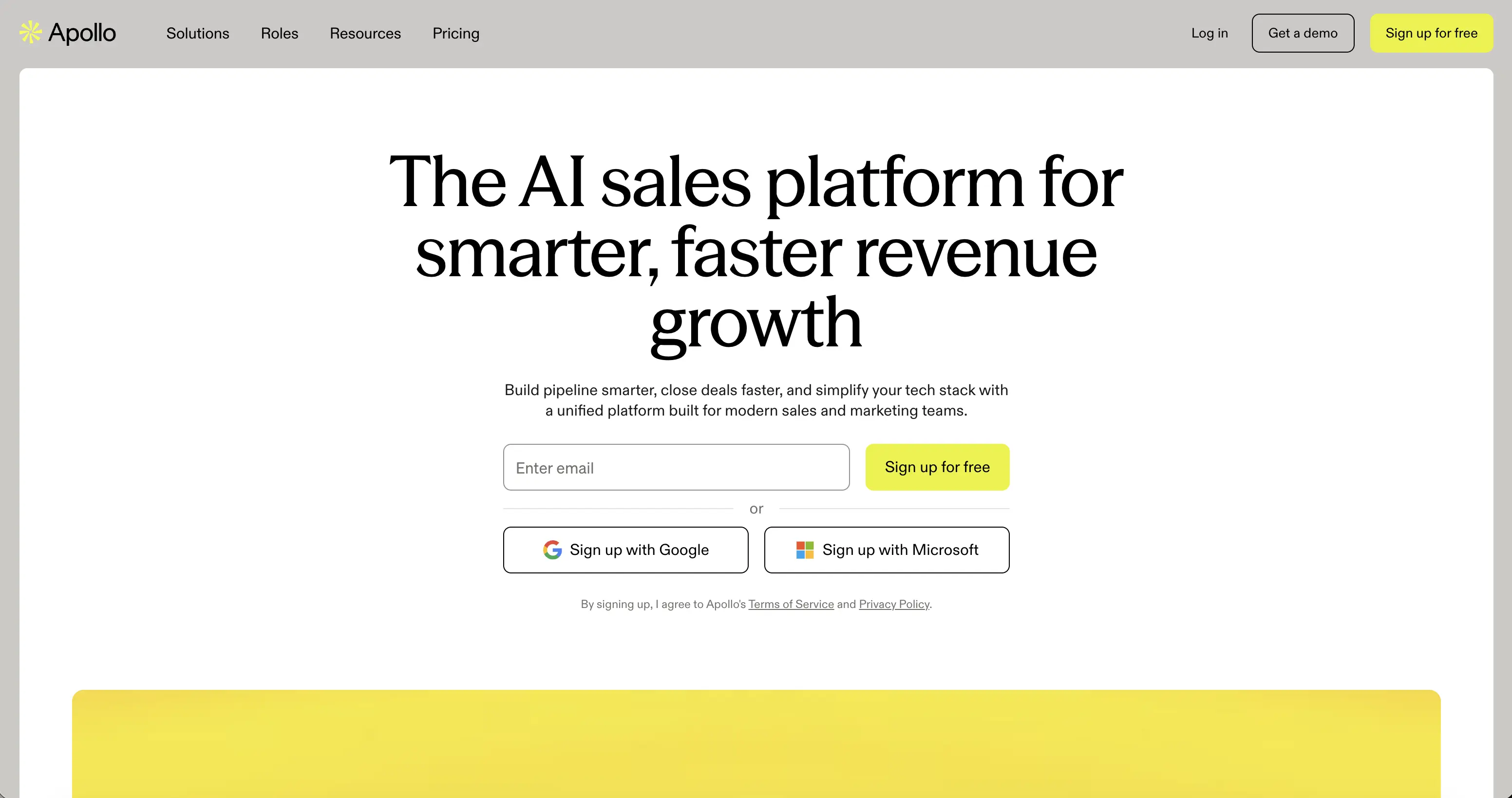
Pour les équipes qui veulent une seule plateforme pour sourcer, enrichir et envoyer.
Apollo marie une énorme base B2B avec des campagnes, de l'enrichissement et une extension Chrome, le tout sur un abonnement par utilisateur.
Là où Skrapp vous donne un outil de recherche sur une liste de taille moyenne, Apollo vous met tout le travail de prospection dans un seul onglet, sur une base bien plus grande. Cette étendue, c'est l'attrait pour une petite équipe qui veut un seul accès.
L'étendue se paie sur la fraîcheur de la donnée et sur le fonctionnement des crédits.
Apollo est une base stockée, donc beaucoup de fiches ont été mises à jour pour la dernière fois des mois avant que vous les sortiez, et vous appellerez des contacts qui ont changé entre-temps — le même vieillissement que Skrapp, à plus grande échelle.
Les crédits sont attribués par utilisateur et strictement plafonnés. Les numéros de portable les entament. Les plafonds d'export et les reproches sur la précision de la donnée sont les deux points qui reviennent le plus dans les avis.
C'est un outil de flux de travail où la donnée est un composant, pas le cœur.
Lancer une séquence directement depuis un filtre, sans quitter l'outil, va vite, je l'accorde. Puis j'ai comparé la donnée à un vrai envoi, et le temps réel l'a emporté.
Enrow trouve et vérifie chaque contact frais, livre les numéros de portable européens que la base d'Apollo ne couvre pas de façon fiable, et ne facture que sur un résultat valide, sans tarification par utilisateur. Vous voulez le tout-en-un ?
Prenez Apollo et laissez Enrow lui fournir la couche de donnée propre.
- +Grande base B2B avec campagnes et enrichissement au même endroit
- +Extension Chrome et intégrations CRM
- +Offre gratuite pour tester (900 crédits/an par utilisateur)
- +Un seul outil pour sourcer, enrichir et envoyer
- –Base stockée, donc la donnée vieillit et la précision est un reproche courant
- –Les crédits sont attribués par utilisateur et strictement plafonnés ; numéros et exports les entament vite, dépassement autour de 0,18 €/crédit
- –Plafonds d'export et griefs sur la qualité de la donnée reviennent dans les avis
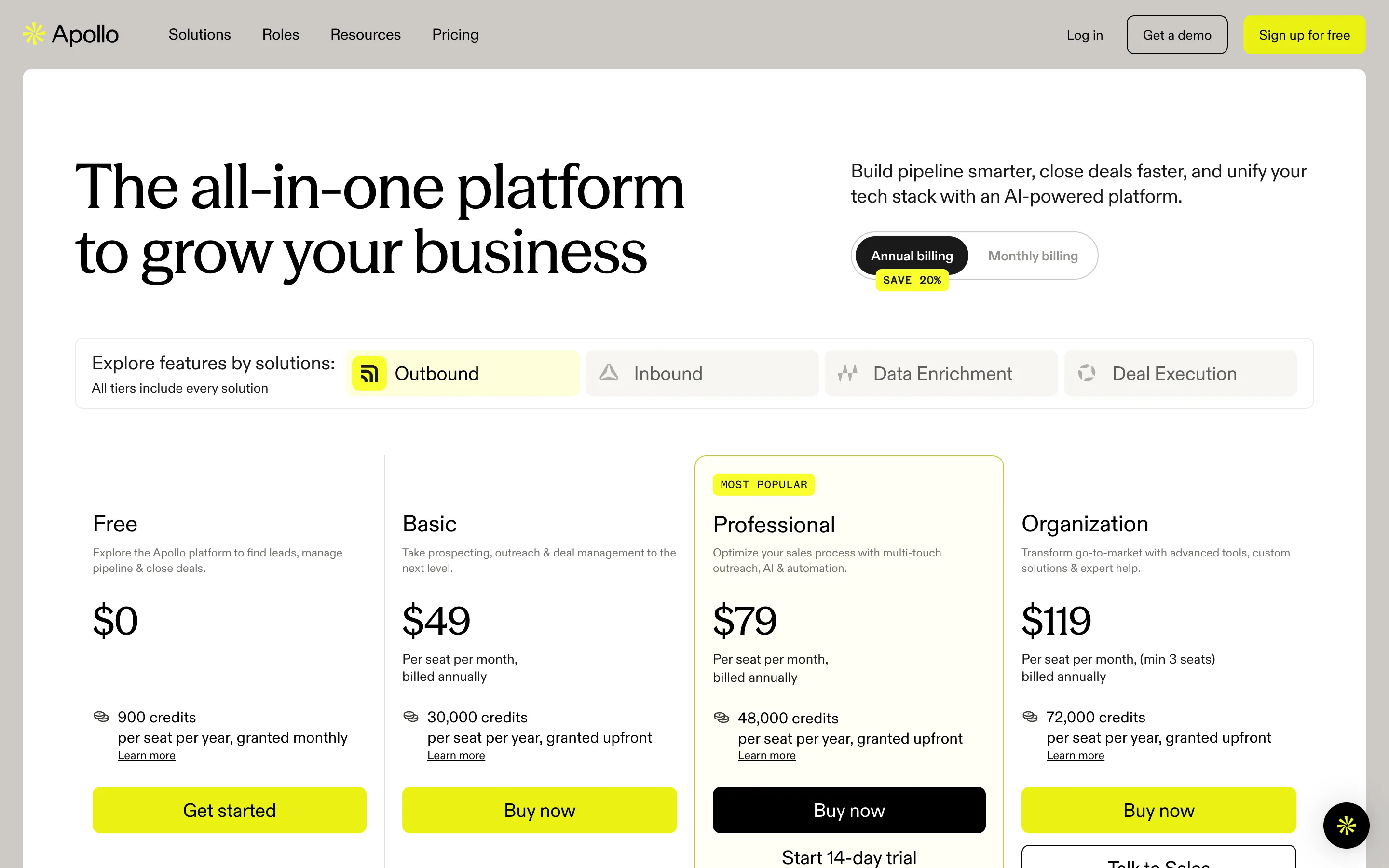
En euros, par utilisateur. Gratuit 900 crédits/an. Basic 45 €/utilisateur/mois en annuel (59 € au mois), soit environ 2 500 crédits unifiés par mois ; un numéro de portable coûte 8 crédits, le dépassement environ 0,18 € l'unité.
Le piège n'est pas le taux de réussite mais le non-report : les crédits d'Apollo ne se reportent pas, donc en tenant compte des mois creux (~78 % vraiment consommés) le coût effectif grimpe autour de 0,030 € l'email valide, environ 2× le Start d'Enrow et 3,8× le Pro. Et c'est par utilisateur : cinq commerciaux, c'est ~295 €/mois avant la moindre recherche.
vs Enrow: Apollo est le tout-en-un, Enrow la couche de donnée ; sur la donnée elle-même, les ~0,0075 € par email vérifié d'Enrow sur Pro sont une fraction des ~0,030 € effectifs d'Apollo, les numéros de portable européens d'Enrow battent une base stockée orientée US, et il n'y a aucun frais par utilisateur qui s'empile.
7. LeadMagic
À regarder quand votre « outil » est en réalité un pipeline de données.
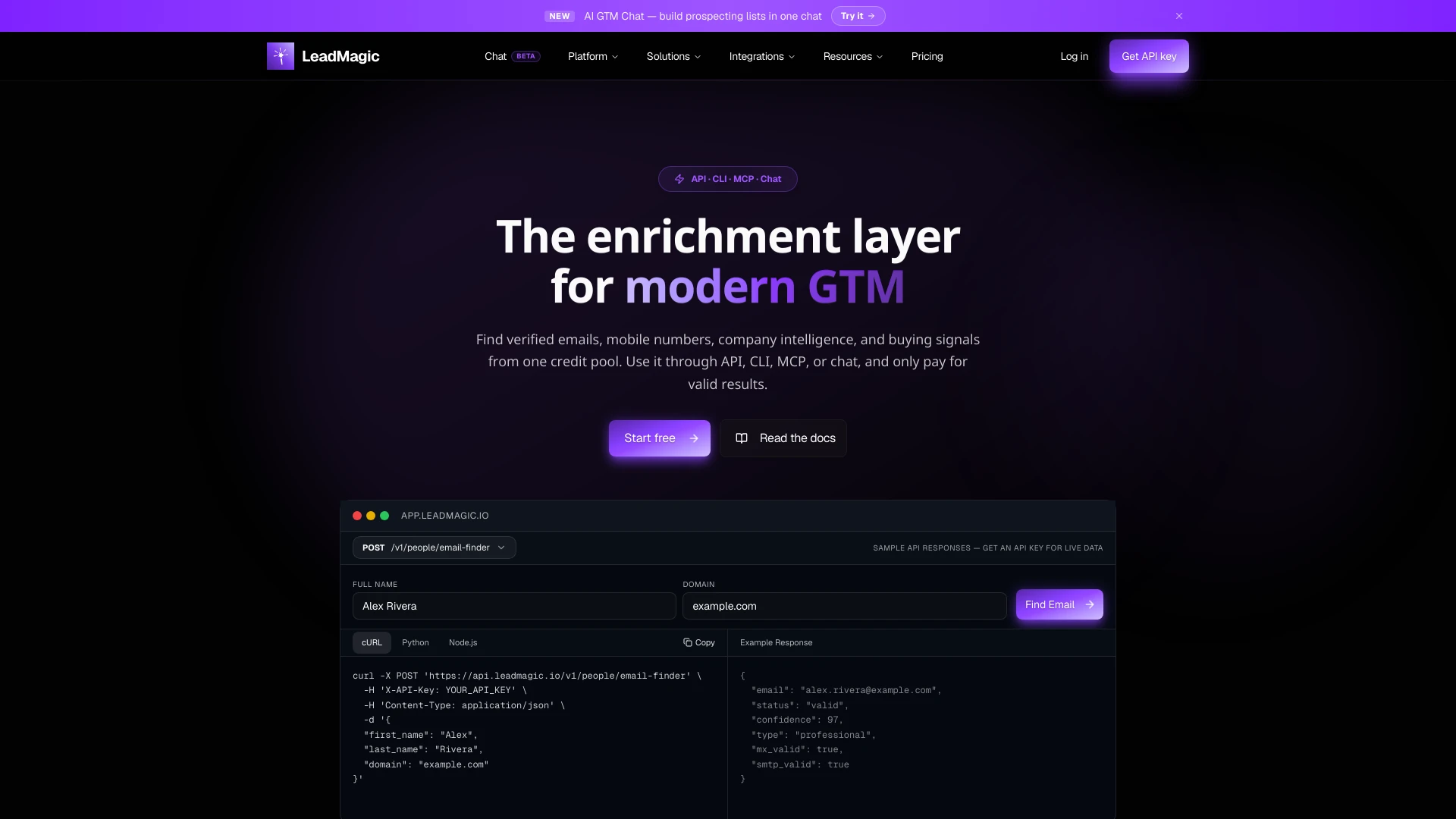
LeadMagic est avant tout une API : plus de 15 points d'accès d'enrichissement (email, portable, entreprise, profil, changement de poste) qui piochent dans une seule enveloppe de crédits, plus une ligne de commande et un serveur MCP pour les flux avec agents IA.
Les crédits ne sont retirés que sur un résultat réussi, donc contrairement à la facturation à la recherche de Skrapp vous ne payez que lorsqu'il renvoie quelque chose ; mais là où Skrapp est une interface posée sur une base, LeadMagic est un jeu de points d'accès que vous scriptez.
Son créneau, ce sont les équipes RevOps qui préfèrent écrire un script que cliquer dans un filtre de recherche.
J'ai branché quelques points d'accès dans un script de test et je l'ai laissé tourner sur un lot. Le solde unique rendait les comptes faciles à suivre, et ne facturer que sur un succès est le bon réglage par défaut.
Mais c'est une API avec une interface minimale, pas un outil qu'on tend à un commercial. Les non-développeurs calent. Les numéros coûtent 5 crédits chacun, et la couverture téléphonique européenne ou RGPD n'est pas publiée, donc la fiabilité en Europe reste une question.
Le report ne démarre qu'à partir d'Essential.
Enrow a lui aussi une API, tout aussi scriptable.
Mais il offre en plus une vraie interface et une extension Chrome que vos commerciaux peuvent réellement utiliser, des numéros de portable européens, et des crédits qui se reportent à partir de Pro. Programmable, sans la partie où tout le monde doit être développeur.
- +Payé au résultat valide, aucun frais sur une recherche ratée
- +Plus de 15 points d'accès alimentés par les mêmes crédits
- +Outils pour développeurs : API, ligne de commande, serveur MCP
- +Recherche de numéros de portable payée sur ce même solde
- –Pas de report sur le forfait d'entrée Basic
- –Les numéros coûtent 5× un email ; aucune information publiée sur la couverture européenne ou RGPD
- –C'est plus une API qu'une interface à parcourir, donc les non-développeurs peinent
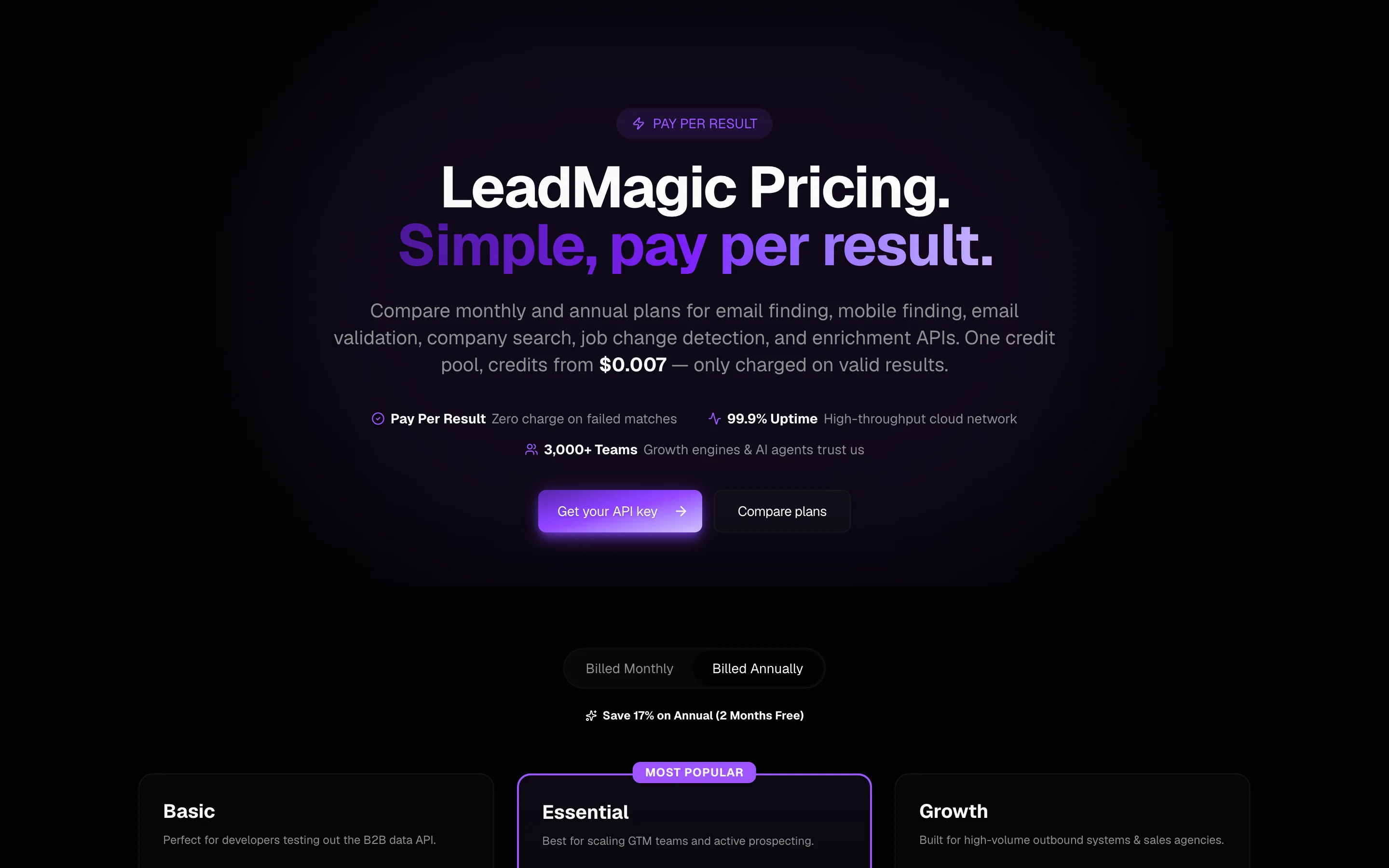
En euros. Basic 45 €/mois pour 2 000 crédits (email 1 crédit, numéro 5, validation 0,25, retirés seulement sur un résultat réussi ; le report ne commence qu'à Essential).
Le compteur est honnête, et le prix affiché est le coût réel : environ 0,0225 € l'email vérifié, à peu près 1,5× les 0,015 € d'Enrow à l'entrée. Le Basic, en revanche, ne reporte pas ses crédits. Un numéro à 5 crédits tourne autour de 0,11 €, sans couverture européenne ni RGPD publiée.
vs Enrow: les deux facturent au résultat valide et ont de vraies API, mais LeadMagic reste au-dessus d'Enrow à chaque volume ; Enrow applique plus de 10 vérifications, ajoute une interface pensée pour les commerciaux et l'export du contact complet vers le CRM en un clic.
8. Findymail
Le choix simple si vous ne voulez que des adresses de cold email américaines et une facturation honnête.
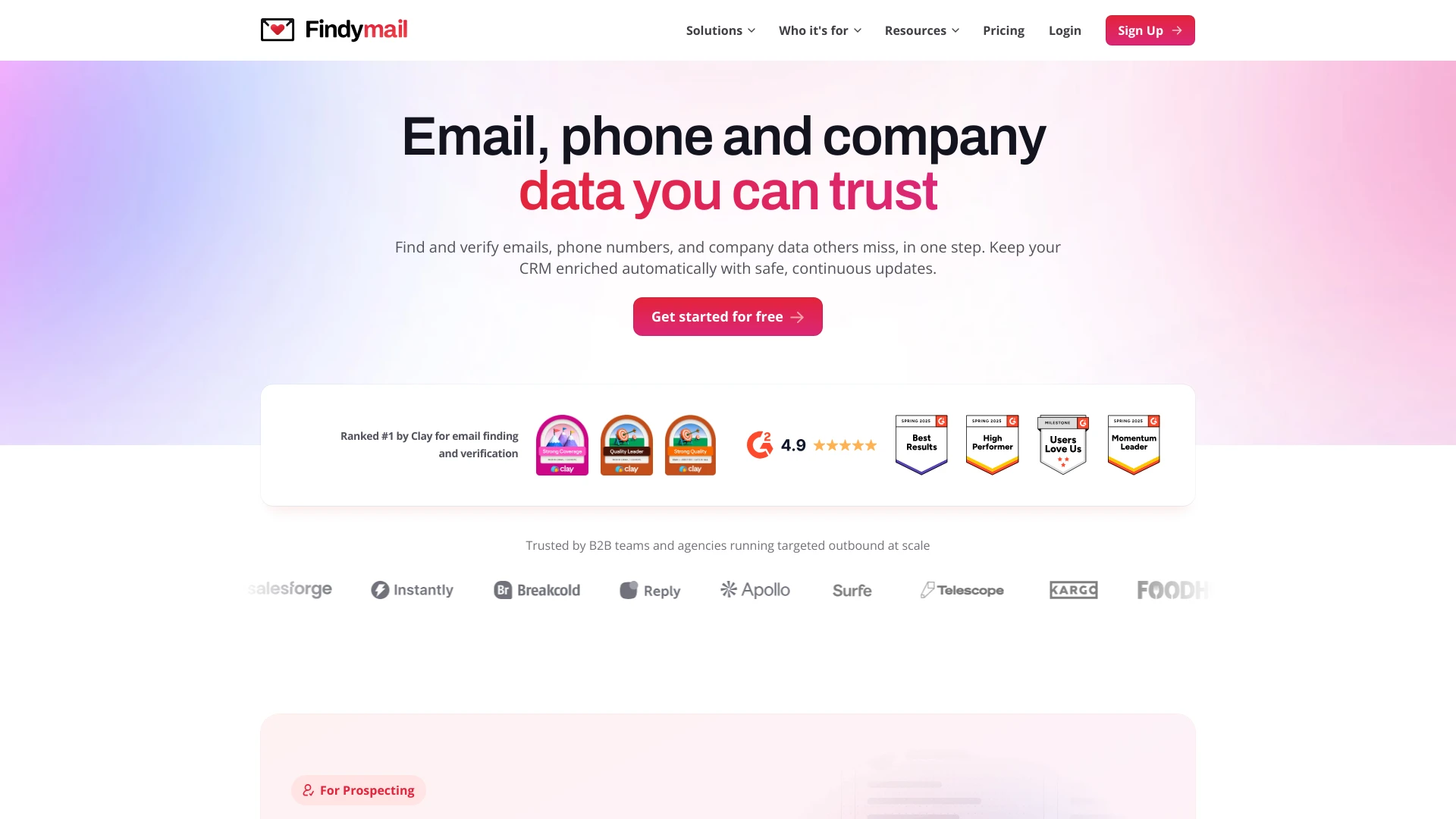
Findymail est un outil de recherche d'emails B2B pensé pour l'envoi, et là où Skrapp facture chaque recherche, il facture sur le résultat trouvé, donc une recherche ratée ne vous coûte rien.
Donnez-lui une liste LinkedIn ou un domaine : il en tire des emails professionnels vérifiés. La précision sur les emails américains est solide. Là où il devance Skrapp, c'est le périmètre : il n'essaie pas d'être une base à parcourir, il essaie de renvoyer une adresse exacte.
La géographie et la portée sont le plafond. Findymail ne renvoie aucun numéro pour les contacts européens — le RGPD ferme cette porte —, donc pour une équipe centrée sur l'Europe, c'est en pratique de l'email seul, comme Skrapp.
Son propre produit de téléphone tourne à 10 crédits le numéro et ne couvre que les États-Unis. Le report plafonne aussi à 2× le quota du mois. Achetez d'avance pour un gros trimestre et le surplus expire au renouvellement.
Payer au résultat trouvé a gardé la facture honnête pendant mon test, ce que la facturation à la recherche de Skrapp ne fait pas. Mais il s'arrête à l'email américain.
Enrow reprend cette facturation et ajoute ce que Findymail ne peut pas : des numéros de portable européens conformes RGPD, des catch-all livrées au lieu d'être écartées, des recherches en temps réel plutôt qu'une liste stockée, et l'export du contact complet vers le CRM en un clic.
Même logique de facturation honnête, mais Enrow va plus loin.
- +Facture sur le résultat trouvé, pas à la recherche
- +Recherche d'emails B2B américains solide et précise
- +SOC 2 Type 2, conforme RGPD, hébergé en Europe
- +Intégrations natives HubSpot, Salesforce, Pipedrive, Instantly et lemlist
- –Numéros aux États-Unis seulement, aucun en Europe (RGPD)
- –Le report des crédits plafonne à 2× le quota du mois
- –Sur abonnement seulement, pas de vraie offre gratuite
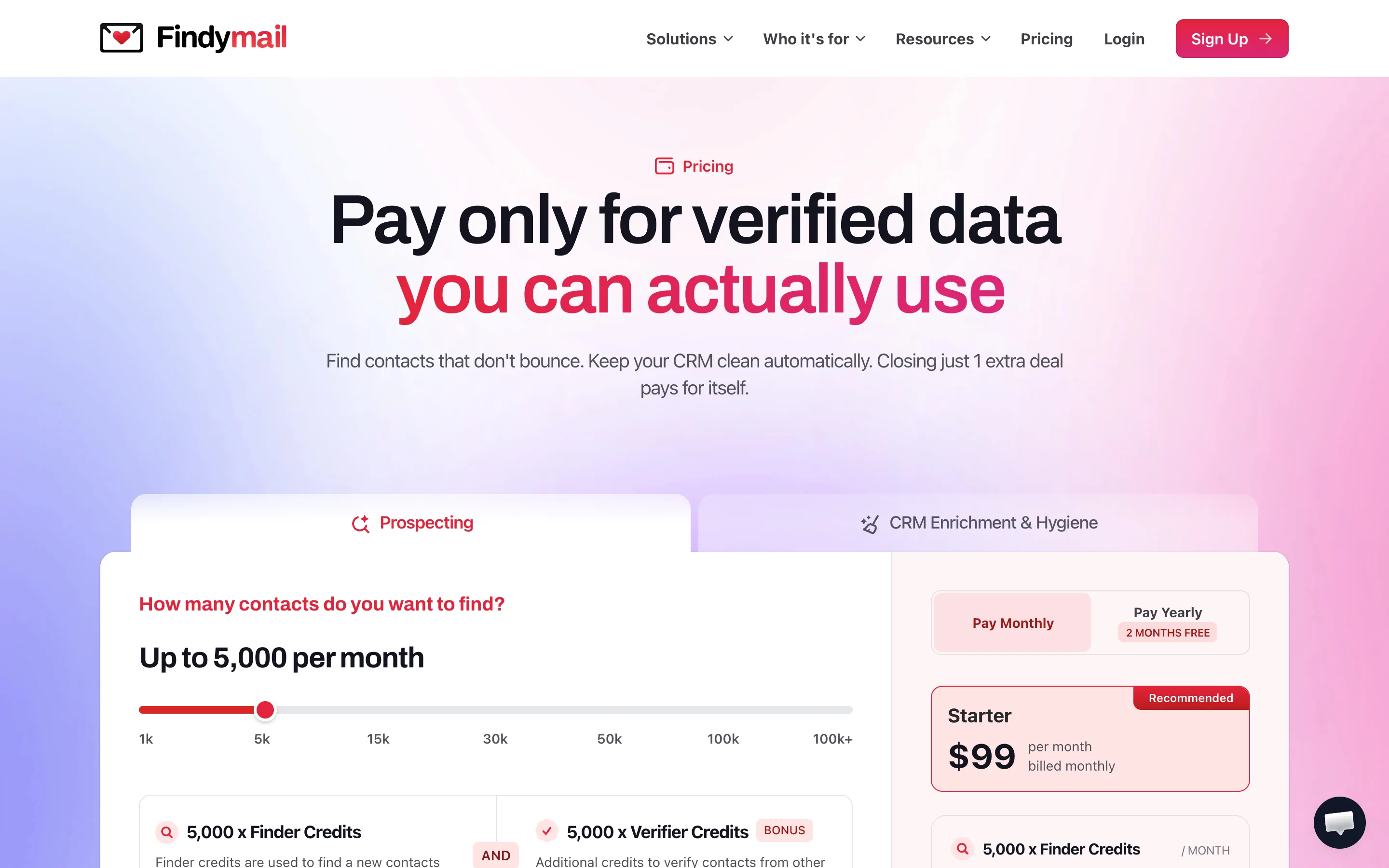
En euros, au mois. Basic 45 € pour 1 000 crédits de recherche (+ 1 000 de vérification) ; l'annuel revient ~17 % moins cher. Facturation au résultat vérifié : 1 email = 1 crédit, 1 numéro = 10 crédits.
Comme il ne facture que sur un email trouvé, l'affichage est proche du réel : le Basic revient à environ 0,045 € l'email vérifié, près de 3× les 0,015 € d'Enrow au même volume de 1 000. Un numéro américain tourne autour de 0,45 € ; pour l'Europe, aucun chiffre, le RGPD ferme la porte.
vs Enrow: tous deux facturent honnêtement, mais Findymail ne se rapproche d'Enrow qu'à son palier de 100 000 crédits — un volume que la plupart des équipes n'atteignent jamais — et même là il ne passe pas devant. Enrow met l'email vérifié à 0,0075 € sur Pro, ajoute des numéros de portable européens à ~0,30 € que Findymail n'a pas le droit de vendre, et pousse le contact complet dans le CRM en un clic.
9. GetProspect
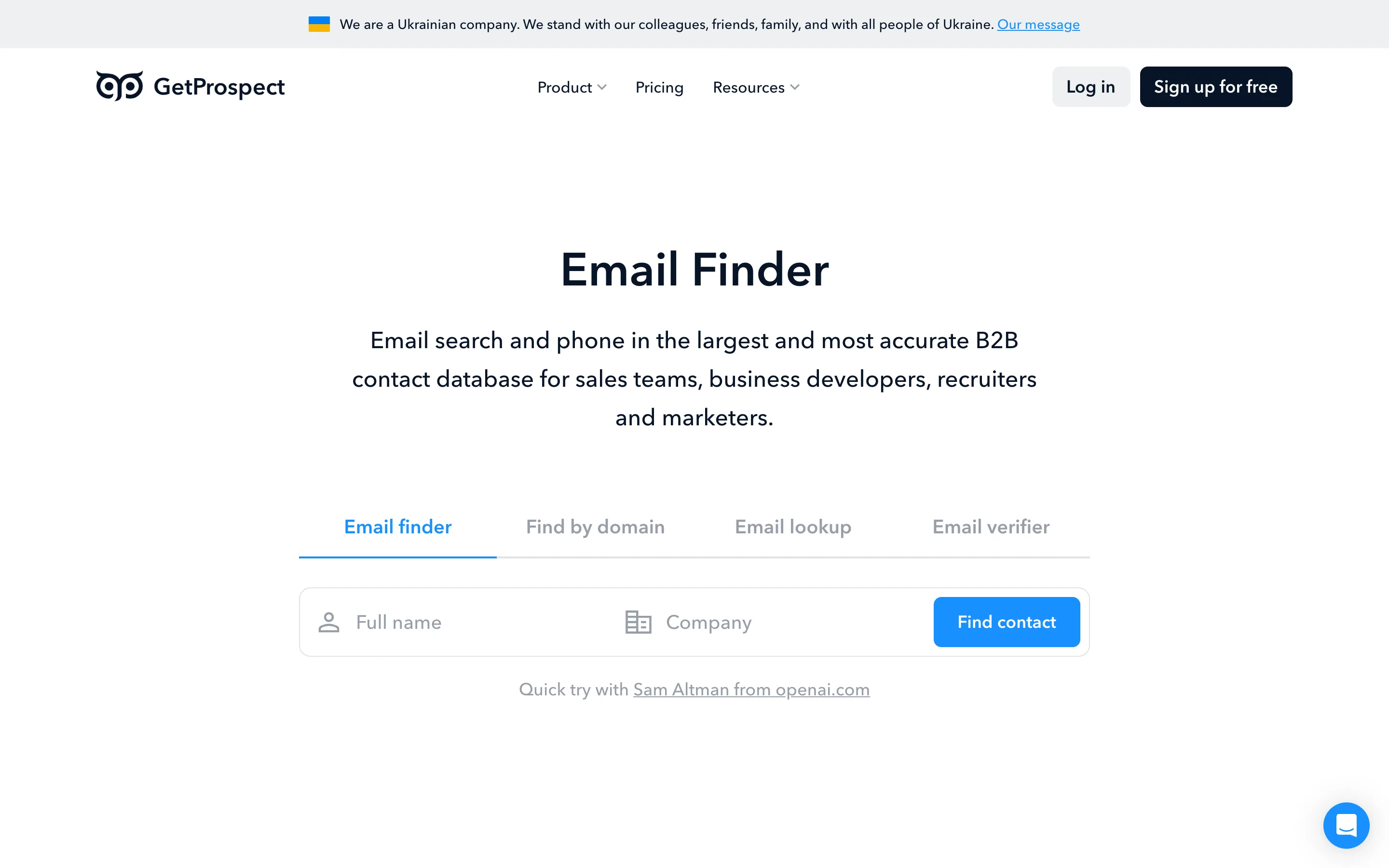
Le miroir le plus fidèle de Skrapp dans cette liste, et c'est tout l'intérêt.
GetProspect fait ce que fait Skrapp : une base B2B que vous parcourez en filtrant par intitulé de poste, entreprise ou secteur, une recherche d'emails LinkedIn et un vérificateur intégré. Il fait même mieux que Skrapp sur la facturation, en ne dépensant un crédit que lorsqu'il renvoie un email valide — une recherche ratée est donc gratuite là où Skrapp facture la recherche.
Son créneau, c'est l'équipe qui aimait la base consultable et l'extension de Skrapp mais veut une facturation au résultat valide et des crédits qui se reportent.
Mais il hérite du plafond de Skrapp en entier. Les adresses sortent d'une liste stockée, donc une fiche ne vaut que ce que valait la dernière reconstruction de GetProspect, et, de la même façon, la précision sur un vrai envoi n'égale pas celle des outils en temps réel. Les numéros de portable sont un ajout secondaire : vendus par blocs de 300, seulement cinq inclus sur le forfait d'entrée, orientés US, sans produit de numéro européen ou RGPD documenté.
J'ai testé une tranche européenne, et le constat était familier : les adresses courantes ressortaient propres, puis les résultats sur les petites entreprises et les sociétés non américaines se raréfiaient vite. Enrow facture au résultat valide de la même façon, mais il trouve chaque contact frais, le soumet à plus de 10 vérifications avant de le valider, couvre les numéros de portable européens que GetProspect ne vend pas, et dépose la fiche complète dans votre CRM en un clic.
- +Facturation au résultat valide : un crédit ne part que sur un email valide, jamais sur une recherche à l'aveugle
- +Base de plus de 100 millions de contacts consultable, plus une recherche LinkedIn et un vérificateur au même endroit
- +Les crédits se reportent d'un mois à l'autre
- +Nombre d'utilisateurs illimité, aucun frais par utilisateur, et une vraie offre gratuite (50 emails valides/mois)
- –Base stockée, donc les fiches vieillissent et la précision sur un vrai envoi ne vaut pas celle des outils en temps réel
- –Les numéros passent par des blocs de jetons, orientés US, sans numéro de portable européen ou RGPD documenté
- –Vérifier des listes externes puise dans des crédits d'option séparés
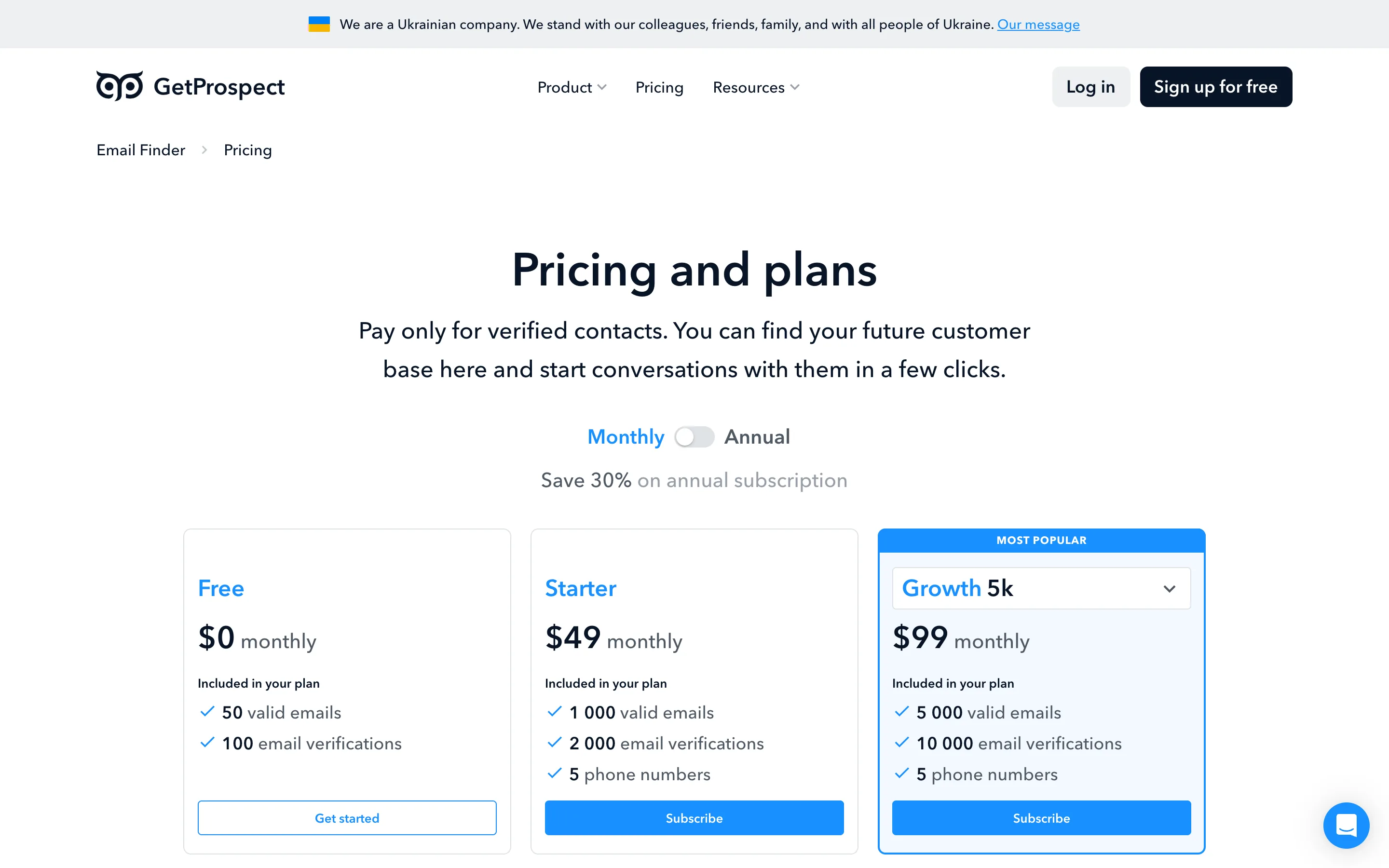
En euros. GetProspect démarre à 45 €/mois pour 1 000 emails valides (31 €/mois en annuel), facturé seulement sur un résultat valide, donc l'affichage tourne autour de 0,045 € l'email valide, près de 3× les 0,015 € d'Enrow au même volume de 1 000. Comme la donnée sort d'une base stockée, le bounce sur un vrai envoi fait grimper le coût réel. Offre gratuite de 50 emails valides/mois ; les numéros se vendent par blocs de 300 (~0,15 € pièce), seulement 5 inclus, sans numéro de portable européen documenté.
vs Enrow: même logique de facturation au résultat valide, mais sur une base stockée qui vieillit là où Enrow interroge en direct, et ses numéros sont des jetons orientés US sans numéro européen confirmé. Enrow fait passer plus de 10 vérifications à chaque adresse, fournit des numéros de portable européens conformes RGPD à environ 0,30 €, et dépose la fiche contact complète dans votre CRM d'un clic sur LinkedIn.
10. Dropcontact
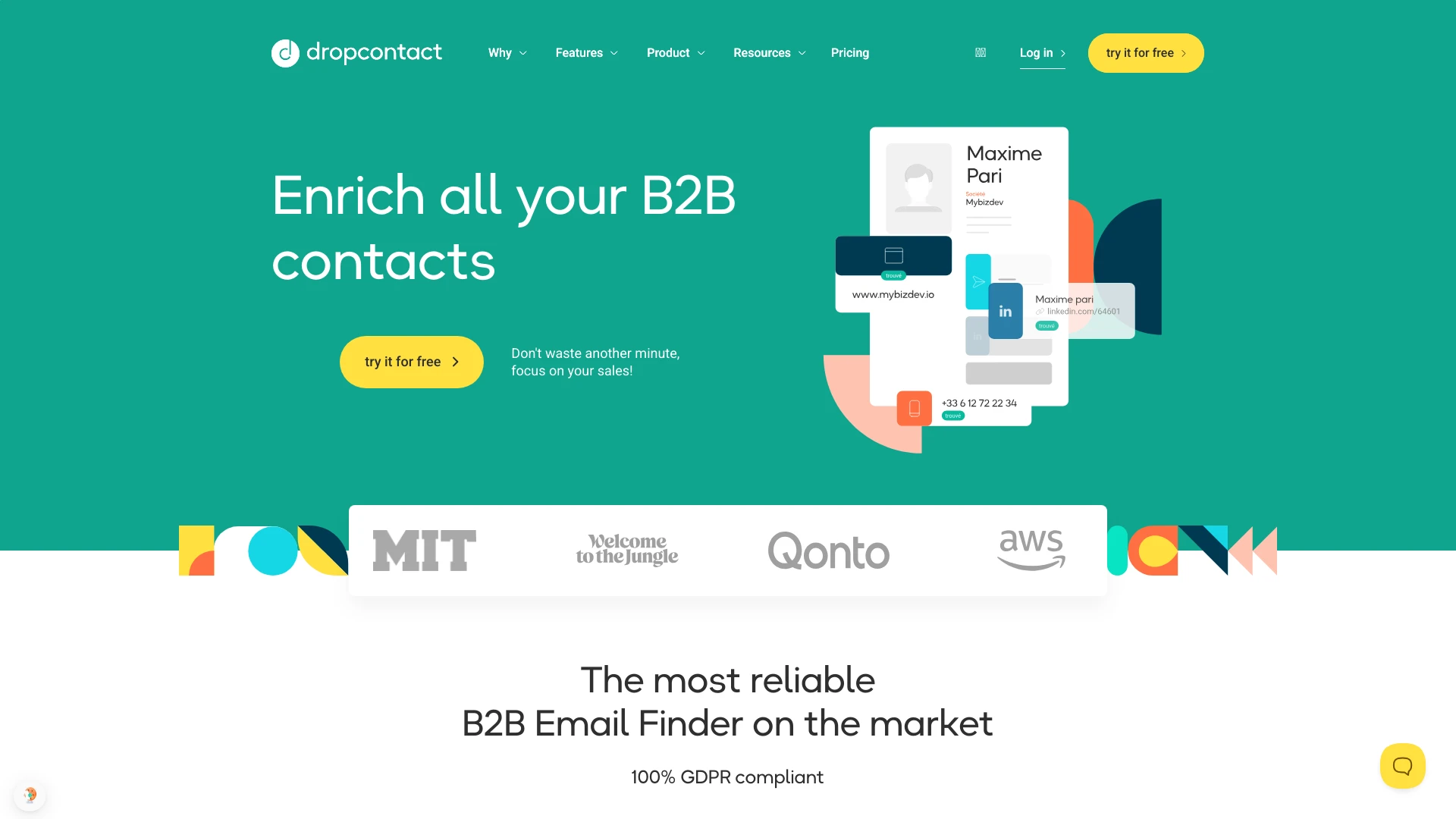
Le choix des équipes attentives à la conformité européenne.
Dropcontact construit et vérifie la donnée par algorithmes plutôt que de revendre une liste stockée, avec des informations légales françaises (SIREN, TVA) et un taux élevé d'emails valides. Contrairement à la base de Skrapp, c'est de l'enrichissement en temps réel, un vrai atout pour des fiches européennes qui dérivent vite.
Son créneau est étroit et clair : nettoyer et enrichir des fiches françaises et européennes dans HubSpot ou Pipedrive.
Sortez de ce créneau et les faiblesses apparaissent. Côté téléphone, c'est faible : les numéros sont tirés seulement de l'extraction dans les signatures d'emails, donc il n'y a pas de vrai produit de portable — le même manque pratique que Skrapp. Pas de base consultable.
Et le palier d'entrée est petit, 500 crédits, donc le coût au résultat valide à faible volume grimpe. C'est d'abord de l'enrichissement, pas un outil de recherche, et il fait encore moins de constitution de listes que Skrapp.
J'ai passé une liste de comptes français, et les champs SIREN et TVA sont ressortis plus propres que tout le reste de ce test — exactement ce pour quoi Dropcontact est fait. C'est aussi la limite de ce qu'il fait.
Enrow trouve et vérifie en temps réel de la même façon, mais il livre vraiment, en toute conformité, des numéros de portable dans tous les pays (Europe comprise), applique plus de 10 vérifications, ne facture que sur un résultat valide, et dépose le contact complet dans votre CRM en un clic.
Pour de l'enrichissement et de la couverture, pas seulement du nettoyage, Enrow est l'outil le plus complet.
- +Enrichissement en temps réel conforme RGPD, sur serveurs européens (pas une base stockée)
- +Emails très majoritairement valides, bonne gestion des catch-all
- +Données françaises (SIREN, TVA)
- +Enrichissement natif dans le CRM : HubSpot, Pipedrive, Salesforce, Zoho
- –Capacité téléphonique faible (extraction de signatures seulement)
- –Pas de base consultable pour constituer des listes
- –Petit palier d'entrée à 500 crédits, donc le coût au résultat valide grimpe à faible volume
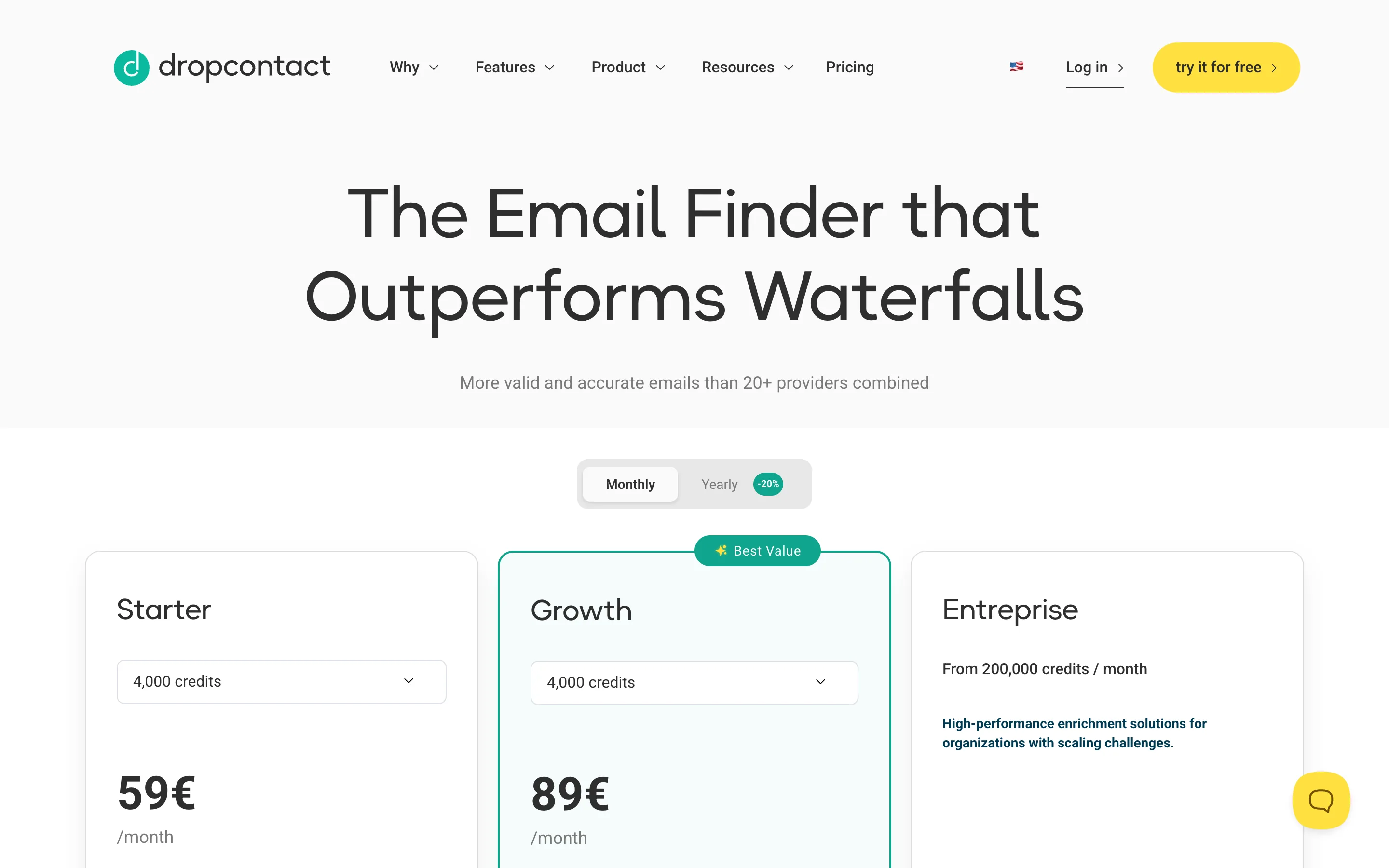
En euros. Le Starter, sans report, coûte 19 €/mois pour 500 crédits ; le plan avec report va de 29 €/mois (500 crédits) à 1 349 € pour 100 000 et 1 849 € pour 150 000, un crédit par contact traité, payé au succès.
Le palier d'entrée revient à environ 0,038 € l'email vérifié (500 crédits pour 19 €, sans report), autour de 2,5× les 0,015 € d'Enrow au Start, qui laisse lui aussi expirer ses crédits ; l'écart reste large à six chiffres : à 100 000 crédits avec report (1 349 €), chaque crédit coûte 0,0135 €, environ 2× les 0,00675 € d'Enrow (540 € pour 80 000). Les numéros existent à peine (extraction de signatures), donc aucun chiffre à citer.
vs Enrow: les deux facturent sur un résultat valide, donc les modes de facturation s'alignent, mais pas le tarif ; Enrow ajoute de vrais numéros de portable dans tous les pays (Europe comprise) à ~0,30 €, que les numéros de signatures de Dropcontact ne peuvent pas égaler, et il pousse le contact complet dans votre CRM en un clic.
Ne me croyez pas sur parole. Passez votre propre liste dans Enrow et comparez le bounce vous-même. 50 crédits gratuits chaque mois, renouvelés, sans carte.
Comparatif côte à côte
Verdict final
Pesez l'ensemble et un outil l'emporte pour le vrai travail dont il est question : trouver et vérifier des emails et des numéros B2B, Europe comprise, et ne payer que lorsque le résultat tient. C'est Enrow. Le prix d'entrée de Skrapp paraît raisonnable, mais Skrapp fait payer chaque recherche, ses adresses sortent d'une base stockée qui vieillit, et il n'y a pas un seul numéro de téléphone dans le produit. Enrow tire chaque contact frais au moment de la requête, le soumet à plus de 10 vérifications, met l'email vérifié à 0,0075 € sur Pro, et renvoie des numéros de portable dans tous les pays, Europe comprise. Puis le geste que rien d'autre ici ne réussit : ouvrez un profil LinkedIn ou Sales Navigator, cliquez une fois, et l'extension Chrome dépose la fiche contact complète et vérifiée — email, numéro, tous les champs — directement dans HubSpot, Salesforce ou Pipedrive. Reconnaissons-le : ce n'est pas un tout-en-un, ni une base consultable — pas de campagnes, pas de technologies utilisées, pas de liste à feuilleter. Si parcourir la base de Skrapp était exactement votre besoin, gardez-la pour cette étape et confiez à Enrow la donnée fraîche. Pour l'exactitude, téléphone compris, Enrow est celui que je signe de mon nom.
Ne me croyez pas sur parole. Passez votre propre liste dans Enrow et comparez le bounce vous-même. 50 crédits gratuits chaque mois, renouvelés, sans carte.
FAQ
Notre méthodologie
Je l'ai vérifié moi-même, pas sur le papier. J'ai constitué une liste de contacts B2B réels, je l'ai fait tourner dans les dix outils sur une seule semaine, puis j'ai envoyé de vrais emails à toute la liste pour mesurer le bounce sur des adresses qui partent pour de bon. Quatre critères ont guidé le classement : combien de contacts utilisables chaque outil a ramenés, le taux de bounce sur cet envoi, le coût réel par contact valide une fois le prix affiché corrigé, et la couverture géographique — surtout les numéros de portable européens obtenus légalement. Rien de sponsorisé, aucun lien affilié, personne n'a payé sa place ; les prix des concurrents proviennent de leurs pages officielles, relevés le 02/07/2026.
utilisateur illimité
Prêt à passer à la vitesse supérieure
sans cb
aucun setup requis