Key takeaway Two prices are public. Launch is $185/mo and Growth $495/mo on monthly billing, $167/mo and $446/mo annually. Free costs $0. Enterprise is quoted, against an annual commitment. But a sticker here is a sum, not a price. One dial sets Actions, a second sets Data Credits, and moving either leaves the other exactly where it was. Launch monthly is $60 of Actions plus $125 of Data Credits, added. Per unit, a Data Credit runs $0.0500 at 2,500/mo down to $0.0425 at 50,000/mo ($0.0452 to $0.0383 annually) and a Launch Action $0.0040 down to $0.0027. Clay's advice is to match the tier to the work rather than forecast a volume. Good advice. And CRM sync and the HTTP API both open on Growth, which tends to settle the choice before any arithmetic gets a say.
Clay changed how it bills on 11 March 2026. Its memo: "Actions are a new measurement of the orchestration work that Clay performs: enrichments, AI tasks, HTTP API calls, and pushes to third-party platforms." Marketplace data prices came down 50–90% in the same move.
Search results have not caught up. Five months on, pages still ranking quote tiers that were retired in March, and the ones carrying today's numbers stop at the plan card, which shows only where each dial starts. So this page prints both dials. Every rung, both billing modes, the unit cost at each stop. Where I stand, since it matters. Enrow is one of the providers sitting in Clay's marketplace, and Enrow is mine.
What each Clay plan costs, and what lands in the account
Four plans, two public prices. Each one pairs an Actions allowance with a separate Data Credits allowance, and that pairing is what the rest of this page takes apart.
| Plan | Billed monthly | Billed annually | Actions included | Data Credits included |
|---|---|---|---|---|
| Free | $0 | $0 | 500 actions/mo | 100 credits/mo |
| Launch | $185/mo | $167/mo | 15,000 actions/mo | 2,500 credits/mo * |
| Growth (Clay's "Recommended") | $495/mo | $446/mo | 40,000 actions/mo | 6,000 credits/mo |
| Enterprise | Quoted | Quoted, annual commitment | 200,000+ actions/mo † | 100,000+ credits/mo † |
* The Launch card summarises "3K data credits/mo" while its own slider starts at 2,500/mo ($125/mo), and the billing doc puts the Launch range at "2,500 to 10,000 per month". I use 2,500 throughout and flag the card's rounder label. † Both Enterprise figures come from the pricing FAQ: "Includes 100,000+ Data Credits and 200,000+ Actions/mo." The Enterprise card still renders "Custom".
Seats never enter it: "Nope! You can add as many people as you'd like to your workspace, completely free." Badges: SOC 2 Type II, GDPR, CCPA, ISO 27001, ISO 42001.
Each headline price is two dials added together
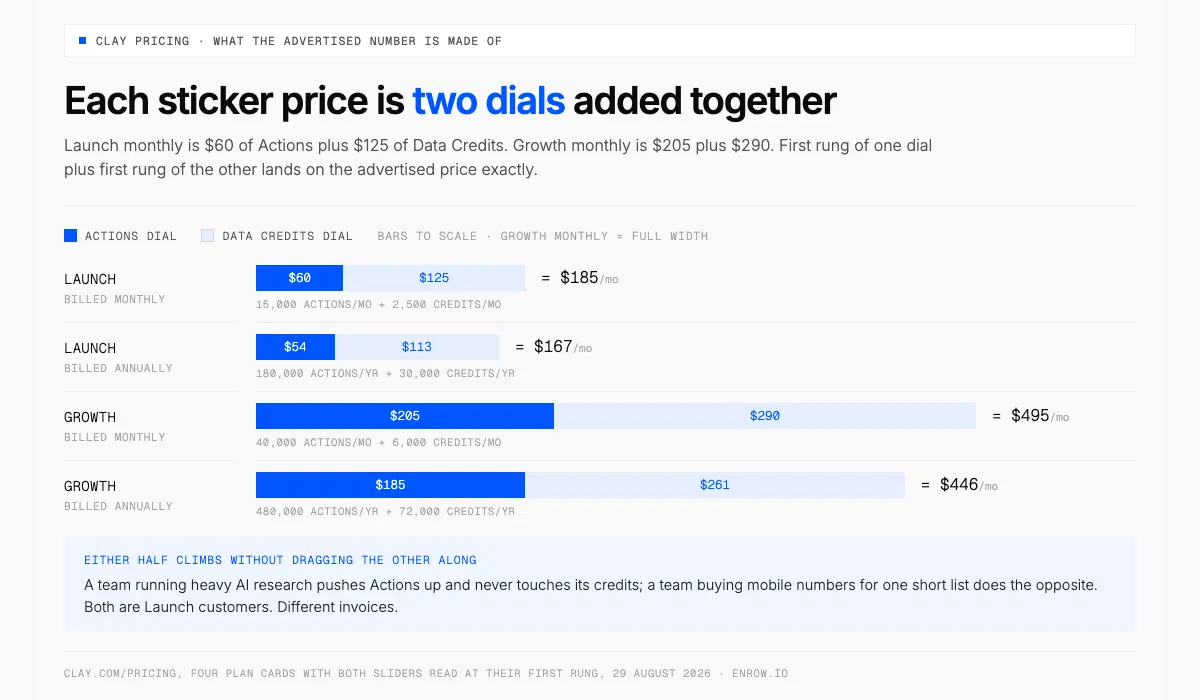
Launch monthly is $60 of Actions plus $125 of Data Credits, and either half climbs without the other.
First rung of one dial plus first rung of the other lands on the advertised price exactly. Both paid plans, both billing modes, nothing rounded away.
| Plan and billing | Actions dial, first rung | Data Credits dial, first rung | Advertised |
|---|---|---|---|
| Launch, monthly | $60/mo for 15,000 actions | $125/mo for 2,500 credits | $185/mo |
| Launch, annual | $54/mo for 180,000 actions/yr | $113/mo for 30,000 credits/yr | $167/mo |
| Growth, monthly | $205/mo for 40,000 actions | $290/mo for 6,000 credits | $495/mo |
| Growth, annual | $185/mo for 480,000 actions/yr | $261/mo for 72,000 credits/yr | $446/mo |
So the sticker is really a starting configuration. Either half climbs without dragging the other along, and that is the useful part of the design. A team running heavy AI research across four hundred accounts pushes Actions up and never touches its credits; a team buying mobile numbers for one short list does the opposite. Both are Launch customers. Different invoices. Clay's pricing calculator sizes it for you.
The Actions dial, rung by rung
Every step up buys a cheaper Action. The same volume prices higher on Growth, because that ticket carries the integration feature set with it.
| Volume (monthly · annual) | Launch, monthly | Launch, annual | Growth, monthly | Growth, annual |
|---|---|---|---|---|
| 15,000/mo · 180K/yr | $60/mo ($0.0040/action) | $54/mo | not offered | not offered |
| 40,000/mo · 480K/yr | $150/mo ($0.00375/action) | $135/mo | $205/mo ($0.00513/action) | $185/mo |
| 60,000/mo · 720K/yr | $200/mo ($0.00333/action) | $180/mo | $290/mo ($0.00483/action) | $261/mo |
| 100,000/mo · 1.2M/yr | $290/mo ($0.00290/action) | $261/mo | $450/mo ($0.00450/action) | $405/mo |
| 200,000/mo · 2.4M/yr | $540/mo ($0.00270/action) | $486/mo | $850/mo ($0.00425/action) | $765/mo |
Across Launch's five rungs the unit price improves 33%. That is Clay's "Actions start at less than $0.01 each and get cheaper with scale", now with the rungs printed underneath it.
The Data Credits dial, rung by rung
Data Credits cost the same on Launch and on Growth at every volume the two share, Growth simply dropping the 2,500 entry rung. Across the monthly range the unit rate improves 15%.
| Volume (monthly · annual) | Monthly | Per credit, monthly | Annual | Per credit, annual | Available on |
|---|---|---|---|---|---|
| 2,500/mo · 30K/yr | $125/mo | $0.0500/credit | $113/mo | $0.0452/credit | Launch only |
| 6,000/mo · 72K/yr | $290/mo | $0.04833/credit | $261/mo | $0.0435/credit | Launch, Growth |
| 10,000/mo · 120K/yr | $460/mo | $0.0460/credit | $414/mo ‡ | $0.0414/credit | Launch, Growth |
| 20,000/mo · 240K/yr | $880/mo | $0.0440/credit | $792/mo | $0.0396/credit | Launch, Growth |
| 50,000/mo · 600K/yr | $2,125/mo | $0.0425/credit | $1,913/mo | $0.03826/credit | Launch, Growth |
‡ The 120,000-credit annual rung renders $414/mo on the Launch card and $413/mo on the Growth card. Both readings were live on 29 August 2026; I print $414 and name the other rather than pick silently.
Which is "Data Credits start at $0.05 each and become more cost-effective as you grow", drawn as a curve. One caveat sits under it. The billing doc describes Launch as 2,500–10,000 credits a month and Growth as 6,000–100,000, while both sliders stopped at 50,000 today. I print what the sliders showed.
Annual billing takes exactly 10% off every rung
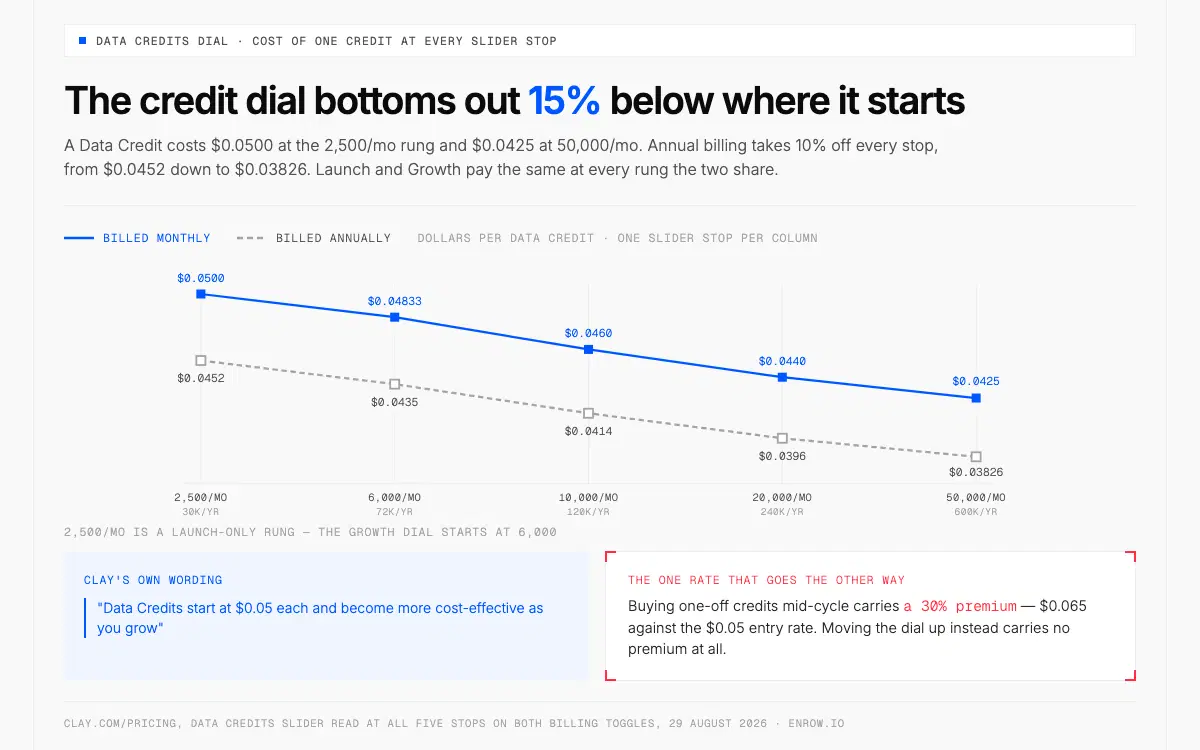
Scale takes only 15% off a credit, while annual billing takes a flat 10% off every rung.
The toggle reads "Annual ∙ Save 10%", and the arithmetic holds at every stop, rounded to the dollar. $60 becomes $54. $290 becomes $261, and $2,125 becomes $1,913. Over a year Launch comes to $2,004 against $2,220 monthly, a $216 difference, while Growth runs $5,352 against $5,940 and saves $588. Annual collects the better rollover treatment described below, too, and "Get all credits up front (annual plans)" is marked included on all four tiers.
Actions are the open question. No Clay page states whether an annual Actions allowance arrives as one yearly pool or gets metered month by month, and that "up front" row names credits only. If your usage across a year is lumpy, ask Clay before you commit.
What a credit buys, and what costs nothing at all
An Action is always exactly one Action. A Data Credit count moves with what you bought.
The definitions, in Clay's words. Actions "measure the orchestration you do in Clay: enriching data, running AI research, and sending data to other tools." Data Credits "buy data or AI from 3rd party vendors in Clay's data marketplace." So one enrichment is a flat single Action, sitting against "0.5–10+ credits based on data type", while a fully enriched record runs "6–20 Data Credits". The per-contact arithmetic for a whole provider chain lives in Clay enrichment waterfall.
Plenty of table work moves neither meter. List-building is free outright: "You can build lists from LinkedIn, Google Maps, Github, CRMs, websites, and more for free on Clay. You only pay credits for data enrichment." And the same doc keeps going. CRM imports, data-warehouse imports, Clay formulas and filters, manual data entry, CSV export, all free.
An empty result is free too: "If an enrichment returns no result, you're not charged Data Credits or Actions." API errors cost nothing. And inside a chain, "once validated data has been returned, no additional Data Credits or Actions will be consumed." Which is exactly what makes depth in a waterfall cheap to build, because the fallbacks sitting below a hit never bill at all. There is a refund line on top of that: "If a provider refunds us due to invalid data, we'll refund those Data Credits back to you."
The marketplace behind those credits reads "150+ providers" in the compare table and "200+ providers" in the site navigation. Both live today. Enrow is one of them, marked "Included in All Plans", with three actions and a choice between Clay's managed account and your own key. It resolves people you have already identified and holds nothing browsable. That is deliberate: the lookup runs live rather than against a stored list, which puts it in a column rather than at the sourcing step. If you are weighing up sources in general, we wrote how to choose a B2B data provider, and the plumbing underneath one of them sits in email finder API.
Which plan fits, and what overrides the volume answer
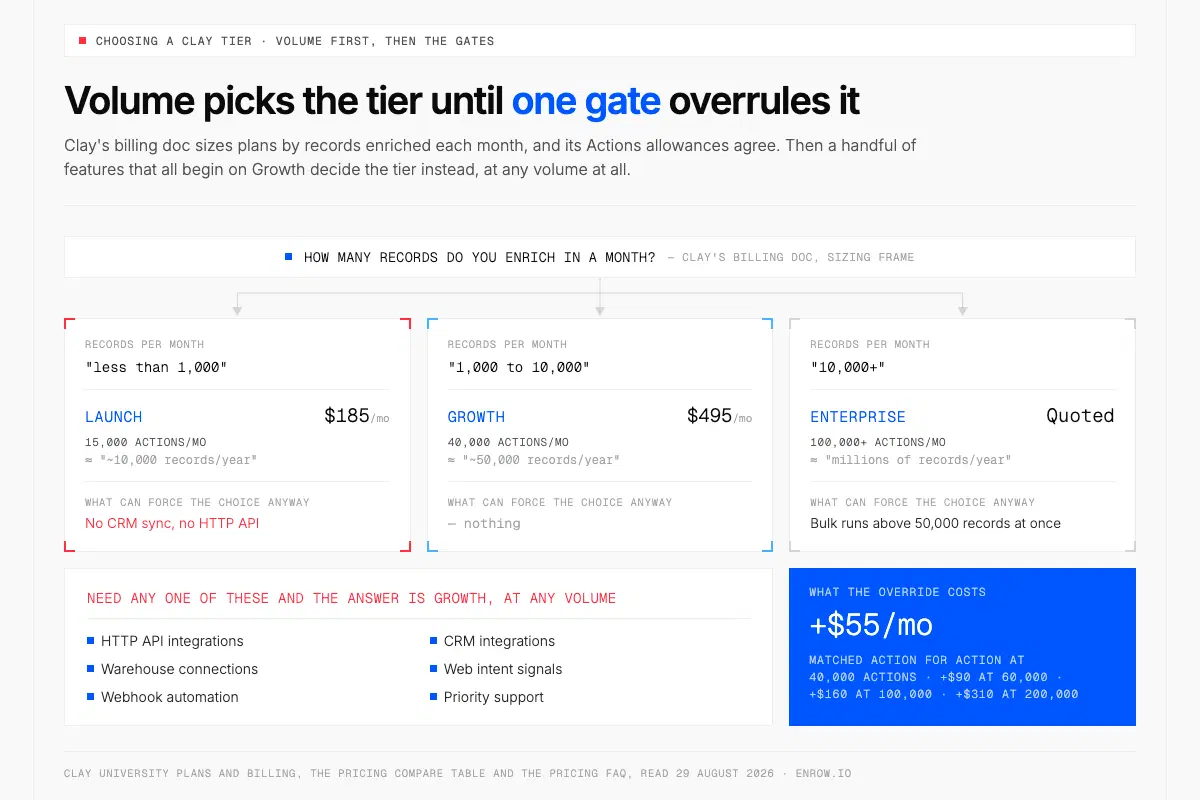
One gate like CRM sync overrides volume, and crossing it costs $55 a month more at 40,000 actions.
The guidance Clay gives here is good and I would follow it: "The best place to start is matching your needs to the right tier, not trying to predict your exact Data Credits or Action volumes." Two of its docs publish sizing frames in different units. They agree, which is more than you get from most pricing documentation.
| Plan | Records/month (billing doc) | Implied by the Actions allowance | What can force the choice anyway |
|---|---|---|---|
| Free | evaluating, 200 rows per table | 500 actions/mo | no phone number enrichment on Free |
| Launch | "less than 1,000 records per month" | 15,000 actions ≈ "~10,000 records/year" | no CRM sync, no HTTP API |
| Growth | "1,000 to 10,000 records per month" | 40,000 actions ≈ "~50,000 records/year" | — |
| Enterprise | "10,000+ records per month" | 100,000+ actions (billing doc; 200,000+ in the pricing FAQ) ≈ "millions of records/year" | bulk runs above 50,000 records at once |
But volume answers only half of it. The other half is a gate. If a CRM sync is the one thing standing between a finished table and your reps, that decides the tier at any volume at all.
| Starts on | What opens up |
|---|---|
| Launch | phone number enrichment · exclusions in search · job change, company news and social listening signals · custom functions · scheduled recurring runs · 50,000 rows per table |
| Growth | HTTP API integrations · CRM integrations · warehouse connections (Snowflake, Fivetran, Postgres, Databricks, BigQuery) § · web intent signals · webhook automation · unlimited ad-audience pushes · priority support |
| Enterprise | bulk enrichment above 50,000 records at once · RBAC with workbook-level credit budgets · SSO · custom CSA and DPA · dedicated growth strategist · 15-minute source sync |
§ The compare table marks warehouse connections included on Growth and the Growth card lists "Auto-sync with data warehouse", while the pricing FAQ's Enterprise paragraph counts them among Enterprise additions. I follow the compare table and flag the conflict.
Credit prices are identical on both tiers, so what the Growth premium buys is that feature list. Matched action for action, it runs +$55/mo at 40,000 actions, +$90 at 60,000, +$160 at 100,000 and +$310 at 200,000. Both paid tiers ship with room to spare, on Clay's own account: "90% of our customers will never hit a usage limit." Clay's figure, not mine.
When one dial empties before the other
Unused Actions reset each cycle. Clay treats them as "the platform capacity your plan includes." Data Credits behave like currency instead: they carry forward, banking up to twice what Launch or Growth grants in a month, so a 10,000-credit plan can sit on 20,000. Annual plans keep 15% of unused credits at renewal, on the same tier or higher. The docs give that 15% as a general annual rule while the pricing FAQ words it around Enterprise.
Run short on credits and you have two routes. Move the credit dial up, which carries no premium at all, or buy one-off credits mid-cycle "at a 30% premium", $0.065 against the $0.05 entry rate. Running short on Actions works the same way, on the other dial: "If you do reach your Action limit, you can upgrade to the next Action tier without necessarily upgrading plans." Emptying one meter never drags the other down with it. Neither forces a plan change on its own.
Which dial binds first comes down to your plan's ratio. Free is 5 actions per credit, Launch 6, Growth about 6.7, Enterprise 2 on the FAQ's figures, all against a model built around "4-5 actions per data credit." Exports, CRM syncs and AI columns pull you toward Actions. Mobile enrichment and long provider chains pull the other way. Last month's usage tells you which of the two you have been.
Clay AI pricing, fixed and metered
Most AI in Clay charges a flat, published credit count. Every prompt also counts as one Action. Fixed pricing "applies to 80% of models in Clay", Clay's own Helium and Argon among them, and the remaining fifth bills the run's real model cost at what Clay states is "0% markup".
| Model | Content generation | Web research |
|---|---|---|
| GPT-5 Nano | 0.2 credits | 0.5 credits |
| GPT-5 Mini | 0.4 credits | 1 credit |
| Gemini 2.5 Flash · Flash Lite | 0.5 credits | 1 credit |
| Clay Helium | — | 1 credit |
| GPT-4o · GPT-4.1 | 1 credit | variable |
| Claude 4.5 Haiku | 1 credit | variable |
| Claude 4.5 Sonnet | 1.5 credits | variable |
| GPT-5.1 | 2 credits | variable |
| Clay Argon | — | 3 credits |
| Gemini 2.5 Pro | 3 credits | variable |
| o3 | 5 credits | variable |
| Claude 4.6 Opus | 7.5 credits | variable |
| Fireworks Kimi K2.6 · GLM 5.2 | variable | variable |
Variable columns withhold an estimate "based on the 75th percentile of past runs" and then settle against the real cost: "Any surplus is refunded; any additional cost is deducted." So the withheld figure is a deposit, not the final charge, and the settlement can go either way. And the balance cannot go negative. Hit zero mid-run and "processing stops", with Clay stating "You will never be charged beyond your available balance."
Making an allowance go further
Clay's own first tip is the biggest lever by some distance. Connect a provider subscription you already pay for and the enrichment "will eliminate the Data Credit cost", while "an Action will still be consumed"; the docs size that at "save 50–80% on Data Credits". After that the advice gets plainer. Filter before you enrich. Add conditional logic so a column only fires on a field that is empty or stale, and test on 10 to 20 rows before you turn it loose on the table.
You can see the bill coming, too. The enrichment panel prints the credit cost beside each option. A run with dependent columns shows "Total estimated credits for the run" with a per-column breakdown, and afterwards the same numbers sit under Settings, then Usage. Clay documents the four things that move a balance unexpectedly as well: a stopped run still consumes for requests already sent, Auto-Update fires refreshes on its own, AI columns charge every row processed, re-running a column enriches again. Documented means designable. Knowing those four exist is most of the work of planning around them.
The free plan, and a trial described two ways
Free is a working tier, not a demo. The monthly allowance is the smallest of the four, 100 Data Credits against 500 Actions (a 5-to-1 ratio), inside tables capped at 200 rows. Waterfalls, Claygent and your own API keys are all switched on, and seats have no ceiling. Phone enrichment is the one exclusion. The footer CTA: "Start for free today. No credit card required."
The 14-day trial is described two ways on two live Clay pages. Your own account on day one is the reading that governs. The billing doc offers a "14-day free trial with 1,000 data credits, giving you access to webhooks, CRM integrations, email sequencers, and HTTP API capabilities." The trial FAQ gives "access to the features from our Growth plan" with "2,000 credits to test Clay out" and "up to 10,000 actions", adding that "Tables in trial are limited to 50 rows." Which leaves three row caps to keep straight: 200 per table on Free, 50 during a trial, 50,000 on Launch and Growth.
ready to stop wasting time?
Connected in minutes.
Verified data in seconds.
FAQ
How much does Clay cost per month?
Free is $0. Launch costs $185/mo and Growth $495/mo on monthly billing, or $167/mo and $446/mo if you pay for the year. Enterprise is quoted and carries an annual commitment. Seats are unlimited and free on every tier, so headcount never touches the invoice.
What is Clay's new pricing model?
Clay repriced on 11 March 2026. Two allowances are metered now where there used to be one. Actions cover orchestration, meaning enrichments, AI runs, HTTP API calls, exports and syncs, while Data Credits buy data and AI from Clay's marketplace. Each plan sets both on its own slider. Clay's memo puts the marketplace price cut at 50–90%.
How much is 1 Clay credit worth in US dollars?
It depends where you sit on the dial. One Data Credit is $0.05 at the 2,500-credit monthly rung, then $0.04833 at 6,000, $0.0460 at 10,000, $0.0440 at 20,000 and $0.0425 at 50,000. Annual billing runs $0.0452 down to $0.0383 at 600,000 credits a year. One-time top-ups carry a 30% premium, so $0.065.
Which Clay plan should I choose?
Start with volume. Clay's billing doc sizes plans by records enriched each month: under 1,000 points to Launch, 1,000 to 10,000 to Growth, above 10,000 to Enterprise. Then check the gates, because they override that answer. CRM integrations, the HTTP API, warehouse connections and webhook automation all begin on Growth, whatever your volume looks like.
Do Clay credits roll over?
Data Credits do. Actions do not. On Launch and Growth, unused Data Credits bank up to twice the monthly allowance, which lets a 10,000-credit plan hold 20,000. Annual plans carry 15% of unused credits into a renewal at the same tier or higher, and unused Actions reset every billing cycle.
Is Clay cheaper billed annually?
Yes, by exactly 10% at every slider rung, rounded to the dollar. Launch lands at $167/mo against $185/mo, which is $2,004 a year rather than $2,220, a $216 difference. Growth runs $446 against $495, so $5,352 against $5,940, saving $588. The 15% credit rollover comes with annual as well.
Does Clay charge per seat?
No. Clay's own answer is "Nope! You can add as many people as you'd like to your workspace, completely free", and the pricing compare table lists unlimited tables and users per workspace on Free, Launch, Growth and Enterprise alike. What you spend tracks the Actions and Data Credits you consume. Headcount never enters it.
What happens if I run out of Actions but not Data Credits?
It happens, because Actions reset every billing cycle and never roll over. A heavy month empties that meter while your Data Credits sit banked. The Actions dial is the fix and it moves on its own: "If you do reach your Action limit, you can upgrade to the next Action tier without necessarily upgrading plans." Your credits stay untouched through all of it.
How expensive is Clay AI?
Most of it is published up front. Fixed pricing covers roughly 80% of Clay's models at a flat credit count per task, so GPT-5 Nano is 0.2 credits for content generation, Clay Helium 1 credit for web research, Claude 4.6 Opus 7.5. The other 20% bill the run's real model cost at what Clay states is 0% markup.
How these figures were checked
Every figure here was lifted straight from Clay's own pages on 29 August 2026. The pricing page with its four cards, both toggles, both sliders read at each rung, the compare table, the pricing FAQ. Clay University on actions and data credits, plans and billing, AI pricing, credit usage and conservation. Four clay.com FAQ articles, plus the March memo. Unit rates, annual totals, plan ratios and the Growth premium are arithmetic done on those rungs, not figures Clay prints anywhere. Where two Clay pages read differently, both readings appear with their source.
Before you touch a slider, open Settings, then Usage, then the column view for last month. The dial that ran hot is the dial to move. It is usually not the one you had in mind.