wiza alternatives
Top 10 Wiza Alternatives & Competitors in 2026
The yardsticks are the ones that actually decide a dialing budget: phone match rate, how many revealed numbers are live rather than stale, real cost per valid phone, and geographic reach, with EU direct dials carrying the most weight. One list. Same week, same numbers.
10 tools tested
updated August 3, 2026
13 min read
Last updated August 3, 2026
The alternatives at a glance
Enrow is the best overall Wiza alternative for teams that want direct dials that actually connect, EU included, and pay only for valid numbers. Plans start at $17/month, and the Pro tier works out to about $0.35 per valid phone ($87 for 10,000 credits, which is 250 phones). Cognism is built for a different buyer, the enterprise that wants a huge phone-verified database and has the annual budget for one; Lusha and Kaspr win fast mobiles with headline stickers and coverage caveats (Kaspr leans EU, Lusha US); RocketReach and SignalHire win broad per-credit lookups with headline stickers and costly misses; Apollo if you want the all-in-one suite. Each owns a clear niche below, and none is the better overall buy on phones.
Wiza reveals emails and phones off a stored B2B database, aimed at a US team that lives inside LinkedIn. The emails are strong.
The phones wobble: stored reveals go stale, so a chunk of the mobiles are wrong (user reviews peg accuracy around 55-65%). Coverage runs thin too, and there's no documented legal basis for EU direct dials.
For most teams chasing a number that rings the right desk, the best Wiza alternative is Enrow.
It finds direct dials from any country in real time, Europe included, and bills 40 credits per phone only when the number comes back valid.
That's about $0.35 per valid phone on Pro ($87 for 10,000 credits = 250 phones); Start opens at $17 for anyone who wants to test smaller first. No valid number, no charge.
There's one thing on this page only Enrow does. Its Chrome extension lifts the entire verified contact off a LinkedIn or Sales Navigator profile, every field, and drops it into HubSpot, Salesforce or Pipedrive with one click, updating the person's existing record where there is one instead of opening a duplicate next to it. Enrow is #1.
The nine tools below each own a narrow niche, and none is the better overall buy for phones.
Why teams look for Wiza alternatives
Wiza is a fine LinkedIn capture tool for a US rep, yet people still leave, and it comes down to three things. If your whole motion is US LinkedIn capture and you rarely dial Europe, Wiza can hold. If it isn't, keep reading.
Conflict of interest disclosure
Let me put the bias on the table. Enrow is my company, it's a phone-and-email data tool, this piece ranks phone finders, and I've ranked mine first. So weigh what follows accordingly. And here's the part I won't dodge: there are whole categories Enrow simply doesn't cover.
No searchable, filterable database, the kind Cognism, Lusha and Apollo ship by the millions of rows, so if the job is browsing and building a list from stored data, they win that and we don't.
No outreach sequences and no dialer, which is Apollo's turf; for sending you'd bolt Enrow onto Emelia, La Growth Machine or lemlist. No technographics. None of that is an oversight.
We'd sooner find and verify a fresh contact on the spot than hand you back a stored row that may already be stale.
Where I'll plant a flag is the single thing Enrow is built to do well: it pulls the freshest, most accurate emails and direct-dial phones, then verifies them. It doesn't go further than that. If what you're after is a browsable database, or one all-in-one suite that also sequences and dials, a tool below suits you better, and I'll say so. But if the whole point is a phone number that rings the right person, that tight focus is exactly why Enrow exists.
The 10 best Wiza alternatives
1. Enrow
#1
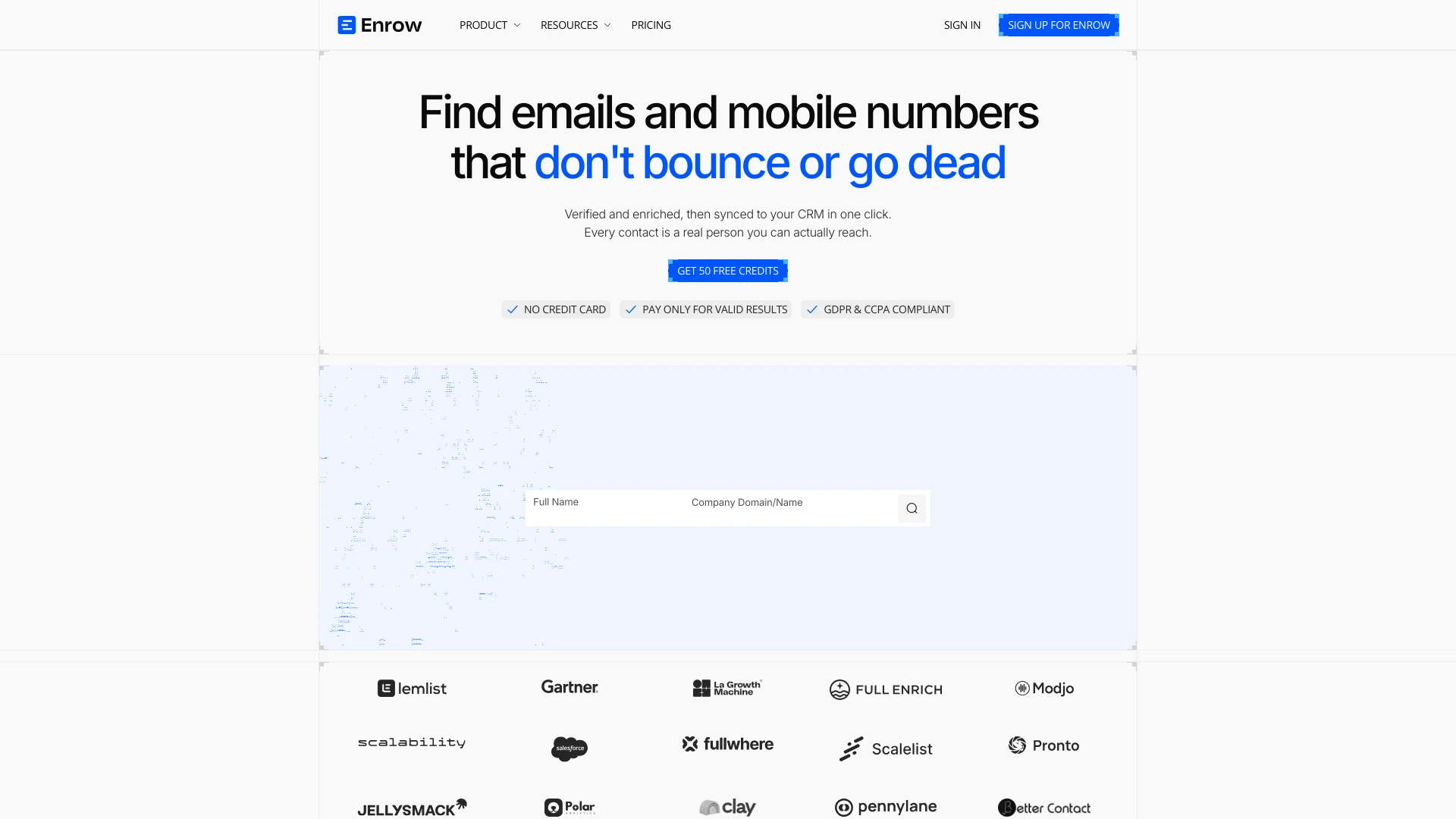
I built this after one too many dialing days spent paying for numbers that turned out dead, misrouted, or attached to someone who'd already moved on.
The split with Wiza is clean, and it starts with where the phone number comes from.
Wiza reveals a mobile from a stored database, so its age is whatever the last refresh left behind. Enrow finds the number in real time, at the moment you ask, then only charges you if it comes back valid. That difference is the whole game on phones.
You stop paying for lines that fail verification, and you stop dialing a number that was correct for someone's last job. On my test list, the French and German mobiles reached the person I actually meant to call, not a general line or a predecessor's old handset.
Then there's the gap Wiza never closes: Europe. Wiza's phone data leans US, and nothing documents how it sources EU numbers legally.
Enrow returns direct dials in any country, and that includes the harder part: European mobile and direct-dial numbers we can source GDPR-cleared.
For a team calling into France, Germany or the Nordics, that's the difference between a compliant dial and a legal headache.
On emails, Enrow runs 10+ verification checks before an address counts, multiple SMTP passes and catch-all checks across servers in different regions, and it delivers catch-all addresses instead of flagging them "risky" and dropping them.
Then the live send. Bounce sat under 1%, discovery ran around 60% on a mixed list, and the phones connected. One caution, to be straight: that sub-1% is an observed average, not a contract.
Now the workflow, where Wiza has no answer at all. From any LinkedIn or Sales Navigator profile, Enrow's Chrome extension exports the full verified contact, every field, email and phone included, straight into HubSpot, Salesforce or Pipedrive in one click. The push runs as a create-or-update, not an insert. Pull the same person again six weeks later, once the mobile is finally there, and the number attaches to the record you already own instead of opening a second one beside it. Same contact, same history, one card. No copy-paste.
Wiza captures profiles into a list you then export; it doesn't drop a complete, verified contact card into your CRM the way this does.
One more thing, for the AI-agent crowd. Enrow ships an official MCP server (the repo is github.com/EnrowAPI/enrow-mcp), so you can call the email finder, verifier and direct-phone finder straight from Claude, Cursor or Windsurf. Fresh, verified emails and phones pulled into an agent workflow, still pay-per-valid. Small thing today.
Handy if you're building.
- +Real-time direct dials in any country, EU included (Wiza's phones are stored-database reveals that age)
- +Pay only for a valid phone; a missing number, or one that fails verification, never costs a credit
- +10+ verification checks per email; catch-all verified and delivered, not dropped
- +Native CRM integrations: Clay, HubSpot, Salesforce, Pipedrive, plus webhooks, and an API that's a pleasure to build on
- +The Chrome extension exports the full verified contact, every field, from a LinkedIn or Sales Navigator profile into your CRM in one click (no rival on this list does this)
- +Credit rollover on Pro and Scale; no per-seat fees, with up to 10 team members on Pro and unlimited on Scale
- –No searchable database, and that's a deliberate call. A stored list drifts out of date, so you end up dialing someone who changed roles two quarters ago. Enrow looks each contact up the moment you ask, which is why the hit tends to be more accurate. To build the list in the first place, work from LinkedIn or Sales Navigator.
- –No outreach sequencing and no dialer, and we're not going to bolt them on. Send the actual sending to Emelia first, then La Growth Machine, then lemlist.
- –No technographics. You get LinkedIn-level company detail, not a read on anyone's tech stack.
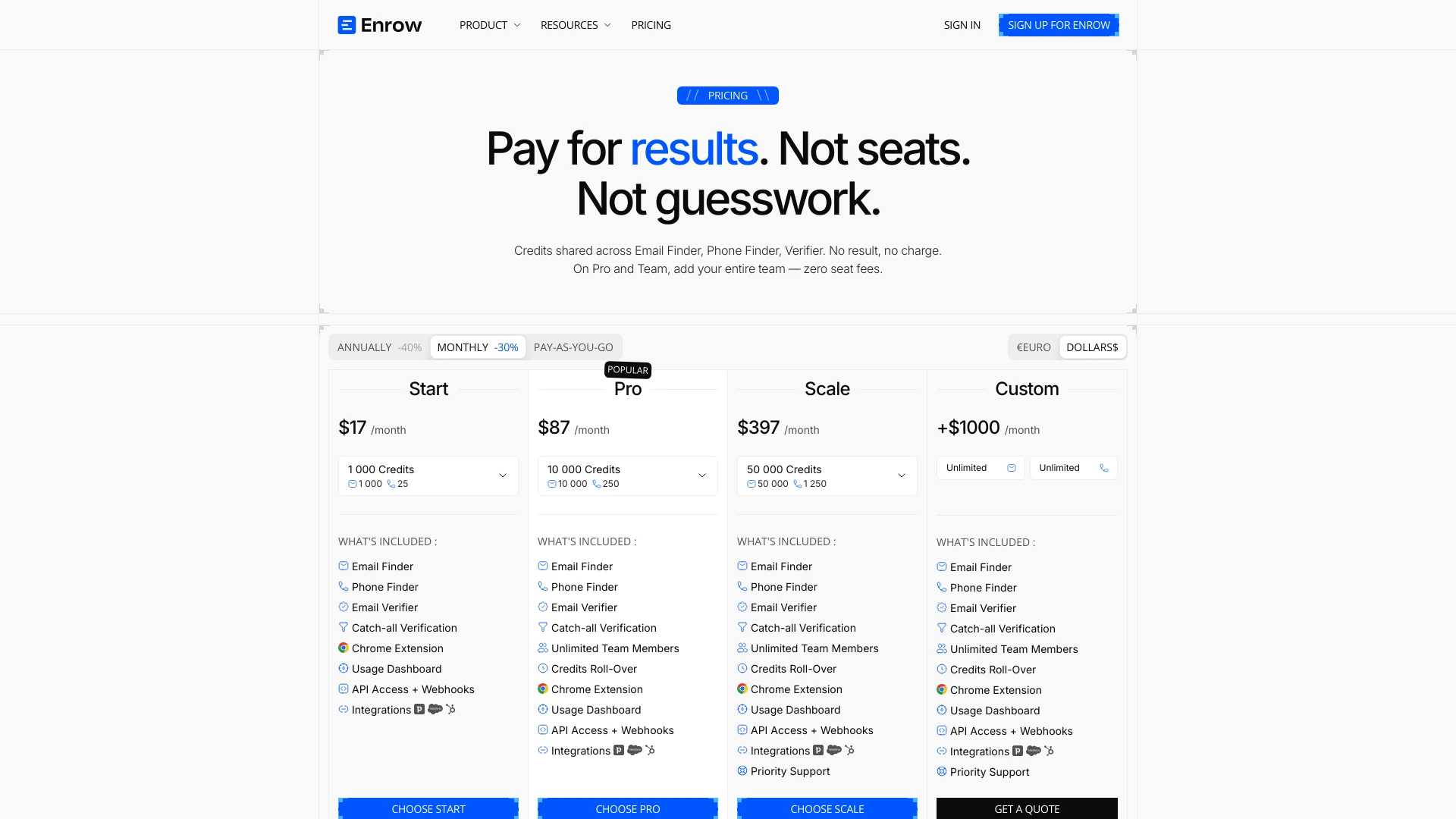
Subscription in three tiers. Start from $17/mo (1,000 credits, monthly only) and $47 for 4,000. Pro from $87/mo (10,000 credits), $167 for 20,000, $247 for 30,000. Scale from $397/mo (50,000 credits) up to $1,397 for 200,000.
Knock about 10% off the Pro and Scale monthly rate if you pay annually, which drops 10,000 to roughly $78/mo and 50,000 to roughly $357/mo.
The credit map is short: 1 email spends 1 credit, a phone spends 40, a standalone verification 0.25, catch-all is baked in, and nothing is billed unless the result comes back valid. Put differently, 10,000 credits is 10,000 emails or 250 phones. Balances roll forward on Pro and Scale.
And the free tier reloads: 50 credits land in the account every month, no card.
A credit only spends when the result is valid, so what's on the sticker is what you actually pay. Pro is the cleanest comparison base: $87 for 10,000 credits, meaning 10,000 valid emails at about $0.0087 each or 250 valid phones at about $0.35 each.
Scale drops further per credit, while Start holds steady as the smaller $17 tier to begin on. Hold the Pro phone number, because every tool below either reveals from a database (haircut the sticker for the dead numbers) or meters phones separately, and that's where the gap opens up.
Don't take my word for the phone quality, put a slice of your own list through it. 50 free credits land every month, no card, enough to pull a real direct dial from any country and call it.
2. Cognism
For enterprise teams that want a huge phone database and can fund it.
Cognism is the phone-data heavyweight: a large B2B database with strong European coverage. Its calling card is "Diamond Data," a set of mobiles a human team has actually phone-verified.
Next to Wiza, this is a different weight class: Wiza captures off LinkedIn one profile at a time, Cognism hands you a filterable database with millions of numbers and a compliance layer built for enterprise.
For a team that needs volume and can pay for it, the phone accuracy is a clear step up from a plain reveal tool.
Then the catch, which is how you buy it. Cognism is annual, seat-based, and quote-only, so there's no $49 entry and no paying by the phone. You buy a platform, and the real cost per number depends entirely on how many you actually pull against the contract.
It's still a stored database, so outside the phone-verified subset, records age like any other. And it's aimed at teams, not a solo rep.
Here's my read. On phone-verified mobiles at scale, Cognism's Diamond Data is a real accuracy story, no argument. But you commit to an annual seat contract to reach it, and the freshness outside that subset is the usual stored-database question.
Enrow takes a different approach: it looks up each number live and bills nothing until that number is valid, with no seat minimum required, so you can test the fit against your own list before any annual commitment.
- +Large B2B database with strong European coverage
- +"Diamond Data" phone-verified mobiles, a real accuracy edge
- +Enterprise compliance layer (GDPR, CCPA, DNC screening)
- +Intent data and integrations for larger teams
- –Annual, seat-based, quote-only, no headline entry sticker and no pay-per-phone
- –Still a stored database outside the phone-verified subset, so records age
- –Built for teams, overkill for a solo rep or small shop
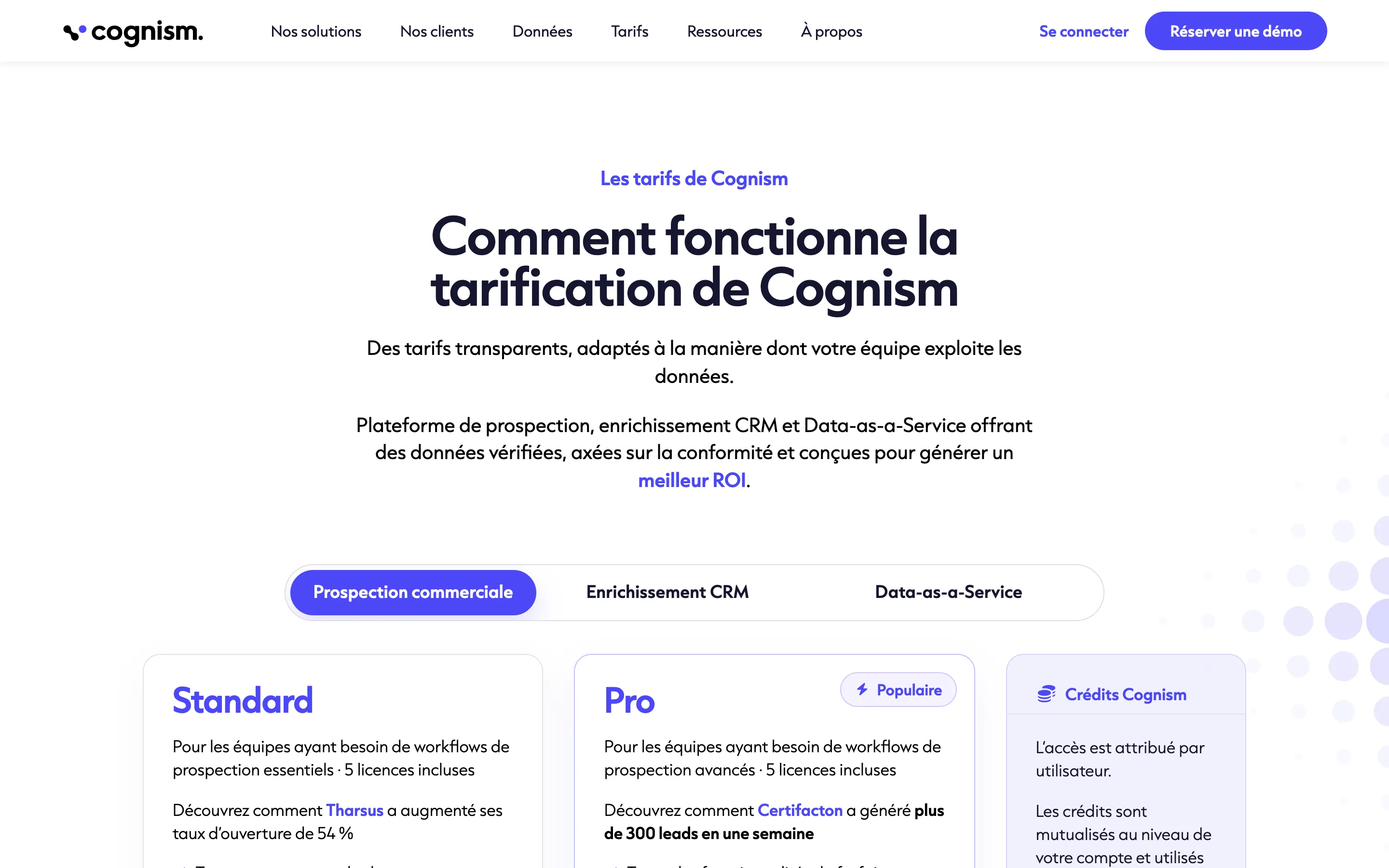
Cognism pricing is quote-only: an annual, seat-based contract, with public estimates putting entry deals in the low-to-mid five figures a year. There's no clean $/valid-phone, because you buy a bundled contract, not a per-number meter.
vs Enrow: Cognism is the enterprise database with the best phone-verification story here; Enrow is the real-time finder you pay by the valid number — no seat minimum, no annual lock-in, opening at $17 with EU direct dials at $0.35 on Pro. Prove the phone quality on a real list before committing a cent.
3. Lusha
Fast US mobiles with a headline sticker and coverage caveats, revealed without leaving the browser tab.
Lusha is the reveal tool a lot of reps already have pinned. Open a LinkedIn profile, hit the extension, get a mobile and an email. Like Wiza it works off a stored database, but its extension is smoother and its US mobile coverage is a real strength.
The niche is clear: a rep who wants a number in two clicks without leaving the tab, mostly for US calling.
Two problems stack up: stored-database freshness, and a credit model that adds up fast. Lusha's numbers age like any stored data, and EU coverage runs thinner with its own compliance questions on top. The per-credit reveal cost climbs, too, once you're past the free trickle.
A revealed number that's dead still burns a credit. Reviews are consistently mixed on how many mobiles actually connect.
When I pulled a batch of US mobiles through the extension, the speed held up and a decent share connected. Both true. But it's a stored database, so a slice of the reveals were stale, and I found no documented EU direct-dial story anywhere in the product.
Enrow, by contrast, looks each number up live. A number that fails verification costs nothing here: the credit only spends once the number comes back valid.
- +Fast, popular Chrome extension for one-click reveals
- +Decent US mobile coverage
- +Simple to roll out to a sales team
- +CRM integrations and a usable free tier
- –Stored database, so a share of revealed mobiles are stale
- –EU coverage thinner, with compliance questions
- –Per-credit reveals get expensive at volume; a dead number still costs a credit
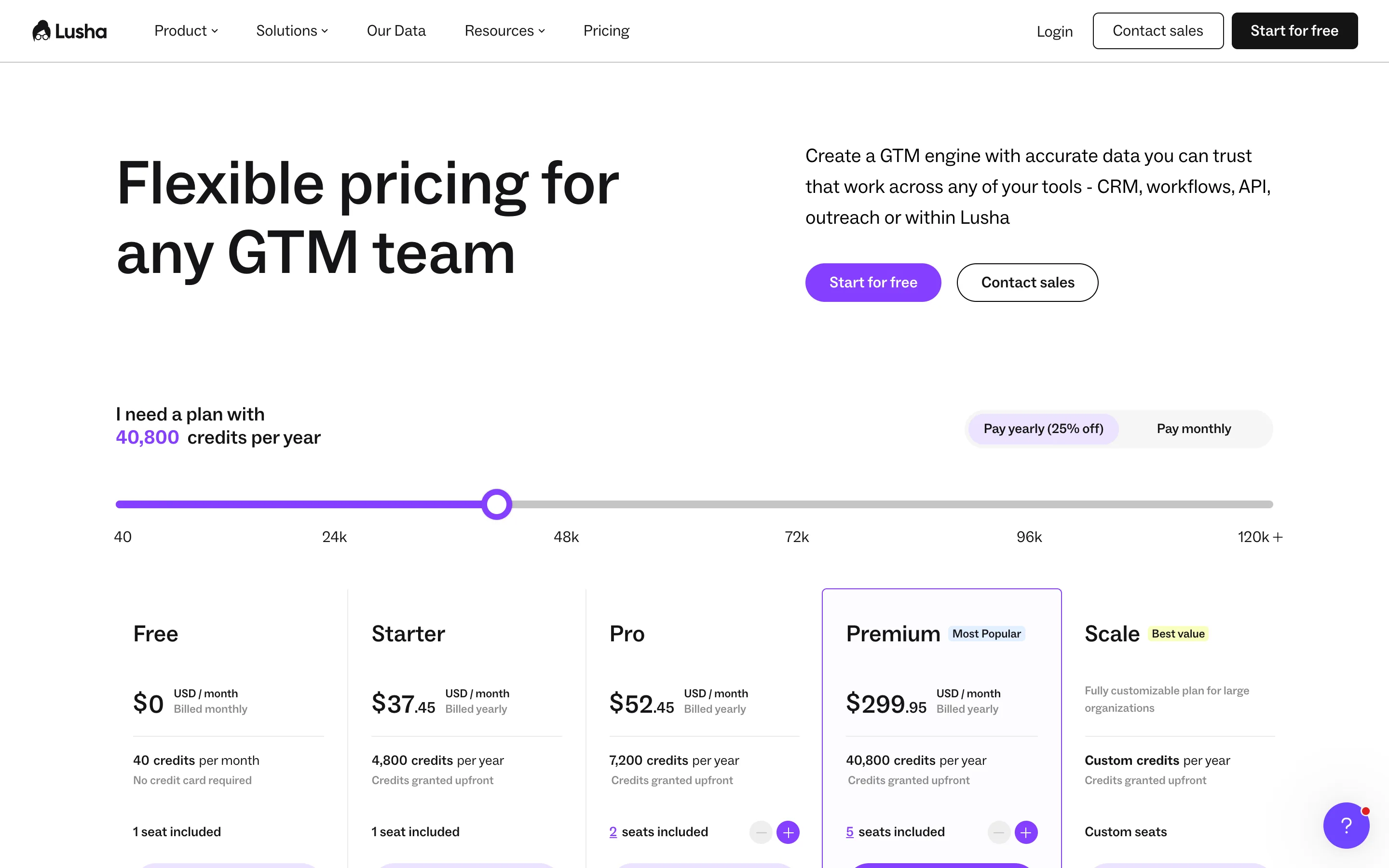
Lusha pricing (USD, per account, re-read 2026-10-05) starts free with 40 credits/month, then Starter at $49.90/mo billed monthly for 400 credits, where a phone reveal costs 5 credits, about $0.62 a number. Lusha bills per reveal, not per connect, so haircut for the stale numbers: at a rough 55-70% mobile-accuracy rate the real cost lands around $0.89-1.13 per valid phone, well above the $0.35 Enrow charges per valid phone on Pro, also monthly, on US-leaning numbers with no documented EU direct dials.
vs Enrow: strip out the dead reveals and Lusha's real cost per valid mobile sits well above Enrow's, off a stored US-leaning database. Enrow looks up numbers live and charges only once the phone is valid. Lusha's extension can't match the one-click full-contact export straight into a CRM.
4. Kaspr
The headline entry point for European mobiles off LinkedIn.
Kaspr (owned by Cognism) is a LinkedIn-first reveal tool with a stronger European tilt than most. Open a profile, get a phone and an email, at a lower price than its parent. Against Wiza, the draw is EU coverage at a headline monthly price, where Wiza leans US.
Its niche is a European SDR who wants mobiles off LinkedIn without an enterprise contract.
The trade is data depth and the usual database freshness. Kaspr pulls from a stored database, so accuracy on mobiles is variable, and its coverage is best on LinkedIn-active profiles. Credits are metered per reveal and the sticker-price plans are capped, so heavy dialing pushes you up the tiers fast.
GDPR compliance is claimed, though as with any reveal tool the documentation is what matters.
I tested it on a French and DACH sample, and for the price the EU hit rate was fair, better than Wiza on European reach at this tier. But it's still a database reveal, so freshness was the open question, and a dead number spent a credit all the same.
Enrow sources EU direct dials the same way, in real time. The credit only spends on a valid number, so misses cost you nothing.
- +Stronger European mobile coverage than most reveal tools
- +Headline monthly entry, LinkedIn Chrome extension
- +Emails and phones from one extension
- +GDPR compliance claimed, backed by Cognism's data
- –Stored database, so mobile freshness is variable
- –Coverage best on LinkedIn-active profiles; thin elsewhere
- –Per-reveal credits, capped sticker-price plans; a dead number still costs one
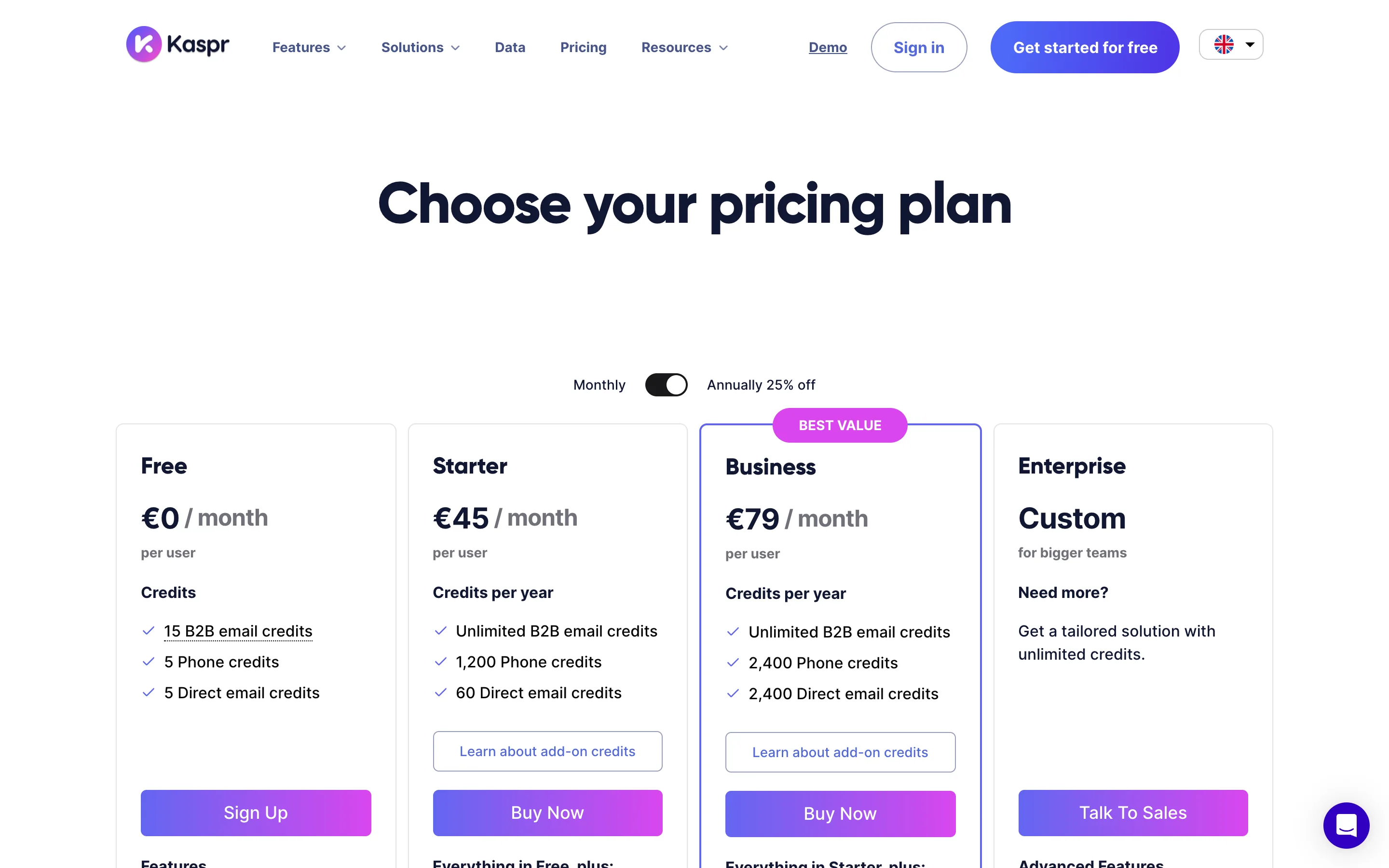
Kaspr pricing (in euros, verified 2026-10-06) starts free (15 email + 5 phone credits/mo), then Starter €59/user/mo month-to-month with 100 phone credits. Kaspr meters per reveal, not per connect: those 100 credits work out near €0.59 a reveal, and at a rough 55-70% mobile accuracy the real cost per valid European phone lands around €0.84-1.07, above Enrow's €0.30 on Pro, on stored numbers whose freshness you can't see.
vs Enrow: Kaspr is an EU reveal tool with costly caveats; Enrow is a real-time EU finder billed on valid results. Enrow sources each direct dial the moment you ask. A miss costs nothing, and the whole contact, once verified, lands in your CRM in a single click.
5. RocketReach
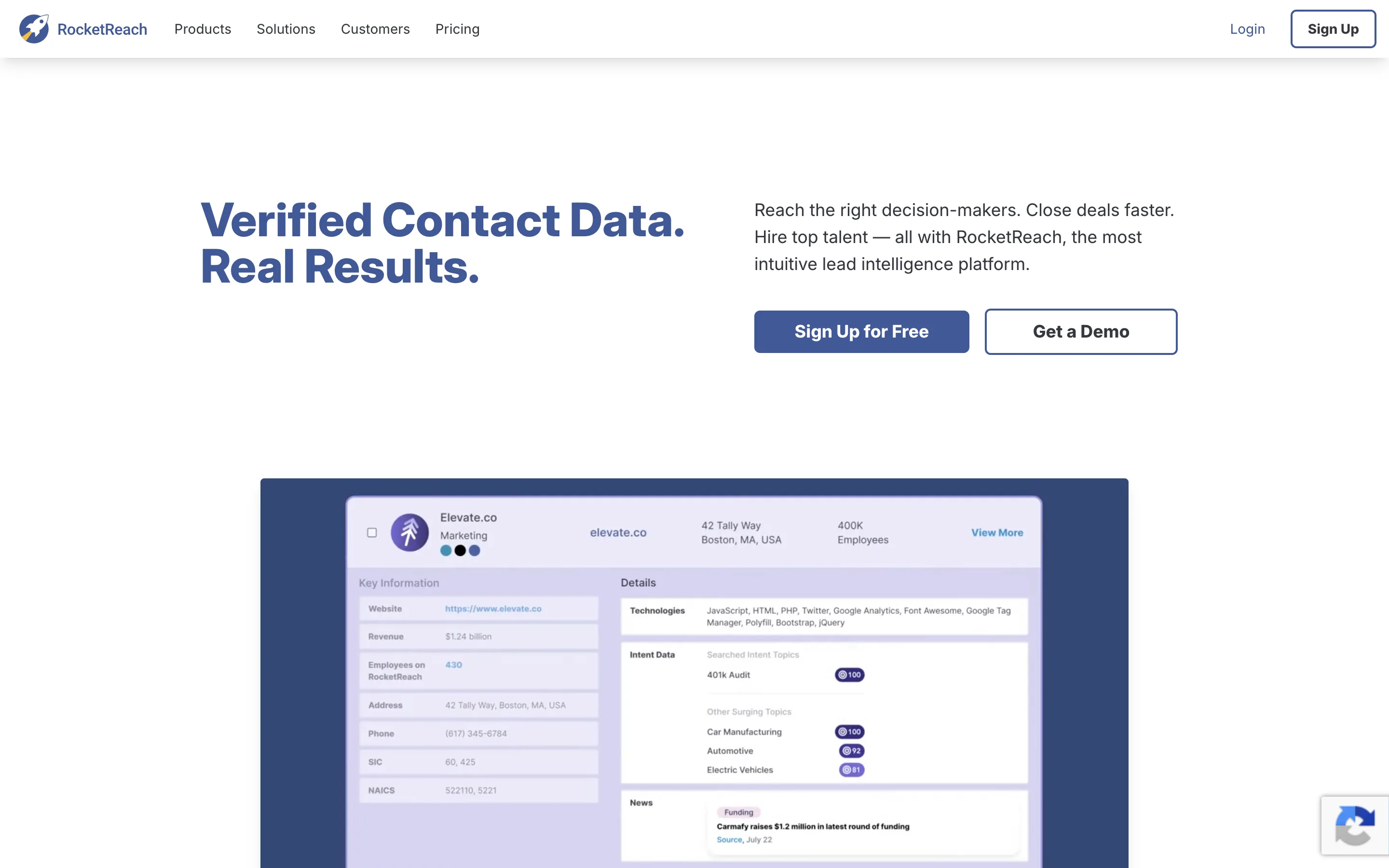
Best when you need reach and volume more than pinpoint mobiles.
RocketReach is a wide-net lookup tool: a large database of professionals, with emails and phone numbers, searchable by name, company or domain. Where Wiza is LinkedIn-capture-first, RocketReach is database-first, so it's built for pulling many contacts at once rather than working a Sales Navigator list profile by profile.
Its niche is recruiters and researchers who need reach across regions and industries more than pinpoint phone accuracy.
Accuracy is exactly where the breadth costs you. It's a big stored database, so reach comes at the expense of freshness, and phone numbers in particular are hit or miss, reviews flag both stale mobiles and misses.
Lookups are metered, and phone lookups often cost more or sit on higher tiers. You pay for a lookup whether or not the number connects.
My read: great for casting a wide net, weaker when you need the specific mobile to be right. That's the trade with breadth.
Enrow takes the opposite bet: it looks up and verifies the one number you need. A credit spends only when that number is valid, so reach doesn't have to mean paying for misses.
- +Very broad database across regions and roles
- +Email and phone lookups plus a bulk/API workflow
- +Good for high-volume research and list pulls
- +Integrations and a Chrome extension
- –Breadth over accuracy; phone numbers are hit or miss
- –Stored data ages; a lookup costs whether or not it connects
- –Phone lookups often gated to higher tiers
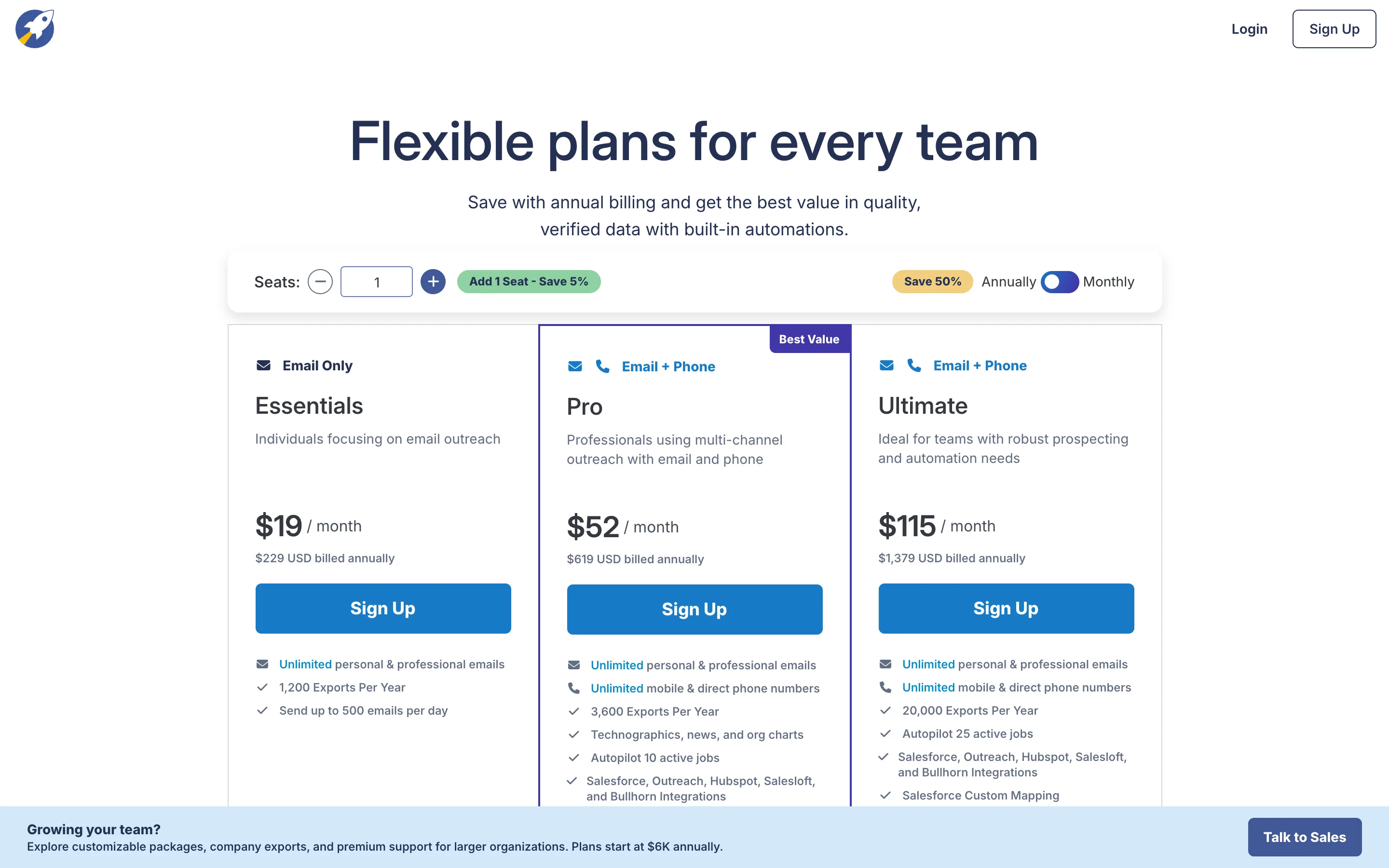
RocketReach pricing (USD, per user) starts free (about 5 lookups/mo, email only), Essentials around $69/mo for email lookups, with phone lookups sitting on the Pro tier around $119/mo. It bills per lookup — you pay on the attempt whether or not a number comes back — so with no published find rate (assume ~30% surface a usable number) plus mobile accuracy around 50-65%, the real cost per valid phone runs well past what Enrow charges per valid phone on Pro ($0.35), on a wide database with no documented EU direct-dial story.
vs Enrow: RocketReach wins on breadth. Enrow wins on whether the one number you called is actually right: looked up in real time, with a credit spent only on a valid result.
6. SignalHire
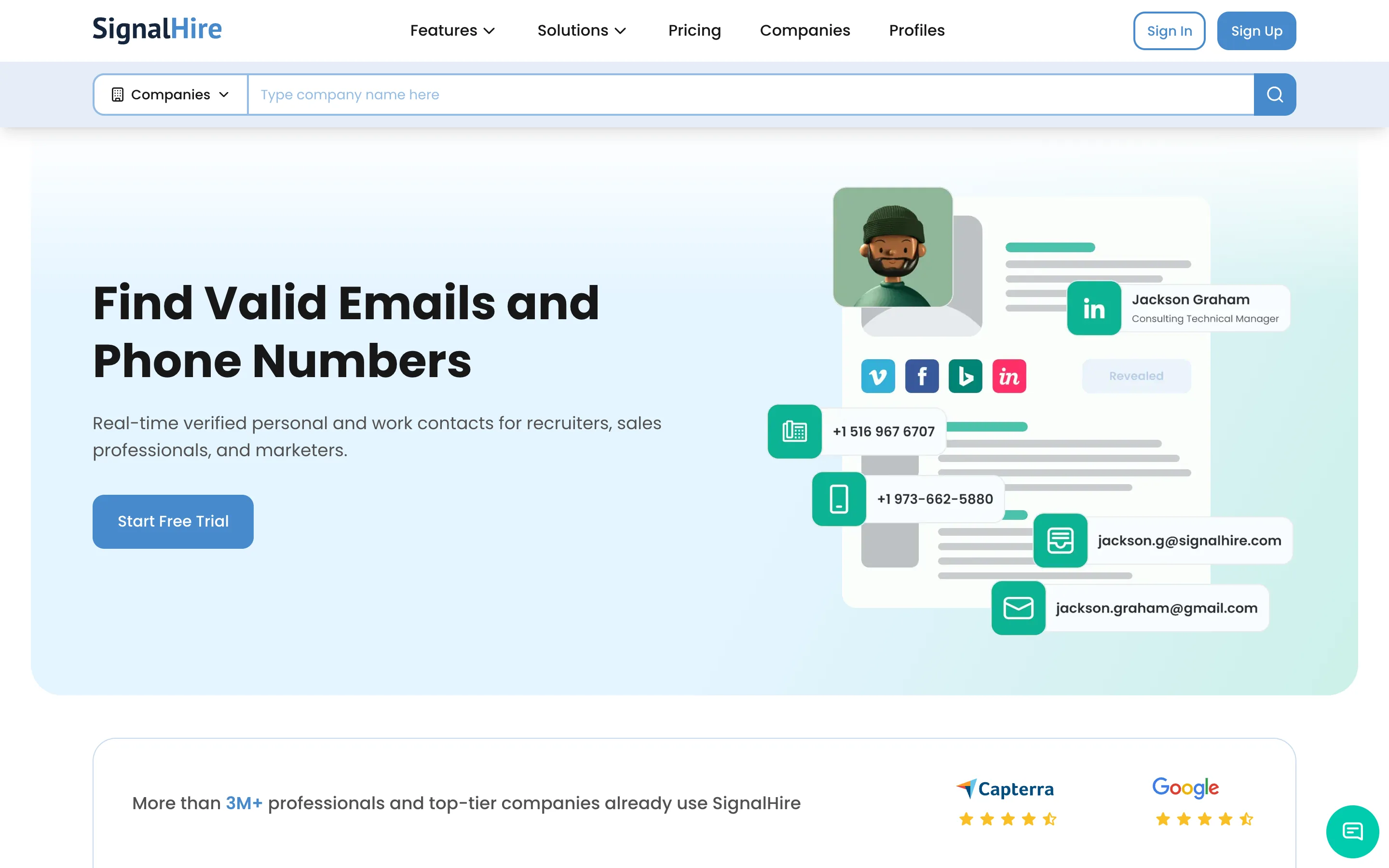
Per-credit reveals with costly misses, with phones sitting in the same pool.
SignalHire is a sticker-price contact finder: emails and phone numbers on a per-credit reveal model, with a browser extension and bulk search. Against Wiza, the pitch is simple: a lower-looking reveal sticker that includes phones without jumping to a phone-specific plan, before accuracy and EU coverage are priced in.
Its niche is a small team or recruiter that accepts sticker-price stored reveals and the freshness trade-off.
Data quality and coverage are where the sticker-price trade shows. It's a stored-database reveal tool, so mobiles vary in accuracy and EU coverage is limited with no strong compliance documentation. Credits are consumed on reveal, so a dead number still costs one.
The sticker is only the sticker, and you can feel where the trade comes from on a live dialing list.
Honestly, for the price it's a reasonable way to get emails plus the occasional phone. But "headline per reveal" and "headline per number that connects" aren't the same thing once you haircut the stale ones.
Enrow's sticker per reveal is higher, no argument there. But what comes back is a number found live and cleared for EU dialing, charged only once it's confirmed valid, which is the metric that matters once you're actually on the phone.
- +Headline per-credit sticker, phones included in the credit pool
- +Browser extension and bulk search
- +Simple, headline entry for small teams
- +Email and phone from one tool
- –Stored-database reveals; mobile accuracy varies
- –Limited EU coverage, weak compliance documentation
- –A dead number still spends a credit
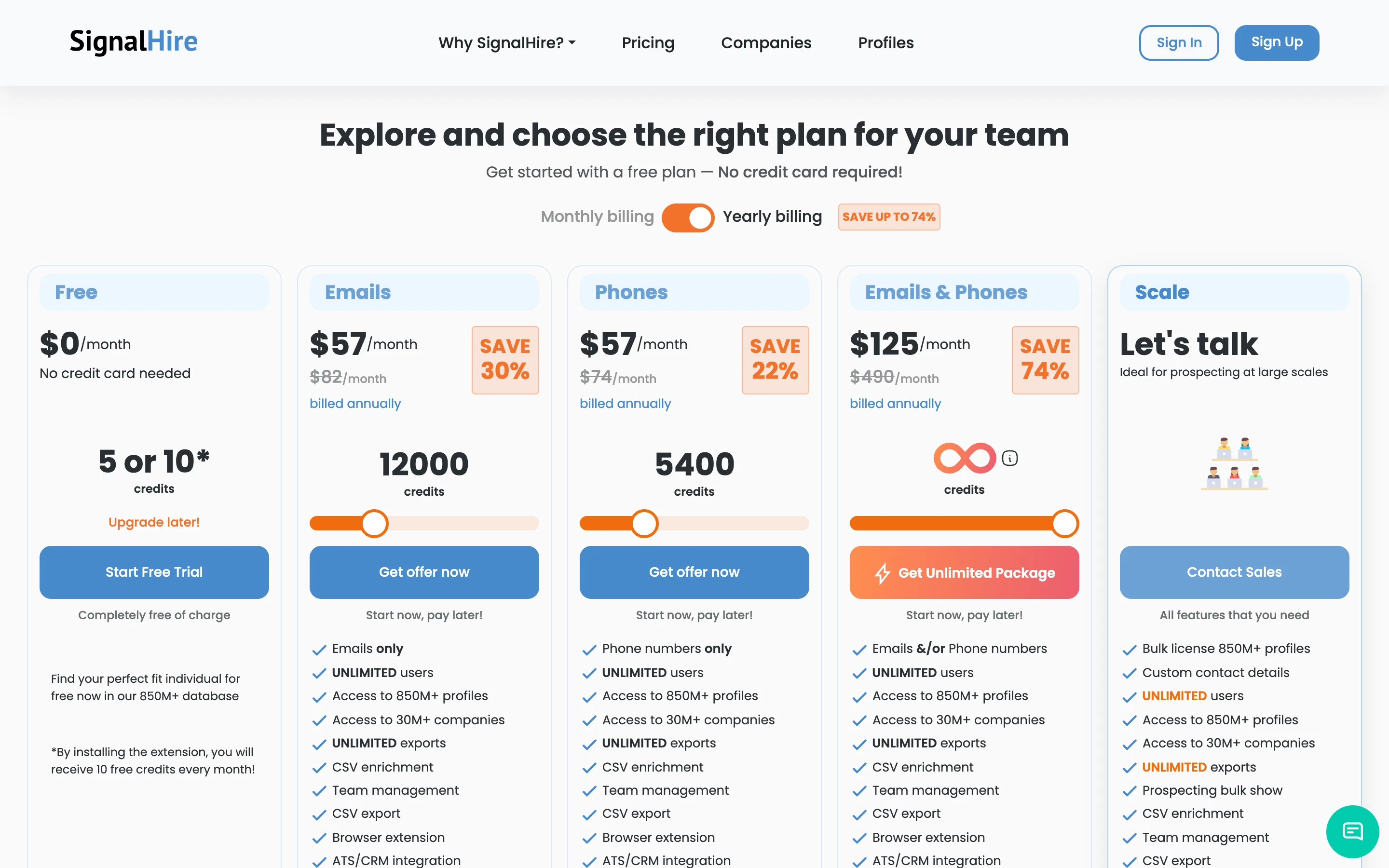
SignalHire pricing (USD, per user, credit-based, verified 2026-07-02) starts free (about 5-10 credits), with paid plans opening around $69/mo for a ~435-credit phones bundle — near $0.16 per reveal at sticker. But reveals are metered whether or not the number connects, and SignalHire's stored data sits on the weaker end, so shave the sticker down for the dead lines and the real cost per valid phone lands in Enrow Pro territory rather than under it, with no EU direct-dial documentation at any price.
vs Enrow: SignalHire sells the per-reveal sticker; Enrow sells the per-valid one, about $0.35 a phone on Pro. That number arrives found live, cleared for EU dialing, billed only once valid, and it lands in your CRM already whole.
7. Apollo

For teams that want the whole outbound suite, not just a phone finder.
Apollo pairs a huge B2B database with sequencing, enrichment and a Chrome extension, all on one seat-based subscription, and it includes a ration of mobile credits. Where Wiza is a focused LinkedIn capture tool, Apollo is the whole outbound stack in one tab: source, enrich, sequence, dial.
For a small team that wants one platform, that breadth is the draw, but the phone data is a component of the suite, not its main event, and that's where a dialing-focused team feels the trade.
Freshness is the soft spot, along with how stingily the mobiles are metered. Apollo is a stored database, so records age and you'll hit contacts who moved on. Mobiles draw from a shared per-seat credit pool at 8 credits each, so heavy dialing drains it fast, and overage is metered.
The recurring reviews are about data accuracy and export caps.
Fair play to Apollo: getting from a filter to a live sequence without leaving the tool is quick. Then I checked the mobiles against a live dial, and real-time won.
Enrow, on the other hand, looks up each number on the spot and covers EU direct dials that Apollo's database doesn't reliably reach. Billing tracks valid results only, with no per-seat math to run.
Apollo is built for a different job, running the whole outbound stack in one tab; if that's what you're after, Enrow sits alongside it as the clean phone layer feeding the sequences.
- +Large database with sequencing and enrichment in one place
- +Chrome extension and CRM integrations
- +Mobile credits included in the subscription
- +One tool to source, enrich, sequence and dial
- –Stored database, so mobiles age and accuracy is a common complaint
- –Phones draw from a shared per-seat credit pool (8 credits per mobile) that doesn't roll over, so heavy dialing drains it fast and any credits a seat doesn't burn are lost
- –Export caps and data-quality gripes recur in reviews
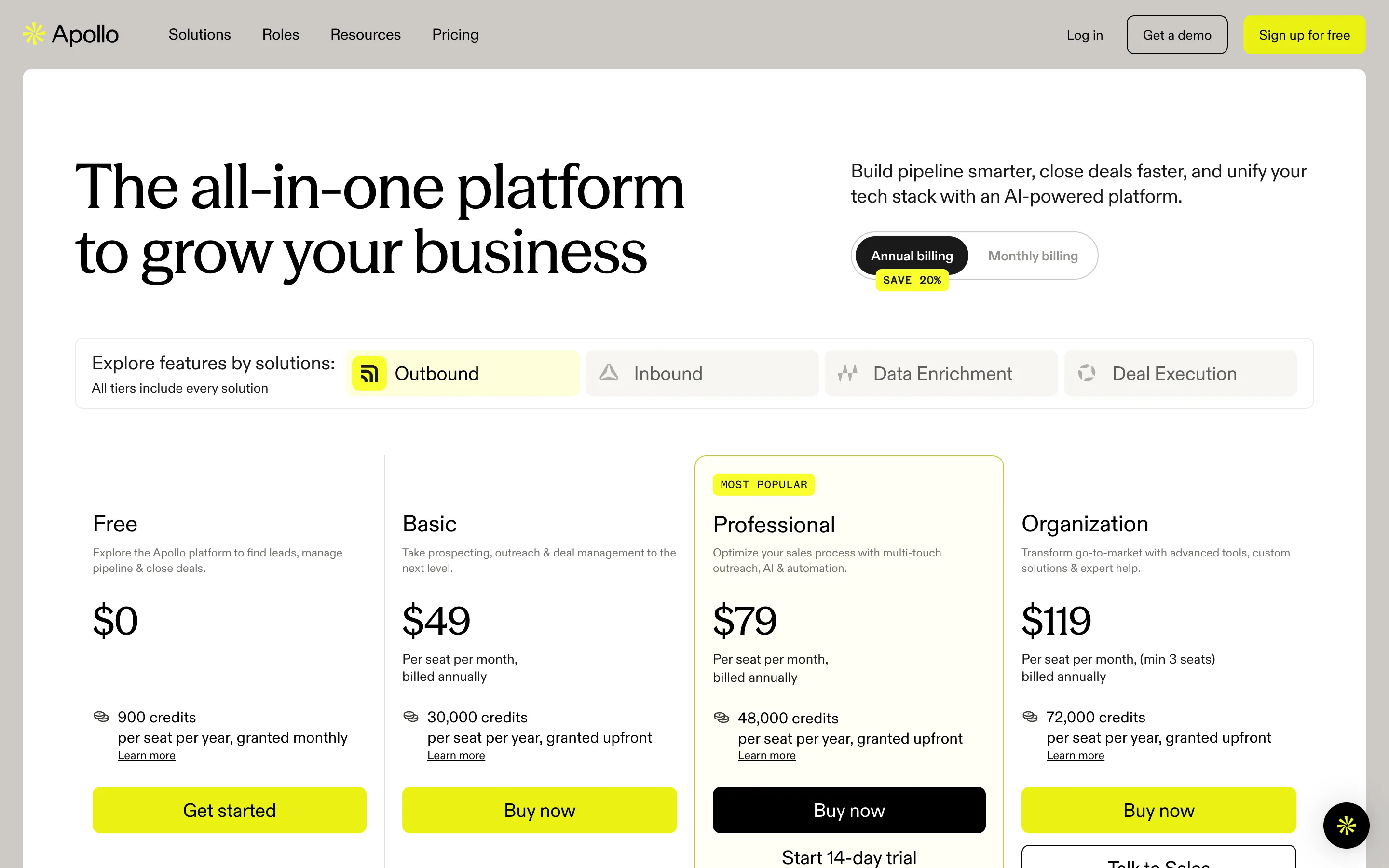
Apollo pricing (USD, per seat) opens at Basic $49/seat/mo annually on one unified credit pool, where a mobile reveal costs 8 credits and an email 1 (verified only). Those credits don't roll over — whatever a seat doesn't burn is lost — so knock Apollo's stored, US-leaning mobiles down for the stale ones on a live dial and the real cost per valid connected mobile ends up higher than what Enrow charges per valid phone on Pro ($0.35). It's steeper still once EU coverage matters, since Apollo documents no EU direct dials, and you pay per seat whether a dialer burns a credit or not.
vs Enrow: Apollo is the all-in-one suite; Enrow is just the phone-and-email layer underneath it, at $0.35 per valid phone on Pro. No expiring pool, no per-seat fee, and EU direct dials Apollo's database doesn't reach.
8. ContactOut
Made for recruiters chasing personal emails and mobiles off LinkedIn.
ContactOut is a LinkedIn-first reveal tool known for surfacing personal emails alongside work ones, plus phone numbers, from a large stored database. Like Wiza it lives in the LinkedIn tab, but it leans harder into personal contact data, which recruiters in particular value.
Its niche is recruiting and talent sourcing, where a personal email or mobile often beats a work one.
The catch is the familiar one, sharpened. Stored data ages and phone accuracy is variable, and surfacing personal data only makes the EU compliance questions louder. Pricing is per user and climbs, with phone and mobile reveals metered on top.
A revealed number that's wrong still costs you.
For recruiting, the personal-data angle is a real strength, I'll grant it. But for B2B dialing where you need the number to be current and compliantly sourced, it's a stored database like the rest.
Enrow sources direct dials live. You pay for a connect, not a reveal, since the credit only spends once the number is valid.
- +Strong personal + work email coverage off LinkedIn
- +Phone numbers alongside emails
- +Popular Chrome extension for recruiters
- +Large database, good LinkedIn coverage
- –Stored database, so freshness and phone accuracy vary
- –EU/personal-data compliance questions
- –Per-user pricing climbs; metered phone reveals
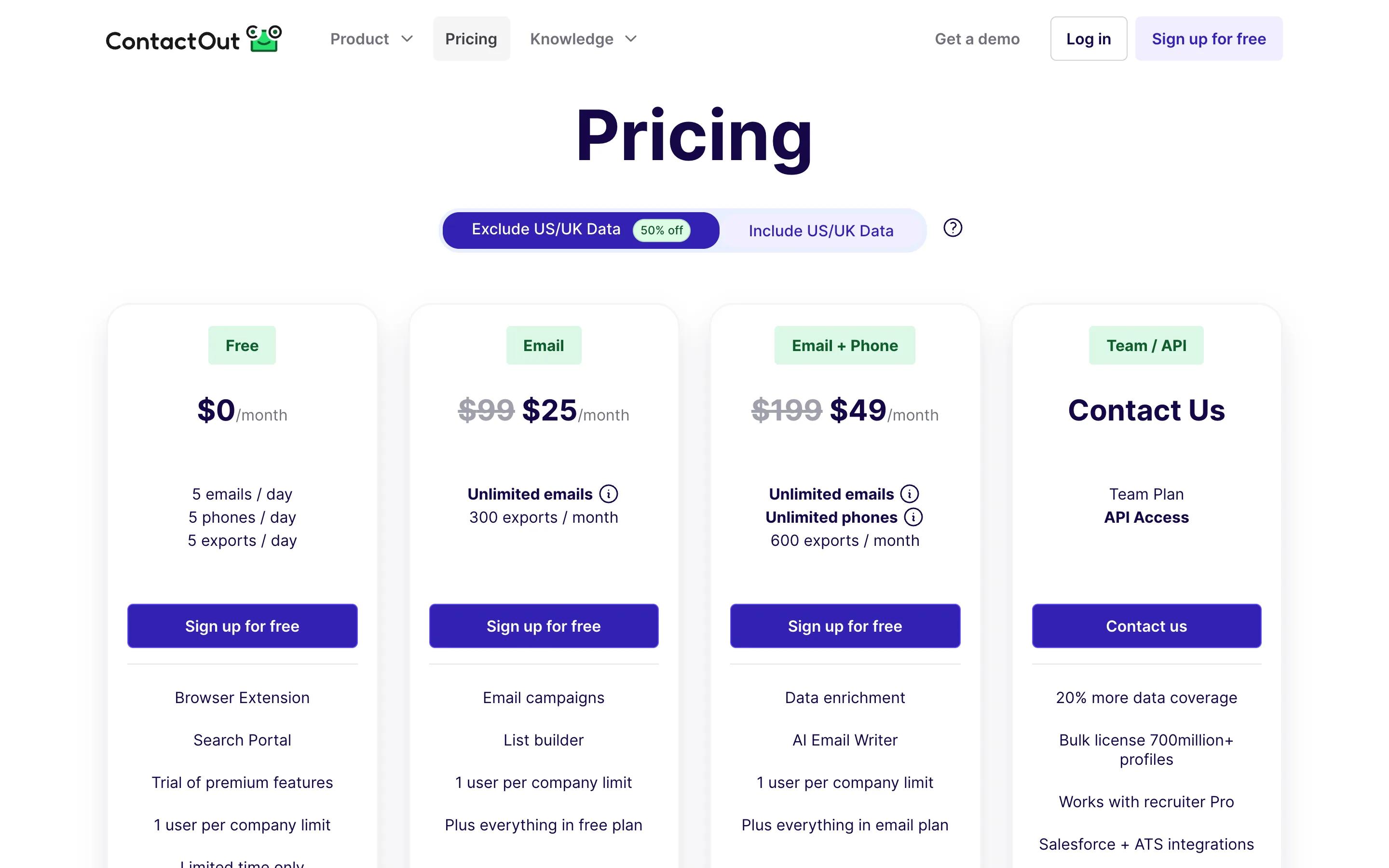
ContactOut pricing (USD, per user) is free for a small handful of daily reveals, with the paid ladder opening around $99/mo for a fixed monthly pool of email and phone reveals. It's priced per seat off a stored database, not per valid result, so there's no honest $/valid-phone — discount for a rough 55-70% mobile accuracy, add in personal numbers with no compliant EU B2B-dial basis, and a legally-dialable EU mobile ends up costing more than Enrow's Pro rate, not less.
vs Enrow: ContactOut wins on personal-email sourcing for recruiters; Enrow wins on dialing-grade B2B phones, pulled fresh. A miss bills nothing, and the whole contact card still lands in your CRM with one click.
9. Seamless.AI
Big claims on the data, big asterisks on the contract.
Seamless.AI markets itself as a "real-time" B2B search engine: search a company or a title, get emails and cell phones, work it from a Chrome extension. Next to Wiza, the pitch is the same LinkedIn-adjacent capture wrapped in a search UI and a much louder marketing voice.
Its niche is a US sales team that wants volume and a familiar in-browser reveal, and doesn't mind a sales call to buy it.
Two things bite. The "real-time" label sits on top of a stored index, and reviews are consistently rough on phone accuracy, with stale mobiles and wrong numbers showing up on live dials. The commercial terms are the other headache. Paid plans are quote-only and per-seat, and the default is an annual contract users report is hard to exit. On top of that, the daily credit pool expires at midnight, so whatever you don't burn is gone.
One credit reveals a phone and an email together, so phones aren't metered on their own, and nothing in the product documents legally-sourced EU direct dials.
I ran a batch through it, and the extension was quick, no argument. But a slice of the mobiles were stale, the European numbers came with no compliance story, and the daily credits reset before I could touch the overflow.
Enrow runs on a different clock. Numbers are looked up live and billed only once valid, with no seat minimum and no annual lock-in. Nothing about your balance disappears at midnight.
- +Fast Chrome extension and a search-engine-style UI
- +Emails and cell phones from a single reveal
- +Large US contact coverage
- +Daily credit refill on paid plans for high-volume days
- –Stored index behind a "real-time" label; reviews flag weak phone accuracy
- –Quote-only, per-seat, annual-contract default that users report is hard to cancel
- –Daily credits expire at midnight, so unused reveals are lost
- –No documented legally-sourced EU direct dials
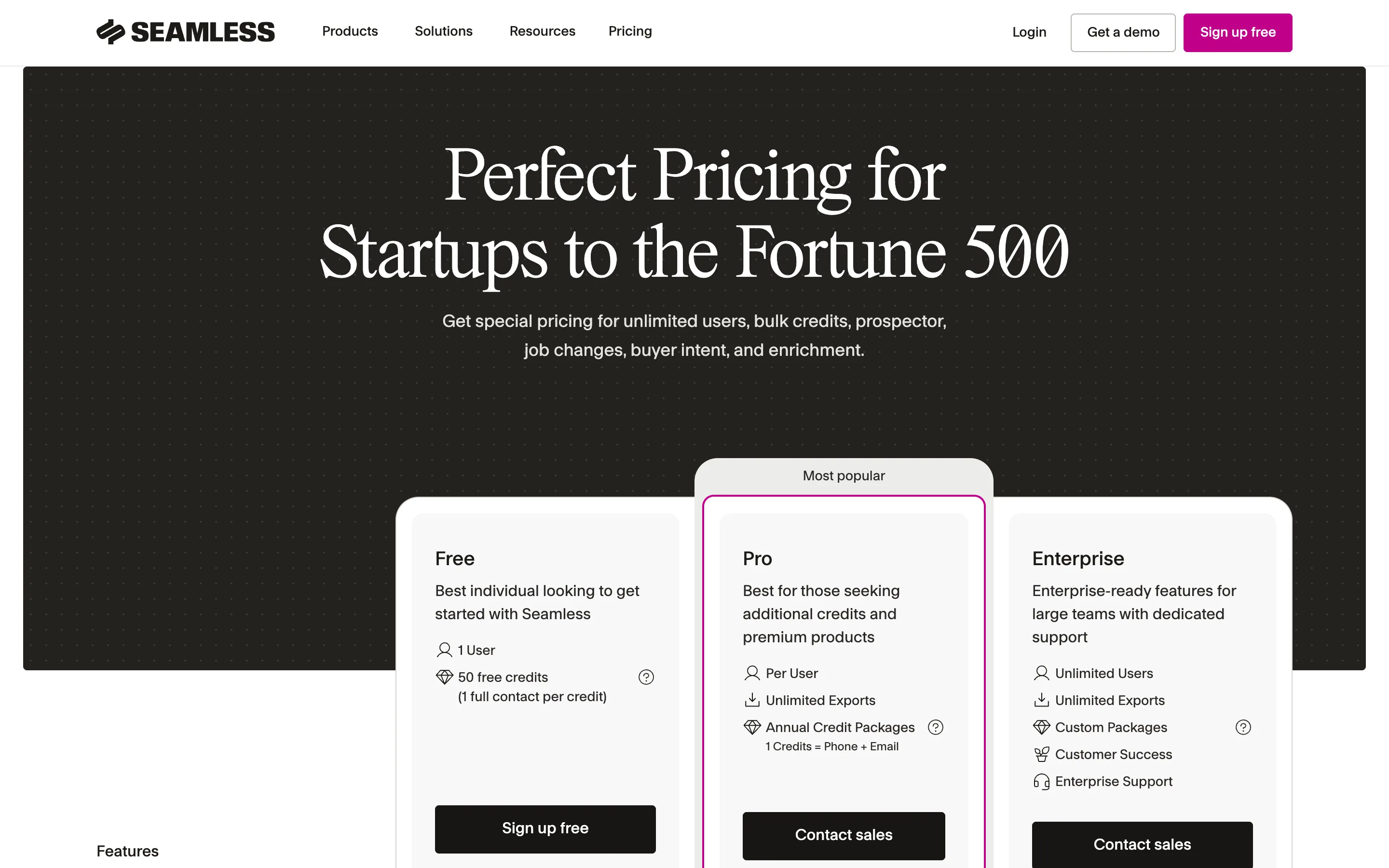
Seamless.AI pricing (USD, per user) is free for 50 lifetime credits, then paid plans are quote-only and annual: the retired Basic tier ran about $147/mo billed yearly for 250 credits/mo, and Pro is sales-quoted with a roughly 5-seat minimum (about $79-150+ per user). A credit reveals a phone and an email together, so there's no clean $/valid-phone, but trim a stored index reviewers rate weak on mobiles (~50-65%) and the real cost per valid European dial rises above what Enrow charges per valid phone on Pro ($0.35), on numbers with no documented EU compliance basis.
vs Enrow: Seamless.AI is the loud, quote-only search engine; Enrow is the quiet pay-per-valid finder. Numbers are sourced live and a miss costs nothing. No annual lock-in, no midnight credit wipe, and the full contact still drops into your CRM in one click.
10. Wiza
The tool this article is measured against.
Wiza is the baseline, so here it is on its own terms. A clean LinkedIn-first prospecting tool: from a profile or a Sales Navigator search it pulls work emails and phones and verifies the emails, then hands the list off to your CRM or a CSV.
For a US rep who prospects out of LinkedIn all day, the workflow is genuinely smooth, and the email accuracy is a real strength, reviewers regularly praise the match rate.
Then the phones. Wiza reveals mobiles from a stored database, so a share are stale or wrong, independent reviews put phone accuracy around 55-65% with coverage far below its email coverage, roughly 20-40% of contacts.
And nothing on the pricing page documents legally-sourced EU direct dials, so a Europe-heavy list runs into both an accuracy and a compliance question. The emails are the strong half; the phones are the softer one.
Wiza is built for one job: LinkedIn-native US prospecting where email carries the workflow and phones are a nice-to-have. On that narrow job it does fine.
But the moment the phone becomes the point, the data going into your dialer is where it thins out, and a Europe-heavy list makes that worse.
Enrow's numbers, on the other hand, are found live and charged only once valid. One click drops the full verified contact into your CRM. Wiza matches none of that on phones.
- +Clean LinkedIn and Sales Navigator capture workflow
- +Strong, well-reviewed email accuracy
- +Verifies emails before counting them (per-valid on emails)
- +CRM integrations and CSV export
- –Phones are stored-database reveals; accuracy around 55-65%
- –Phone coverage far below email coverage (~20-40% of contacts)
- –No documented legally-sourced EU direct-dial story
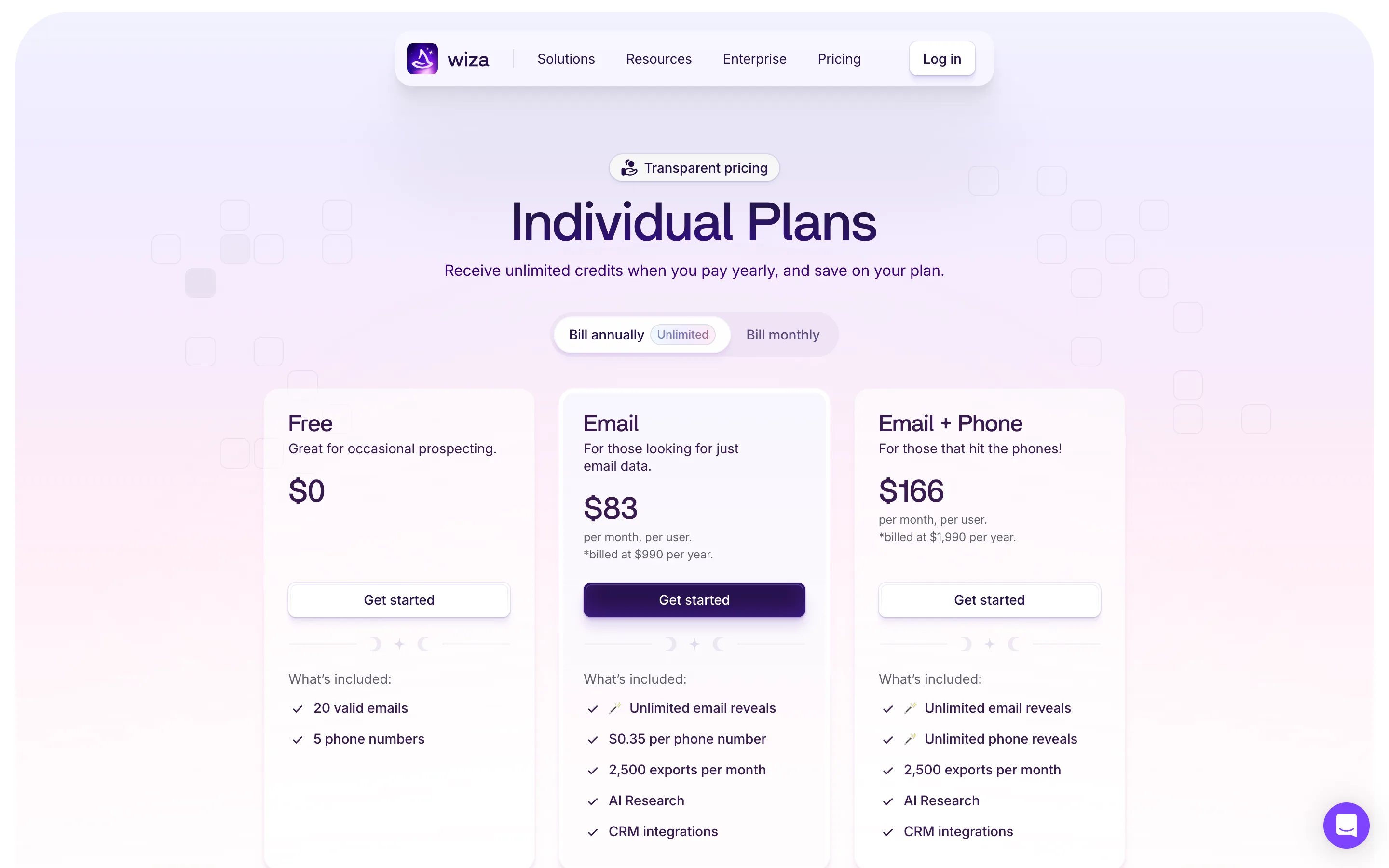
Wiza pricing (USD, per user) is free for 20 emails + 5 phones, then Starter $49/mo for 100 valid emails + 100 phone numbers ($0.35 per extra phone). Wiza bills per valid email, so on emails the sticker is honest — but its monthly Email plan runs about $0.20 per valid email, roughly 23x Enrow's $0.0087 Pro benchmark. On phones, that $0.35 is per reveal off a stored database, so discount for Wiza's ~55-65% accuracy and the real cost per valid phone rises to about $0.54-0.64, above the $0.35 Enrow charges per valid phone on Pro.
vs Enrow: Wiza charges for a stored-database reveal whether it connects or not. Enrow finds the number live, bills nothing until it's valid, and hands the whole contact to your CRM in one click.
Don't take my word for the phone quality, put a slice of your own list through it. 50 free credits land every month, no card, enough to pull a real direct dial from any country and call it.
Side-by-side comparison
Final Verdict
Boil it down to the job that matters, a direct-dial phone that reaches the right person, Europe included, paid for only when it's valid, and Enrow is the pick. It sources each number in real time. The charge lands only on a valid result, about $0.35 per valid phone on Pro. Wiza is a clean LinkedIn capture tool with strong emails, but its phones are stored-database reveals reviewers put around 55-65% accurate, with no documented EU direct-dial story. And the part no tool here matches: one click lifts the full verified contact, email and phone, off a LinkedIn or Sales Navigator profile into HubSpot, Salesforce or Pipedrive. Enrow isn't an all-in-one, though, and it won't pretend to be: no searchable database, and no built-in sequencing or dialer, so pair it with Cognism or Apollo for lists and Emelia or lemlist for sending. But if you need a phone number that connects, legally, in Europe, that narrow focus is the whole job.
Don't take my word for the phone quality, put a slice of your own list through it. 50 free credits land every month, no card, enough to pull a real direct dial from any country and call it.
FAQ
How we evaluated these tools
No sponsor, no affiliate link, nobody paid to rank. I ran it myself: one phone list, dialed through every self-serve tool in a single week, then I actually called the numbers that came back to hear which ones hit a live desk — the demo-gated holdouts like Cognism I scored on their published pricing, docs and reviews instead. Four things set the order: match rate, how many rang a real person, the true cost per valid phone once you strip the per-reveal headline, and EU direct-dial coverage weighted heaviest. Every competitor price and feature comes straight off the official page, read 2026-07-02.
ready to stop wasting time?
Connected in minutes.
Verified data in seconds.
no credit card
no setup required