pipecorn alternatives
Top 10 Pipecorn Alternatives & Competitors in 2026
We ran 10 alternatives against the four things that actually decide an outbound budget: match rate, bounce on a live send, real cost per valid contact, and EU phone coverage. Same list, same week, every tool.
10 tools tested
updated October 6, 2026
15 min read
Aktualisiert am 6. Oktober 2026
The alternatives at a glance
if you need verified emails and EU direct dials, paid only when they land, Enrow is the move: $17/month in, about $0.017 per valid email at entry and $0.0087 at Pro volume, roughly a fifth of what Pipecorn's 3-credit meter charges once you scale. The other nine each own a lane. FullEnrich and BetterContact if you specifically want a waterfall, Emelia if you must send from the same login, Apollo if you want the whole dashboard. Route by niche below. None is the better overall buy.
Pipecorn is a waterfall. One slider hides 100+ data sources; you pay 3 credits per verified email, 30 per mobile. It bills only valid results, which is fair enough.
But 3 credits an email works out to about $0.049 each at entry, and that rate barely budges with volume — roughly 5× Enrow once you're buying real numbers.
The direct source is Enrow: 1 credit = 1 verified email, 10+ verification checks, GDPR-cleared EU direct dials, charged only when valid, from $17/month. Click once in the Chrome extension and the whole verified contact drops from LinkedIn into your CRM. And the free tier refills. 50 credits, every month.
Why teams look for Pipecorn alternatives
Pipecorn does the waterfall thing well. Teams still leave it, for three plain reasons. None of that is a bug in the waterfall. It's the tax on asking a hundred vendors a question one strong source answers.
Conflict of interest disclosure
Straight up: Enrow is my company, and I've ranked it #1 on my own list. Read the rest with that in hand.
Now the part that matters more. Pipecorn, and a couple of tools below, do something Enrow deliberately won't — they chain 100-plus vendors into one call to wring out the last percent of coverage. Genuine capability, that.
If your one and only aim is to brute-force every provider on earth in a single request, a waterfall is the right shape, and I'll point you to the best one. Enrow made the opposite bet.
One job: find and verify the most accurate emails and direct dials, from a single high-signal source, in real time. Watering that down into a reseller stack is something we refuse to do.
And the focus is exactly why the data survives a live send, and why the price per valid contact stays clean.
If the hundred-vendor chain is what you're after, a tool below fits. If it's the source those chains are reaching for, that's the whole point of Enrow.
The 10 best Pipecorn alternatives
1. Enrow
#1
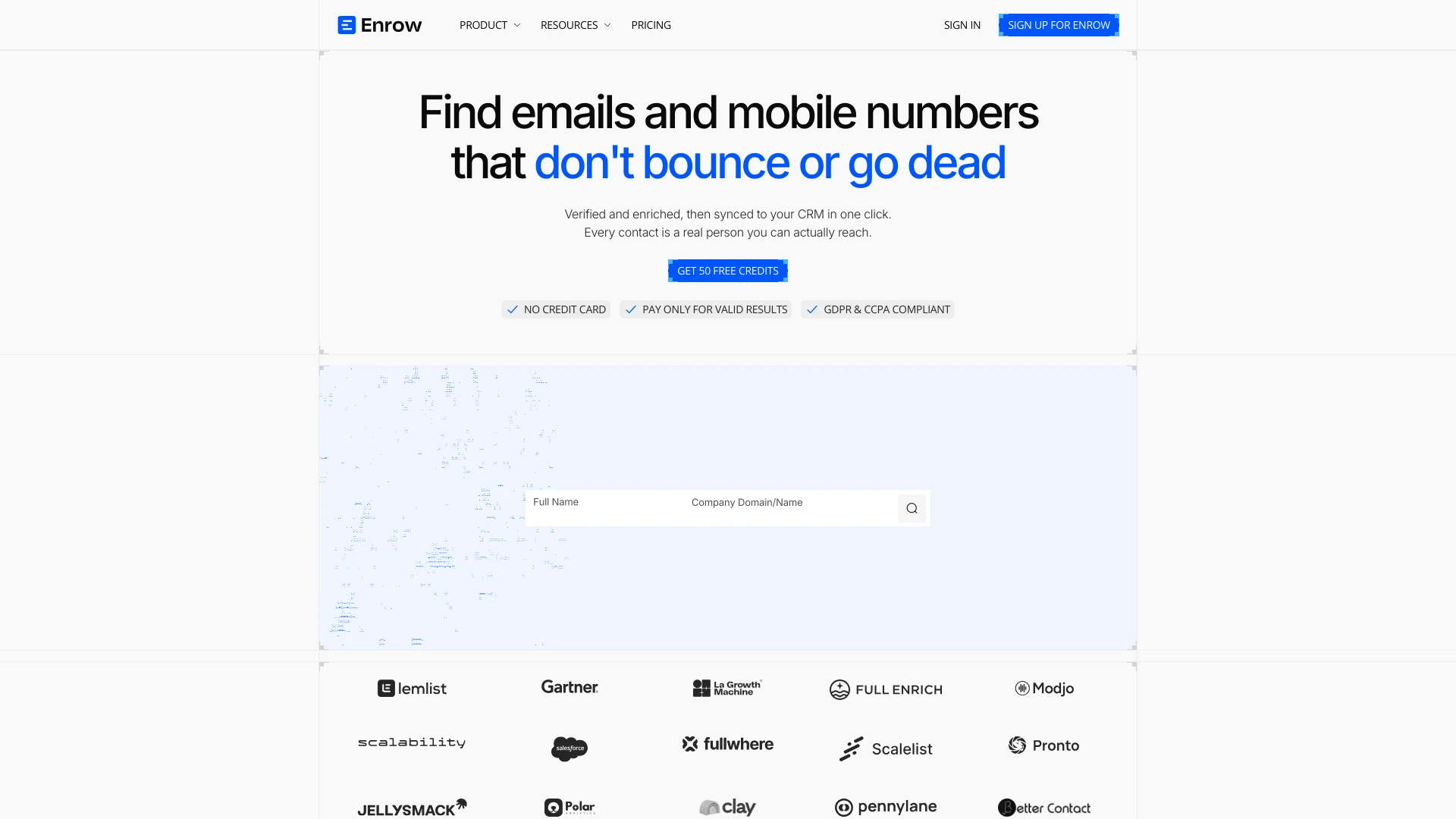
Full disclosure, again: this one's mine. I built it because I was tired of paying stacks and databases to enrich files, finding a fraction, and still eating bounces.
The core difference with Pipecorn is what you're actually buying. A waterfall buys reach across other people's data, marked up and metered at 3 credits an email.
Enrow is the data — found live, from one source, never routed through a chain. Enrow runs its own real-time lookup and charges a single credit only when the address comes back verified and deliverable. A miss is free.
So is an address that fails verification, since it never counts as valid to begin with.
Verification is where the two stop being comparable. Pipecorn leans on each vendor's own checks plus a verifier pass. Enrow runs 10+ checks per address in-house — multiple SMTP passes and catch-all probes from servers in different regions — before a credit moves.
Catch-alls come back verified and usable, not dumped as "risky." On my mixed list, discovery landed around 60-70% and the live send bounced under 1%. Observed on that list, not a contract.
Then phones, where "just add another vendor" turns pricey and geographically thin. Pipecorn's mobiles route through US-leaning providers. Enrow's Direct Phone Finder returns dials in any country, Europe included. No per-vendor markup stacked on the number.
No shrug on a French or German dial.
And the trick nobody else here matches. One click in the Chrome extension turns the LinkedIn or Sales Navigator profile on your screen into the complete verified record inside HubSpot, Salesforce or Pipedrive: email, direct dial, every field. It arrives as a create-or-update, so the contact keeps a single identity — one row, one owner, one position in the lists and scoring rules you already built, rather than a second entry quietly competing with the first.
Pipecorn pushes a contact to your CRM too — the difference is that Enrow drops the whole verified card, phone included, from a profile in one motion. For agent workflows, there's another layer.
There's an official MCP server (repo github.com/EnrowAPI/enrow-mcp), so Claude or Cursor can call the finder and verifier straight from a prompt; the API page has the details.
- +Billed only on valid results; misses cost nothing
- +1 credit = 1 verified email, not 3 — the rate keeps dropping as you scale
- +Direct dials in any country, Europe included
- +10+ verification checks per email; catch-alls verified and delivered
- +A LinkedIn profile becomes a full verified contact inside HubSpot, Salesforce or Pipedrive on a single click
- +Native Clay, HubSpot, Salesforce and Pipedrive integrations, plus a documented API and MCP server
- –It's a single high-signal source, not a 100-vendor aggregator. Chaining every provider on earth into a single call is a waterfall's job by design, not ours. We chose depth over stacking, and the direct match rate is already high — you rarely need the chain, and you keep clean per-valid economics.
- –No database to browse. Stored lists age, and you end up pitching people who already left, so real-time is the fix we chose; list sourcing stays in LinkedIn or Sales Navigator.
- –It won't send your campaigns. Sequencing is a product we refuse to build; Emelia, La Growth Machine or lemlist cover that side.
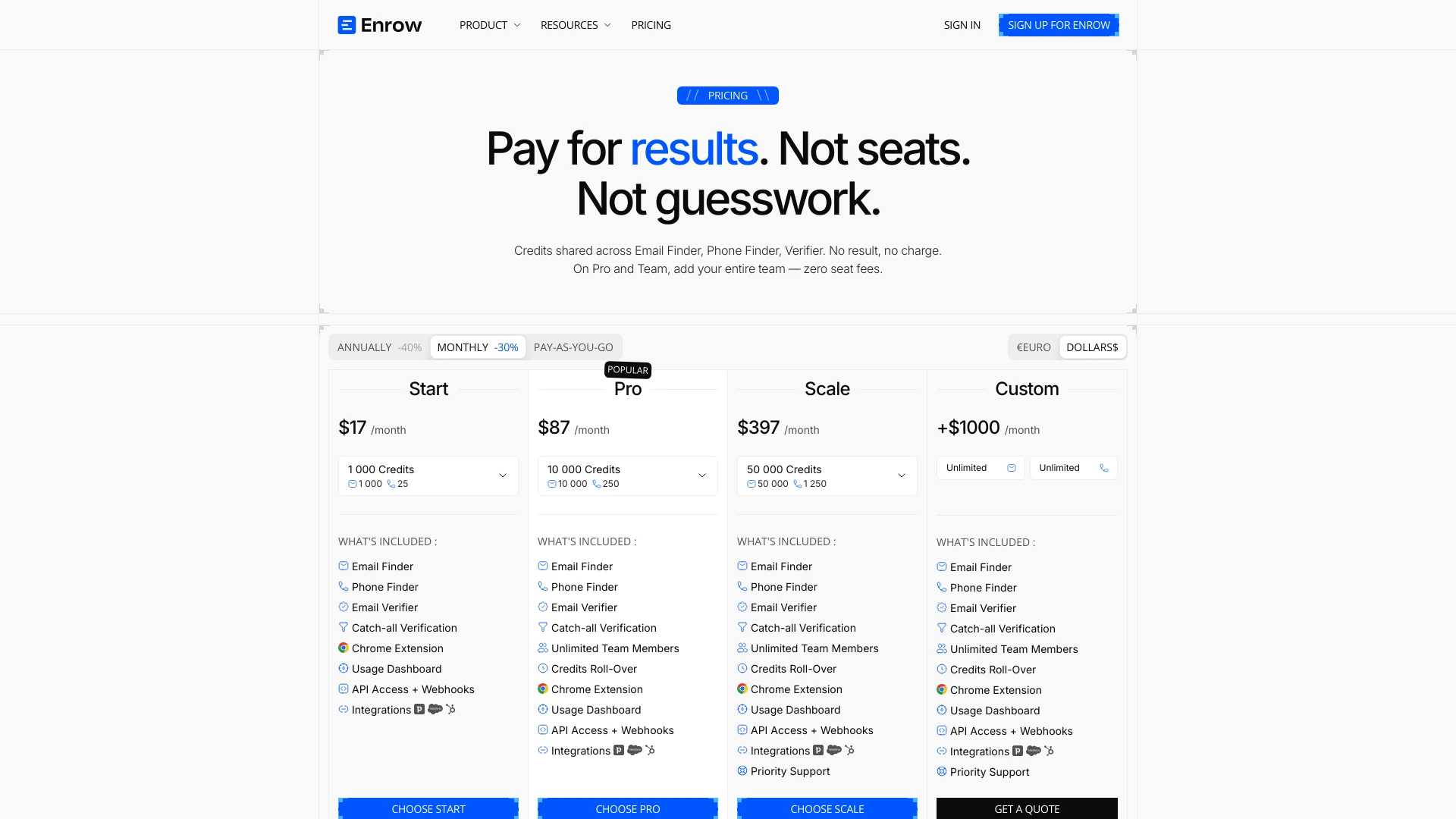
Three tiers, priced monthly. Start: 1,000 credits for $17 or 4,000 for $47 (monthly only). Pro: 10,000 for $87, 20,000 for $167, 30,000 for $247. Scale: 50,000 for $397, 80,000 for $597, 140,000 for $997, 200,000 for $1,397.
Annual trims Pro and Scale about 10%, which puts 10,000 near $78/mo and 50,000 near $357/mo.
One credit buys one email; a phone runs 40 credits; a verification is 0.25, catch-all included. Nothing is charged unless the result is valid, so the cleaner comparison base is Pro: $87 buys 10,000 valid emails or 250 valid phones, about $0.0087 per email or $0.35 per phone.
Start remains the $17 entry tier. Pro and Scale credits roll over.
Skip the entry tier. The argument is volume, and volume is where Pipecorn's meter hurts. A 9,000-email month runs about $78 on Enrow (Pro, 10,000 credits at $87 covers it).
Those same 9,000 emails on Pipecorn come to 27,000 credits — its $399/month tier — because you're paying 3 credits apiece. More than five times the cost for one list, and the gap only widens the higher you climb.
The free tier refills on its own: 50 credits every month, no card, for as long as you want. Since credits only burn on valid results, none of the 50 die on a miss.
Every month, 50 fresh credits land in your account. No card, and they only spend on valid results. Run Enrow against the tool you're leaving.
2. Emelia
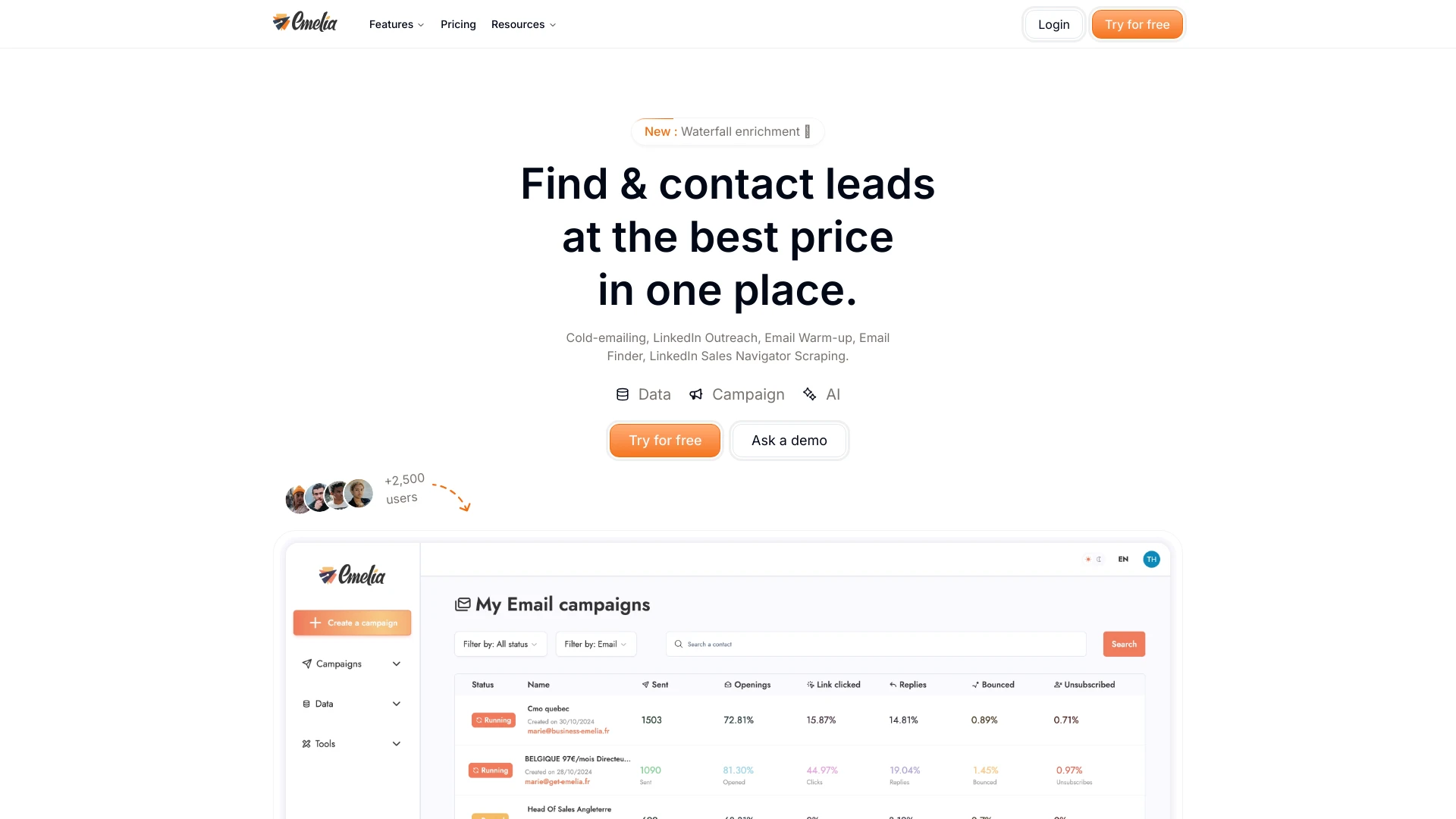
Emelia is a different job. It sends.
It's a sequencer with a finder bolted on: cold email, LinkedIn steps, warm-up, one login. Pipecorn never played in that lane, and neither do we. Emelia is where I point people who ask us for sequencing.
It runs its own waterfall on the finder side too. If you want the stack and the sender together, this is the tidy option.
As a data source it's fine, not the point. Finder credits burn on results found, phone coverage stays thin, and heavier data use lands on add-on credit packs. The setup I actually recommend: Enrow finds and verifies, Emelia sends.
- +Finds and verifies, then sends: cold email, LinkedIn steps and warm-up in one login
- +Finder credits charge on results found, not on searches
- +Waterfall enrichment and Sales Navigator scraping included
- +Unlimited sending and contacts on paid plans
- –Thin phone coverage; not a dialing tool
- –Heavy data use pushes into add-on credit packs
- –Outreach-first, so data depth trails the pure finders
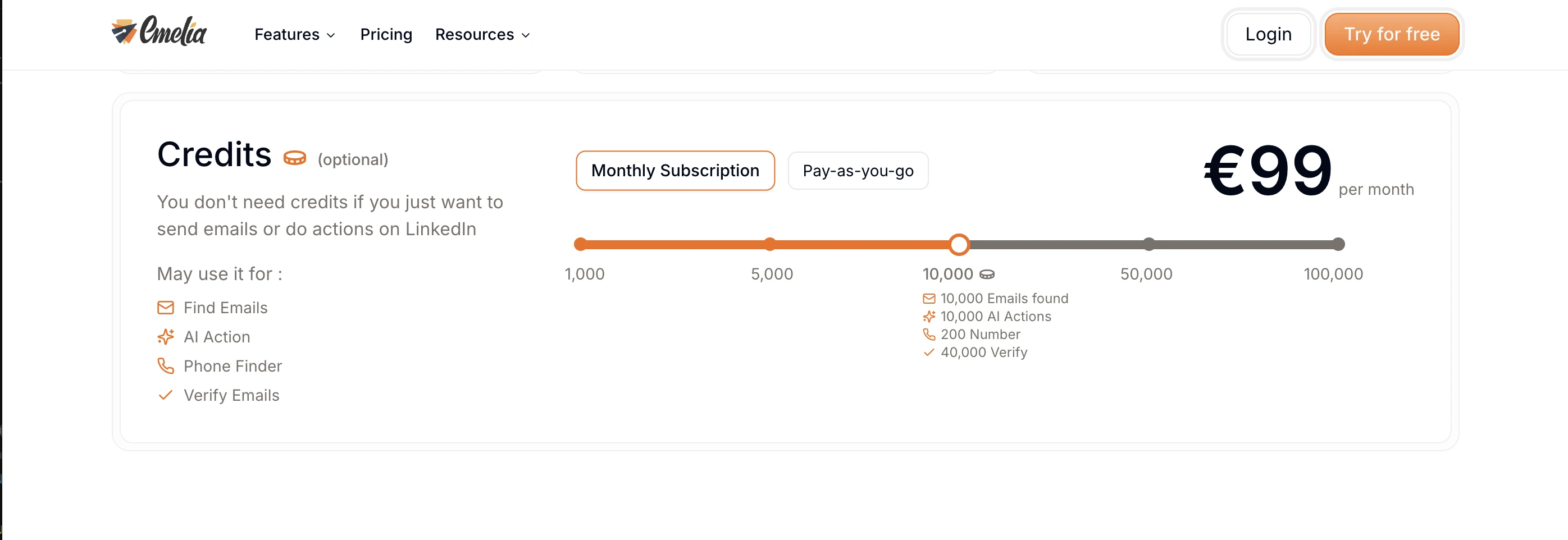
Converted from EUR (+20%): a credits add-on runs about $23/month for 1,000 (1 per email found, 50 per phone), putting a valid email near $0.0228, about 1.3× what Enrow charges for that many contacts.
vs Enrow: different jobs, no contest on data — it's the sender, not the source. Feed it Enrow's verified contacts at $0.017 apiece and both do their best work.
3. FullEnrich
FullEnrich is Pipecorn's closest relative on this list, and that's why it's here.
Same core idea: chain a stack of third-party providers, fire a contact through them one after another, hand back the first verified hit from a single credit pool.
Where Pipecorn advertises 100+ sources, FullEnrich runs 15+, and the pitch is identical — stack enough vendors and you catch contacts a single source misses. On a genuinely obscure target, that reach is real, and our FullEnrich breakdown runs the full comparison.
It also carries every waterfall trade-off Pipecorn does. Which vendor found the number, or how fresh it is, stays out of view. A verified mobile costs 10 credits, a personal email 3, so phone-heavy or personal-email lists drain a plan fast.
And it's an enrichment layer, not a rep-facing product — no one-click full-contact CRM export, no owned EU-phone documentation. It resells coverage. Enrow is one of the sources a chain like this reaches for.
- +Waterfall across 15+ data sources in one call
- +Charged only on a valid, verified result
- +Single shared credit pool with generous rollover
- +Strong on hard-to-find contacts a single source misses
- –No source visibility: you can't tell which vendor found the contact or how stale it is
- –Mobiles 10 credits, personal emails 3 — the meter climbs fast on volume
- –Enrichment layer, not a rep tool; no one-click CRM export, no owned EU-phone documentation

FullEnrich (EUR at dollar parity, per verified result) opens at $29/month for 500 credits — a work email is 1 credit, a personal email 3, a mobile 10. At 1,000 credits a valid work email runs about $0.055, roughly 3.2× Enrow's $0.017, and it barely eases with volume (near $0.035 even at 100,000).
vs Enrow: both bill only on valid, but one resells a stack and the other is the source. Enrow finds the contact directly at $0.0087 at Pro (3-5× under FullEnrich across the board) and returns EU dials the chain has to shop around for.
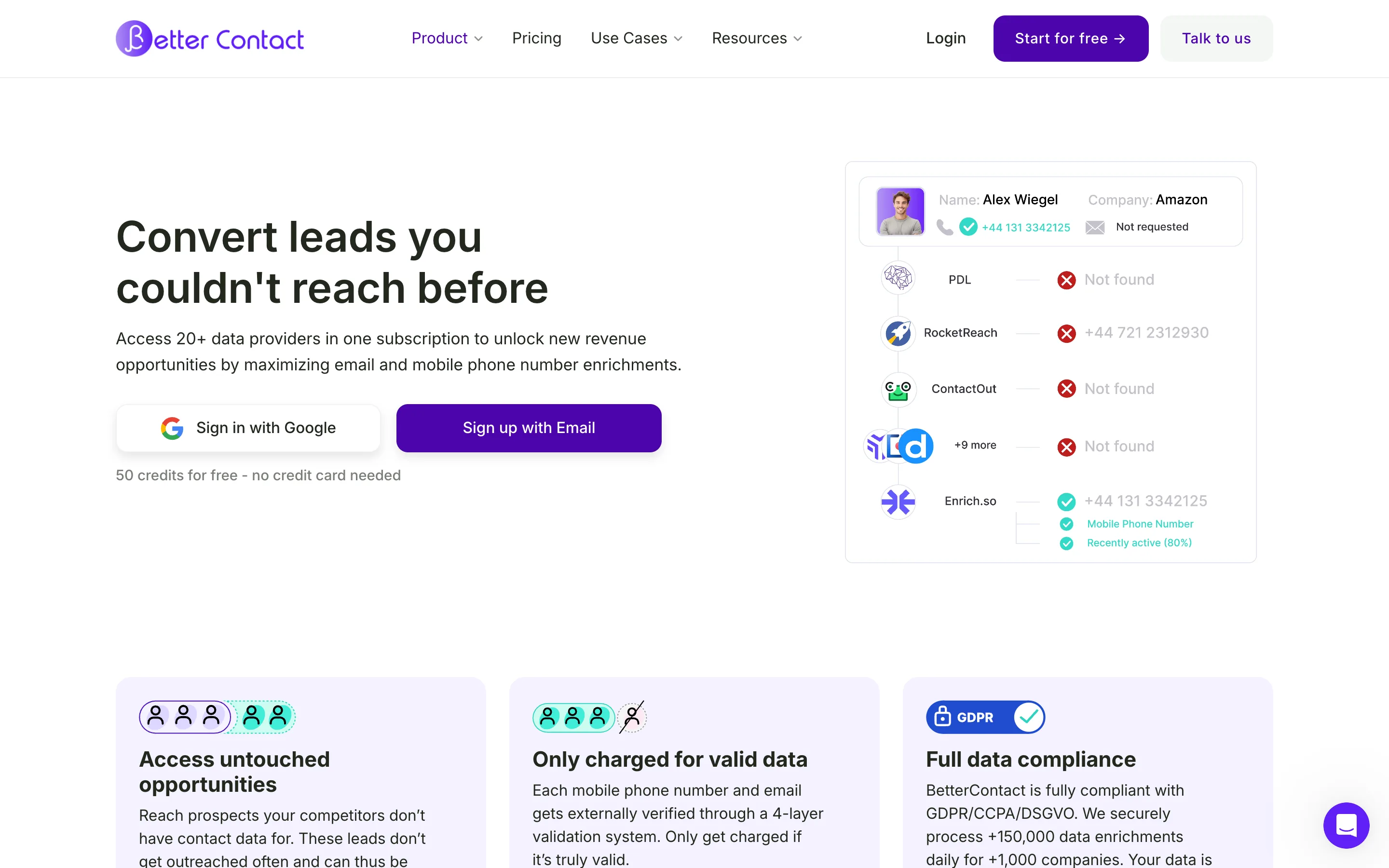
BetterContact is the leaner waterfall, and against Pipecorn it's the flat-rate version of the same bet.
A chain across 20+ providers (RocketReach, Apollo, Prospeo, Hunter and the rest), one credit pool, a credit charged only when a valid result lands. For teams sold on a waterfall but put off by Pipecorn's slider and credit multipliers, BetterContact's flat plans are a simpler front door.
On my list it caught a couple of stubborn contacts a single source missed, which is exactly the job.
But it inherits the same trade-offs Pipecorn has. You still can't see which vendor found the number or how fresh it is. Phones still cost 10 credits. And it's an enrichment layer, not a rep tool: no real UI to live in, no one-click CRM export, no owned EU-phone documentation.
It resells other people's coverage. Enrow is one of the sources a chain like this reaches toward.
- +Waterfall across 20+ data sources in one call
- +Charged only on a valid result; catch-alls not billed
- +Verification (via Bouncer) included in the credit cost
- +Flat-rate plans instead of a credit slider
- –No source visibility: you can't tell which vendor found the contact or how stale it is
- –Mobiles cost 10 credits, so phone-heavy lists drain plans fast
- –API/enrichment layer, not a rep tool; no one-click CRM export, no owned EU-phone documentation

BetterContact opens at $15/month for 200 credits (1 per verified email, 10 per mobile), charged only on a valid find. At its $49/1,000 tier a valid email lands about $0.049, nearly 3× Enrow's $0.017 for that same 1,000-credit tier, waterfall opacity attached.
vs Enrow: same "only pay for valid" honesty, but a reseller stack in place of a source. Enrow finds the contact directly at $0.0087 at Pro, real-time, and returns EU dials the chain has to shop around for.
5. Apollo

Apollo is the answer when someone wants the whole motion in one tab: database, sequences, enrichment, a dialer, one subscription.
Against a pure waterfall, that's a category jump. Pipecorn enriches; Apollo is the cockpit you run outbound from, data sitting inside it. For a small team that wants everything end to end without stitching tools together, the pitch is real.
It runs waterfall enrichment on its own paid tiers now, too.
The bill for that breadth is the data. Apollo is a stored database, so records age, and its reviews circle two gripes on repeat: accuracy and export caps. Mobiles pull 8 credits each from the shared pool.
Getting from a filter to a live sequence in one sitting impressed me — but checking those contacts against a live send is where real-time won.
- +Large B2B database with sequencing and enrichment in one place
- +Chrome extension and CRM integrations
- +Workable free tier (75 credits/seat/month)
- +One tool to source, enrich, dial and send
- –Stored database, so records go stale and accuracy gripes recur in reviews
- –Credits are per seat and expire each cycle; no rollover
- –Export caps bite before the lookups do
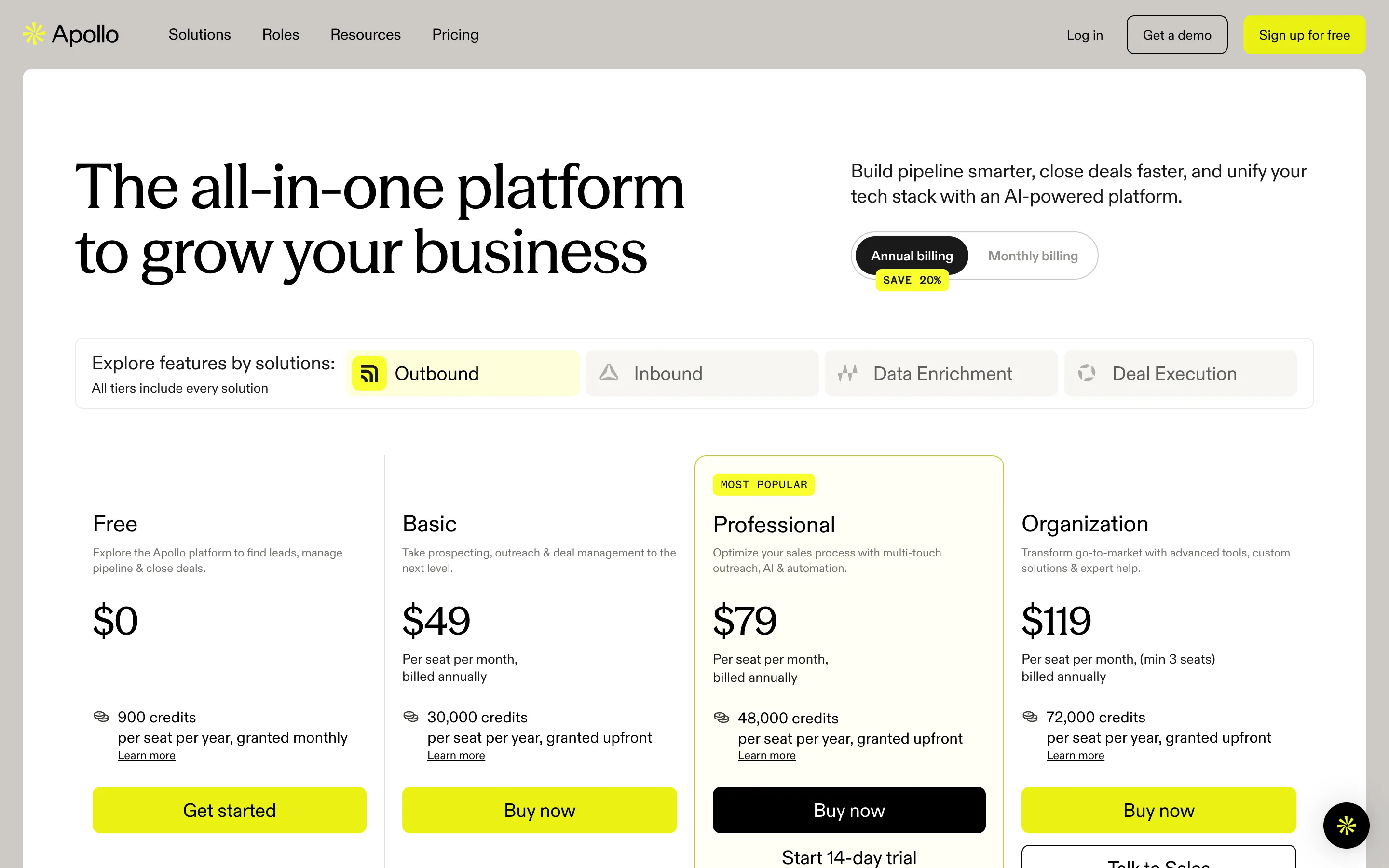
Apollo is per seat: Basic runs $65/seat/mo ($49 annual) for 2,500 credits, one per revealed email, eight per mobile, and credits expire each cycle. That prices a valid email near $0.026, but with no rollover the real rate climbs to about $0.033 — near 2× Enrow's $0.017 — and a five-rep team runs $325/month before an extra lookup.
vs Enrow: buy Apollo for the cockpit if you want one, then let Enrow supply the layer it can't keep fresh. On emails it's real-time against a database that ages; on EU phones it's a verified dial against a stored reveal.
6. LeadMagic

LeadMagic is for people whose "tool" is a pipeline.
It's API-shaped: 15+ enrichment endpoints (email, mobile, company, profile, job changes) drawing on one shared credit pool, plus an MCP server for agent workflows. Credits deduct only on success, which is the right default. Where Pipecorn buries the vendors behind a slider, LeadMagic hands you endpoints to wire up yourself.
It's also not something you hand a rep. No real UI to live in, EU phone coverage is unpublished, and rollover kicks in one tier up. The docs read better than most tools' dashboards — which tells you exactly who it's for.
- +Pay-per-valid: failed matches cost nothing
- +15+ endpoints on one shared credit pool
- +Developer tooling: API, CLI, MCP server
- +Mobile finder included in the same pool
- –No rollover on the entry Basic plan
- –Mobiles cost 5× an email, with no published EU/GDPR phone detail
- –API-first, so non-developers will stall
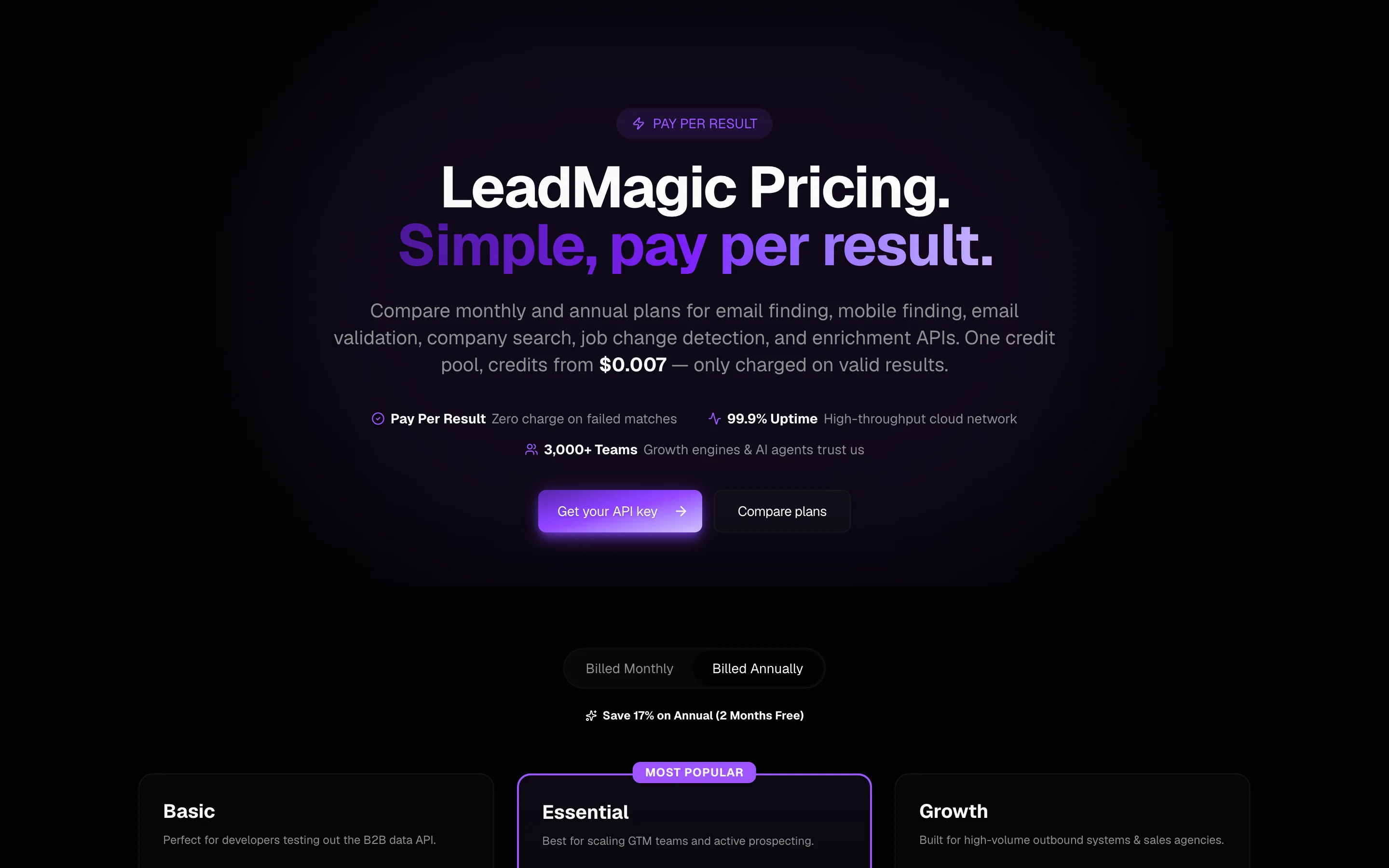
LeadMagic opens at $49/month for 2,000 credits (email 1, mobile 5, validation 0.25), deducted only on success. That's about $0.0245 a valid email, roughly 1.4× Enrow's $0.017, and since Basic doesn't roll over, any credits left at renewal push your real rate higher still. A mobile lands near $0.12, with no published EU coverage.
vs Enrow: two honest meters, two audiences. Enrow matches the API story and then adds everything a rep actually opens: a real UI, the extension, the one-click CRM export.
7. Prospeo

Prospeo's price is its whole pitch. Look past it.
On my list it found about 20% of the contacts. Enrow found 60-70%.
Prospeo only bills for what it returns, so those misses don't burn credits — but they do cost you a finished list: when four in five targets come back empty, you run a second tool to fill the rest.
Which is, ironically, how contacts end up feeding chains like Pipecorn's in the first place.
The rest reads about how you'd expect at the price. Quality wobbles past small jobs, phones cost 10 credits with no documented EU coverage, and pricing is per user.
- +1 credit per found email, 0 on a miss
- +Quick Chrome extension for LinkedIn and domains
- +Verification included in the same credit pool
- +Free plan (100 credits/month)
- –Found about 20% of my test list; most contacts simply don't come back
- –Phones cost 10 credits with no documented EU story
- –Per-user pricing stacks on teams; credits don't roll over
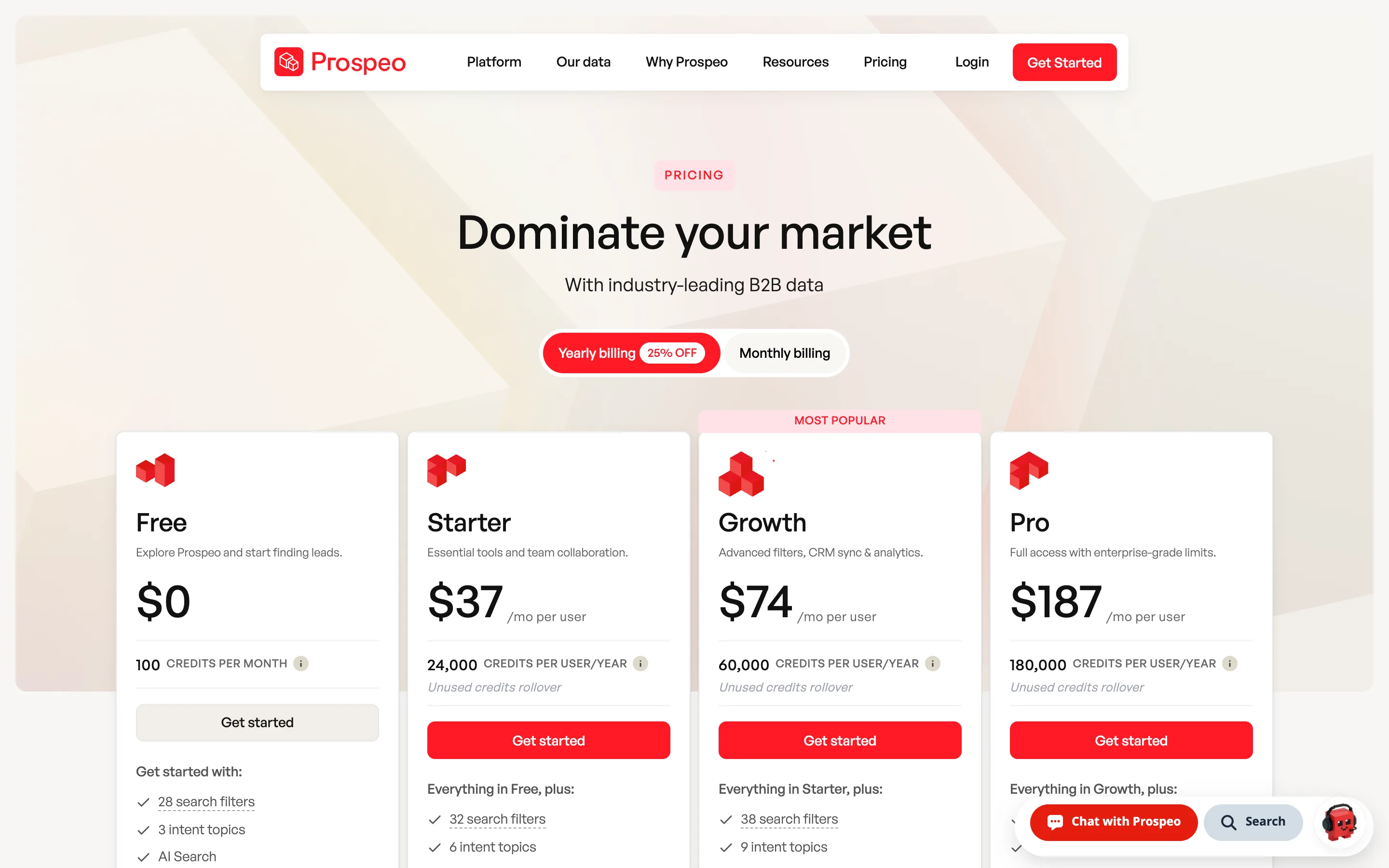
Prospeo opens at $49/month for 2,000 credits per user (mobiles 10 credits, annual about 25% off), billed only on a found result. The Starter sticker reads about $0.0245 per valid email, around 1.4× Enrow's $0.017 — and since it found only ~20% of my list, the misses cost reach, not money: you finish the list on a second tool. Phones work out near $0.245 with nothing documented behind them.
vs Enrow: the sticker already runs above Enrow, and the find rates live on different planets. Enrow's real-time discovery buys you a finished list at $0.017 per valid email, not a fifth of one — the whole reason people bolt waterfalls onto tools like this.
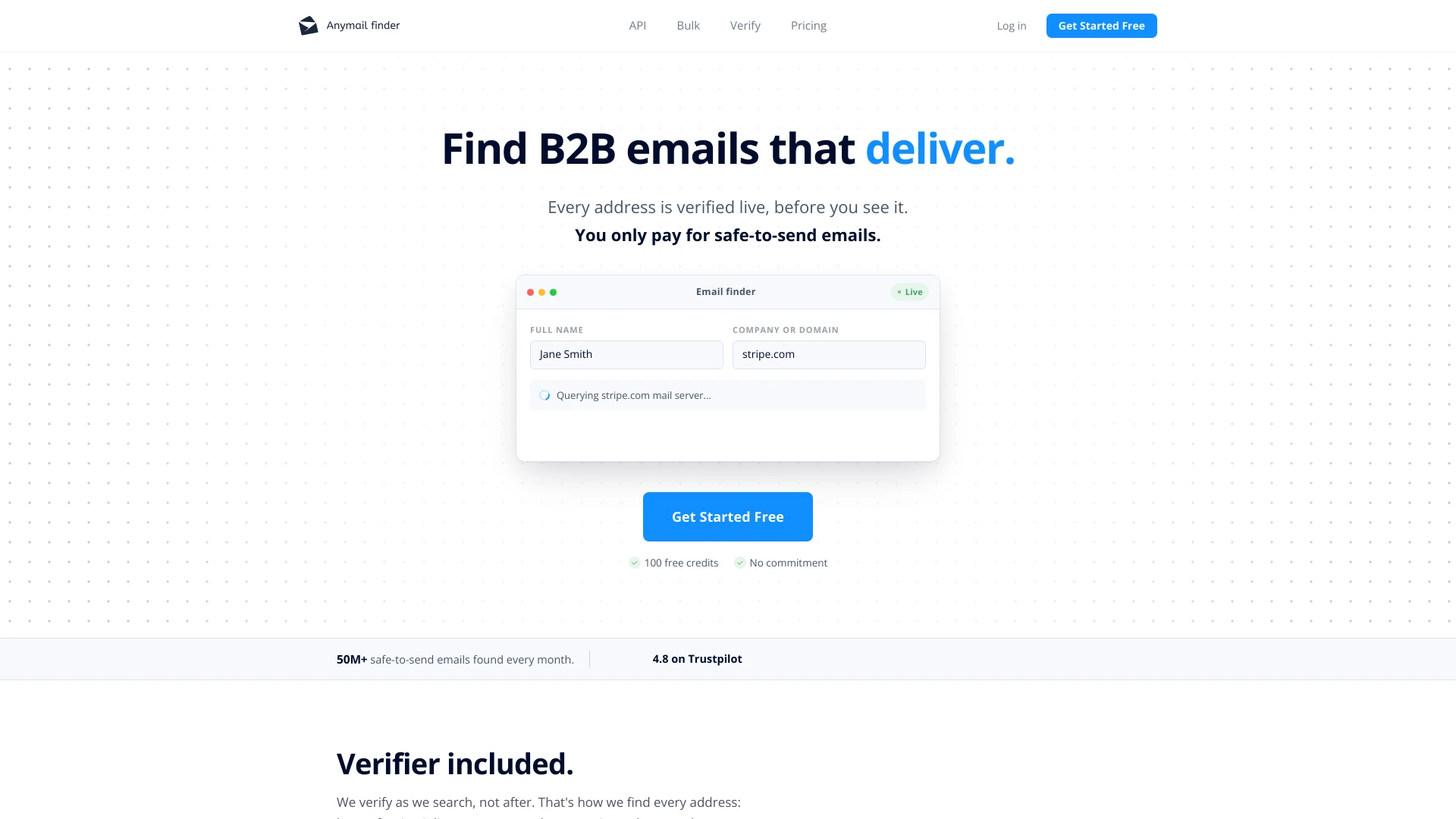
Anymailfinder fixes the credit math and stops there.
Where Pipecorn charges 3 credits an email through a stack, Anymailfinder charges 1 credit for 1 found email, direct, and only when the address passes verification. No phones, no waterfall, no CRM push. Checking an outside address costs less, and unused credits roll over while you stay subscribed.
The meter is honest and the scope fits in one sentence. On a messy list, the unverifiable rows cost me nothing, which kept the bill clean and small.
- +Charged only for emails confirmed valid
- +1 credit = 1 found email, no waterfall multiplier
- +Credits roll over while subscribed
- +Access it however you like: single lookups, bulk lists, or a straight API call
- –Email-only, no phones at all
- –Entry sits at $0.049 per valid email, roughly 3× Enrow's rate
- –No CRM push or contact export to speak of
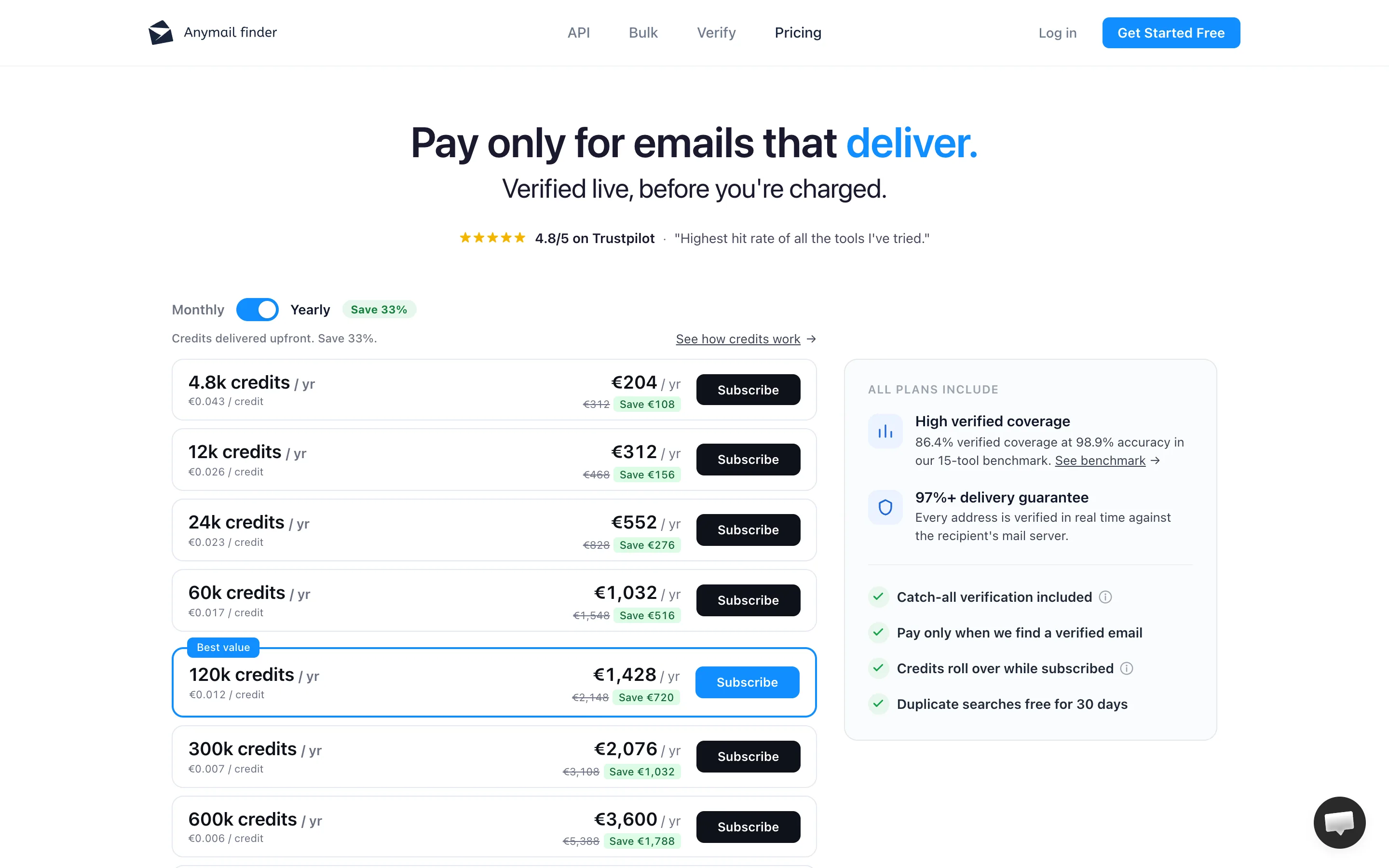
Priced in USD, one credit per found email: Standard opens at $29/month for 400 credits, with annual roughly a third cheaper. Per-found billing keeps the sticker honest, but at the $49/1,000 tier a valid email is about $0.049, roughly 2.9× what Enrow charges for that many emails — direct 1-credit model, entry rate still well above Enrow's.
vs Enrow: same billing philosophy, no waterfall markup, but half the product and roughly triple the entry rate per valid email. Match the volume and Enrow undercuts it, then throws in the phones and one-click CRM export Anymailfinder never set out to build.
9. Findymail
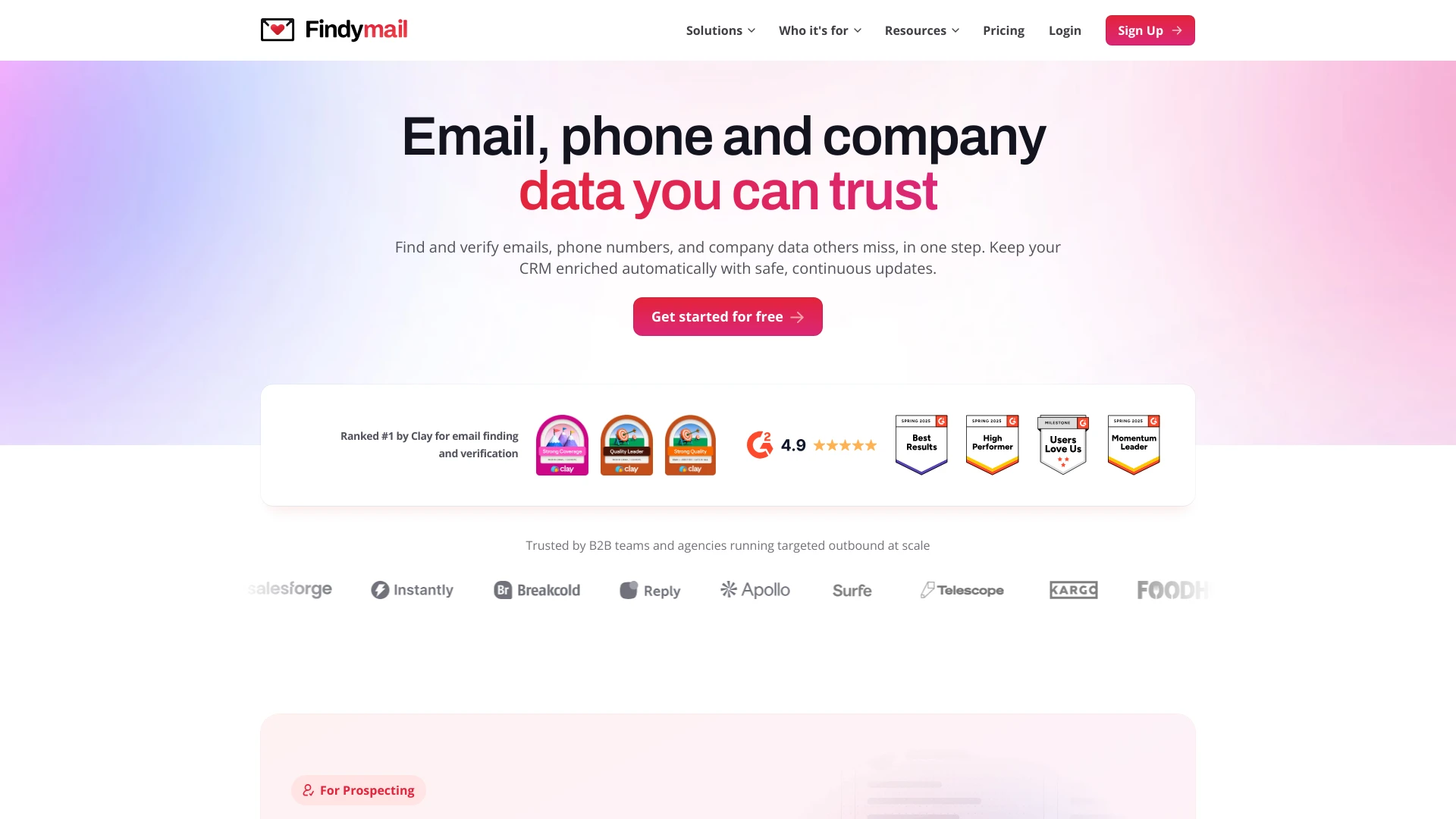
I'll give Findymail its due: it's a real email finder, and on US addresses it performs.
It also bills the way a finder should — the same way a waterfall's own vendors get measured: charged on the found, verified result, zero on a miss.
Point it at a domain list or a LinkedIn export and what comes back tends to survive a live send. We go deeper on the matchup in our Findymail breakdown.
Two ceilings hold it back: geography and the floor price. GDPR closed EU phones to Findymail, so for European calling it's a spectator, and its phone numbers cover the US only.
The plan floor is $49/month for 1,000 credits, unused credits carry over only to 2× your monthly allowance, and there's no meaningful free plan — just 10 trial credits. On my list its US addresses held up. The French half came back email-only.
- +Charged on found, verified results, so a miss costs nothing
- +Strong US B2B email accuracy
- +SOC 2 Type 2, GDPR-compliant, EU-hosted
- +Native HubSpot, Salesforce, Pipedrive, Instantly and lemlist integrations
- –No EU phone data (GDPR-blocked); phone numbers cover the US only
- –Rollover caps at 2× the monthly allowance
- –No meaningful free plan; the floor is $49/month
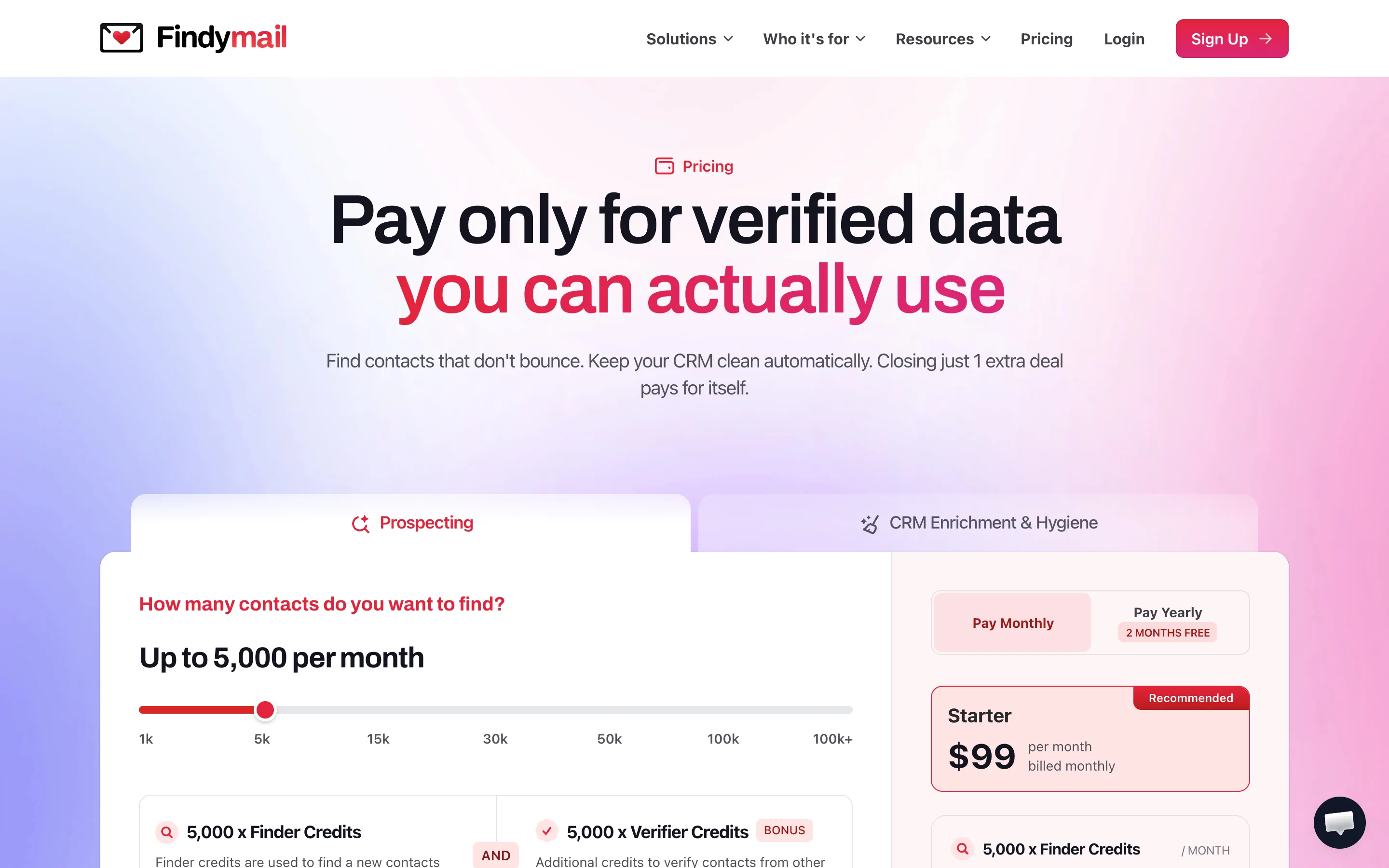
Findymail is a single Starter slider opening at $49/month for 1,000 finder credits, annual about two months free, phones 10 credits, rollover capped at 2×. The per-valid model keeps this honest, though the $49 entry is about $0.049 per valid email — nearly 3× Enrow's $0.017 for an equivalent batch, one credit an email against Pipecorn's three. Phones price near $0.20 on paper, except the paper skips Europe entirely.
vs Enrow: same honest meter, narrower map, higher rate. Enrow opens at $17 rather than $49, prices a valid email at $0.017 against Findymail's $0.049 at the same entry volume, and returns the EU direct dials Findymail legally can't.
10. Dropcontact
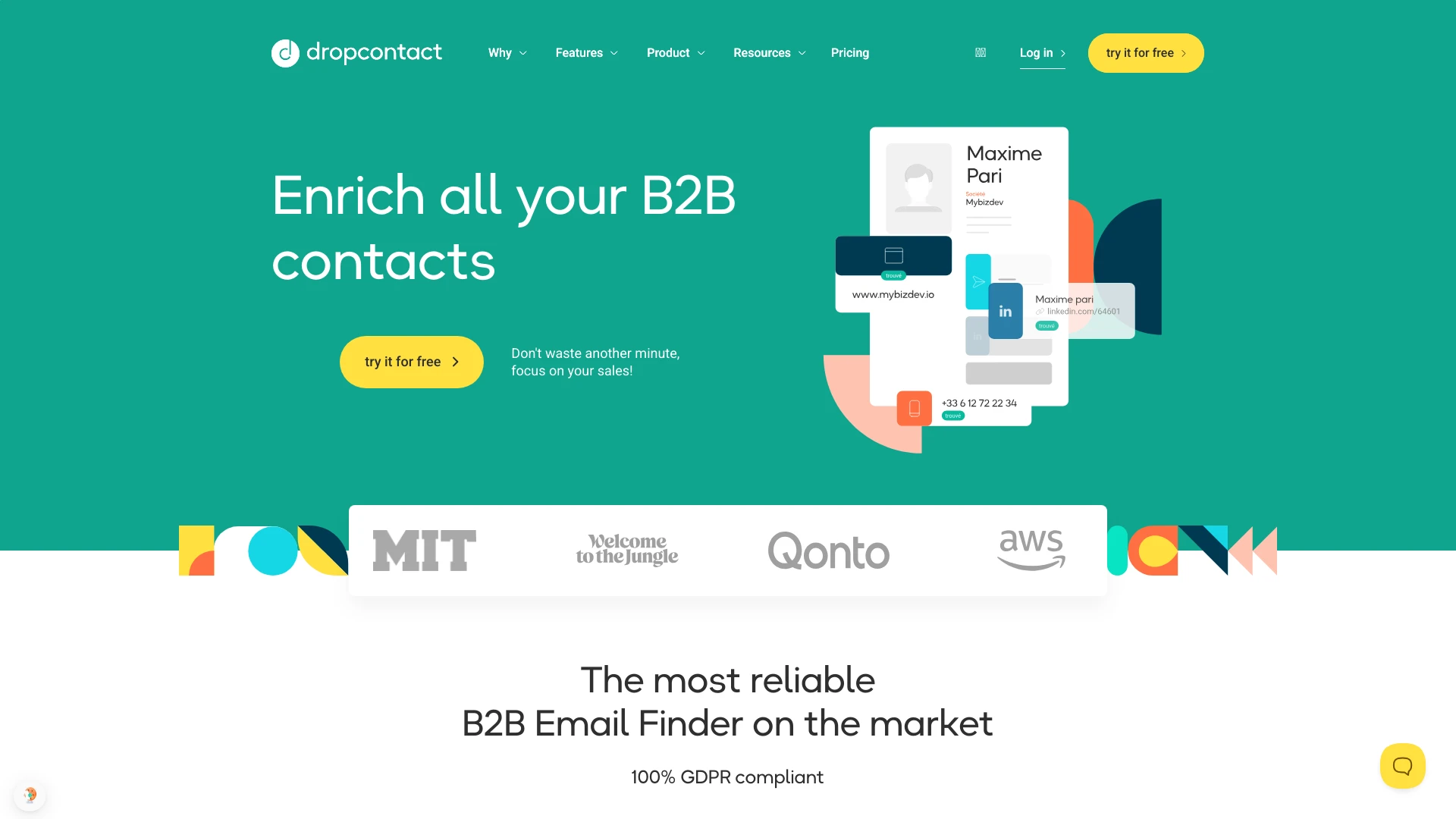
Dropcontact is the pick your DPO would make.
Everything runs under GDPR on EU servers, the data is computed fresh rather than pulled off a resold list, and it carries French firmographics (SIREN, VAT) most tools skip. On emails it works pay-on-success: an address it can't find gets the credit reimbursed.
For cleaning a French or European CRM, it's a fair specialist, and our Dropcontact page runs the full comparison.
But read the job description. Dropcontact enriches rows you already have; hunting a contact from scratch, the way a finder or a waterfall does, isn't what it's built for. Phones only surface when one can be scraped from an email signature, so there's no direct-dial product behind the promise.
It cleaned my French rows nicely and turned up two phone numbers across a hundred contacts.
- +GDPR-first: EU servers, compliant by design
- +Pay-on-success on emails; unfound addresses are reimbursed
- +French firmographics (SIREN, VAT) built in
- +CRM-native enrichment for HubSpot, Pipedrive, Salesforce, Zoho
- –Enriches existing rows; not a real-time finder for new contacts
- –Phones come only from signature scraping, no direct-dial product
- –The €19 Starter's 500 credits don't roll over; carry-over costs €29 for the same 500
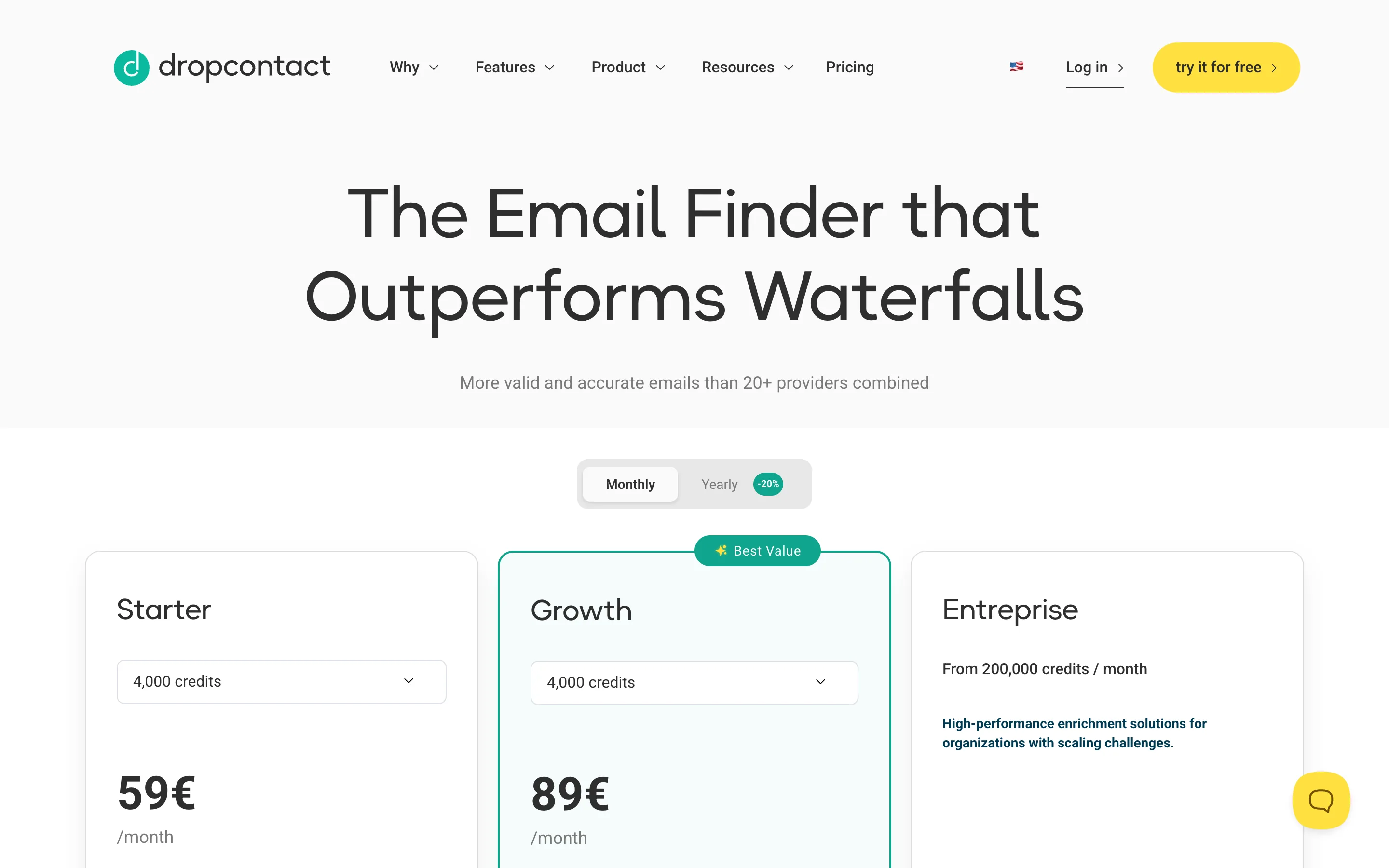
Dropcontact opens at €19/month for 500 credits with no rollover, or €29 with rollover, billing one credit per found contact and reimbursing misses. That puts the entry math near €0.038 per email on the €19 Starter — about 2.5 times Enrow's €0.015 Start rate in euros, both monthly, neither one rolling over. No per-phone figure to quote, since there's no real phone product.
vs Enrow: enrichment versus finding. Dropcontact completes rows you already own; Enrow finds and verifies new contacts in real time at €0.015 per valid email on Start, in euros, against Dropcontact's ~€0.038 at entry (about 2.5× on monthly plans), and returns EU direct dials instead of signature scraps.
Every month, 50 fresh credits land in your account. No card, and they only spend on valid results. Run Enrow against the tool you're leaving.
Side-by-side comparison
Final Verdict
Pipecorn's hundred-vendor waterfall earns its keep on genuinely obscure targets. But you pay in opacity — whose data, how fresh, you never learn — its phones lean on US-focused vendors, and at 3 credits an email the per-valid cost runs roughly 5× a direct source at the volumes a scaling team buys. So for the data layer underneath, Enrow wins this page: verified emails and EU direct dials, found in real time, from $17/month, one credit an email, charged only when the result is real. And the thing no rival here matches — one click turns a LinkedIn profile into a complete verified contact, phone included, already in your CRM. It won't aggregate a hundred vendors or send your campaigns — that's deliberate, and with a high direct match rate it has no need to. Take the 50 free credits you get back every month and let your own list decide.
Every month, 50 fresh credits land in your account. No card, and they only spend on valid results. Run Enrow against the tool you're leaving.
FAQ
How we evaluated these tools
Nobody paid for a slot here — no affiliate links, no sponsored placements, and the top spot wasn't for sale. I ran the test myself: pushed the same contact list through every tool inside one week, then fired the results at a live inbox to see what actually bounced. Four things set the order — how many contacts came back, how many died on the send, what a valid contact costs once the junk is priced in, and whether the tool can hand you legally-sourced EU phone numbers. Competitor prices come off official pricing pages I read on 2026-07-06.
bereit, keine zeit mehr zu verschwenden?
Verbunden in Minuten.
Verifizierte Daten in Sekunden.
keine Kreditkarte
kein Setup nötig