cognism alternatives
Top 9 Cognism Alternatives & Competitors in 2026
So I tested the nine alternatives below, with Cognism itself run alongside as the baseline. The yardsticks are the ones that actually decide a dialing budget: phone match rate, connect accuracy on live dials, real cost per valid phone rather than per credit, and legally-sourced EU coverage.
10 tools tested
updated August 3, 2026
14 min read
Aktualisiert am 3. August 2026
The alternatives at a glance
Enrow is the best overall Cognism alternative for teams that want GDPR-cleared direct dials in any country, found fresh and billed only on a valid number, from $17/month, about $0.35 per valid phone on Pro ($87 for 10,000 credits = 250 phones), with Start as the $17 entry tier. The enterprise package — a browsable database of millions, intent data, five bundled seats — is a different job, and it's the one Cognism itself is built around. Lusha and Kaspr sell self-serve reveals off stored databases; Apollo bundles a sequencer; ContactOut and Wiza work off LinkedIn. Each owns a niche. None matches fresh, valid, EU-legal direct dials at Enrow's price.
Cognism sells phone-verified "Diamond Data" mobiles on quote-only annual contracts — third-party estimates run roughly $1,500 to $25,000+ a year, per-seat fees on top. Strong data, enterprise door. The best Cognism alternative for most teams is Enrow: GDPR-cleared direct dials in any country, found and verified in real time, billed only when the number is valid, from $17/month, about $0.35 per valid phone on Pro. And Enrow's Chrome extension does the one thing nothing else here can: a single click on a LinkedIn or Sales Navigator profile files the entire verified record, direct dial included, into HubSpot, Salesforce or Pipedrive. Enrow is #1. The nine tools below each hold one narrow niche, nothing more.
Why teams look for Cognism alternatives
Cognism is strong at what it does, so most people leave for reasons of cost and model, not quality. If your budget clears the five-figure enterprise range and you want a browsable database with intent signals baked in, Cognism fits. If you want fresh, valid direct dials without the contract, keep reading.
Conflict of interest disclosure
Up front, the obvious: I founded Enrow, Enrow sells phone and email data, and I've ranked it first in an article about phone data. You'd be right to squint. Squint, then check the math yourself.
Several tools below do things Enrow never will. Cognism, Lusha, Apollo and RocketReach ship huge browsable datasets you can filter and prospect from cold; Enrow has no database to browse.
It doesn't send outreach sequences either — pair it with Emelia, La Growth Machine or lemlist for that — and it carries no intent data or technographics. We chose that narrowness on purpose.
Finding one number live and verifying it before it counts beats reselling a stored row and hoping it still rings.
So the claim I'll defend is narrow too: on fresh, verified email and phone data, EU direct dials included, Enrow is the strongest tool on this page. For a database, sequences or a full suite, one of the tools below covers it. For dials that connect, keep reading.
That single focus is the point.
The 9 best Cognism alternatives
1. Enrow
#1
I built Enrow after one too many months of paying credits for revealed mobiles that belonged to somebody's previous job.
The split with Cognism starts with the model. Cognism is a stored database you reveal from; Enrow is a real-time finder that goes and gets the number when you ask, then verifies it before it counts. That matters most on phones.
A database mobile was true at some refresh months back. Enrow's is sourced and checked on the spot. And we're not blocked by GDPR on European numbers: we cover EU direct dials, which is the exact ground Cognism competes on.
So this isn't Enrow ducking the compliance fight. We're in it.
Then the billing. Cognism charges a credit to reveal a contact whether or not that mobile still connects. Enrow charges 40 credits per phone, and only when it returns a valid number. No number, no charge.
On emails it's 1 credit each, again only on a valid result, with 10+ verification checks behind every address — multiple SMTP passes, catch-all checks across servers in different regions. Bounce sat under 1% on my live send, which is an observed average, not a contract I'll pretend to guarantee.
There's also what happens once the number is found. Enrow's Chrome extension sits on the LinkedIn or Sales Navigator profile and, on a single click, sends the whole verified record into HubSpot, Salesforce or Pipedrive: name, company, email, direct dial, every field. It sends it as a create-or-update. Half the time the person is already in your CRM and the only thing missing was a mobile that rings, so the dial lands on the contact who is already there instead of opening a second one under the same name.
Cognism's extension surfaces rows from its database; it won't hand your CRM a finished, freshly verified contact card. On my run that was the difference between assembling a call list by hand and finding one waiting in Salesforce.
One more, for the AI-agent crowd. Enrow ships an official MCP server and API (the repo is github.com/EnrowAPI/enrow-mcp), so you can call the email finder, verifier and direct-phone finder straight from Claude, Cursor or Windsurf. Fresh, verified numbers pulled into an agent workflow, still pay-per-valid.
Cognism has an API; it doesn't have this.
- +GDPR-cleared direct dials in any country, found and verified in real time
- +Pay only for a valid phone: 40 credits per number, charged solely on a hit — a miss never costs you
- +10+ verification checks per email; catch-all verified and delivered, not dropped
- +Native CRM integrations: Clay, HubSpot, Salesforce, Pipedrive, plus webhooks and a genuinely good API
- +Chrome extension pushes the whole verified record, direct dial included, from LinkedIn or Sales Navigator into the CRM in a single click — nothing else ranked here does that
- +No per-seat fees; up to 10 team members on Pro and unlimited on Scale; credits roll over on Pro and Scale
- –No database to search. That's the design: a stored row starts drifting out of date the day it's written, so Enrow looks each contact up live instead — which is exactly why its numbers connect more often. Source your lists in LinkedIn or Sales Navigator; Cognism and Lusha are the ones selling the big browsable set.
- –No sequences, ever. Enrow stops at the data. For sending, use Emelia first, then La Growth Machine, then lemlist.
- –No intent data, no technographics. Company info is LinkedIn-level; tech stacks and buying signals are Cognism's department.
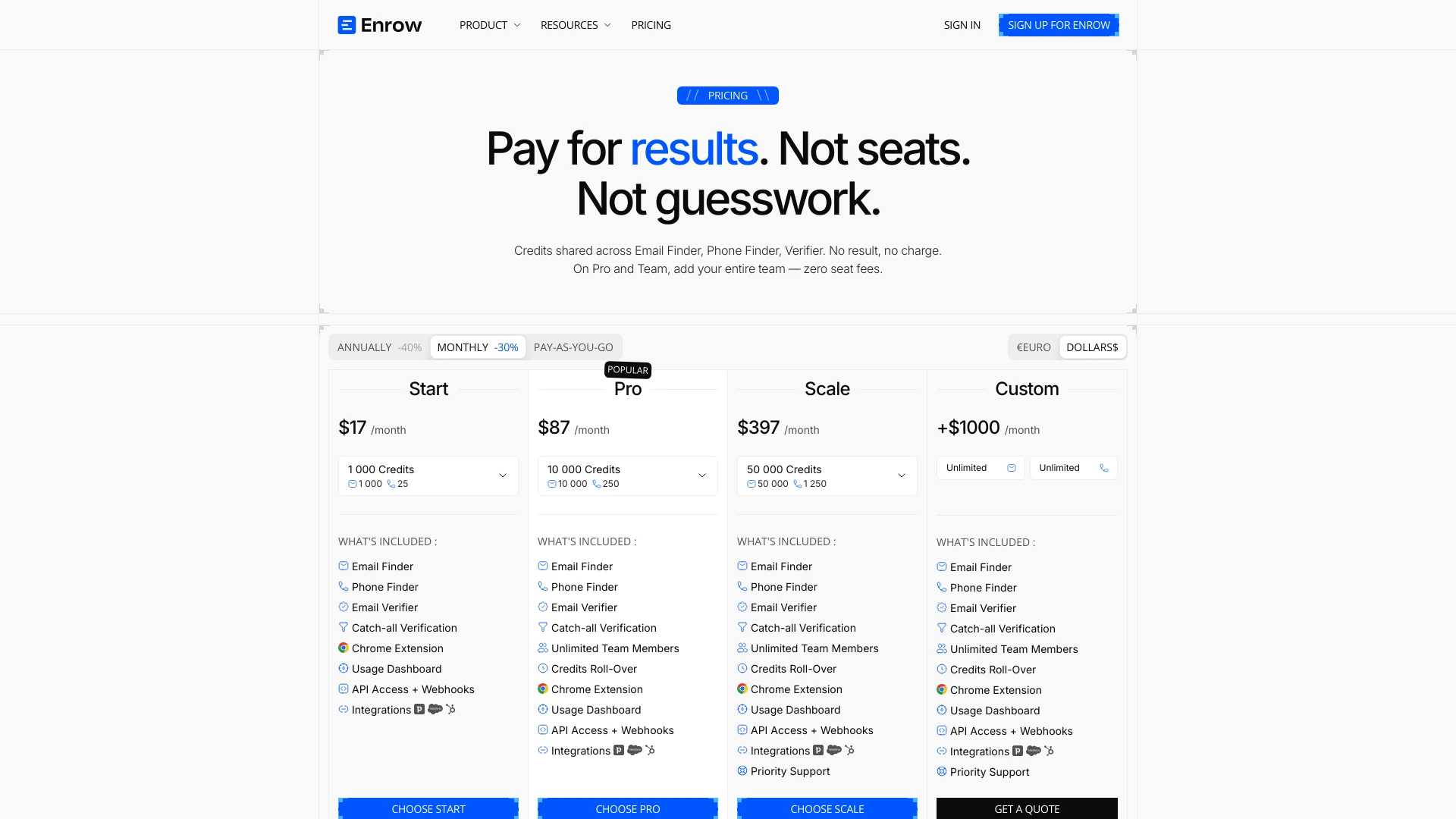
Subscription in three tiers. Start from $17/mo (1,000 credits, monthly only) and $47 for 4,000. Pro from $87/mo (10,000 credits), $167 for 20,000, $247 for 30,000. Scale from $397/mo (50,000 credits) up to $1,397 for 200,000.
Annual billing knocks roughly 10% off Pro and Scale — 10,000 credits land near $78/mo, 50,000 near $357/mo. The credit math: 1 email = 1 credit, 1 phone = 40 credits, verification 0.25, catch-all included, and you're charged only on a valid result.
A 1,000-credit month covers 1,000 emails or 25 phones; 10,000 covers 250 phones. Pro and Scale roll unused credits over. The free tier is 50 credits every month — recurring, not a one-time trial — no card required.
Because a credit only spends on a valid result, the sticker is the real cost. Enrow takes neither of the two penalties every other billing model on this page quietly charges. A miss costs nothing — search a prospect we can't find and no credit leaves your balance.
An address that fails the checks doesn't touch your balance either. And credits roll over on Pro and Scale, so a quiet August doesn't burn what you paid for in July. The cleaner comparison base is Pro: $87 for 10,000 credits, meaning 10,000 valid emails at about $0.0087 each or 250 valid phones at about $0.35 each.
Scale drops further, and Start remains the smaller $17 entry tier. Hold the Pro phone number, because every tool below either charges for the attempt (RocketReach), bills per reveal off a stored database (so a chunk of what you pay for won't connect), or gates mobiles behind an enterprise contract.
That's where the gap opens.
Don't take a founder's word on his own tool. Load your call list into Enrow and count the valid dials yourself — the free tier gives you 50 credits every month, recurring, no card.
2. Cognism
The tool this article is measured against, so here it is on its own terms.
Cognism is a true enterprise platform. A large, globally-sourced contact and company database, an email finder and verifier, intent data through Bombora, and its signature: Diamond Data, mobiles it phone-verifies by actually calling to confirm the right person picks up.
On the numbers that carry the Diamond flag, connect rates are strong. User reviews commonly put them well above a standard database (a rough 2–3x is the figure reviewers cite, not a controlled benchmark), and the GDPR/DNC compliance work is real and well-documented.
Money and model are where it breaks down. Cognism sells nothing but quote-only annual contracts.
Third-party procurement data (Vendr and published breakdowns) puts real deals from roughly $1,500 to $25,000+ a year depending on tier and seats, with Pro (where the better mobile verification and intent live) at the top of that range, plus per-seat licensing.
Treat those as third-party estimates, not list prices. There's no monthly option and no free plan.
And here's the nuance that decides everything on phones: only the Diamond subset is phone-verified. The rest is standard database reveal, and a standard reveal is a snapshot that keeps ageing after it's taken.
A mobile true at the last refresh may be dead now, but revealing it still costs a credit. On-demand verification exists on Pro, but that's a workflow, not a guarantee across the whole set.
Fair play to Cognism on the thing it's famous for: when a mobile is Diamond-verified, it connects, and the compliance paperwork is airtight. Then I priced it against a self-serve budget.
Enrow finds each direct dial fresh, verifies it before it counts, and charges 40 credits only on a valid number. No five-figure floor, no per-seat math, no annual lock-in.
A browsable database with intent signals is Cognism's own turf — a different purchase for a different job. Fresh, valid direct dials without the contract are the whole reason this list exists.
- +Large, well-sourced global B2B database with strong EU coverage
- +Diamond Data: phone-verified mobiles with high connect rates on the verified subset
- +Solid GDPR, CCPA and DNC compliance, well documented
- +Intent data (Bombora), CRM enrichment and a real API
- –Enterprise-only: annual contract, quote-based (third-party estimates put real deals ~$1,500–$25,000+/yr), plus per-seat licensing; no monthly, no free plan
- –Only the Diamond subset is phone-verified; standard reveals are stored rows that age and may not connect
- –You pay a credit to reveal whether or not the mobile still works (not billed per valid dial)
- –No self-serve entry for small teams
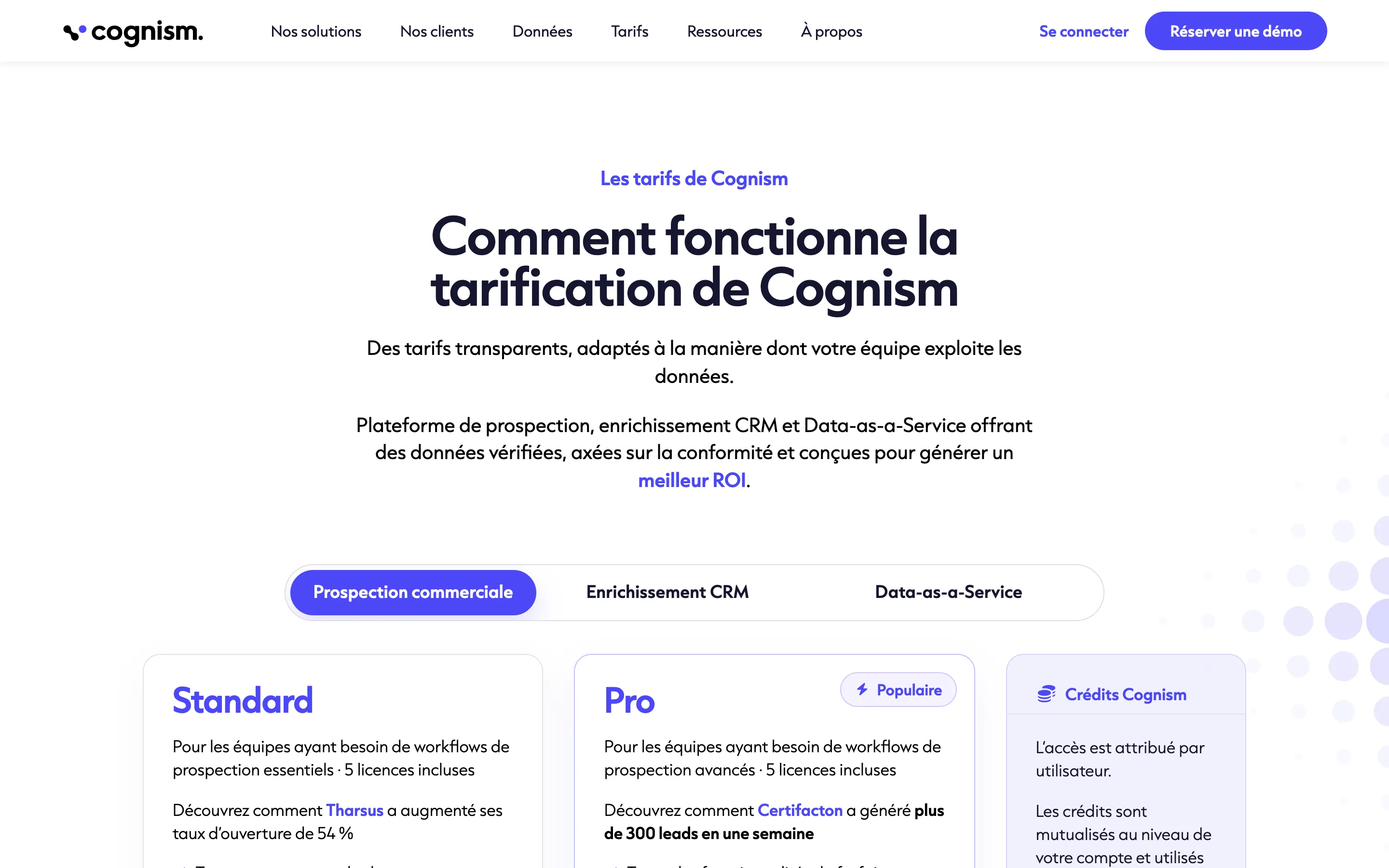
Cognism pricing. Quote-only, no public numbers. Two tiers, Standard and Pro, both annual with five seats bundled. Every dollar figure here is a third-party estimate, not an official list price, so verify against your own quote.
Procurement marketplaces (Vendr) and published breakdowns describe real deals from roughly $1,500 to $25,000+ a year, commonly framed as a flat platform fee (often cited around $15,000 on Standard) plus roughly $1,500 per user, with Pro-tier and Diamond-heavy contracts at the top of that range and larger multi-seat deals reported higher still.
The credit model is 1 credit = 1 contact revealed; a credit isn't re-charged unless the contact changes jobs.
On real cost per valid phone, the honest read is: it depends entirely on your contract and how many of your reveals are Diamond-verified versus standard.
Take a mid-five-figure contract and even a generous few thousand mobile reveals a year, and you're paying several dollars per revealed mobile before you account for the standard-reveal rows that don't connect.
Assume the non-Diamond mix connects at a rough 50–70% and the real cost per valid dial climbs further. The Diamond subset connects well; the rest is stored-database data with the usual accuracy decay.
vs Enrow: different weight class on price. Enrow's $0.35 Pro benchmark per valid phone is charged only on a hit, with no five-figure floor, no seats, no annual lock-in, and EU numbers cleared the same way. Cognism gives you the browsable database, intent data and a phone-verified subset Enrow doesn't. Enrow gives you fresh, valid direct dials at a fraction of the entry cost, plus one-click full-contact CRM export. If you're a team of five dialing EU prospects, the math isn't close.
3. Lusha
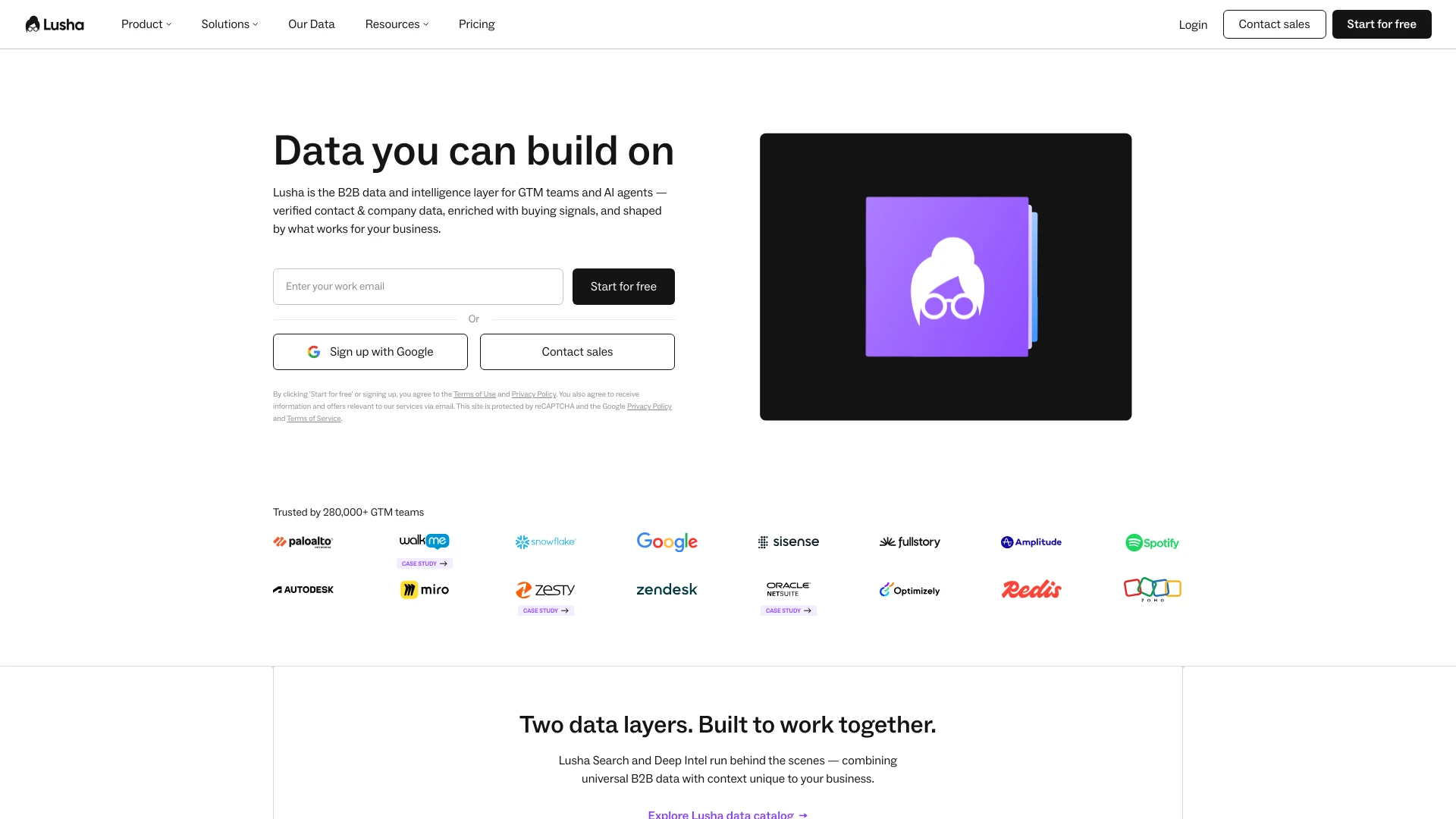
Mobiles today, on a card, no sales call. That's Lusha's whole offer.
Lusha is the self-serve answer to Cognism. A big contact database, a slick Chrome extension, and monthly plans you buy without talking to anyone. Where Cognism gates its mobiles behind an enterprise contract, Lusha lets a rep start revealing today.
It exists for exactly that buyer: individuals and small teams who want low-friction mobile and email reveals without a procurement cycle.
Model and credit math are the catch. Lusha is a stored database, so mobiles age like any other, and reviewers tend to report European accuracy as patchier than the US (a qualitative pattern from user reviews, not a measured figure).
The credit system is asymmetric: 1 credit per email but 5 credits per phone, so a phone-heavy month burns through an allowance fast. And you pay to reveal whether or not that number still connects.
What stood out on my run: the extension is quick, and for US contacts the hit rate was fine. Then I dialed the EU numbers and a real share went nowhere.
Enrow sources each EU dial at request time, and the charge lands only if the number is valid: no 5-credit tax on a number that fails verification.
- +Fast, self-serve; buy on a card, no sales call
- +Popular, easy Chrome extension
- +Decent US contact coverage
- +Free plan (40 credits/month)
- –Stored database; mobiles age, and reviewers report EU accuracy patchier than US
- –Asymmetric credits: 5 per phone vs 1 per email — phones get expensive
- –You pay to reveal even when the number doesn't connect
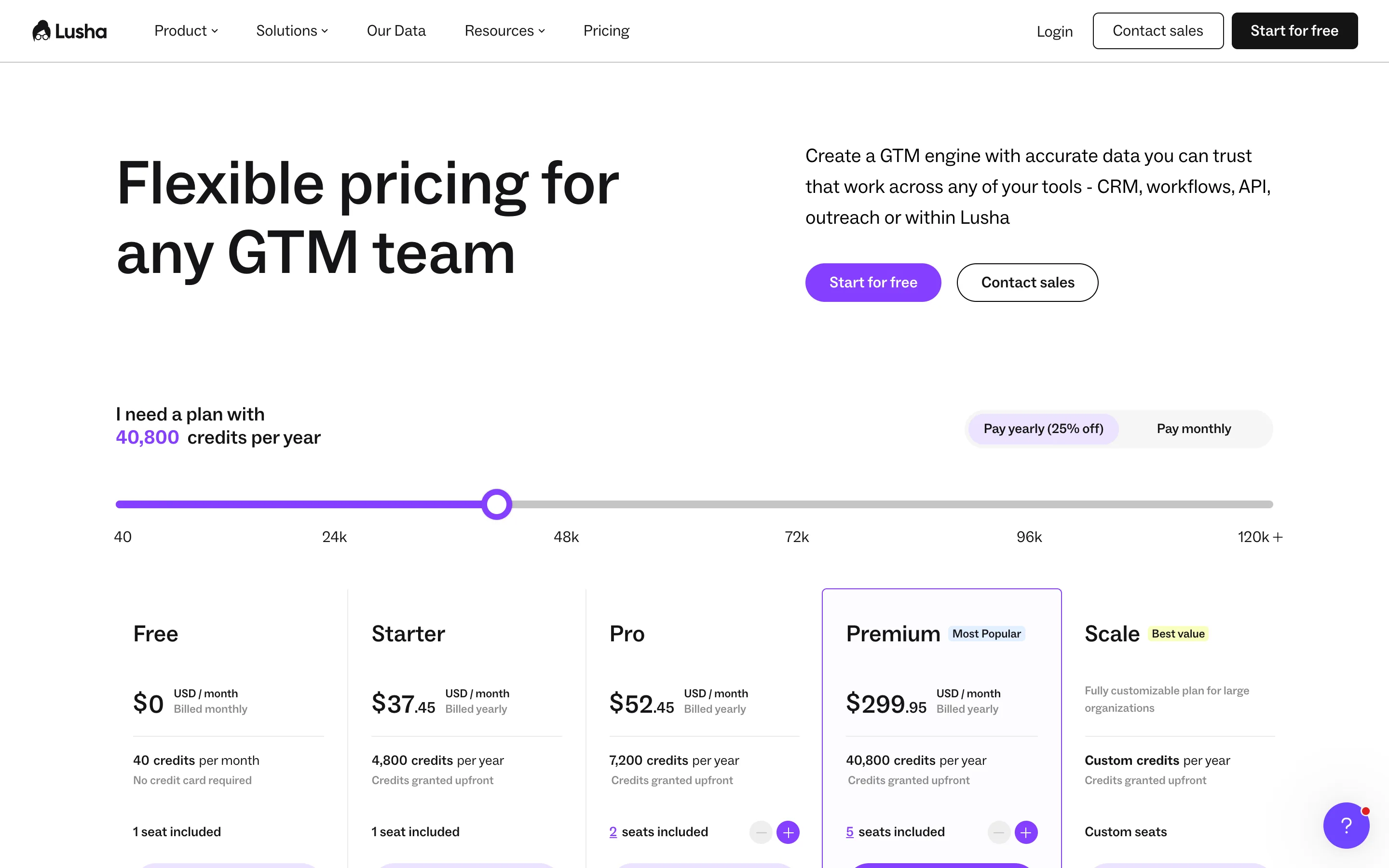
Lusha pricing (USD) starts at $49.90/mo for 400 credits ($37.45/mo billed annually), with phones charged 5 credits each to an email's 1. Those are stored-database reveals, so after the 50–70% that still connect, a valid mobile costs nearer $0.89–1.25 on monthly billing.
vs Enrow: Enrow's $0.47 per valid phone on Start, or $0.35 on Pro, both monthly, undercuts that by roughly two to three and a half times — billed only on a number found live, with no 5x phone tax and EU dials legally sourced where Lusha's stored rows read softer in Europe.
4. Kaspr
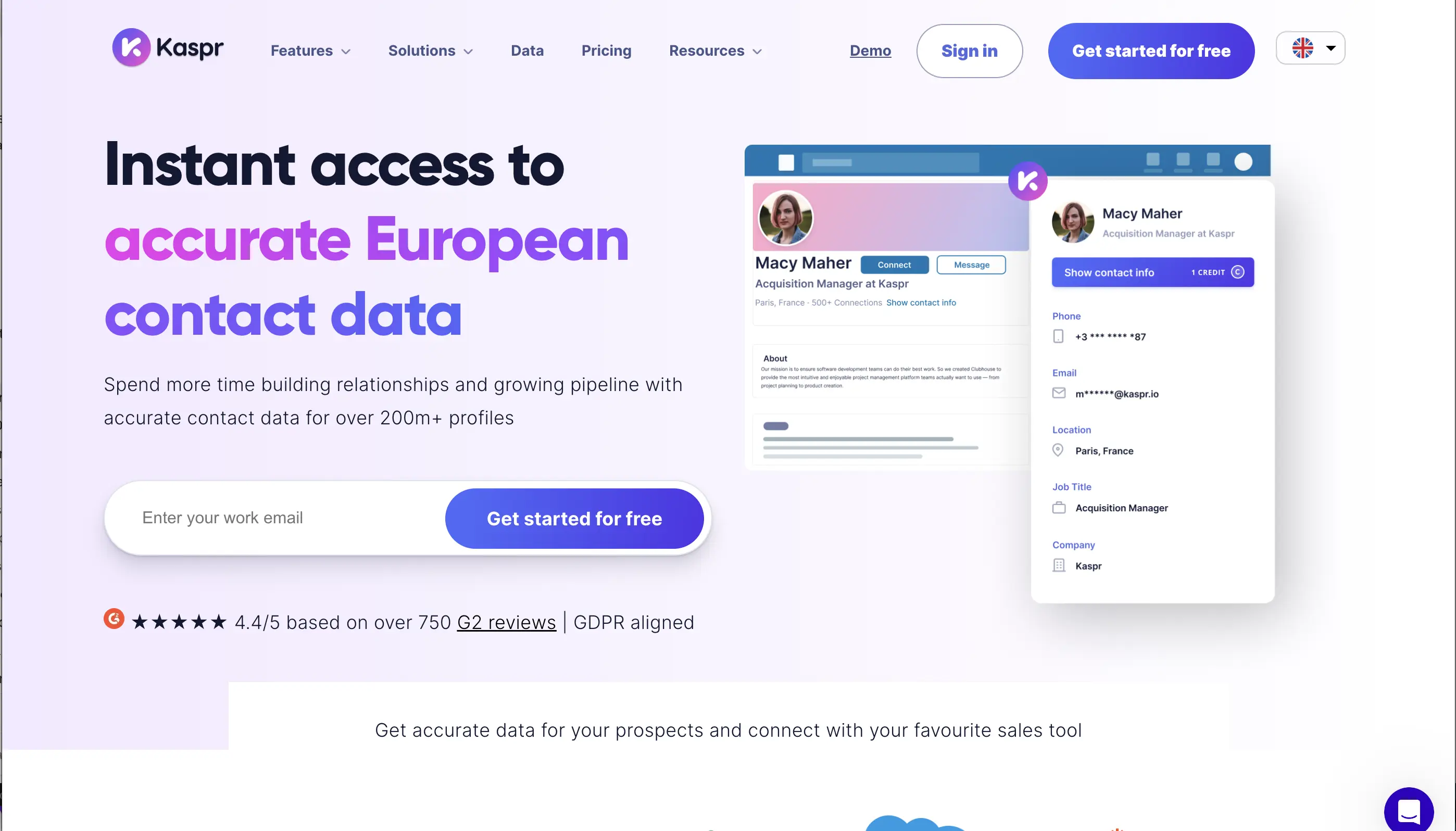
Cognism's own little sibling, sold by the seat instead of the contract.
Kaspr (owned by Cognism) is the budget, self-serve, LinkedIn-first cousin. You work from a LinkedIn profile or list, reveal phones and emails, and it leans European with a stated GDPR/CCPA alignment sourced across many providers.
Where Cognism is the enterprise contract, Kaspr is €59-a-user territory — built for small EU-focused teams that want mobile reveals off LinkedIn without Cognism's floor.
Depth and the reveal model are what you give up. Kaspr is still a database reveal: you pull a stored number, phone credits are metered per user per month (100 on Starter, 200 on Business), and a revealed mobile can be stale.
Data quality outside its core European set gets uneven, and the per-user pricing stacks up across a team.
I revealed a batch of French and German contacts through it, and the EU tilt is real — noticeably better than the US-first tools on European numbers. Still, Kaspr decrements a fixed monthly phone ration whether the number connects or not, off stored rows.
Enrow pulls the dial live, checks it, and only then takes the 40 credits.
- +Sticker-price, self-serve entry (€59/user/mo)
- +European focus with a stated GDPR/CCPA posture
- +Smooth LinkedIn reveal workflow
- +Free plan (5 phone credits/month)
- –Database reveal; stored mobiles can be stale
- –Phone credits are a fixed monthly ration (100 Starter / 200 Business), spent on reveal not valid dial
- –"Unlimited" B2B emails is fair-use capped at 10,000 per account per month (terms) — extra seats never lift that ceiling
- –Per-user pricing adds up; quality thins outside core EU data
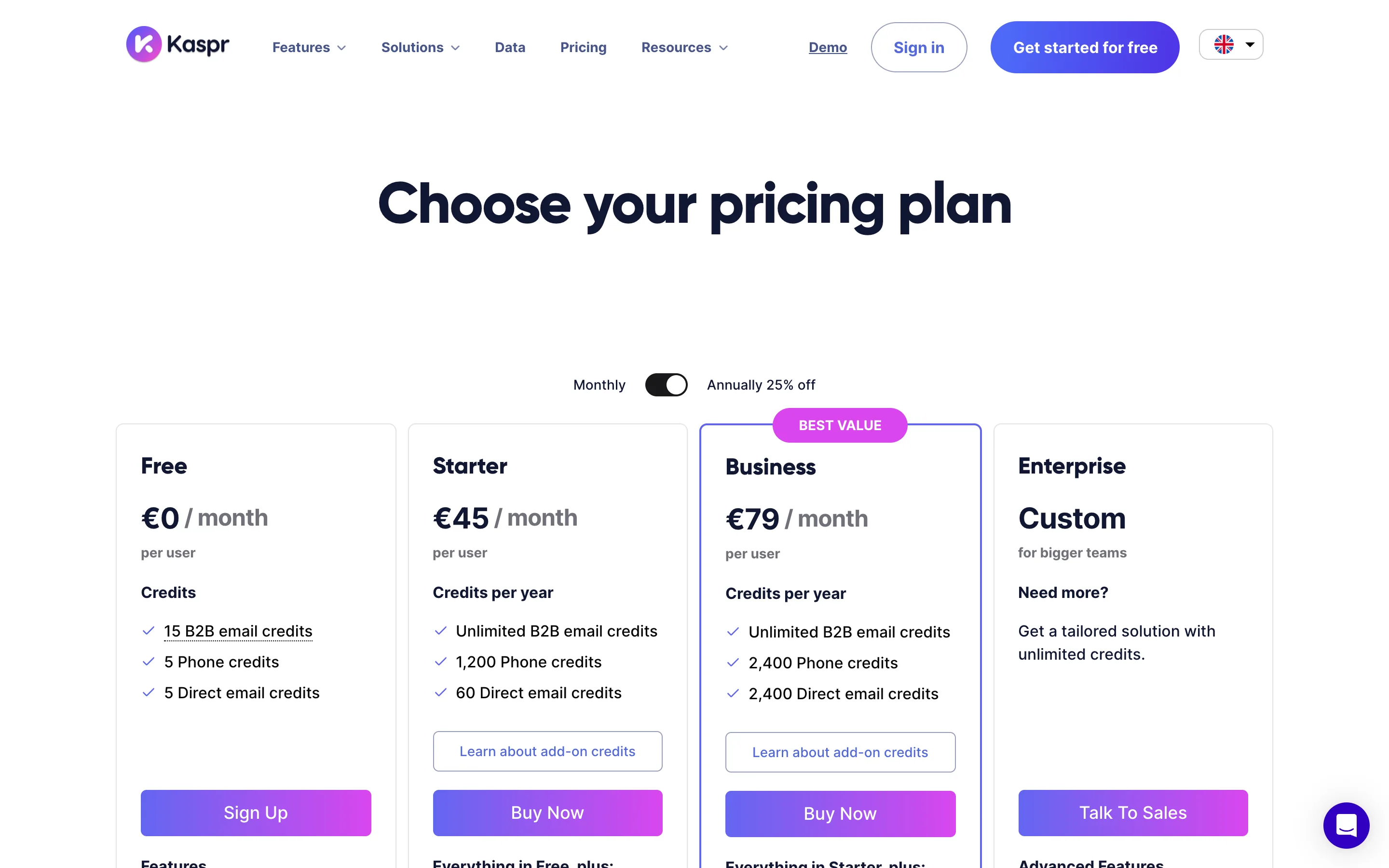
Kaspr pricing (in euros, per user) starts at €59/user/mo for 100 phone credits — about €0.59 a reveal off a stored database. Allow for the 50–70% that connect and a valid EU dial runs nearer €0.84–1.18, per user.
vs Enrow: that sits above Enrow's €0.30 Pro benchmark (€75 for 10,000 credits, billed monthly like Kaspr), where 40 credits leave your balance only on a number found live — with no per-seat fees, and the finished record filed into your CRM in one click.
5. RocketReach
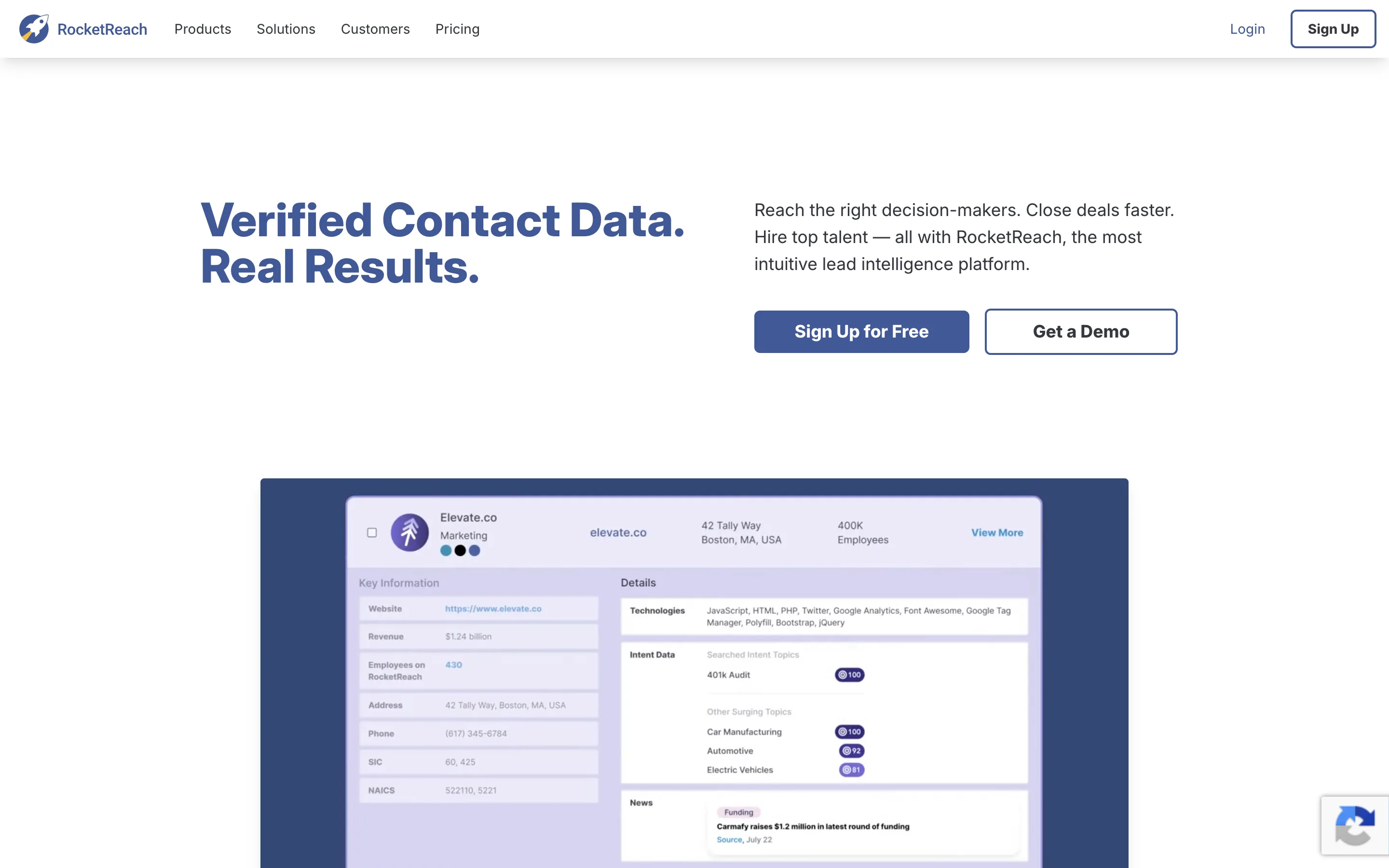
One credit, any lookup, enormous reach. That's the sale.
RocketReach runs one of the broader contact databases and keeps billing simple: one credit buys a lookup, email or phone or both. It's self-serve, low at the sticker, and the reach across roles and regions is wide.
What it owns is breadth sticker-sensitive — a lot of possible contacts, headline entry sticker, no contract.
Read that billing line again, though, because it's doing something the pricing page never spells out. The credit buys the attempt, not the answer. Search a prospect RocketReach has never heard of and the credit is gone regardless.
That's penalty one, and it's the expensive one: only a minority of searches come back with anything, so your bill is a multiple of the sticker before you've dialed a single number. Penalty two follows straight after.
What does come back is a stored row, and a meaningful share of stored mobiles are outdated — reviewers put RocketReach's phone accuracy below the specialist dialers. You pay for everything you ask for, get an answer to some of it, and part of that answer rings nobody.
I'll give it this: nearly every prospect I searched came back with something, and the flat one-credit model spared me the usual mental accounting. Then I dialed, and the connect rate went soft.
Enrow trades breadth for freshness on purpose — fewer contacts than a giant database, but every dial fetched and checked at request time and billed only when it's good, so more of what you pay for actually rings a desk.
- +Very broad contact coverage across roles and regions
- +Simple model: one credit per lookup (email or phone)
- +Sticker-price self-serve entry
- +Bulk lookups and API available
- –Pay-per-search: the credit is charged on the attempted lookup, so a search that returns nothing still bills
- –Stored database; mobile accuracy trails the specialists, so part of what does come back won't connect
- –Lookup caps reset monthly with no rollover — unused lookups are simply lost
- –No dedicated EU-compliance/direct-dial story
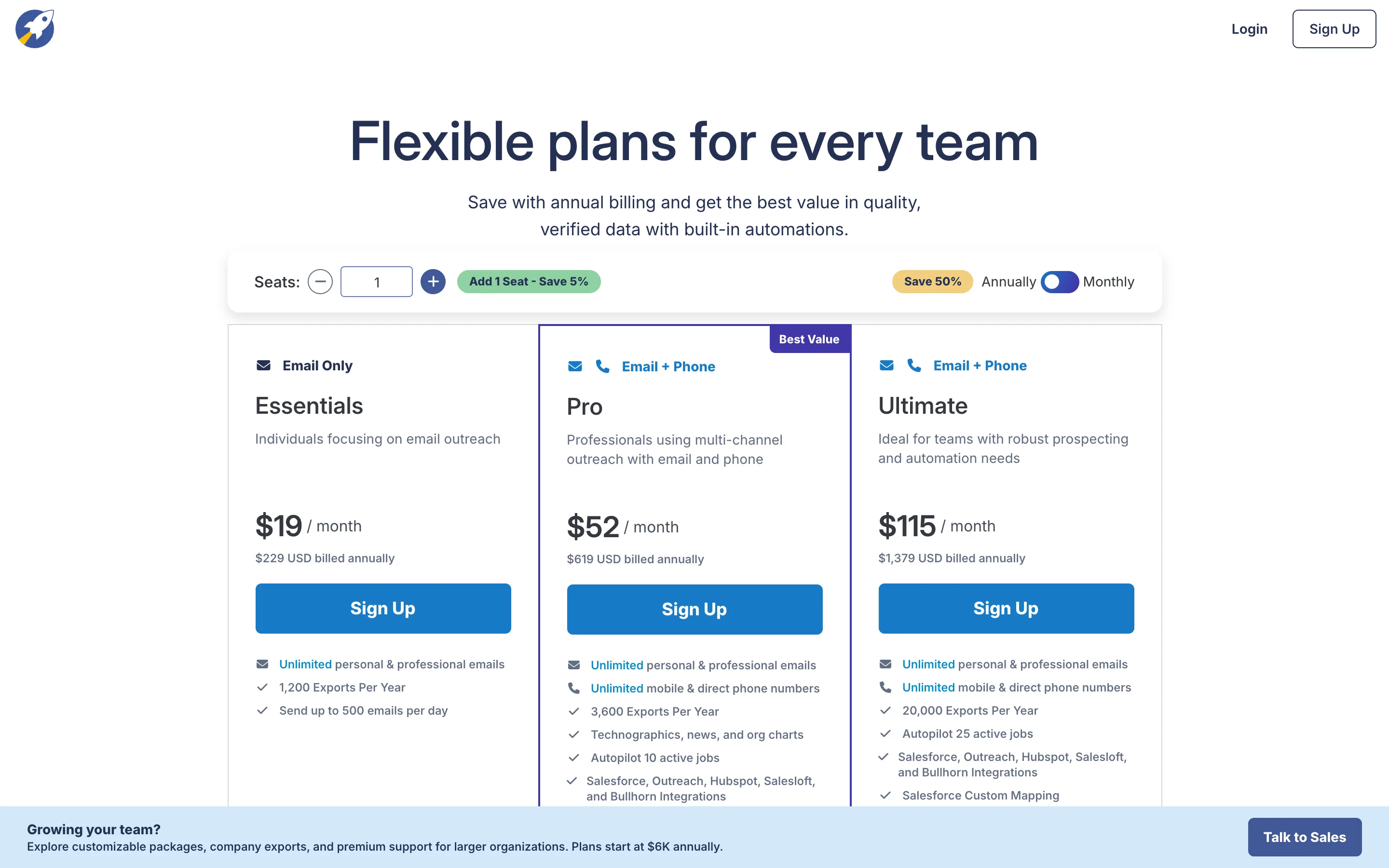
RocketReach pricing (USD) runs about $69 to $209/mo by tier, but the entry Essentials ($69/mo) is email-only, so phones need Pro ($119/mo) or above. And the credit buys the attempt, not the answer: pay for every search, assume ~30% return anything, then haircut the stored rows that don't connect, and a valid dial lands at $1.30–4.10 depending on tier.
vs Enrow: RocketReach wins on raw reach; Enrow wins on the dial you're paying for — 40 credits only on a valid number found live, about $0.35 on Pro, with EU-cleared dials and a CRM handoff RocketReach doesn't attempt.
6. SignalHire
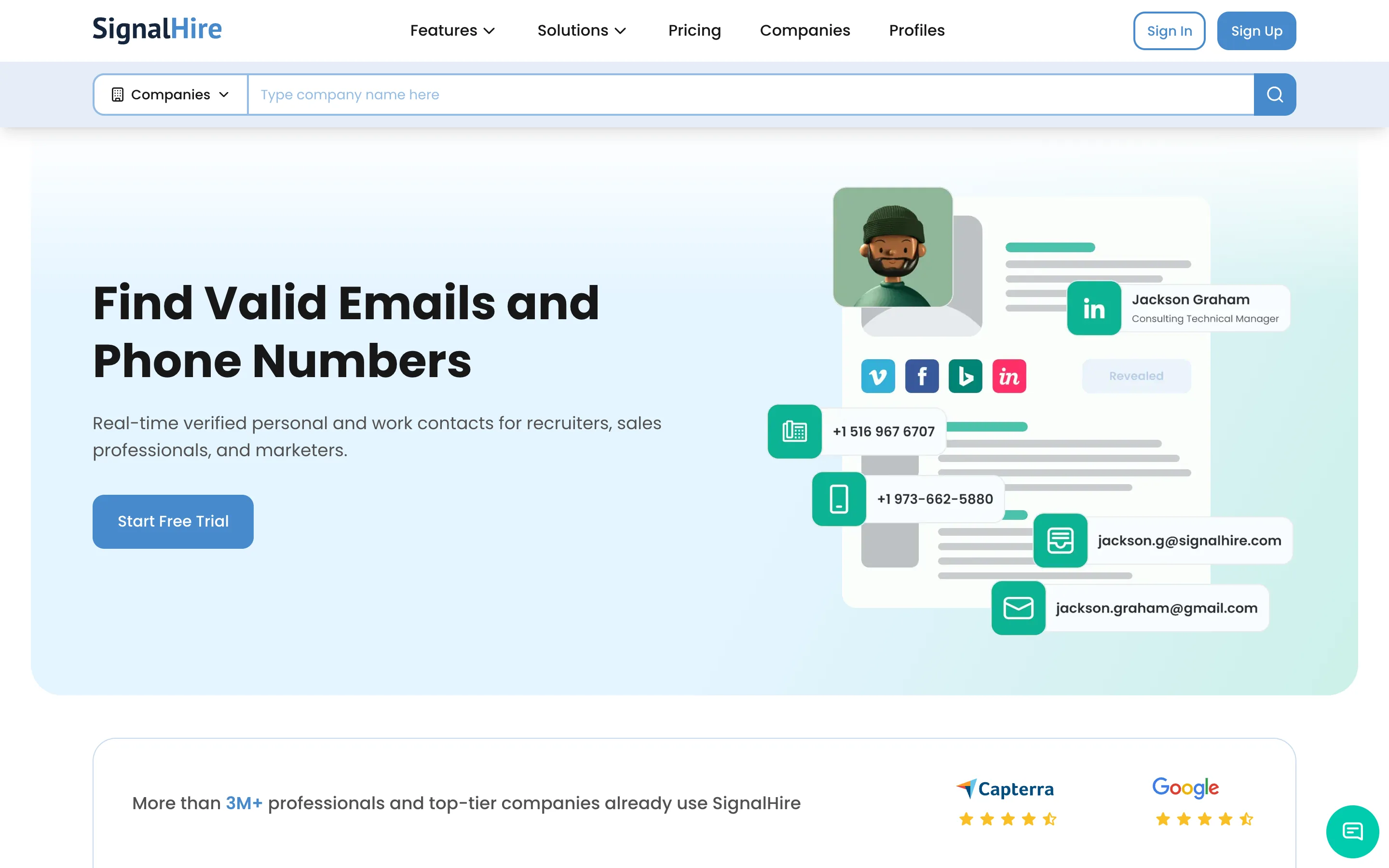
A single credit that covers email or phone, aimed mostly at recruiters.
SignalHire finds emails and phones from a single, simple credit pool — one credit per contact, no asymmetric phone tax like Lusha's. It leans toward recruiting workflows, with candidate-friendly search and a straightforward reveal.
The buyer it serves best: teams, recruiters especially, who want email and phone in one reveal without a Cognism-scale commitment.
Nothing new on the downside, though. SignalHire is a database reveal, so the mobiles are stored and age, and there's no dedicated EU direct-dial compliance story. Accuracy is fine for the price, not specialist-grade, and a credit spends on the reveal regardless of whether the number connects.
Testing it, I never once had to think about credit math, and I'll admit I liked that. But it's still a stored reveal, and when I put its European numbers on a live dial the connect rate was ordinary.
Enrow's promise runs the other way (no valid number, no charge), which is a different deal from "here's a stored row, that'll be one credit."
- +Unified credit: one credit per contact, email and phone
- +Headline entry, recruiter-friendly search
- +Simple, predictable pricing
- +Free trial credits
- –Stored database; mobiles age like any DB reveal
- –No dedicated EU direct-dial/compliance story
- –Credit spends on reveal, not on a valid connect
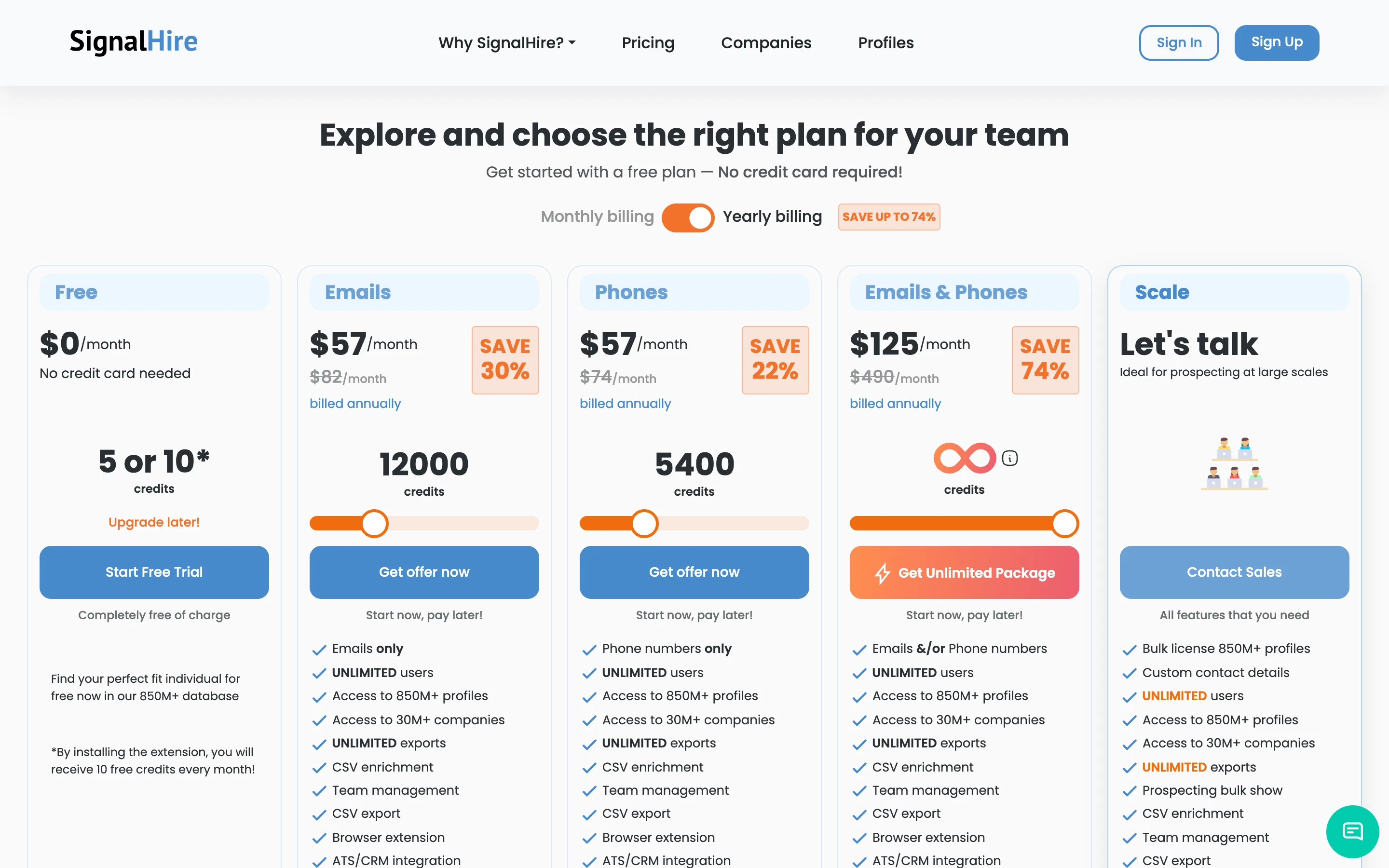
SignalHire pricing (USD) sells phones at $69/mo for 435 phone credits — about $0.16 a reveal on the sticker. But that's a stored reveal, not a valid dial: haircut the EU mobiles that no longer connect and the real cost per valid number climbs into and past Enrow's range.
vs Enrow: the unified credit is convenient, but Enrow charges 40 credits only on a valid number found live — about $0.35 on Pro, every one of them rings — plus EU-cleared dials and the one-click record-to-CRM push SignalHire has no answer to.
7. Apollo
Database, sequencer, enrichment — the whole motion in one tab. That's Apollo.
Apollo pairs a huge B2B database with sequencing, enrichment and a Chrome extension on a seat-based subscription. Against Cognism, it's the cheaper, more self-serve all-in-one: source and send without leaving the tool, enrichment included.
It suits small teams that want one platform to do the whole motion, where the data is a component of the workflow rather than the point.
Phone data is what pays for that breadth. Apollo runs one unified credit pool per seat — 2,500 credits a month on Basic — and a mobile draws 8 of them against an email's 1.
Spend the whole pool on phones and you get 312 reveals; spend it on email and the phones never happen.
Its stored rows drift out of date like any database's, mobile accuracy is one of the most common review complaints, and whatever you haven't spent when the month ends is deleted. There's no EU direct-dial compliance story to speak of.
Getting from a filter to a live sequence without leaving Apollo is quick, quicker than stitching a finder to a sender, and that's real. Then I checked the mobiles against a live dial and real-time won.
Enrow looks each number up at the moment you ask, reaches the EU direct dials Apollo's credit pool can't buy you at any price, and bills only on valid with no per-seat math.
If the suite is what you're after, Apollo does the suite — and Enrow can feed it a phone layer that actually connects.
- +Large database with sequencing and enrichment in one place
- +Chrome extension and CRM integrations
- +One unified credit pool, no separate ledgers to reconcile (email 1 credit, mobile 8)
- +Sourcing and sending in one tool, enrichment built in
- –A mobile costs 8 credits out of a 2,500-credit seat pool; accuracy is a common complaint
- –No rollover: unspent credits are deleted every month, so you use roughly 78% of what you paid for
- –Stored database, so data ages; credits are per seat, and five reps mean five pools
- –No EU direct-dial/compliance story
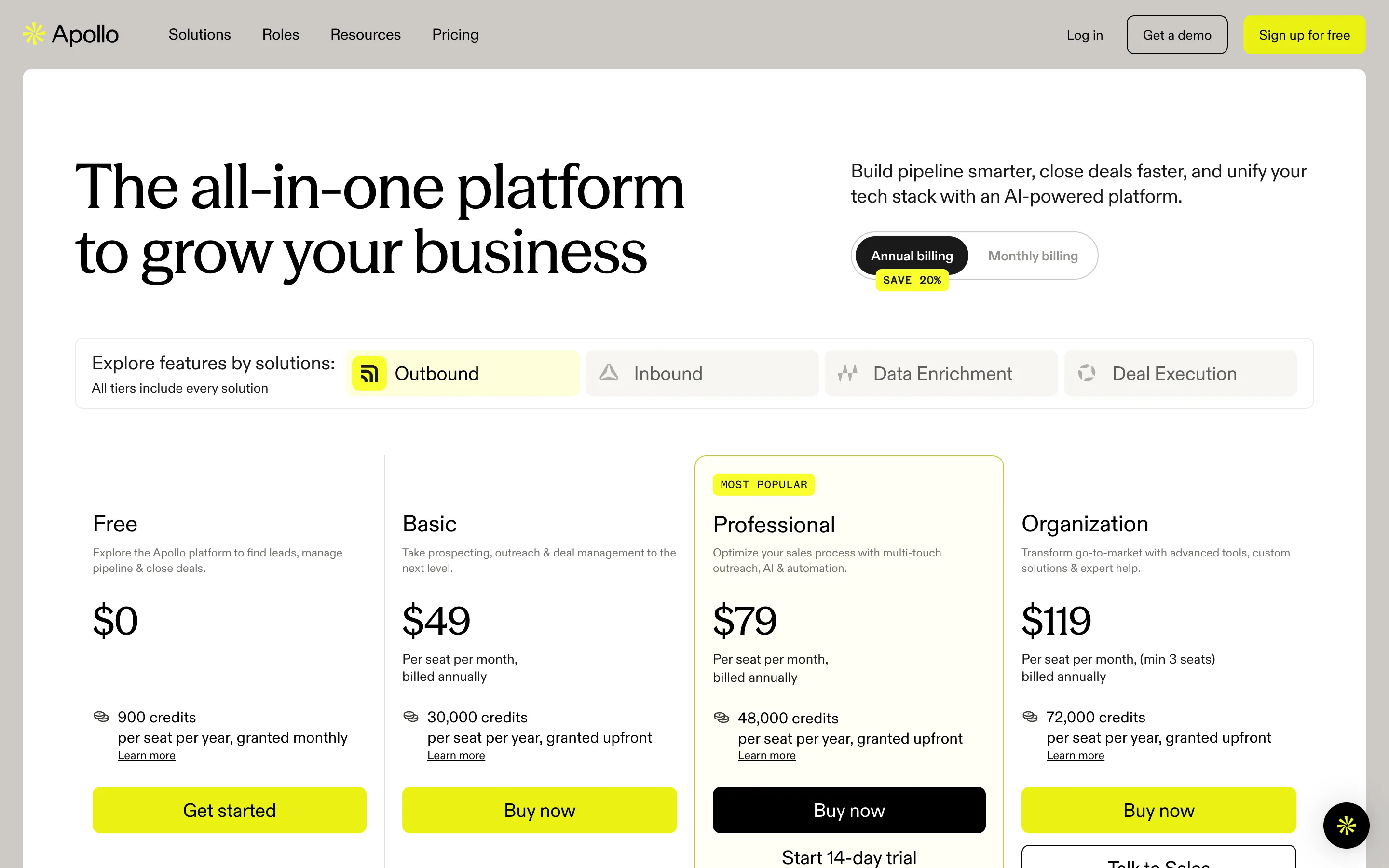
Apollo pricing (USD, per seat) starts at $65/seat/mo ($49 annual) for 2,500 unified credits, an email costing 1 and a mobile 8. Credits don't roll over, so real utilization sits near 78% — about $0.033 per valid email, and a stored, US-leaning mobile works out to $0.38–0.53 per valid dial once you haircut the ones that connect, worse on EU numbers Apollo ships no GDPR product for.
vs Enrow: Apollo is the all-in-one; Enrow is the phone layer. Enrow's $0.35 already includes EU dials and rolls credits over on Pro and Scale, with no per-seat fees. Run both if you want the suite and the clean dials.
8. ContactOut
Recruiters keep ContactOut installed for one reason: personal emails, with phones riding along.
ContactOut works off LinkedIn: a Chrome extension and a search portal that surface work and personal emails plus phone numbers. It's known for personal-email coverage, and it bundles phones into its higher plans.
The natural user is a recruiter or LinkedIn-heavy prospector who wants contact details straight from a profile without a Cognism contract.
Read the fine print, and there's the wall. The "unlimited" framing on the Email and Email+Phone plans hides strict monthly fair-use caps — the Email plan tops out around 2,000 emails/month, the Email+Phone plan around 2,000 emails plus 1,000 phones, with no overages.
It's a stored reveal, so mobiles age, and there's no EU direct-dial compliance story. You're metered against a hidden ceiling, not billed per valid dial.
On my test profiles the personal-email coverage earned its reputation — it surfaced addresses other tools missed. But on phones it's the same stored-reveal story with an opaque cap on top.
Enrow works the opposite way: each dial found live, verified before it bills, 40 credits taken only on a valid number. No hidden monthly ceiling.
- +Strong personal-email coverage off LinkedIn
- +Chrome extension and search portal
- +Phones bundled into higher plans
- +Free daily allowance to test
- –"Unlimited" plans hide strict monthly fair-use caps (no overages)
- –Stored reveal; mobiles age; no EU direct-dial compliance story
- –Metered against a hidden ceiling, not billed per valid dial
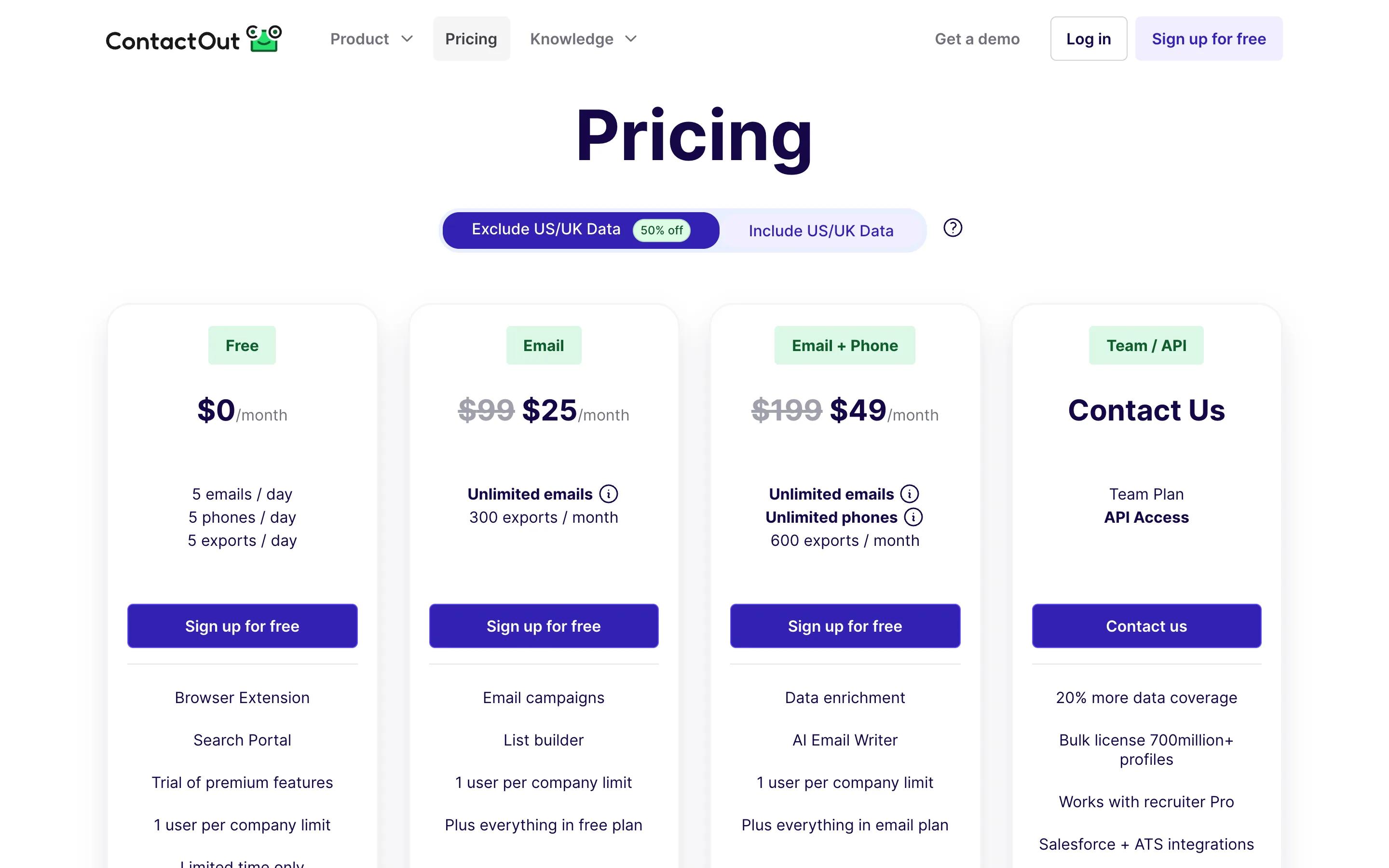
ContactOut pricing (USD; caps sit in the Terms, not the pricing page) runs $49/mo for Email and $99/mo for Email+Phone, flat per seat with "unlimited" reveals capped by hidden fair-use limits (~2,000 emails, ~1,000 phones). There's no clean per-valid-phone figure: the phones come off a stored database against a cap most teams never max, and the EU mobiles this page is about are exactly what a US-first stored set gets wrong.
vs Enrow: Enrow bills per credit too, but only 40 of them leave your balance when a phone turns out valid — roughly $0.35 on Pro, no cap to game and nothing lost on a miss — and its EU dials come with the finished record pushed to your CRM in a click.
9. UpLead
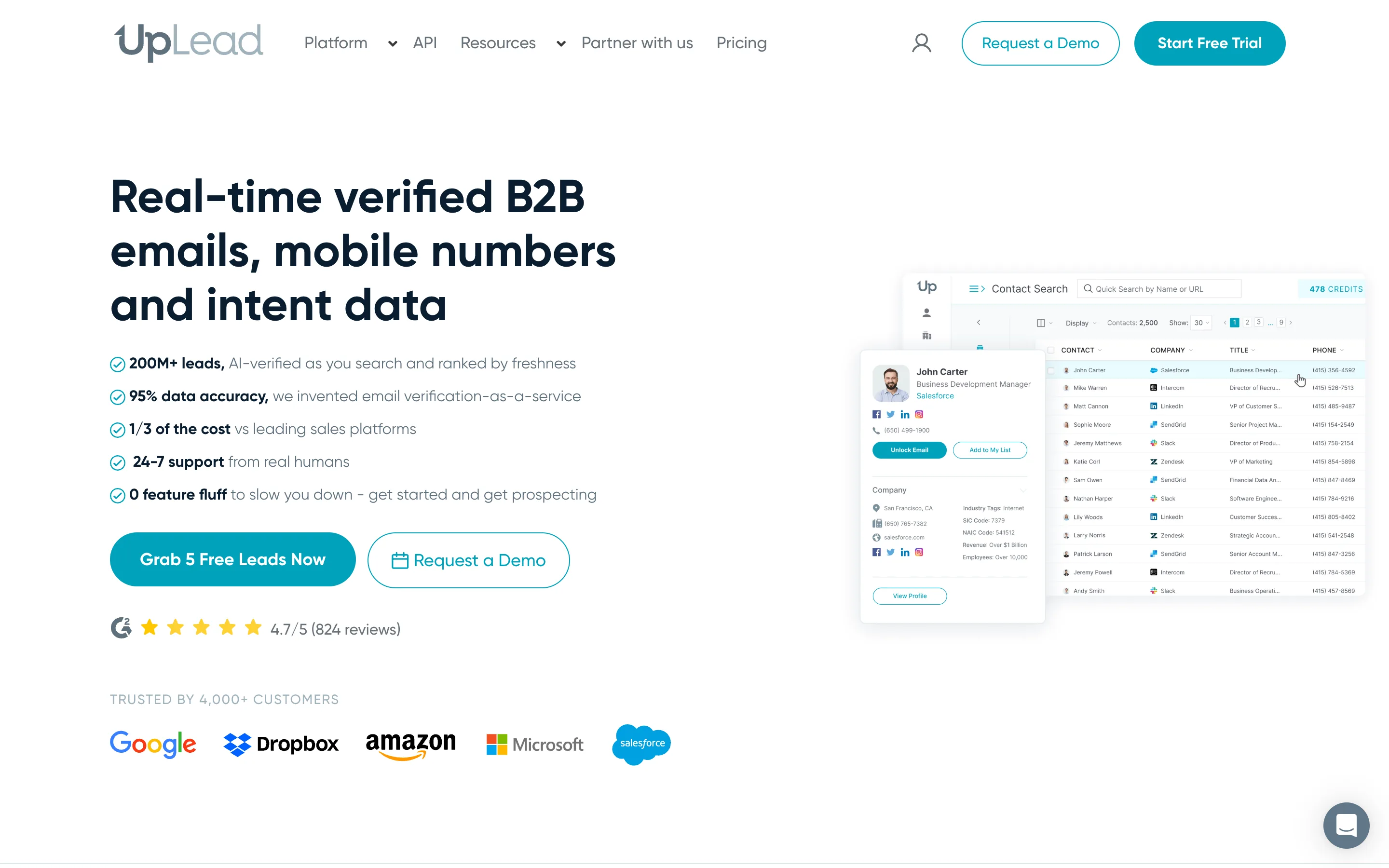
A browsable database you buy on a card, with the email checked the moment you reveal it.
UpLead is the self-serve, transparent-pricing take on the enterprise database Cognism sells behind a quote. Filter a contact list, reveal the rows you want, and every email is tested in real time against the mail server before it lands — UpLead backs that with a 95% accuracy guarantee and credits back the ones that bounce.
Against Cognism it's the small-team version of the same idea: a searchable database with mobile direct dials attached, minus the annual contract. One credit reveals a contact, and the mobile number rides along inside that same credit.
Phones are the catch, and they're the part this page turns on. The email side is genuinely well-verified; the mobiles are not. They come off a stored, US-leaning database, they age like any stored row, and a credit spends on the reveal whether or not the number still connects — the bounce-back guarantee covers emails, not dead dials. There's no dedicated EU direct-dial compliance story, and 170 credits at the entry tier disappears fast once you're pulling phones too.
On my run the email accuracy earned its keep — clean, well-verified, few bounces. Then I dialed the mobiles and it was the familiar stored-reveal story, softer on the European numbers.
Enrow finds each dial live, verifies it before it counts, and takes 40 credits only on a valid number: no credit burned on a mobile that rings nobody.
- +Transparent self-serve pricing; buy on a card, no sales call or annual contract
- +Real-time email verification with a 95% accuracy guarantee and bounce credit-back
- +Searchable B2B database with technographics and intent, mobiles bundled into the contact credit
- +Chrome extension and native CRM integrations
- –Mobiles are stored, US-leaning rows that age; no dedicated EU direct-dial compliance story
- –A credit spends on the reveal, not on a valid dial — the accuracy guarantee covers emails, not dead phones
- –Only 170 credits on the $99 entry tier, and extra credits run $0.50–0.60 each
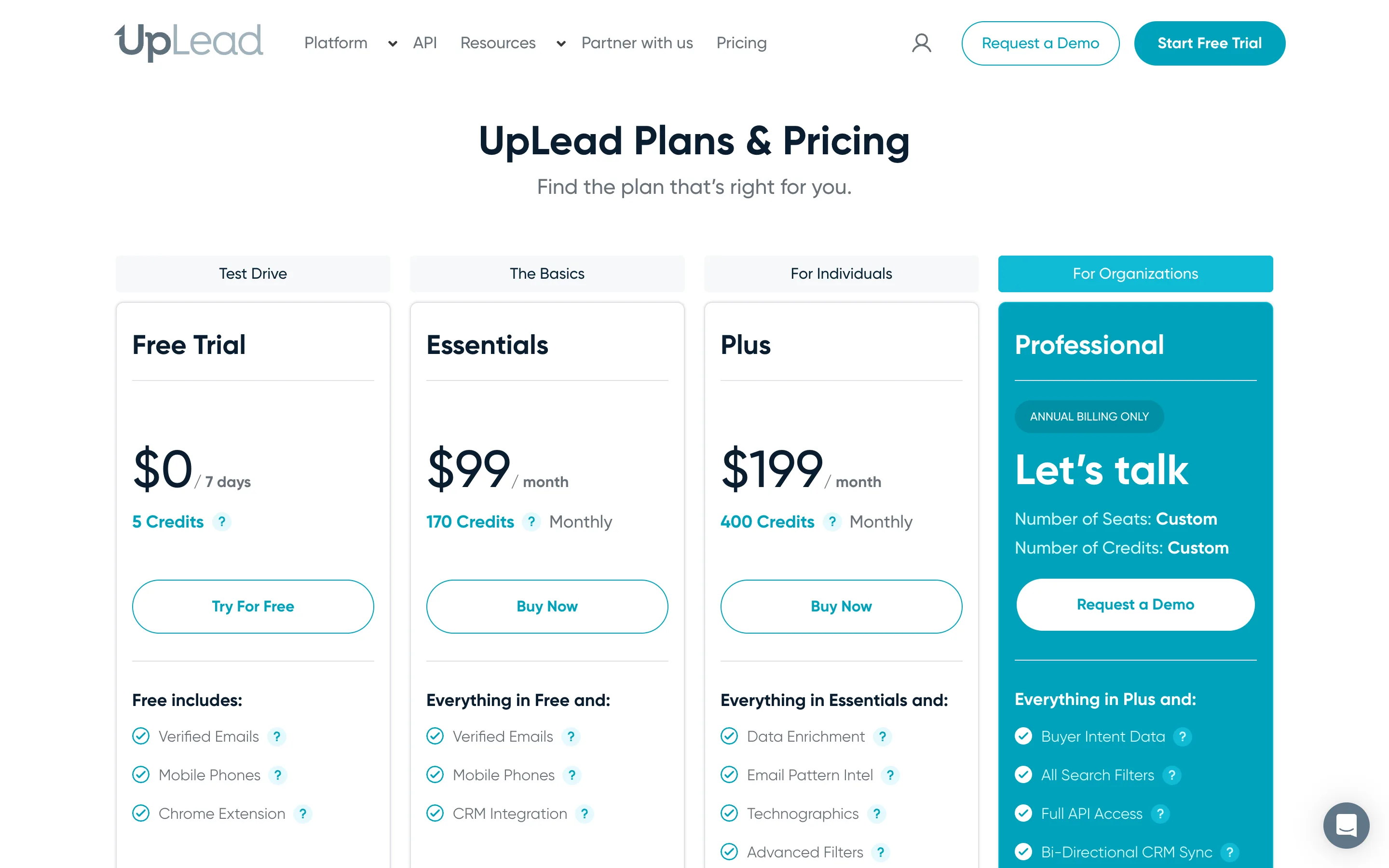
UpLead pricing (native USD) starts at $99/mo for 170 credits on Essentials ($74/mo billed annually, 2,040 credits/year), one credit revealing a contact with its verified email and mobile bundled — about $0.58 a reveal. That mobile is a stored reveal, so after the 50–70% that still connect, a valid EU dial runs nearer $0.85–1.15, less on annual.
vs Enrow: Enrow's $0.35 Pro benchmark is charged only on a number found live and verified, with EU dials legally sourced where UpLead's stored, US-leaning rows read softer in Europe — plus the finished record pushed to your CRM in one click.
10. Wiza
If your pipeline starts life as a Sales Navigator search, Wiza was built with you in mind.
Wiza's whole trick is Sales Navigator: run a search, and Wiza turns it into an exportable list with verified emails and phone numbers attached.
It's built for the LinkedIn-list workflow Cognism's database sidesteps, and it serves teams who source in Sales Navigator and want emails and mobiles bolted onto those lists without leaving the flow.
It's a scraper-plus-reveal, though, so phone coverage and accuracy depend on what's findable, and mobiles come from stored data with the usual aging. Credits don't roll over — unused ones expire monthly — and the entry credit count is small. There's no dedicated EU direct-dial compliance story.
I turned a 200-row Sales Navigator search into a working spreadsheet in a few minutes, and that part is slick; the pay-per-type overage ($0.35 per contact with a phone) is honestly labeled too. But the mobile side is still a stored reveal.
Enrow sources and checks each dial at the moment you ask, charges only on valid, and lands the whole verified record in your CRM instead of a CSV you then import.
- +Best-in-class Sales Navigator list export
- +Emails and phones attached to scraped lists
- +Transparent overage ($0.15/email, $0.35/phone contact)
- +Free tier to test (20 emails, 5 phones)
- –Stored-data mobiles with the usual aging; coverage depends on what's scrapable
- –Credits expire monthly, no rollover
- –No EU direct-dial/compliance story
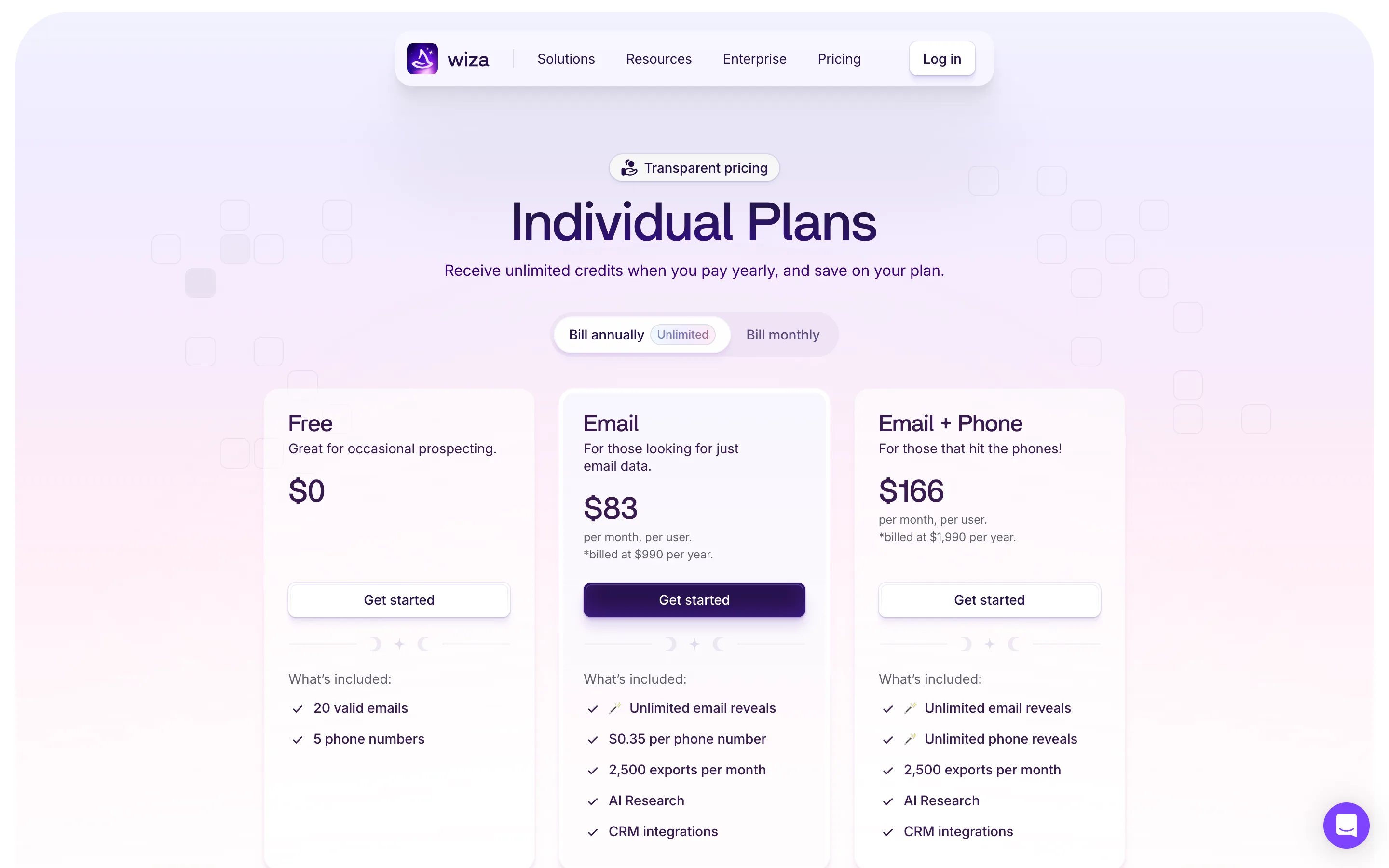
Wiza pricing (USD, per user) starts at $49/user/mo for 100 valid emails plus 100 phones, with overage at $0.35 per contact with a phone. Fold the plan fee in and Starter's bundled phones already cost about $0.49 a reveal; after the 50–70% of stored numbers that connect, a valid mobile runs $0.70–1.00 all-in, and credits expire monthly.
vs Enrow: Enrow charges 40 credits on a valid number and nothing on a miss (about $0.35 on Pro), with EU dials and the finished contact filed into your CRM instead of a CSV you import.
Don't take a founder's word on his own tool. Load your call list into Enrow and count the valid dials yourself — the free tier gives you 50 credits every month, recurring, no card.
Side-by-side comparison
Final Verdict
Judge every tool here on the one question that decides a dialing budget — how many valid direct dials, EU included, does each dollar buy — and Enrow wins. It finds each dial fresh, verifies before it counts, and charges 40 credits only on a valid number: about $0.35 per valid phone on Pro, no contract, no seats. Then the thing nothing else here answers: one click in the Chrome extension moves the complete verified record, direct dial and all, from a LinkedIn or Sales Navigator profile into HubSpot, Salesforce or Pipedrive. New prospect, it gets created. Already on file, it gets updated in place rather than duplicated. Enrow isn't an all-in-one, though — no searchable database, no sequencing, no intent data — and if a five-figure annual contract with a browsable dataset describes your world, that's the job Cognism was built for. For direct dials that connect, at a self-serve price, Enrow is the answer on this page.
Don't take a founder's word on his own tool. Load your call list into Enrow and count the valid dials yourself — the free tier gives you 50 credits every month, recurring, no card.
FAQ
How we evaluated these tools
No one paid for a spot here and no link on this page earns me a cut. I ran it myself: one prospect list, every tool fired at it inside a single week, then I dialled the numbers that came back to hear which ones actually connected. Four things set the order — phone match rate, how many of those live dials a human picked up, real cost per valid phone once the billing tricks are stripped out, and coverage, with legally-sourced EU direct dials weighted heaviest because that's the ground Cognism owns. RocketReach lists no find rate, so I assume ~30% and flag it as a guess; the rest — prices and features — comes straight from each vendor's own pages, checked 2026-07-02.
bereit, keine zeit mehr zu verschwenden?
Verbunden in Minuten.
Verifizierte Daten in Sekunden.
keine Kreditkarte
kein Setup nötig